Listen to this Post
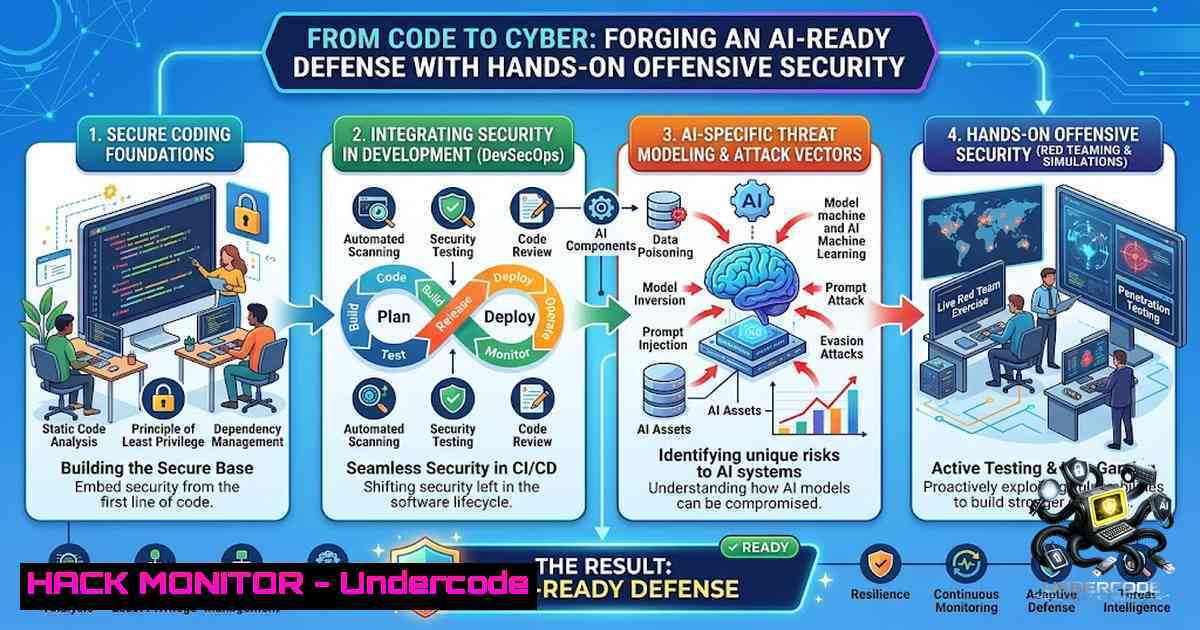
Introduction:
The modern threat landscape is no longer defined by static signatures but by adaptive, AI-driven attacks that evolve faster than traditional defenses can respond. As organizations race to adopt artificial intelligence, the security professional’s role has shifted from reactive patching to proactive threat hunting, requiring a fusion of cloud hardening, API security, and AI-powered analytics. This Independence Day, as Coding Now – Gurukul of AI emphasizes the importance of upskilling for true professional freedom, we dissect the critical technical competencies required to build a resilient career in cybersecurity and AI.
Learning Objectives:
- Deploy AI-based threat detection using open-source tools like Snort and Zeek integrated with machine learning models for anomaly detection.
- Harden Windows and Linux endpoints against common exploits using verified PowerShell and bash commands.
- Automate incident response workflows via API security auditing and cloud configuration checks for AWS and Azure environments.
You Should Know:
- Reverse-Engineering Your Technical Gaps: Log Analysis and System Hardening
The first step to mastering cybersecurity is understanding where your defenses are weakest. Treating system logs as forensic evidence allows you to identify misconfigurations and potential attack vectors. For Linux systems, start by reviewing past system errors and authentication logs. Use `history | grep -i “fail\|error”` to recall previous command failures and `sudo journalctl -p err -b` to view boot-time errors that often indicate underlying vulnerabilities. For network analysis, `ss -tulwn` lists all listening ports, while `nmap -sV localhost` inventories running services that should be secured.
On Windows, PowerShell provides equivalent capabilities. Use `Get-EventLog -LogName System -EntryType Error | Select-Object -First 20` to fetch recent system errors, and `netstat -an | findstr “LISTENING”` to identify open ports. To create a structured approach, build a “gap log” file: `touch interview_gaps.txt` and document each missed security question with a corresponding command that would have detected the issue (e.g., `grep “Failed password” /var/log/auth.log` for brute-force detection). Automate this daily review by scheduling a quiz script: `crontab -e` → 0 9 /usr/bin/python3 /home/user/security_flashcards.py.
- Building an AI-Powered Mock Interview and Training Lab
Instead of relying on expensive human mock panels, deploy a local AI model to simulate high-pressure technical interviews focused on API security, cloud hardening, and vulnerability exploitation. Install Ollama on Linux, macOS, or WSL withcurl -fsSL https://ollama.com/install.sh | sh. Pull a cybersecurity-fine-tuned model such as `ollama pull falcon2:11b` orollama pull llama3.1:8b. Run an interactive session where the AI acts as a senior cloud security architect:ollama run llama3.1:8b --system "You are a senior cloud security architect. Ask me five tough questions about IAM misconfigurations and S3 bucket policies. Score each answer.". For Windows users, enable WSL2 with `wsl –install -d Ubuntu` and then run the Ollama installation script within the Ubuntu environment. This setup mirrors real interview pressure and provides immediate, unbiased feedback on your technical readiness.
3. Extracting Threat Intelligence: AI-Enhanced Log Analysis Pipeline
Modern SOC analysts leverage machine learning to sift through massive log volumes. Begin by collecting sample logs: on Linux, export the last 1000 SSH authentication logs with sudo journalctl -u sshd --since "1 hour ago" > ssh_logs.txt. On Windows, export failed logon events (ID 4625) using Get-WinEvent -LogName Security | Where-Object {$_.Id -eq 4625} | Export-Csv -Path failed_logons.csv. Next, install the AI anomaly detection framework: pip install scikit-learn pandas numpy. Create a Python script that loads the CSV logs, engineers features like login count per source IP, and trains an Isolation Forest model to detect outliers. Automate this pipeline with cron or Task Scheduler to trigger alerts via webhook (Slack, Teams), enabling real-time threat hunting that mimics advanced training courses.
- Hardening Cloud Environments: API Security and Configuration Audits
Cloud misconfigurations remain a primary attack vector. For AWS IAM hardening, install and configure the AWS CLI withaws configure. List all IAM users with unused access keys usingaws iam list-users --query 'Users[].UserName' --output text | xargs -11 aws iam list-access-keys --user-1ame. Enforce Multi-Factor Authentication (MFA) for all users by simulating a policy that denies actions without MFA. For Azure, use the Azure CLI to check for overly permissive roles:az role assignment list --include-inherited --query "[?principalType=='User']". These commands form the backbone of any cloud security curriculum, ensuring that students understand how to audit and remediate identity and access management gaps. -
Defending AI Models: Adversarial Attack and Secure Coding
As AI becomes integrated into security tools, the models themselves become targets. Adversarial attacks—subtle perturbations in input data—can cause AI models to misclassify threats. To defend against this, implement secure coding practices and input validation. Use prompt engineering to sanitize inputs before they reach the model. For instance, in Python, validate incoming data against expected schemas using libraries likepydantic. Additionally, employ model hardening techniques such as adversarial training, where the model is retrained on adversarial examples to improve robustness. Courses covering Generative AI in Cybersecurity now dedicate modules to these defenses, emphasizing the importance of securing the AI lifecycle from development to deployment.
6. Vulnerability Exploitation and Mitigation: Simulating Real-World Attacks
To defend effectively, one must think like an attacker. Use tools like Metasploit to simulate exploits in a controlled lab environment. For Linux, launch a simulated brute-force attack using hydra -l admin -P /usr/share/wordlists/rockyou.txt ssh://192.168.1.100. On Windows, use PowerShell to simulate a credential dumping attack with `Invoke-Mimikatz` (only in authorized labs). Mitigation involves implementing account lockout policies, using strong passwords, and deploying intrusion detection systems like Snort. Configure Snort with `snort -c /etc/snort/snort.conf -i eth0` to start detecting malicious traffic. These hands-on exercises are critical for any cybersecurity professional and are a staple of comprehensive training programs.
What Undercode Say:
- Key Takeaway 1: True independence in the tech industry comes from mastering the intersection of AI and cybersecurity, where proactive threat hunting and cloud hardening are non-1egotiable skills.
- Key Takeaway 2: Hands-on experience with verified Linux/Windows commands and AI-driven tools like Ollama and Isolation Forest transforms theoretical knowledge into practical, career-ready expertise.
Analysis: The integration of AI into cybersecurity is not a future trend but a present necessity. Courses that merely teach theory are obsolete; the modern curriculum must include command-line proficiency, cloud API auditing, and adversarial AI defense. The ability to set up a local AI lab for interview practice and log analysis demonstrates a commitment to continuous learning that employers highly value. Furthermore, as organizations migrate to multi-cloud environments, skills in AWS and Azure security auditing become critical differentiators. The emphasis on offensive security—simulating attacks to understand defenses—ensures that professionals are not just reactive but predictive in their approach. Finally, the focus on secure coding and model hardening addresses the often-overlooked vulnerability of the AI systems themselves, rounding out a holistic security skill set.
Prediction:
- +1 The demand for professionals skilled in AI-driven threat detection and cloud hardening will surge by 40% over the next two years, creating lucrative opportunities for those who upskill now.
- +1 Local AI models like Ollama will become standard tools for cybersecurity training, democratizing access to high-quality, pressure-testing interview prep.
- -1 Organizations that fail to invest in AI-security training for their staff will face a 25% increase in successful breach attempts due to misconfigured cloud APIs and unpatched AI models.
- -1 The gap between available cybersecurity jobs and qualified candidates will widen, as traditional degree programs lag behind the rapidly evolving technical requirements of AI-integrated defense.
- +1 Hands-on, command-line-centric courses will become the gold standard, rendering purely theoretical certifications less valuable in the job market.
- +1 The integration of AI into SIEM and SOAR platforms will automate 30% of tier-1 SOC analyst tasks, shifting the focus to higher-level threat hunting and AI model management.
- -1 Adversarial AI attacks will become more sophisticated, targeting the very models designed to detect them, necessitating continuous model retraining and validation.
- +1 Professionals who master both offensive (ethical hacking) and defensive (AI-powered monitoring) skills will command premium salaries and leadership roles.
- +1 Cloud providers will increasingly offer AI-driven security auditing tools, but the human expertise to interpret and act on these insights will remain in high demand.
- +1 The “learn today, lead tomorrow” philosophy will drive a new generation of tech leaders who are as comfortable with a terminal as they are with a whiteboard.
▶️ Related Video (84% Match):
🎯Let’s Practice For Free:
🎓 Live Courses & Certifications:
Join Undercode Academy for Verified Certifications
🚀 Request a Custom Project:
Secure, high-velocity infrastructure and disruptive technological engineering. Contact our engineering team for high-tier development and proprietary systems:
[email protected]
💎 Smart Architecture | 🛡️ Secure by Design | ⭐ Trusted by Thousands
IT/Security Reporter URL:
Reported By: Independenceday Ai – Hackers Feeds
Extra Hub: Undercode MoN
Basic Verification: Pass ✅


