
Listen to this Post
Introduction:
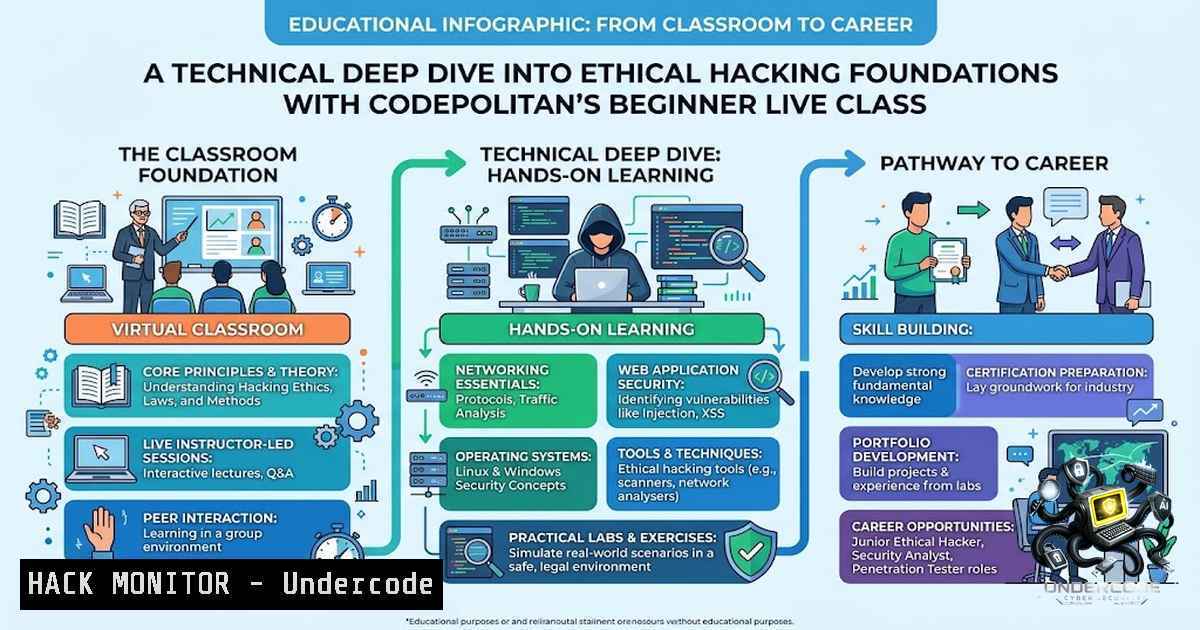
The cybersecurity industry faces a critical shortage of skilled professionals capable of identifying, exploiting, and mitigating security vulnerabilities responsibly. Ethical hacking programs like CODEPOLITAN’s “Ethical Hacking for Beginners” Live Class—delivered in partnership with JagoanSiber—bridge this gap by equipping aspiring security practitioners with hands-on penetration testing skills. This 16-session live program covers the full spectrum of ethical hacking: from reconnaissance and vulnerability analysis to digital forensics and security reporting. The curriculum emphasizes that security testing is not merely about finding flaws—it requires systematic identification, validation, evidence collection, and responsible disclosure within defined scopes.
Learning Objectives & Secrets:
- Objective 1 – Master the Ethical Hacking Lifecycle: Understand and apply the complete penetration testing framework—reconnaissance, scanning, enumeration, exploitation, and reporting—across web applications and network infrastructures.
-
Objective 2 Secret Tip – Automate Reconnaissance Intelligently: Leverage multi-threaded automation tools like AutoRecon to accelerate service enumeration across multiple targets simultaneously, saving hours of manual scanning while maintaining thoroughness.
-
Objective 3 Secret Tip – Validate Before Reporting: Always verify each vulnerability through manual exploitation and evidence collection before drafting a security report. A false positive in a bug bounty submission can damage credibility and waste triage time.
You Should Know:
- Information Gathering & Reconnaissance: The Foundation of Every Penetration Test
Reconnaissance is the most critical phase of any ethical hacking engagement. The quality of your intelligence gathering directly determines your exploitation success rate. In 2026, modern reconnaissance workflows combine passive OSINT (Open Source Intelligence) with active scanning techniques.
Passive Reconnaissance (OSINT) – theHarvester:
 Gather emails, subdomains, and hosts from public sources
theHarvester -d target.com -b google,bing,linkedin,dnsdumpster -l 500

Run all available sources and save results
theHarvester -d target.com -b all -f report.html
theHarvester (v4.10.1) supports 50+ data sources and is pre-installed on Kali Linux. This tool gathers intelligence without ever touching the target directly—ideal for initial footprinting.
Active Scanning – Nmap & Masscan:
 Comprehensive scan with version detection, scripts, and OS fingerprinting
nmap -sV -sC -O -A target.com

Fast full-port discovery (all 65535 ports at high speed)
nmap -p- --min-rate=10000 192.168.1.0/24

UDP scan for common services
nmap -sU --top-ports 100 target.com

Vulnerability scanning with NSE scripts
nmap --script=vuln target.com

Masscan – scan entire /16 network for web ports at 100,000 packets/sec
masscan 10.0.0.0/16 -p80,443,8080,8443 --rate=100000
Nmap remains the undisputed king of network mapping in 2026, with over 600 pre-installed security tools available in Kali Linux. Masscan complements Nmap by delivering asynchronous scanning at speeds of up to 10 million packets per second.
Automated Reconnaissance – AutoRecon:
 Install AutoRecon
sudo apt install autorecon

Run automated enumeration against a target
autorecon 10.0.0.1

Scan multiple targets from a file
autorecon -t targets.txt
AutoRecon is a multi-threaded network reconnaissance tool that performs automated enumeration of services—ideal for CTF environments and professional penetration testing. It orchestrates dependencies including dirb, dnsrecon, enum4linux-1g, ffuf, gobuster, nikto, and nmap.
- Vulnerability Analysis: SQL Injection and XSS in 2026
SQL Injection and Cross-Site Scripting remain the most prevalent web application vulnerabilities despite decades of awareness. In 2026, OWASP still ranks injection as a top-three risk.
Testing for SQL Injection with SQLMap:
 Automated SQL injection detection and exploitation
sqlmap -u "http://target.com/page?id=1" --batch --dbs

Extract tables from a specific database
sqlmap -u "http://target.com/page?id=1" -D database_name --tables

Dump user credentials
sqlmap -u "http://target.com/page?id=1" -D database_name -T users --dump
SQLMap is one of the most essential Kali Linux tools for automated SQL injection testing.
Preventing SQL Injection – Parameterized Queries:
 VULNERABLE – Never do this:
query = f"SELECT  FROM users WHERE username='{user_input}'"

SECURE – Use parameterized queries (prepared statements)
cursor.execute("SELECT  FROM users WHERE username = %s", (user_input,))
Parameterized queries (prepared statements) are identified by OWASP as “Defense Option 1”—the mandatory method for all SQL commands. The core principle is separating SQL logic from user data through pre-compilation and binding.
Testing for XSS and Implementing CSP:
 Use Burp Suite or OWASP ZAP to intercept and modify requests
 Configure browser to proxy through Burp (127.0.0.1:8080)
 Test input fields with: <script>alert('XSS')</script>
For 2026, the recommended XSS defense is a strict, nonce-based Content Security Policy (CSP) with strict-dynamic, avoiding `unsafe-inline` and host allowlists. Microsoft Entra ID will enforce CSP globally starting mid-to-late October 2026, blocking all unauthorized scripts.
3. Windows and SMB Enumeration with enum4linux-1g
Active Directory and Windows environments remain prime targets for attackers. enum4linux-1g is the next-generation tool for enumerating Windows and Samba systems.
 Install enum4linux-1g
sudo apt install enum4linux-1g

Full enumeration – users, groups, shares, services, OS info
enum4linux-1g -A 192.168.1.100

Enumerate users via RPC
enum4linux-1g -U 192.168.1.100

Enumerate shares
enum4linux-1g -S 192.168.1.100

Export results to JSON for further processing
enum4linux-1g -A -oJ report.json 192.168.1.100
enum4linux-1g is a wrapper around Samba tools (nmblookup, net, rpcclient, smbclient) and supports JSON/YAML export for integration with other tools. It performs “smart” enumeration by checking whether SMB or LDAP is accessible and dynamically skipping irrelevant checks.
4. Digital Forensics: Evidence Collection and Integrity
Digital forensics transforms raw data into admissible evidence. The principles of integrity and chain of custody must be followed to ensure legitimacy and accuracy.
Disk Imaging with dcfldd:
 Create a bit-for-bit forensic image with hash verification
sudo dcfldd if=/dev/sda hash=md5,sha256 hashlog=hash.txt of=evidence.dd

Verify image integrity
sha256sum evidence.dd

Use Guymager for GUI-based imaging
sudo guymager
dcfldd is an enhanced version of dd with built-in hashing capabilities—essential for forensic integrity. Proper evidence hashing using SHA-256 ensures admissibility.
File Recovery and Analysis:
 Recover all file types from a disk image
foremost -t all -i evidence.dd -o recovered/

Recover specific file types
foremost -t jpg,png,pdf -i evidence.dd -o output/

Extract hidden data from images (steganography)
steghide extract -sf suspicious.jpg
Foremost is a powerful file recovery tool included in Kali Linux.
Live Forensic Data Collection:
 Capture running processes
ps auxww

Capture network connections
ss -tulnp

Capture system logs
journalctl -xe

Memory acquisition (requires specialized tools)
 Use LiME or Volatility for memory forensics
5. Security Reporting and Responsible Disclosure
A vulnerability is only as valuable as the report that communicates it. Professional reporting requires structure, clarity, and actionable remediation guidance.
Essential Report Structure:
- Executive Summary – High-level overview for non-technical stakeholders
- Assessment Scope and Methodology – What was tested and how
- Findings Overview (Dashboard) – Visual summary of vulnerability severity
- Detailed Findings (by Severity) – Each vulnerability with:
– Vulnerability name and CVE/CWE reference
– Description and impact analysis
– Proof of concept (screenshots, payloads, logs)
– CVSS v4.0 score
– Remediation steps
5. Remediation Recommendations (Prioritized)
6. Risk Acceptance Register
7. Appendix: Raw Scan Data
Key Reporting Principles:
- Include reproducible steps for each finding
- Provide clear remediation guidance
- Follow responsible disclosure protocols
- Never disclose vulnerabilities publicly before the vendor has had reasonable time to patch
What Undercode Say:
- Key Takeaway 1 – Systematic Methodology Matters: Ethical hacking is not about running random tools and hoping for results. The process requires disciplined execution of each phase—reconnaissance, scanning, exploitation, and reporting—with proper documentation at every step. Security testing is about understanding systems deeply, not just finding bugs.
-
Key Takeaway 2 – Hands-On Practice is Non-1egotiable: Theory alone cannot build cybersecurity skills. Practical labs, simulated environments, and real-world bug bounty platforms like HackerOne and Bugcrowd are essential for developing the intuition and technical proficiency required in the field. The gap between knowing a vulnerability exists and successfully exploiting it in a controlled environment is where true learning happens.
The journey from cybersecurity student to professional ethical hacker requires continuous learning, ethical discipline, and a commitment to responsible disclosure. Foundational programs like CODEPOLITAN’s Ethical Hacking for Beginners provide the structured roadmap needed to navigate this complex field. As regulatory frameworks like the EU Cyber Resilience Act (CRA) mandate 24-hour vulnerability reporting starting September 2026, the demand for skilled security professionals who can identify, validate, and report vulnerabilities professionally will only intensify.
Prediction:
+1 – The democratization of ethical hacking education through accessible live classes and hands-on labs will continue to expand the global cybersecurity talent pool, helping organizations address the persistent skills shortage.
+1 – Automated reconnaissance tools like AutoRecon and AI-powered OSINT agents will become standard in professional workflows, allowing ethical hackers to focus on complex exploitation and reporting rather than repetitive scanning tasks.
-1 – As AI-generated code becomes more prevalent, injection vulnerabilities (SQLi and XSS) may resurge due to AI models generating insecure string concatenation patterns. Organizations must deploy mandatory input sanitization middleware at the gateway or ORM layer.
-1 – Regulatory pressure from FedRAMP’s Vulnerability Evaluation and Reporting rules (mandatory December 2026) and the EU CRA’s 24-hour reporting obligations will strain security teams unprepared for rapid vulnerability disclosure cycles.
+1 – The integration of Model Context Protocol (MCP) servers with penetration testing frameworks—as seen with Kali Linux 2026.1’s new MetasploitMCP tool—points toward a future where AI assistants can intelligently guide ethical hacking workflows.
▶️ Related Video (74% Match):
🎯Let’s Practice For Free:
🎓 Live Courses & Certifications:
Join Undercode Academy for Verified Certifications
🚀 Request a Custom Project:
Secure, high-velocity infrastructure and disruptive technological engineering. Contact our engineering team for high-tier development and proprietary systems:
[email protected]
💎 Smart Architecture | 🛡️ Secure by Design | ⭐ Trusted by Thousands
IT/Security Reporter URL:
Reported By: https://lnkd.in/p/eB5kMfen – Hackers Feeds
Extra Hub: Undercode MoN
Basic Verification: Pass ✅


