Listen to this Post
Introduction:
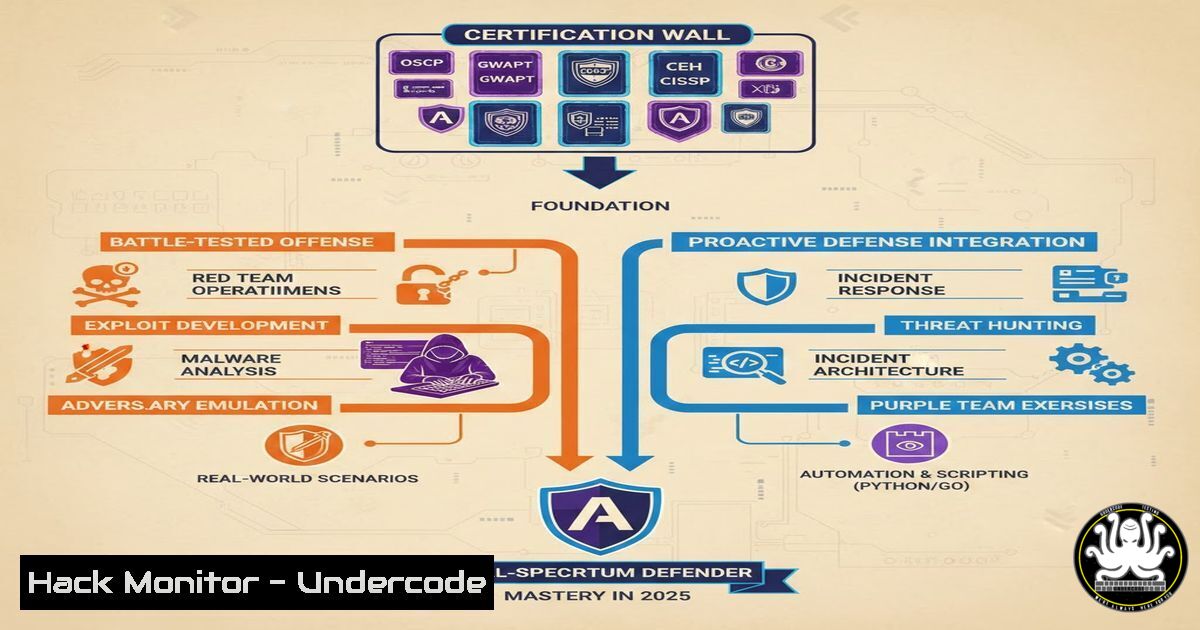
The journey from aspirant to certified offensive security professional is a testament to disciplined study and hands-on application. As exemplified by a practitioner’s year-end reflection on earning prestigious certifications like OSCP, KLCP, and OSWP, this path transforms theoretical knowledge into actionable defense through ethical hacking. This article deconstructs the core technical competencies behind these accolades, providing a actionable guide to weaponizing your learning for real-world organizational security.
Learning Objectives:
- Understand the practical, command-line driven skills validated by key offensive security certifications.
- Learn to automate critical security assessment and hardening tasks across Linux and Windows environments.
- Apply proven methodologies for penetration testing, wireless assessment, and endpoint security enhancement.
You Should Know:
- Mastering the Kali Linux Arsenal: The KLCP Foundation
The Kali Linux Certified Professional (KLCP) certification establishes fluency in the penetration tester’s primary toolkit. It’s not just about knowing tools exist, but about wielding them efficiently from the terminal.
Step‑by‑step guide explaining what this does and how to use it.
Core Competency: Efficient navigation, package management, and service manipulation within a Kali environment.
Linux Commands & Tutorial:
Advanced Package Management: Beyond apt update && apt upgrade, learn to pin packages, manage third-party repos, and build from source.
 Add a custom tool repository (e.g., for latest exploit-db)
echo "deb http://http.kali.org/kali kali-rolling main non-free contrib" | sudo tee /etc/apt/sources.list.d/custom.list
sudo apt-get update --allow-insecure-repositories
 Pin a specific tool version to avoid breaking changes
echo "nmap hold" | sudo dpkg --set-selections
Service Management & Stealth: Controlling services like SSH for offensive engagements.
 Change SSH port and restrict login for operational security
sudo sed -i 's/Port 22/Port 2222/g' /etc/ssh/sshd_config
echo "AllowUsers your_username" | sudo tee -a /etc/ssh/sshd_config
sudo systemctl restart ssh
Bash Automation for Recon: Automate initial enumeration.
!/bin/bash
 Basic automated recon script
TARGET=$1
echo "[] Running quick scan on $TARGET"
mkdir -p recon/$TARGET
nmap -sC -sV -oA recon/$TARGET/initial $TARGET &
dirb http://$TARGET /usr/share/wordlists/dirb/common -o recon/$TARGET/dirb.txt &
wait
echo "[+] Recon data saved to recon/$TARGET/"
2. Penetration Testing Execution: The OSCP Methodology
The Offensive Security Certified Professional (OSCP) validates a rigorous, hands-on penetration testing methodology. It emphasizes manual exploitation, privilege escalation, and structured reporting.
Step‑by‑step guide explaining what this does and how to use it.
Core Competency: Following a structured approach: Reconnaissance, Scanning, Exploitation, Post-Exploitation, and Reporting.
Practical Walkthrough & Commands:
- Active Reconnaissance & Enumeration: Use Nmap scripts for deep service enumeration.
nmap -p 1-65535 -sV -sS -T4 -A --script=vuln,default -oA full_scan $TARGET
- Vulnerability Analysis & Manual Exploitation: Research public exploits (e.g., from Exploit-DB) and adapt them.
Search for exploits locally in Kali
searchsploit "Apache 2.4.49"
Compile and run a simple buffer overflow proof-of-concept (example)
gcc -fno-stack-protector -z execstack -o poc poc.c
./poc $TARGET 80
- Post-Exploitation & Lateral Movement: After gaining a shell, enumerate the system for privilege escalation paths and credentials.
Linux Privilege Escalation Checks:
 Check for SUID binaries
find / -perm -4000 -type f 2>/dev/null
 Check cron jobs
crontab -l
ls -la /etc/cron
Windows Privilege Escalation Checks (via shell):
whoami /priv
systeminfo | findstr /B /C:"OS Name" /C:"OS Version"
3. Compromising the Airwaves: Wireless Penetration with OSWP
The Offensive Security Wireless Professional (OSWP) focuses on attacking and securing Wi-Fi networks, targeting WEP, WPA, and WPA2 protocols.
Step‑by‑step guide explaining what this does and how to use it.
Core Competency: Using the Aircrack-ng suite to capture handshakes and conduct cryptographic attacks.
Step-by-Step Attack Chain:
- Interface Preparation: Put your wireless card in monitor mode.
sudo airmon-ng check kill
sudo airmon-ng start wlan0
2. Reconnaissance: Identify target access points and clients.
sudo airodump-ng wlan0mon
3. Handshake Capture: Deauthenticate a client to force a reconnection and capture the 4-way handshake.
 In one terminal, capture packets targeting a specific BSSID and channel
sudo airodump-ng -c 6 --bssid AA:BB:CC:DD:EE:FF -w capture wlan0mon
 In another, send deauth packets
sudo aireplay-ng --deauth 10 -a AA:BB:CC:DD:EE:FF wlan0mon
4. Cracking: Use a wordlist to crack the captured handshake.
aircrack-ng -w /usr/share/wordlists/rockyou.txt capture-01.cap
4. From Offense to Defense: Automating Security Hardening
True expertise is shown by translating offensive knowledge into automated defense, “strengthening the organization’s security posture.”
Step‑by‑step guide explaining what this does and how to use it.
Core Competency: Writing scripts to automate compliance checks and system hardening.
Automation Examples:
Linux Hardening Script Snippet:
 Disable unnecessary services
for service in avahi-daemon cups bluetooth; do
sudo systemctl stop $service
sudo systemctl disable $service
done
 Enforce secure SSH configurations (Idempotent)
sudo sed -i 's/^PasswordAuthentication yes/PasswordAuthentication no/' /etc/ssh/sshd_config
sudo sed -i 's/^PermitRootLogin yes/PermitRootLogin no/' /etc/ssh/sshd_config
Windows PowerShell Hardening (via Admin PowerShell):
 Disable SMBv1 for vulnerability mitigation
Set-SmbServerConfiguration -EnableSMB1Protocol $false -Force
 Enable Windows Defender real-time protection and cloud-delivered protection
Set-MpPreference -DisableRealtimeMonitoring $false -EnableCloudProtection $true
- Integrating AI into Security Operations: The Next Frontier
Looking toward “bigger goals,” integrating AI and Machine Learning into security workflows is crucial for threat prediction and log analysis.
Step‑by‑step guide explaining what this does and how to use it.
Core Competency: Using Python with security libraries to analyze data and detect anomalies.
Basic Tutorial: Create a simple script to parse SSH auth logs and detect brute force attempts.
!/usr/bin/env python3
import re
from collections import Counter

failed_attempts = []
with open('/var/log/auth.log', 'r') as f:
for line in f:
if 'sshd' in line and 'Failed password' in line:
ip = re.search(r'from (\d+.\d+.\d+.\d+)', line)
if ip:
failed_attempts.append(ip.group(1))

ip_counts = Counter(failed_attempts)
for ip, count in ip_counts.most_common(5):
if count > 10:
print(f"[!] Brute Force Alert: IP {ip} failed {count} times.")
 Optional: Automate block with iptables
 import subprocess
 subprocess.run(['iptables', '-A', 'INPUT', '-s', ip, '-j', 'DROP'])
What Undercode Say:
- Certifications are Milestones, Not Destinations: The wall of certificates symbolizes proven skill acquisition, not the end of learning. Each cert’s value is realized only when its methodologies are routinely applied to real-world attack simulation and defense automation.
- Automation is the Force Multiplier: The transition from passing exams to “leading and automating security projects” is the key differentiator. The true professional output is not a PDF certificate, but a suite of scripts that persistently enforce configuration baselines, monitor for deviations, and respond to threats.
Prediction:
The convergence of offensive security methodologies, automated defense scripting, and AI-driven analytics will define the next evolution of cybersecurity roles in 2025 and beyond. Professionals who merely hold certifications will be outpaced by those who engineer their offensive insights into scalable, self-healing security architectures. The future belongs to “security engineers” who can code, exploit, and remediate with equal proficiency, turning manual penetration testing findings into automated, organization-wide guardrails. The next “wall” will feature not just certificates, but dashboards of vulnerabilities auto-remediated and threats neutralized by systems they designed.
▶️ Related Video (80% Match):
🎯Let’s Practice For Free:
IT/Security Reporter URL:
Reported By: Sudheeshgl Cybersecurity – Hackers Feeds
Extra Hub: Undercode MoN
Basic Verification: Pass ✅


