
Listen to this Post
Introduction:
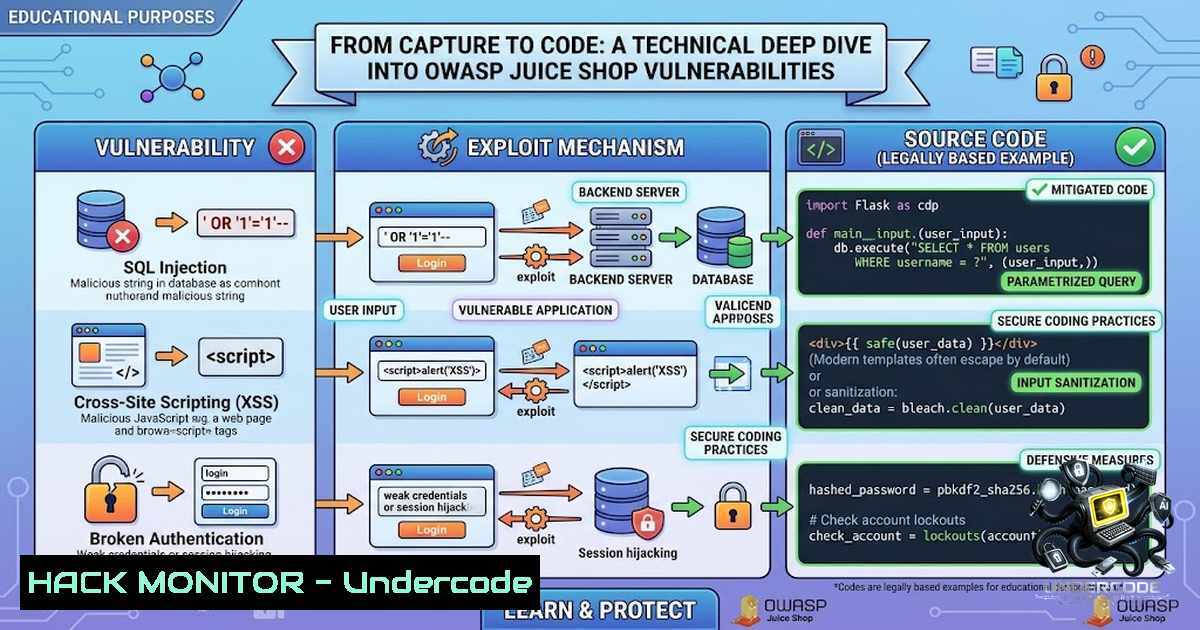
Bug bounty competitions provide an unparalleled hands-on environment for security researchers to transition from theoretical knowledge to practical exploitation. The OWASP Juice Shop, an intentionally vulnerable web application, serves as a modern training ground where ethical hackers can safely probe for real-world vulnerabilities like SQL Injection, Cross-Site Scripting (XSS), Insecure Direct Object References (IDOR), and Broken Access Control. This article dissects the technical underpinnings of these common flaws, providing a step-by-step guide to discovering and mitigating them, just as participants in a recent competition at Mandsaur University experienced firsthand.
Learning Objectives & Secrets:
- Objective 1: Master SQL Injection for Authentication Bypass – Understand how unsanitized user input can manipulate backend SQL queries to grant unauthorized admin access. Secret Tip: Always test with simple payloads like `’ OR 1=1–` first; if successful, the application is critically vulnerable.
- Objective 2: Exploit IDOR via API Manipulation – Learn to identify and exploit insecure direct object references by tampering with predictable identifiers in API requests. Secret Tip: Use Burp Suite to intercept and modify sequential IDs (e.g., `/rest/basket/6` to
/rest/basket/1) to access other users’ private data. - Objective 3: Execute DOM-Based XSS Attacks – Discover how client-side JavaScript can inadvertently execute malicious scripts from URL parameters. Secret Tip: The search bar is often a prime target; inject
<iframe src="javascript:alert(xss)">to trigger a proof-of-concept alert.
You Should Know:
- Setting Up Your Lab Environment (Linux & Windows)
Before hunting for bugs, you need a local instance of the Juice Shop. The fastest method is using Docker. This isolates the application and allows for safe, repeatable testing.
- Step 1 (Linux/macOS/Windows with Docker): Open your terminal or command prompt and pull the official image.
docker pull bkimminich/juice-shop
- Step 2: Run the container, mapping port 3000 on your host to the container’s port.
docker run -d -p 3000:3000 bkimminich/juice-shop
For enhanced vulnerability coverage (including XXE challenges which are disabled by default in Docker), you can use the `unsafe` environment variable:
docker run -d -p 3000:3000 -e "NODE_ENV=unsafe" bkimminich/juice-shop
- Step 3: Open your browser and navigate to `http://localhost:3000`. You now have a fully functional, vulnerable web application ready for testing.
2. SQL Injection: Dumping the User Database
SQL Injection remains one of the most critical web vulnerabilities. In Juice Shop, the product search endpoint is susceptible to a UNION-based SQL injection attack.
– Step 1: Navigate to the search bar on the main page.
– Step 2: Intercept the search request using Burp Suite or simply paste the following encoded payload into the URL bar after `http://localhost:3000/`:/rest/products/search?q=qwert%27%29%29%20UNION%20SELECT%20id%2C%20email%2C%20password%2C%20%274%27%2C%20%275%27%2C%20%276%27%2C%20%277%27%2C%20%278%27%2C%20%279%27%20FROM%20Users--
- Step 3: The application will return a list of products, but injected into this list will be the
id,email, and `password` hashes of all registered users. - What this does: The payload breaks out of the original `SELECT` query and appends a `UNION SELECT` statement that extracts data from the `Users` table. The `–` comments out the rest of the original query to prevent syntax errors.
3. IDOR: Viewing Another User’s Shopping Basket
Insecure Direct Object Reference occurs when an application exposes internal objects (like database keys) without verifying user authorization.
- Step 1: Log in to the Juice Shop with any valid user account.
- Step 2: Add an item to your basket.
- Step 3: Open Burp Suite and ensure your browser’s traffic is being proxied through it.
- Step 4: In Burp, locate the `GET /rest/basket/6` request (the number ‘6’ is your basket ID).
- Step 5: Send this request to Burp Repeater. Change the basket ID from `6` to `1` and send the request.
- Step 6: Observe the `200 OK` response. The server returns the contents of the admin’s basket (User ID 1). You can enumerate all baskets by incrementing the ID.
- Remediation: Always enforce server-side authorization checks. The API must verify that the authenticated user owns the resource being accessed, not just that they have a valid session.
4. Broken Access Control: Admin Panel Exposure
Broken Access Control is ranked 1 in the OWASP Top 10 for good reason. Often, developers hide admin links but fail to protect the underlying API endpoints.
- Step 1: Log out of the Juice Shop. You don’t even need to be authenticated.
- Step 2: Manually navigate to `http://localhost:3000//administration`.
- Step 3: The administration panel loads, displaying a list of all registered users, customer feedback, and other sensitive data.
- What this demonstrates: The application relies on “security by obscurity.” The link isn’t in the navigation menu, but there is no server-side check to confirm the user has admin privileges. Anyone who knows or guesses the URL can access it.
- Advanced Exploit: An even more critical flaw allows unauthenticated users to create administrator accounts by sending a crafted POST request to `/api/Users` with a `”role”:”admin”` parameter.
5. Cross-Site Scripting (XSS): Stored and DOM-Based
XSS allows attackers to inject malicious scripts into web pages viewed by other users. Juice Shop contains multiple XSS vectors.
- DOM-Based XSS (Search Bar):
- Step 1: Go to the Juice Shop homepage.
- Step 2: In the search bar, enter the following payload:
<iframe src="javascript:alert(xss)">. - Step 3: Press Enter. An alert box with “xss” will appear, confirming the vulnerability.
-
Stored XSS (Customer Feedback):
- Step 1: Navigate to the “Customer Feedback” section.
- Step 2: In the comment field, paste a payload like
<script>alert('Stored XSS')</script>. - Step 3: Submit the feedback.
- Step 4: Go to the “About Us” page. The feedback slider will execute your script every time a user views the page.
6. XXE Injection: Reading Local Files
XML External Entity (XXE) injection is a powerful attack that can lead to local file disclosure and Server-Side Request Forgery (SSRF).
- Step 1: Navigate to the “Complaint” or file upload section.
- Step 2: Upload an XML file (or submit XML data) with the following payload:
<!DOCTYPE foo [<!ENTITY xxe SYSTEM "file:///etc/passwd">]>
<complaint><message>&xxe;</message></complaint>
- Step 3: If the application is vulnerable and the parser allows external entities, the contents of the `/etc/passwd` file will be returned in the response.
7. OSINT and Credential Discovery
Not all hacks are technical. Sometimes, the vulnerability lies in poor operational security.
- Challenge: Log in as the user
[email protected]. - Method: The credentials for this account were publicly discoverable via a YouTube video with over 1.4 million views. This highlights the importance of not reusing credentials and being aware of your digital footprint.
What Undercode Say:
- Key Takeaway 1: Vulnerabilities are rarely obvious; they hide in the details of API requests, HTTP headers, and client-side JavaScript. Patience and methodical testing, such as checking every parameter in Burp Suite, are more valuable than speed.
- Key Takeaway 2: Ethical hacking is as much a mindset as it is a skillset. It requires thinking like an attacker—anticipating how a system can be misused—to build more resilient defenses. The “aha” moment comes not from breaking things, but from understanding the logic flaw that allowed the break.
Prediction:
- +1: The gamification of cybersecurity through platforms like OWASP Juice Shop and bug bounty competitions will continue to produce a new generation of highly skilled, practice-ready security professionals who understand the nuances of modern web and API security.
- +1: As API-driven architectures become the norm, the demand for hands-on training that specifically targets API security misconfigurations (BOLA, excessive data exposure) will surge, making tools like Juice Shop even more critical for developer and security training.
- -1: The ease with which these vulnerabilities can be exploited in a controlled environment often leads to a false sense of security. Many production applications still suffer from these same basic flaws, and the gap between training and real-world security remains a significant risk.
▶️ Related Video (82% Match):
🎯Let’s Practice For Free:
🎓 Live Courses & Certifications:
Join Undercode Academy for Verified Certifications
🚀 Request a Custom Project:
Secure, high-velocity infrastructure and disruptive technological engineering. Contact our engineering team for high-tier development and proprietary systems:
[email protected]
💎 Smart Architecture | 🛡️ Secure by Design | ⭐ Trusted by Thousands
IT/Security Reporter URL:
Reported By: https://lnkd.in/p/epR4YTE6 – Hackers Feeds
Extra Hub: Undercode MoN
Basic Verification: Pass ✅


