
Listen to this Post
Introduction:
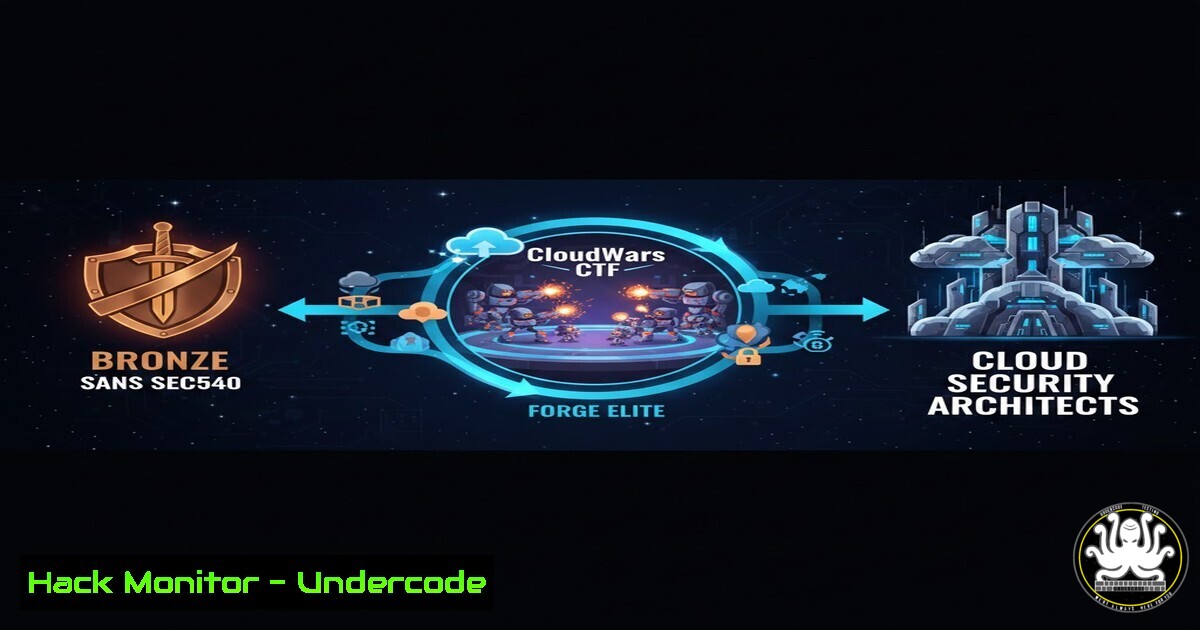
In the high-stakes arena of cloud security, theoretical knowledge is merely the entry ticket. True expertise is forged in the crucible of hands-on, adversarial simulation. The SANS SEC540: Cloud Security and DevOps Automation course, crowned by its competitive CloudWars Capture The Flag (CTF), represents the gold standard for professionals seeking to translate architectural principles into actionable, resilient defenses across AWS, Azure, and GCP. This immersive training bridges the critical gap between understanding cloud models and actively defending complex, multi-service environments against sophisticated threats.
Learning Objectives:
- Architect and implement secure identity and access management (IAM) frameworks across multi-cloud environments.
- Design and validate network segmentation and data security controls using infrastructure-as-code (IaC) principles.
- Develop proficient threat modeling skills specific to cloud-native applications and DevOps pipelines.
You Should Know:
- Mastering the Identity Frontier: The Keystone of Cloud Security
The principle of least privilege isn’t new, but its implementation in the cloud is notoriously complex. SEC540 emphasizes that identity is the new perimeter. A misplaced IAM role or an over-permissive service account can lead to catastrophic data exfiltration.
Step‑by‑step guide explaining what this does and how to use it.
Scenario: You need to audit an AWS IAM role for excessive permissions and potential privilege escalation paths.
Step 1: Install and configure the `awscli` and prowler, an AWS security auditing tool.
pip install awscli
git clone https://github.com/prowler-cloud/prowler
cd prowler
./prowler -R
Step 2: Authenticate your CLI with credentials for the audit account.
aws configure
Step 3: Run a focused check for IAM risks.
./prowler -c extra739,extra740 -M json
extra739: Checks for IAM roles that allow `””` actions on `””` resources.
extra740: Identifies IAM policies that may allow privilege escalation.
Step 4: Analyze the JSON output. For any high-risk finding, use the AWS Console or CLI to remediate by rewriting the policy. A secure policy should specify exact actions and resources.
aws iam get-policy-version --policy-arn arn:aws:iam::123456789012:policy/ExamplePolicy --version-id v1
aws iam create-policy-version --policy-arn arn:aws:iam::123456789012:policy/ExamplePolicy --policy-document file://new-policy.json --set-as-default
2. Threat Modeling Cloud-Native Applications with STRIDE
Cloud architectures introduce novel threat vectors. The SEC540 curriculum leverages adapted threat modeling methodologies like STRIDE (Spoofing, Tampering, Repudiation, Information Disclosure, Denial of Service, Elevation of Privilege) to deconstruct cloud workloads.
Step‑by‑step guide explaining what this does and how to use it.
Scenario: Threat model a serverless application using an API Gateway, Lambda, and DynamoDB.
Step 1: Diagram the data flow. (API Client) -> (API Gateway) -> (Lambda Function) -> (DynamoDB Table).
Step 2: Apply STRIDE per component.
Spoofing: Can an attacker forge a request to API Gateway without valid JWT tokens? Enforce authentication via AWS Cognito.
Tampering: Can request/response data be altered in transit? Mandate TLS 1.2+.
Information Disclosure: Does the Lambda function’s execution role have read/write access to all DynamoDB tables? Scope the role to the specific table ARN.
Step 3: Document threats and countermeasures in a threat model registry for ongoing security hygiene.
- Network Access & Segmentation in a Boundary-Less World
While the network perimeter has dissolved, micro-segmentation via Security Groups, NSGs, and VPC Service Controls is paramount. The CloudWars CTF likely challenged participants to navigate and secure these software-defined networks.
Step‑by‑step guide explaining what this does and how to use it.
Scenario: Harden an Azure VM by restricting its Network Security Group (NSG) rules.
Step 1: Identify the VM and its associated NSG using Azure CLI.
az vm list --resource-group MyResourceGroup --show-details --query '[].{Name:name, NSG:networkProfile.networkInterfaces[bash].networkSecurityGroup.id}'
Step 2: Review existing NSG rules.
az network nsg rule list --nsg-name MyNSG --resource-group MyResourceGroup -o table
Step 3: Remove overly permissive rules (e.g., allowing SSH from 0.0.0.0/0).
az network nsg rule delete --name AllowAllSSH --nsg-name MyNSG --resource-group MyResourceGroup
Step 4: Add a restrictive rule allowing SSH only from a specific management IP.
az network nsg rule create --name RestrictSSH --nsg-name MyNSG --resource-group MyResourceGroup --priority 100 --source-address-prefixes 203.0.113.5/32 --destination-port-ranges 22 --protocol Tcp --access Allow
4. Securing Data Access: Encryption & Beyond
Data protection extends far beyond encryption at rest. SEC540 delves into encryption in transit, key lifecycle management, and data classification enforced by cloud-native tools.
Step‑by‑step guide explaining what this does and how to use it.
Scenario: Enable default encryption and enforce TLS for an Amazon S3 bucket.
Step 1: Apply default AES-256 encryption via the AWS CLI.
aws s3api put-bucket-encryption --bucket my-sensitive-bucket --server-side-encryption-configuration '{"Rules": [{"ApplyServerSideEncryptionByDefault": {"SSEAlgorithm": "AES256"}}]}'
Step 2: Enforce a bucket policy that denies all `GetObject` requests that do not use TLS.
aws s3api put-bucket-policy --bucket my-sensitive-bucket --policy file://tls-enforce-policy.json
Content of `tls-enforce-policy.json`:
{
"Version": "2012-10-17",
"Statement": [{
"Sid": "EnforceTLS",
"Effect": "Deny",
"Principal": "",
"Action": "s3:GetObject",
"Resource": "arn:aws:s3:::my-sensitive-bucket/",
"Condition": {"Bool": {"aws:SecureTransport": "false"}}
}]
}
5. Automating Security with DevOps (DevSecOps) Pipelines
Integrating security into CI/CD is non-negotiable. The course covers automating security scans for Infrastructure-as-Code (IaC) and container images.
Step‑by‑step guide explaining what this does and how to use it.
Scenario: Integrate a Terraform security scan into a GitHub Actions pipeline.
Step 1: In your GitHub repository, create a workflow file .github/workflows/tfsec.yml.
Step 2: Configure the workflow to run `tfsec` on every pull request to the main branch.
name: "Terraform Security Scan"
on:
pull_request:
branches: [ "main" ]
jobs:
tfsec:
runs-on: ubuntu-latest
steps:
- uses: actions/checkout@v3
- name: Run tfsec
uses: aquasecurity/[email protected]
with:
args: --exclude-downloaded-modules
Step 3: The pipeline will now automatically fail and provide feedback if the Terraform code contains security misconfigurations, such as publicly accessible S3 buckets or open security groups.
What Undercode Say:
- Key Takeaway 1: Cloud security maturity is measured by the depth of hands-on, adversarial experience, not certifications alone. The CTF model is the ultimate validator of skill.
- Key Takeaway 2: Effective cloud defense is a unified architecture of identity, data, network, and development lifecycle controls—no single silver bullet exists.
The post highlights a critical evolution in cybersecurity training: the shift from passive learning to active, competitive defense. The participant’s mention of drafting “solution diagrams so quickly” underscores the pressure-testing of architectural decision-making under time constraints, mirroring real-world incident response. This methodology directly addresses the industry’s talent gap by producing professionals who don’t just understand threats but can instantly architect defenses against them. The integration of all major cloud providers (AWS, Azure, GCP) ensures skills are vendor-agnostic and principles-based, which is essential in today’s hybrid and multi-cloud enterprises.
Prediction:
The future of cloud security training will become increasingly gamified and AI-integrated. We will see CTF platforms that generate dynamic, AI-driven attack scenarios tailored to a participant’s specific cloud environment, requiring real-time adaptation of defense architectures. Furthermore, as AI-assisted coding becomes ubiquitous, future courses like SEC540 will place greater emphasis on securing AI-generated IaC code and auditing AIOps platforms for security flaws. The line between training simulation and automated, continuous penetration testing of live environments will blur, creating a new standard of always-on, experiential skill development for security architects.
▶️ Related Video (78% Match):
🎯Let’s Practice For Free:
IT/Security Reporter URL:
Reported By: David D – Hackers Feeds
Extra Hub: Undercode MoN
Basic Verification: Pass ✅


