Listen to this Post
Introduction:
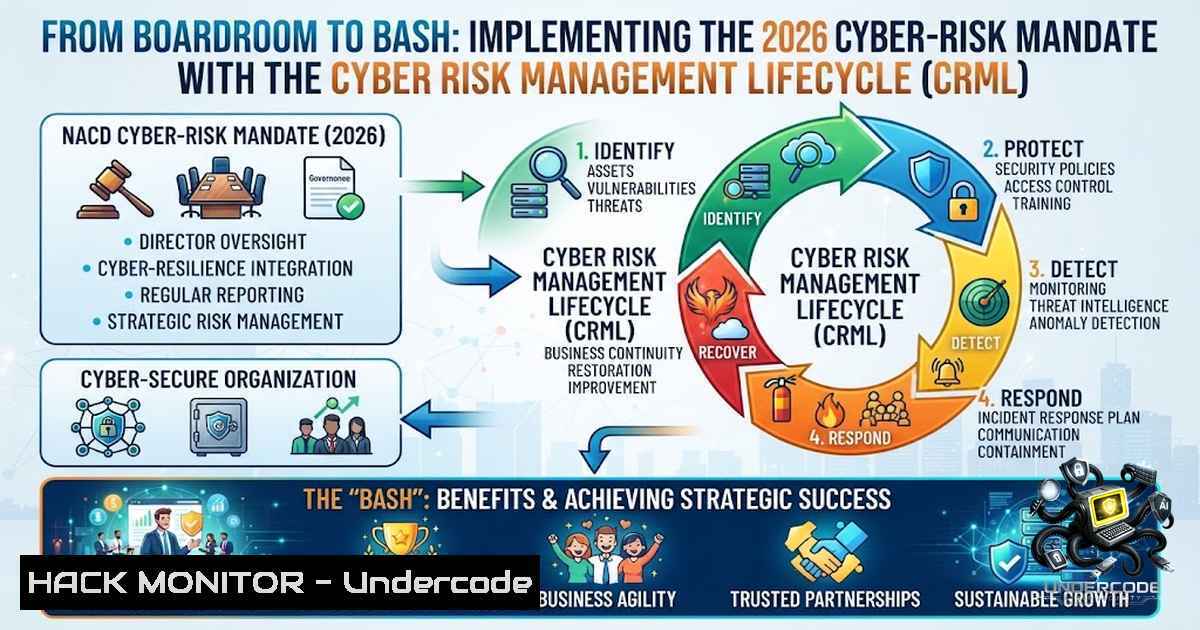
The era of treating cybersecurity as a technical footnote in the boardroom has officially ended. The 2026 Director’s Handbook on Cyber-Risk Oversight from the NACD (National Association of Corporate Directors) and the Internet Security Alliance reframes cyber risk not as an IT concern but as a fiduciary duty—a strategic imperative that demands continuous oversight. This shift validates a core truth: cyber risk is dynamic, shared, continuous, and adversarial, meaning a static annual checklist will always lose to a threat that learns and adapts in real time.
Learning Objectives:
- Understand the four defining characteristics of modern cyber risk and why they demand a continuous governance model.
- Learn to implement the Cyber Risk Management Lifecycle (CRML) as a practical framework for dynamic risk oversight.
- Acquire actionable technical commands and configurations for Linux, Windows, and cloud environments to operationalize board-level risk principles.
You Should Know:
- The Dynamic Attack Surface: Why Continuous Monitoring Is Non-1egotiable
The attack surface is no longer a fixed perimeter; it is a “living three-dimensional figure” where risk rises and falls in real time. Asset categories on one axis, attack tactics on another, and cyber risk as height—the colors are not fixed. Peaks erupt where exposure concentrates, and the “blue fog” of the unknown spreads faster than anyone can watch. By the time a periodic snapshot is read, the surface it described has already changed shape. Governing this requires a continuous reading, asset by asset, which is precisely what the CRML provides.
Step‑by‑step guide to mapping your dynamic attack surface:
- Inventory All Digital Assets: Create a comprehensive list of all assets—on-premises servers, cloud instances, containers, APIs, and IoT devices. Use network scanning tools like `nmap` (Linux) or `Test-Connection` (Windows PowerShell).
– Linux: `nmap -sn 192.168.1.0/24` (Discover live hosts)
– Windows PowerShell: `1..254 | ForEach-Object { Test-Connection -ComputerName “192.168.1.$_” -Count 1 -ErrorAction SilentlyContinue }`
2. Map Asset Categories: Classify assets by type (e.g., web servers, databases, endpoints). Tools like `masscan` can rapidly scan large networks.
– Linux: `masscan -p80,443 192.168.1.0/24 –rate=1000`
3. Identify Exposed Services: Use `nmap` for detailed service enumeration.
– Linux: `nmap -sV -p- 192.168.1.10` (Version detection on all ports)
4. Visualize Risk as Height: Assign risk scores based on vulnerability severity and asset criticality. Use tools like `OpenVAS` or `Nessus` for vulnerability scanning.
– Linux (OpenVAS): `gvm-cli socket –gmp-username admin –gmp-password password socket –xml “
5. Implement Continuous Discovery: Schedule weekly scans to capture new assets and infrastructure changes. Automate with `cron` (Linux) or Task Scheduler (Windows).
– Linux Cron: `0 2 0 /usr/bin/nmap -sL 192.168.1.0/24 > /var/log/asset_inventory.log`
6. Integrate Threat Intelligence: Feed scan results into a SIEM or threat intelligence platform to correlate with known attack patterns.
- The Cyber Risk Management Lifecycle (CRML): From Theory to Continuous Operation
The CRML is a continuous loop of identification, quantification, mitigation, and validation that mirrors the dynamic nature of the threat itself. It moves beyond point-in-time reports to a living process.
Step‑by‑step guide to operationalizing the CRML:
- Inventory, Contextualize, and Value Digital Assets: Document not just what you have, but its business value and impact if compromised.
– Tool: Use a CMDB (Configuration Management Database) like `GLPI` or Snipe-IT.
– Command (Linux): `lshw -short` to list hardware; `dmidecode` for system details.
2. Identify Vulnerabilities, Threats, and Consequences: Conduct regular vulnerability assessments and threat modeling.
– Linux (using auditd): `ausearch -m avc -ts recent` to check for SELinux denials indicating potential vulnerabilities.
– Windows (using PowerShell): `Get-WindowsUpdateLog` to review patch status.
3. Cyber Risk Assessment, Calculation, and Prioritization: Quantify risk using a framework like FAIR (Factor Analysis of Information Risk).
– Script (Python pseudo-code):
risk_score = (threat_likelihood  vulnerability_score  business_impact)
if risk_score > threshold: trigger_remediation()
4. Cyber Risk Mitigation: Apply defenses and controls—people, process, and technology.
– Linux (IPTables): `iptables -A INPUT -p tcp –dport 22 -j DROP` (Block SSH)
– Windows (Firewall): `New-1etFirewallRule -DisplayName “Block SSH” -Direction Inbound -Protocol TCP -LocalPort 22 -Action Block`
5. Cyber Risk Monitoring: Continuously monitor for changes in risk posture.
– Linux: `tail -f /var/log/syslog | grep -i “attack\|fail”`
– Windows: `Get-EventLog -LogName Security -1ewest 50`
6. Cyber Risk Assessment and Recalculation: Periodically reassess and adjust the risk posture based on new threats and changes. This closes the loop and starts the cycle anew.
- Cloud Security Hardening: Implementing the Handbook’s Cloud Oversight Principles
The NACD handbook includes a specific tool for “Overseeing Cloud Services Security”. Effective cloud governance requires a shared responsibility model where the board ensures that security controls are not just configured but continuously validated.
Step‑by‑step guide to cloud security hardening (Azure/AWS example):
- Enforce Multi-Factor Authentication (MFA): Mandate MFA for all administrative accounts. Use Azure AD Conditional Access or AWS IAM policies.
– Azure CLI: `az ad conditional-access policy create –1ame “Require MFA for Admins” …`
– AWS CLI: `aws iam create-policy –policy-1ame RequireMFA –policy-document file://mfa-policy.json`
2. Implement Just-In-Time (JIT) Access: Use Azure Privileged Identity Management (PIM) or AWS IAM Access Analyzer to grant temporary, time-bound permissions.
– Azure CLI: `az rest –method post –uri “https://graph.microsoft.com/v1.0/privilegedAccess/azureResources/roleAssignmentRequests” …`
3. Harden Operating System Baselines: Use Azure Policy or AWS Config to enforce security baselines.
– Azure Policy (Linux): Enforce that SSH is not disabled and that auditing is enabled.
– AWS Config Rule: `config-rule-required-tags` to enforce tagging for asset management.
4. Enable Comprehensive Logging: Turn on Azure Monitor or AWS CloudTrail and send logs to a SIEM.
– Azure CLI: `az monitor diagnostic-settings create –resource
– AWS CLI: `aws cloudtrail create-trail –1ame my-trail –s3-bucket-1ame my-bucket`
5. Conduct Regular Cloud Security Posture Assessments: Use tools like Microsoft Defender for Cloud or AWS Security Hub.
– Azure CLI: `az security assessment-metadata list`
– AWS CLI: `aws securityhub get-findings`
6. Implement Network Segmentation: Use Virtual Networks (VNet) or Virtual Private Cloud (VPC) with Network Security Groups (NSGs) or Security Groups.
– Azure CLI: `az network nsg rule create –1sg-1ame MyNSG –1ame DenyAll –priority 1000 –access Deny –protocol ” –direction Inbound –source-address-prefixes ” –source-port-ranges ” –destination-address-prefixes ” –destination-port-ranges ”`
4. API Security: Securing the Digital Supply Chain
APIs are the backbone of modern digital business, yet they are a primary attack vector. The handbook’s emphasis on third-party and supply chain riskmakes API security a boardroom concern. OWASP’s API Security Top 10 provides a practical starting point.
Step‑by‑step guide to API security hardening:
- Discover All APIs: Use API discovery tools to find shadow APIs. Tools like `Postman` or `Swagger Inspector` can help.
– Command (Linux using curl): `curl -X OPTIONS https://api.example.com/v1/` (to check allowed methods)
2. Implement Strong Authentication and Authorization: Use OAuth 2.0 or OpenID Connect (OIDC). Never rely on API keys alone.
– Example (Python with Flask-JWT):
jwt = JWT(app, authenticate, identity)
@jwt_required()
def protected():
return jsonify({'message': 'Access granted'})
3. Validate and Sanitize Input: Prevent injection attacks by validating all input.
– Example (Node.js with Express-validator):
body('email').isEmail().normalizeEmail()
4. Implement Rate Limiting and Throttling: Protect against brute-force and DoS attacks.
– Nginx Configuration:
limit_req_zone $binary_remote_addr zone=mylimit:10m rate=10r/s;
location /api/ {
limit_req zone=mylimit burst=20 nodelay;
}
5. Use an API Gateway: Centralize security controls including authentication, rate limiting, and request validation.
– Kong or AWS API Gateway: Configure policies to enforce security at the edge.
6. Monitor API Activity: Log all API requests and responses. Set up alerts for anomalous patterns.
– ELK Stack: Use Filebeat to ship API logs to Elasticsearch for analysis.
5. Mitigating AI-Generated Threats and Quantum Risks
The handbook highlights that emerging technology cuts both ways—generative AI creates value while being weaponized into AI-generated attacks, and quantum computing introduces a “harvest now, decrypt later” threat. Boards must oversee post-quantum planning now.
Step‑by‑step guide to mitigating AI and quantum threats:
1. Inventory Cryptographic Assets: Identify all systems using RSA or ECC encryption.
– Linux: `find /etc/ssl -1ame “.key” -exec openssl rsa -in {} -1oout -text \;`
– Windows (PowerShell): `Get-ChildItem -Path Cert:\ -Recurse | Where-Object { $_.PublicKey.Key.KeySize -lt 2048 }`
2. Plan for Post-Quantum Cryptography (PQC): Begin testing NIST-approved PQC algorithms like CRYSTALS-Kyber.
– OpenSSL (experimental): `openssl speed -evp kyber512`
3. Implement AI-Based Threat Detection: Deploy AI-powered WAFs and SIEMs that use behavioral analytics.
– Example: Configure ModSecurity with AI/ML rulesets to detect zero-day attacks.
4. Defend Against AI-Powered Phishing: Use AI-based email filtering and conduct regular phishing simulations. Train employees to recognize AI-generated deepfakes.
5. Secure AI Models Themselves: Protect against model poisoning and prompt injection attacks.
– Example: Implement input sanitization and adversarial training for ML models.
6. Regularly Update Incident Response Plans: Include scenarios for AI-driven attacks and quantum decryption events.
What Undercode Say:
- Key Takeaway 1: Cyber risk is a fiduciary duty, not a technical footnote. Boards must adopt a continuous governance model like the CRML to keep pace with dynamic threats.
- Key Takeaway 2: The attack surface is a living entity. Static checklists and annual reports are obsolete; continuous monitoring and real-time risk assessment are now mandatory.
Analysis:
The NACD handbook’s fifth edition is a watershed moment for corporate governance. It explicitly ties cyber risk oversight to fiduciary duty, meaning directors can no longer delegate cybersecurity to the IT department and forget about it. The framework’s six principles and fifteen tools provide a practical roadmap, but their success hinges on operationalizing concepts like the CRML and dynamic attack surface management. The handbook’s focus on emerging technologies—AI and quantum computing—is particularly timely, as these introduce risks that are not just technical but existential to business models. The call for resilience as a “shared discipline” underscores that supply chain vulnerabilities are a systemic risk, requiring industry-wide collaboration. Ultimately, this handbook is not just a guide; it is a mandate for a new era of cyber governance where risk is managed continuously, collaboratively, and with the full weight of boardroom authority.
Prediction:
- +1 Organizations that adopt the CRML and continuous attack surface monitoring will demonstrate superior resilience and potentially lower cyber insurance premiums, gaining a competitive advantage.
- +1 The demand for board-level cyber expertise will surge, leading to a new class of “cyber-qualified” directors and specialized training programs.
- -1 Companies that fail to treat cyber risk as a continuous, board-level fiduciary duty will face increased regulatory scrutiny, shareholder lawsuits, and catastrophic breach costs, as the “passive oversight” era is officially over.
- -1 The “harvest now, decrypt later” threat will materialize sooner than expected, catching organizations without post-quantum cryptography plans off guard and exposing decades of encrypted data.
- -1 AI-generated attacks will outpace traditional defenses, widening the gap between attackers and defenders and forcing a fundamental shift from reactive to predictive security postures.
▶️ Related Video (74% Match):
🎯Let’s Practice For Free:
🎓 Live Courses & Certifications:
Join Undercode Academy for Verified Certifications
🚀 Request a Custom Project:
Secure, high-velocity infrastructure and disruptive technological engineering. Contact our engineering team for high-tier development and proprietary systems:
[email protected]
💎 Smart Architecture | 🛡️ Secure by Design | ⭐ Trusted by Thousands
IT/Security Reporter URL:
Reported By: Jpcastro 2026 – Hackers Feeds
Extra Hub: Undercode MoN
Basic Verification: Pass ✅


