Listen to this Post
Introduction:
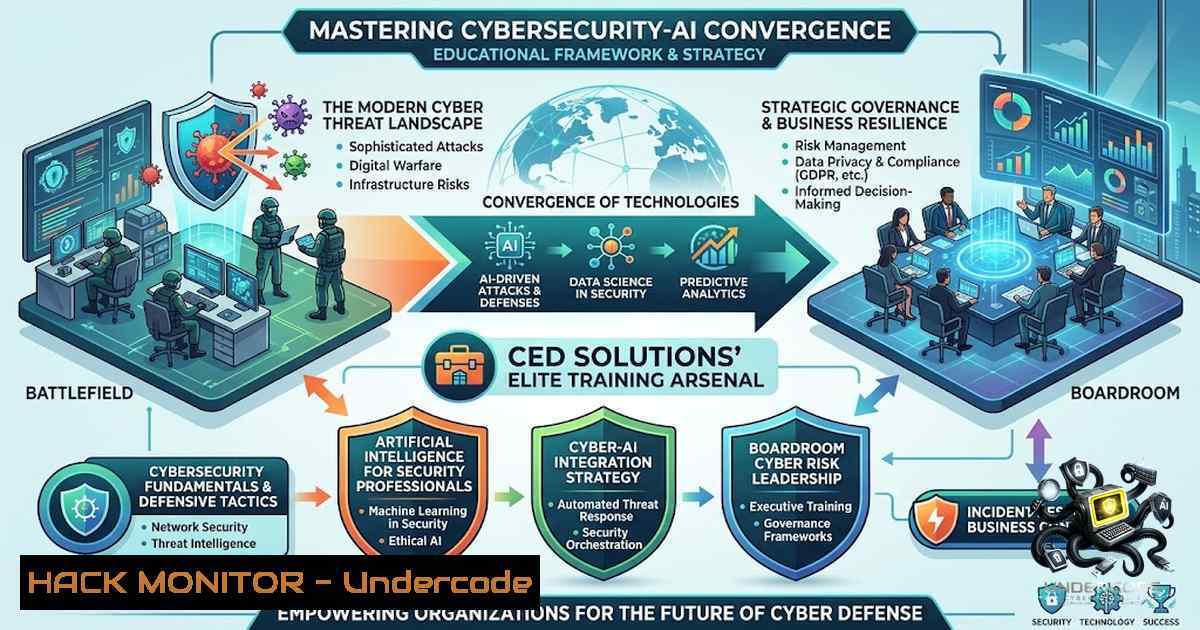
The modern digital battlefield is no longer fought with firewalls alone—it demands AI-driven threat intelligence, Zero Trust architecture, and military-grade incident response. As cyber threats evolve from nuisance malware to nation-state espionage, professionals must bridge the gap between traditional IT security and next-generation artificial intelligence. CED Solutions, a veteran-owned training powerhouse with over 27 years of experience and 50,000+ students trained, stands at this crossroads, offering a comprehensive arsenal of certifications that transform IT professionals into cyber warriors.
Learning Objectives:
- Master the core competencies of Certified Ethical Hacking (CEH), CISSP, and CompTIA Security+ to build a rock-solid security foundation.
- Architect and implement Zero Trust security models using Microsoft SC-100 and Azure security frameworks.
- Operationalize AI and machine learning for security analytics, threat hunting, and automated incident response with Microsoft AI-900/AI-102 and CompTIA SecAI+.
- Develop advanced SOC operations skills through Cisco CBRCOR, including playbook automation and SecDevOps methodologies.
- Acquire forensic investigation and incident handling capabilities with EC-Council CHFI and ECIH certifications.
You Should Know:
- The Cyber Range: Hands-On SOC Operations with Cisco CBRCOR
The Cisco CBRCOR (Performing CyberOps Using Cisco Security Technologies) course is the quintessential boot camp for Security Operations Center (SOC) analysts. This 5-day, instructor-led deep dive covers cybersecurity operations fundamentals, automation, and the application of playbooks in incident response.
Step-by-Step Guide: Setting Up a Basic Security Monitoring Lab
To simulate the CBRCOR environment, you can build a home lab using Security Onion or Elastic Stack. Here’s how to initiate network traffic capture and analysis:
- Deploy Security Onion: Download the ISO and install it on a VM (minimum 8GB RAM, 4 vCPUs).
- Configure Network Interfaces: Ensure you have a management interface (e.g.,
eth0) and a monitoring interface (e.g.,eth1) in promiscuous mode.Check interface status ip a Enable promiscuous mode on the monitoring interface sudo ip link set eth1 promisc on
- Start the Elastic Stack: Security Onion uses Elasticsearch, Logstash, and Kibana.
sudo so-elastic-start
sudo so-kibana-start
- Capture Live Traffic: Use `tcpdump` to verify packet capture.
sudo tcpdump -i eth1 -1 -c 100
- Analyze Alerts: Navigate to the Kibana dashboard (https://your-ip:5601) and search for `event.module: zeek` to view network metadata.
This lab mirrors the CBRCOR objective of “detecting cyberattacks, analyzing threats, and making appropriate recommendations to improve cybersecurity”. The course also grants 40 Cisco Continuing Education (CE) credits, making it vital for recertification.
2. Architecting Zero Trust: Microsoft SC-100 Cybersecurity Architect
The Microsoft SC-100 course is an advanced, expert-level certification designed for seasoned security engineers. It focuses on designing and evaluating cybersecurity strategies across Zero Trust, Governance Risk Compliance (GRC), and security operations (SecOps).
Step-by-Step Guide: Implementing a Zero Trust Policy with Azure Conditional Access
Zero Trust principles dictate “never trust, always verify.” Here’s how to enforce this using Azure AD Conditional Access:
- Access Azure Portal: Navigate to `Azure Active Directory` > `Security` >
Conditional Access. - Create a New Policy: Click
+ New policy. - Assign Users: Select specific users or groups to test the policy.
- Define Conditions: Under
Cloud apps or actions, selectAll cloud apps. - Set Grant Controls: Choose `Grant` and select `Require multi-factor authentication` and
Require device to be marked as compliant. - Enable Policy: Set `Enable policy` to `On` and click
Create.
Windows Command to Check Compliance:
 On a Windows 10/11 device, check if the device is Azure AD joined and compliant
dsregcmd /status
Look for `AzureAdJoined : YES` and Compliant : YES. This ensures that only trusted, compliant devices can access corporate resources, a core tenet of the SC-100 curriculum.
- The AI Vanguard: Azure AI Fundamentals and CompTIA SecAI+
Artificial Intelligence is revolutionizing cybersecurity, from predictive analytics to automated threat hunting. CED Solutions offers a dual-track approach: the Microsoft AI-900 (Fundamentals) and AI-102 (Designing AI Solutions) for builders, and the new CompTIA SecAI+ for security practitioners.
Step-by-Step Guide: Building a Threat Intelligence Bot with Azure AI
This tutorial uses Azure AI Services to analyze potentially malicious URLs:
- Create an Azure AI Services Resource: In the Azure portal, create a new `AI Services` resource.
- Deploy a Model: Navigate to `Azure OpenAI` and deploy a model like
gpt-35-turbo. - Write a Python Script: Use the OpenAI SDK to analyze URLs.
import openai
openai.api_key = "YOUR_API_KEY"
openai.api_base = "YOUR_ENDPOINT"</li>
</ol>

def analyze_url(url):
response = openai.ChatCompletion.create(
engine="gpt-35-turbo",
messages=[
{"role": "system", "content": "You are a cybersecurity analyst. Analyze if this URL is potentially malicious."},
{"role": "user", "content": url}
]
)
return response['choices'][bash]['message']['content']

print(analyze_url("http://suspicious-domain.com"))
4. Integrate with Security Tools: Use Azure Logic Apps to trigger this script when a new alert is generated in Microsoft Sentinel.
This hands-on approach aligns with the CompTIA SecAI+ objective of using AI tools effectively while understanding ethical considerations. CED Solutions was among the first to offer this 5-day LIVE Virtual course, which includes an Exam Pass Guarantee.
- Fortifying the Cloud: Azure Security and Hybrid Administration
With organizations rapidly migrating to the cloud, securing Azure infrastructure is paramount. CED Solutions provides targeted training for the Microsoft Certified: Azure Security Engineer Associate and the Windows Server Hybrid Administrator Associate.
Step-by-Step Guide: Hardening an Azure VM with Just-in-Time (JIT) Access
JIT access reduces the attack surface by allowing RDP/SSH only when needed:
- Navigate to Defender for Cloud: In the Azure portal, go to
Microsoft Defender for Cloud. - Select Workload Protections: Click on
Just-in-time VM access. - Enable JIT on a VM: Select your virtual machine and click
Enable JIT. - Configure Ports: Set the allowed ports (e.g., 3389 for RDP) and the maximum allowed time (e.g., 4 hours).
- Request Access: When you need to connect, request access via the portal, specifying your IP address and duration.
Linux Command to Verify Open Ports:
 Scan for open ports on the VM to ensure only JIT-opened ports are accessible
sudo nmap -sS -p- -Pn <VM_IP>
This practice ensures that management ports are not persistently exposed, a critical security control covered in Azure security courses.
- The Offensive Mindset: Ethical Hacking and Penetration Testing
Understanding the attacker’s mindset is crucial for defense. CED Solutions offers the Certified Ethical Hacker (CEH) and CompTIA PenTest+ certifications, providing hands-on experience with exploitation techniques.
Step-by-Step Guide: Performing a Basic Network Scan with Nmap
Nmap is a staple tool for ethical hackers. Here’s how to use it to discover live hosts and open ports:
- Install Nmap: On Linux, use
sudo apt-get install nmap. On Windows, download from the official site. - Discover Live Hosts: Perform a ping sweep to find active devices.
nmap -sn 192.168.1.0/24
- Scan for Open Ports: Conduct a TCP SYN scan on a specific target.
sudo nmap -sS -p- -T4 <target_ip>
- Identify Services: Use version detection to identify running services and their versions.
sudo nmap -sV -p 80,443 <target_ip>
- Generate a Report: Use the `-oA` flag to save the output in all formats (normal, XML, grepable).
This reconnaissance phase is the first step in any penetration test, teaching students how to identify vulnerabilities before malicious actors do.
6. Forensic Readiness: Computer Hacking Forensic Investigator (CHFI)
In the aftermath of a breach, digital forensics is essential for understanding the attack vector and gathering evidence. The CHFI course covers the entire forensic investigation process, from data acquisition to reporting.
Step-by-Step Guide: Acquiring a Disk Image with `dd`
Creating a forensic image is a critical skill. Here’s how to do it in Linux:
- Identify the Source Drive: Use `lsblk` to list all block devices.
lsblk
- Create a Bit-for-Bit Copy: Use `dd` to copy the source drive to an image file.
sudo dd if=/dev/sdb of=./evidence.dd bs=4096 conv=noerror,sync
- Verify the Image: Calculate the hash of the image to ensure integrity.
sha256sum evidence.dd
4. Mount the Image for Analysis (Read-Only):
sudo mkdir /mnt/forensic
sudo mount -o loop,ro evidence.dd /mnt/forensic
This process ensures that evidence is preserved without alteration, a fundamental principle of computer forensics taught in the CHFI course.
- Incident Response in Action: EC-Council Certified Incident Handler (ECIH)
When a security incident occurs, a structured response is vital. The ECIH certification teaches the lifecycle of incident response, from preparation to post-incident activities.
Step-by-Step Guide: Creating an Incident Response Playbook
A playbook automates and standardizes the response to common threats. Here’s a template for a ransomware playbook:
1. Preparation: Ensure backups are available and offline.
- Identification: Detect the ransomware via endpoint alerts (e.g., file encryption events).
- Containment: Immediately isolate the infected system from the network.
– Windows Command:
 Disable network adapter
Disable-1etAdapter -1ame "Ethernet" -Confirm:$false
– Linux Command:
 Bring down the network interface
sudo ifconfig eth0 down
4. Eradication: Reimage the system from a known good backup.
5. Recovery: Restore data from backups and verify system integrity.
6. Lessons Learned: Conduct a post-mortem to improve security posture.This structured approach aligns with the CBRCOR objective of leveraging playbooks in formulating an Incident Response (IR).
What Undercode Say:
- Certification is the New Currency: In a field where experience is king, certifications like CISSP, CEH, and the new SecAI+ serve as verifiable proof of competency. CED Solutions’ “Exam Pass Guarantee” reduces the risk of investment, making certification more accessible.
- AI is Not a Silver Bullet, But a Force Multiplier: The integration of AI into cybersecurity (SecAI+) is not about replacing human analysts but augmenting their capabilities. The ability to write a Python script that leverages Azure OpenAI to triage alerts is becoming as fundamental as knowing how to use Nmap. The real value lies in understanding the “why” behind the AI’s decisions, ensuring responsible and ethical use.
Prediction:
- +1 The demand for professionals holding the CompTIA SecAI+ certification will skyrocket by 2027, as enterprises scramble to operationalize generative AI securely. CED Solutions’ early mover advantage positions its graduates at the forefront of this lucrative niche.
- +1 Zero Trust architecture will transition from a buzzword to a regulatory requirement, making the Microsoft SC-100 and similar architect-level certifications mandatory for senior cloud security roles within the next 18 months.
- -1 The rapid proliferation of AI-driven attack tools will outpace the current workforce’s defensive capabilities, creating a critical skills gap that only intensive, hands-on training programs (like those offered by CED Solutions) can bridge. Organizations that fail to upskill their SOC teams will face catastrophic breaches.
▶️ Related Video (80% Match):
🎯Let’s Practice For Free:
🎓 Live Courses & Certifications:
Join Undercode Academy for Verified Certifications
🚀 Request a Custom Project:
Secure, high-velocity infrastructure and disruptive technological engineering. Contact our engineering team for high-tier development and proprietary systems:
[email protected]
💎 Smart Architecture | 🛡️ Secure by Design | ⭐ Trusted by ThousandsIT/Security Reporter URL:
Reported By: Richardrrodgers The – Hackers Feeds
Extra Hub: Undercode MoN
Basic Verification: Pass ✅🔐JOIN OUR CYBER WORLD [ CVE News • HackMonitor • UndercodeNews ]
📢 Follow UndercodeTesting & Stay Tuned:


