Listen to this Post
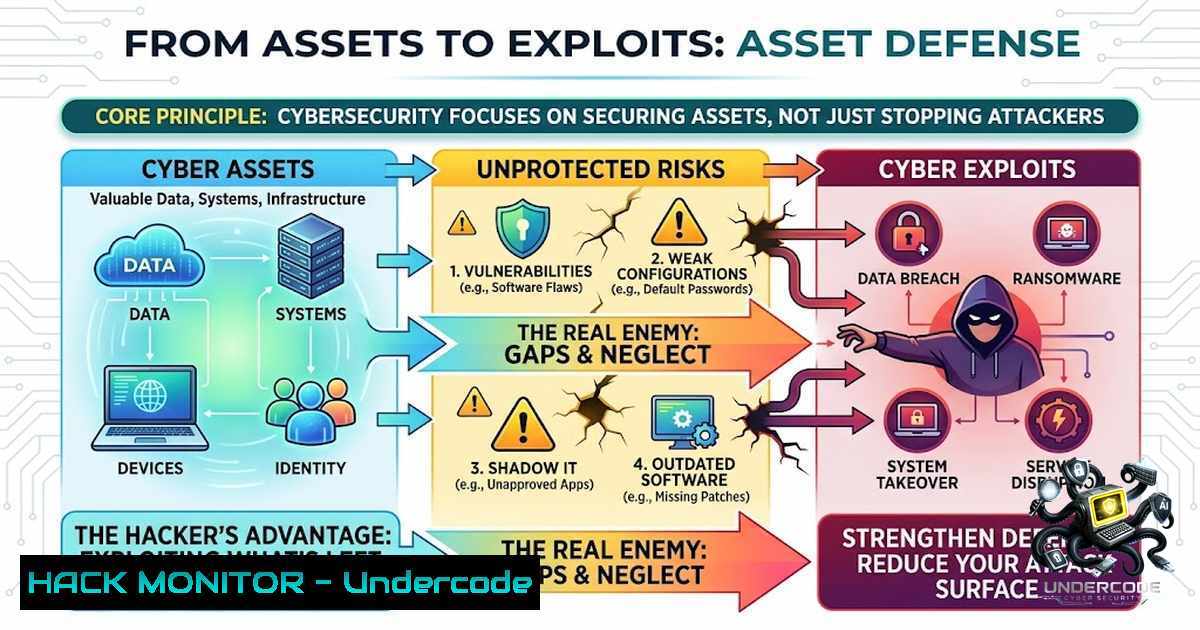
Introduction:
The cybersecurity industry often frames its narrative around the clash between attackers and defenders, focusing on malware signatures and intrusion detection. However, this perspective misses the foundational truth of risk management: security begins not with the threat, but with the asset. By shifting focus from the “how” of an attack to the “what” that is being protected, professionals can align technical controls with business value, transforming reactive defense into proactive risk mitigation.
Learning Objectives:
- Understand the “Asset-First” security model and its application in organizational risk assessments.
- Identify common vulnerability classes and their exploitability using open-source intelligence (OSINT) tools.
- Implement asset discovery and vulnerability scanning techniques across Linux and Windows environments.
- Develop a practical threat modeling methodology to prioritize remediation efforts based on business impact.
You Should Know:
- Understanding the Asset Lifecycle and Attack Surface Mapping
Before deploying firewalls or EDR solutions, an organization must understand what it owns. This process, known as Asset Management, is the bedrock of the NIST Cybersecurity Framework (Identify function). An asset isn’t just a server; it includes data (PII, financial records), hardware (IoT devices, workstations), software (custom APIs, third-party libraries), and intangible assets (brand reputation, intellectual property).
The challenge lies in the “Shadow IT” phenomenon, where developers deploy cloud resources without central oversight. To combat this, security teams must adopt continuous discovery. A practical approach involves leveraging the Security Information and Event Management (SIEM) system and network sniffing to build a live inventory.
Step-by-step guide for Asset Discovery in Linux:
- Nmap Scanning: Identify live hosts on your network.
sudo nmap -sn 192.168.1.0/24
- Service Enumeration: Determine running services and versions.
sudo nmap -sV -p- 192.168.1.100
- API Endpoint Discovery: Use tools like `ffuf` to brute-force hidden directories on web servers.
ffuf -u http://target/FUZZ -w /usr/share/wordlists/dirb/common.txt
Step-by-step guide for Asset Discovery in Windows (PowerShell):
Get-ADComputer -Filter  | Select-Object Name, OperatingSystem
Get-Service | Where-Object {$_.Status -eq "Running"}
- The Anatomy of a Vulnerability: Beyond the CVE Score
A vulnerability is a weakness in an asset that a threat can exploit. While Common Vulnerabilities and Exposures (CVE) scores (CVSS) are useful, they often lack context. A critical vulnerability in a development server is less dangerous than a medium vulnerability in a publicly facing authentication API handling production data.
Understanding the “Exploitability” factor requires analyzing the attack vector, complexity, and privilege level required. For example, the Log4Shell vulnerability (CVE-2021-44228) allowed unauthenticated remote code execution (RCE). The threat was high because the asset (Java logging libraries) was ubiquitous.
Step-by-step guide for Vulnerability Analysis (Manual):
- Identify Banner: Use `curl -I http://target` to see server headers.
- Version Check: Compare the version against the NVD (National Vulnerability Database).
- Proof of Concept (PoC): Ethically, test simple payloads.
Example for SQL Injection test
curl "http://target/login.php?user=' OR '1'='1' -- -"
- Mitigation: If vulnerable, apply the patch or implement a Web Application Firewall (WAF) rule.
3. Threat Modeling: The STRIDE Framework
Threat modeling is the process of identifying potential threats to assets. Microsoft’s STRIDE framework categorizes threats into six areas:
– Spoofing (Impersonating a user/service).
– Tampering (Modifying data).
– Repudiation (Denying actions).
– Information Disclosure (Data leakage).
– Denial of Service (Resource exhaustion).
– Elevation of Privilege (Gaining unauthorized access).
Applying this to the “Customer Database” asset mentioned in the original post:
– Threat: An attacker uses leaked credentials to spoof a legitimate user (Spoofing).
– Countermeasure: Implement Multi-Factor Authentication (MFA) and adaptive access controls.
Step-by-step guide to conduct a Threat Model (Using OWASP Threat Dragon):
1. Draw Data Flow Diagram (DFD): Map the flow of data from the user to the database.
2. Identify Trust Boundaries: Where does data move from trusted to untrusted (e.g., web server to internet)?
3. Apply STRIDE: For each element, list applicable threats.
4. Document Mitigations: Use a spreadsheet to track status.
- Risk Calculation: Likelihood and Impact (Quantitative vs. Qualitative)
Risk is the intersection of threat, vulnerability, and impact. The formula is: Risk = Threat x Vulnerability x Impact.
– Qualitative: Uses scales (High/Medium/Low) based on expert judgment.
– Quantitative: Uses monetary values (e.g., Single Loss Expectancy – SLE).
To secure a critical asset, a security engineer must ask: “If this server goes down, how much revenue do we lose per hour?” This data determines if you spend $10,000 or $100,000 on redundancy.
Practical Example for Risk Mitigation:
If a vulnerability has a CVSS score of 7.5 (High) but the asset is isolated in a sandbox with no sensitive data, the risk is low. Conversely, a CVSS 4.3 (Medium) vulnerability in a public-facing “Password Reset” endpoint might present high risk due to the data it protects.
Step-by-step guide for Risk Prioritization (DREAD Model):
- Damage Potential: How bad is the damage?
- Reproducibility: How easy is it to replicate the attack?
- Exploitability: How easy is it to launch?
- Affected Users: How many users are impacted?
- Discoverability: How easy is it to find?
Score each from 1-10. Total > 30 indicates “Critical”.
5. Cloud Hardening and API Security Essentials
Modern assets are rarely on-premises; they reside in the cloud (AWS, Azure, GCP). The shared responsibility model dictates that the cloud provider secures the cloud, while the customer secures their assets in the cloud.
Common misconfigurations include open S3 buckets (Data Leakage) and overly permissive Identity and Access Management (IAM) roles (Elevation of Privilege).
Commands for Cloud Auditing (AWS CLI):
- Check S3 Buckets:
aws s3api get-bucket-acl --bucket my-bucket
- Check IAM Policies:
aws iam get-account-authorization-details --filter Role
- List Unencrypted Buckets:
aws s3api get-bucket-encryption --bucket my-bucket
For API Security, ensure you validate JSON Web Tokens (JWTs) strictly. Implement rate limiting to prevent DDoS.
Windows Command for Network Security (Check Open Ports):
netstat -an | findstr LISTENING
6. The Human Element: Security Awareness and Training
The original post highlights that employees are assets. They are also the most significant vulnerability (Social Engineering). Technical controls (EDR, Firewalls) are useless if an employee willingly gives away credentials via phishing.
Mitigation Strategies:
- Simulated Phishing Campaigns: Use tools like GoPhish to test employees.
- Zero Trust Architecture: Never trust, always verify. Require device health checks before granting access.
- Privileged Access Management (PAM): Restrict admin rights. Users should only have the minimum privileges required to do their jobs.
What Undercode Say:
- Key Takeaway 1: Security is fundamentally a business risk management problem. Understanding the value of an asset (customer trust, IP) determines how much you should spend to protect it.
- Key Takeaway 2: Technical skills (tool proficiency) are secondary to analytical thinking. Understanding why a decision is made about risk is more critical than knowing how to run a vulnerability scan.
Analysis:
The student’s journey reflects a maturation from “tool operator” to “risk analyst.” The misconception that “vulnerabilities are the hacker’s fault” ignores the reality that most breaches exploit misconfigurations and poor asset management. By focusing on assets, the student is aligning with frameworks like MITRE ATT&CK and NIST. The emphasis on “informed decisions” suggests a move towards GRC (Governance, Risk, and Compliance), which is a high-level engineering domain. The industry needs more professionals who can translate technical risk into business language to secure budget. The ability to prioritize threats based on “what matters most” is the difference between a security admin and a security architect. This proactive mindset is crucial in a landscape where 90% of attacks are financially motivated and targeting the path of least resistance.
Prediction:
- +1: The shift towards asset-centric security will drive increased demand for Cloud Security Posture Management (CSPM) tools, automating the discovery of unknown assets and reducing the mean time to detect (MTTD) misconfigurations.
- +1: Professionals with a dual focus on compliance (GDPR, HIPAA) and technical implementation will see a 20% increase in hiring demand, as organizations prioritize data governance alongside defense.
- -1: As assets become more distributed (hybrid, multi-cloud), the attack surface expands geometrically, potentially outpacing the ability of manual security teams to manage risk effectively, leading to a surge in insurance premiums for companies with poor asset inventories.
- -1: Reliance on CVSS scores alone without business context will lead to “alert fatigue” and the misallocation of resources, leaving medium-risk but high-impact business logic flaws open to exploitation.
▶️ Related Video (78% Match):
🎯Let’s Practice For Free:
🎓 Live Courses & Certifications:
Join Undercode Academy for Verified Certifications
🚀 Request a Custom Project:
Secure, high-velocity infrastructure and disruptive technological engineering. Contact our engineering team for high-tier development and proprietary systems:
[email protected]
💎 Smart Architecture | 🛡️ Secure by Design | ⭐ Trusted by Thousands
IT/Security Reporter URL:
Reported By: Chisimdi Onyeakaruru – Hackers Feeds
Extra Hub: Undercode MoN
Basic Verification: Pass ✅


