
Listen to this Post
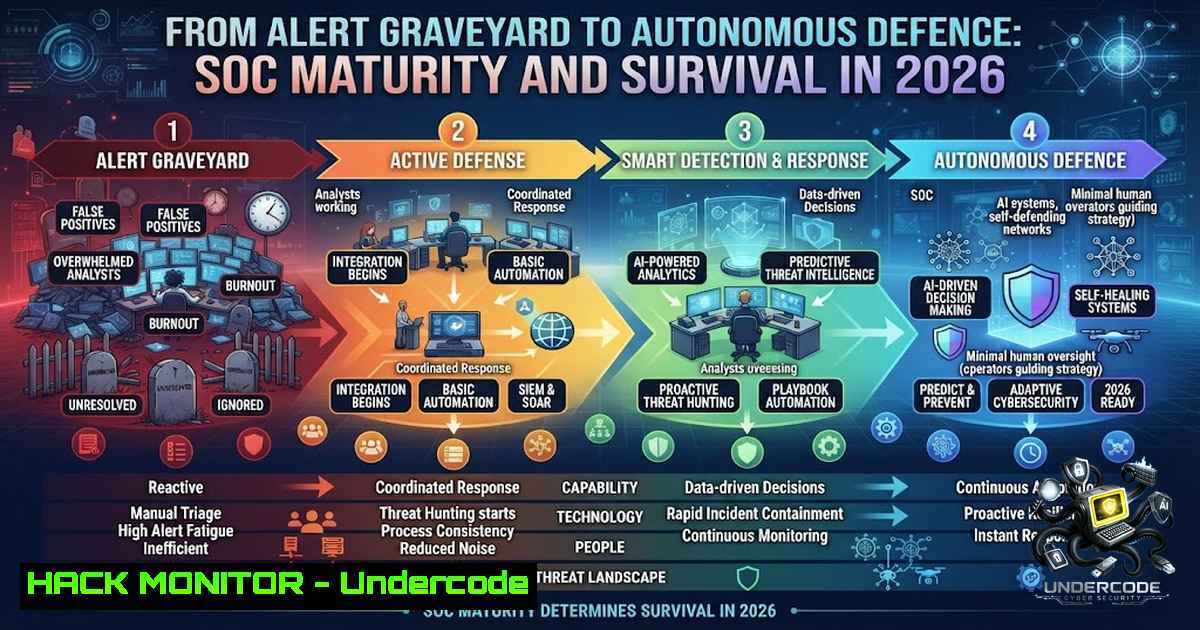
Introduction:
The Security Operations Center (SOC) is no longer a “nice-to-have” back-office function; it is the central nervous system of modern digital defence. Yet, as KHIPU Networks and Palo Alto Networks prepare to host an executive roundtable on 30 July 2026, the fundamental question remains: where does your organisation sit on the SOC maturity curve, and how do you navigate the journey from reactive chaos to proactive, AI-driven resilience? With adversaries now launching attacks up to 100 times faster using agentic AI, and security teams drowning in an average of 4,484 alerts per day, the old playbook of manual triage and siloed tools is not just inefficient—it is a liability.
Learning Objectives:
- Understand the five-stage SOC maturity model and objectively assess your organisation’s current posture.
- Learn how to leverage AI and automation to reduce Mean Time to Respond (MTTR) and eliminate alert fatigue.
- Develop a practical, phased roadmap for transforming your SOC from reactive monitoring to predictive, autonomous defence.
- The Five Stages of SOC Maturity: Where Do You Stand?
Most maturity models define a clear progression from ad-hoc chaos to optimised, intelligence-driven operations. Understanding these stages is the first step in any transformation journey.
- Level 0 – Manual Operations: Analysts manually triage alerts without the support of SIEM, SOAR, or XDR tools. Responses are ad-hoc, and threat intelligence is virtually non-existent.
- Level 1 – Rule-Based Defence: Organisations implement basic rule-based solutions like UEBA to prioritise threats through risk scoring. However, the SOC remains largely reactive, fighting fires as they occur.
- Level 2 – DIY AI Integration: AI is introduced into workflows to enhance threat hunting and log correlation. This frees up analyst time but often involves bespoke, difficult-to-maintain models.
- Level 3 – Commercial AI Platforms: Advanced SOCs leverage platforms like Cortex XSIAM to automate triage and accelerate response. However, these pre-trained models are limited to what they have been taught to recognise.
- Level 4 – The Autonomous SOC (AGI): The holy grail—where the SOC autonomously identifies advanced attack patterns, ingests vast threat data, and reasons through complex scenarios without human intervention.
Step‑by‑Step Guide to Assessing Your SOC Maturity:
- Audit Your Tool Stack: List all security tools (SIEM, EDR, NDR, SOAR). Identify integration gaps and data silos.
- Measure Alert Fatigue: Calculate your average daily alert volume and the percentage of false positives. If your team spends more than 3 hours daily on manual triage, you are likely stuck at Level 0 or 1.
- Evaluate Response Times: Track your Mean Time to Detect (MTTD) and Mean Time to Respond (MTTR). Mature SOCs measure these in minutes, not hours or days.
- Test Your Data Quality: Run a “data completeness” check. Are your firewalls, cloud workloads, and endpoints all feeding into a single pane of glass? If not, you have visibility gaps.
2. The AI Imperative: Automating the Triage Nightmare
In 2026, 94% of organisations are using AI in at least one SOC function, but only 37% have adopted it widely. The gap between early adopters and laggards is widening. AI is not just about speed; it is about sanity. SOC teams are unable to deal with 67% of daily alerts, with 83% reporting that alerts are false positives.
Step‑by‑Step Guide to Implementing AI-Powered Triage:
- Consolidate Telemetry: Move all security data into an AI-ready data lake. Platforms like Cortex XSIAM unify data from firewalls, endpoints, identity, and cloud environments.
- Deploy Agentic AI for Investigation: Use AI agents that can autonomously investigate alerts. For example, an agent can cluster phishing campaigns by language and intent, not just malicious links.
- Automate Context Enrichment: Ensure your AI tools can load business context (e.g., which systems are critical, which users have elevated access) to rank alerts accurately.
- Set Human-in-the-Loop Guardrails: Define which actions the AI can take autonomously (e.g., quarantining a known malicious file) and which require human approval (e.g., terminating a privileged user session).
Relevant Commands (Linux/Windows for SOC Analysts):
- Linux (Log Analysis): `grep -E “Failed password|Accepted password” /var/log/auth.log | awk ‘{print $1,$2,$3,$9,$11}’ | sort | uniq -c | sort -1r` – Quickly identify brute-force attempts.
- Windows (PowerShell – Event Log Triage): `Get-WinEvent -FilterHashtable @{LogName=’Security’; ID=4625} -MaxEvents 50 | Format-List TimeCreated, Message` – Pull the last 50 failed login events.
- Network (PCAP Analysis): `tshark -r capture.pcap -Y “http.request” -T fields -e ip.src -e http.host -e http.request.uri` – Extract HTTP requests from a pcap to identify suspicious outbound connections.
3. Platformization: Killing the Tool Sprawl
One of the biggest challenges highlighted by KHIPU Networks is the “fragmented security stack”. Managing disparate tools leads to visibility gaps, increased operational overhead, and slower response times. The solution is “platformization”—consolidating detection, automation, and analytics into a single platform like Palo Alto Networks Cortex.
Step‑by‑Step Guide to Platform Consolidation:
- Identify Redundancies: Map out all your security tools. If you have three different tools doing log aggregation, it is time to consolidate.
- Prioritise a Single Pane of Glass: Choose a platform that provides unified visibility across network, cloud, and endpoints. This eliminates the need for analysts to hop between consoles.
- Leverage Managed Services: If you lack in-house expertise, consider a managed SOC like KHIPU’s 24x7x365 Managed Defence, which leverages the Cortex platform to reduce incident response times from hours to minutes.
- Measure Cost Savings: According to a Forrester TEI study, Cortex XSIAM customers achieve a 257% ROI and 73% cost savings compared to traditional approaches.
4. Securing the Dissolving Perimeter with SASE
The traditional perimeter is dead. With hybrid workforces, VPNs are no longer sufficient. KHIPU and Palo Alto Networks advocate for Zero Trust Access via Prisma Access (SASE) to provide consistent, high-performance security for every user.
Step‑by‑Step Guide to SASE Deployment:
- Assess Your Remote Access: Identify all users, devices, and applications accessing your network from outside the corporate firewall.
- Implement Zero Trust Principles: Adopt a “never trust, always verify” model. Authenticate and authorise based on identity and context, not just network location.
- Deploy a SASE Architecture: Converge network security (SWG, CASB, FWaaS) and WAN capabilities into a single cloud-delivered service.
- Monitor Continuously: Use AI to detect anomalies in user behaviour, such as impossible travel or unusual data exfiltration patterns.
Relevant Commands (Cloud & Network Hardening):
- Azure CLI (Check for Publicly Exposed Storage): `az storage account list –query “[?allowBlobPublicAccess == ‘true’]”` – Identify storage accounts with public blob access enabled.
- AWS CLI (S3 Bucket Permissions): `aws s3api get-bucket-acl –bucket
` – Review bucket permissions to ensure they are not publicly writable. - Linux (Firewall Hardening): `sudo iptables -A INPUT -p tcp –dport 22 -m conntrack –ctstate NEW -m recent –set` – Use `recent` module to limit SSH brute-force attempts.
5. Building the Agentic Workforce
Palo Alto Networks’ Cortex AgentiX is revolutionising automation by providing prebuilt AI agents that can dynamically plan, reason, and execute solutions just as an expert would. This is not about replacing analysts; it is about augmenting them to handle higher-value work.
Step‑by‑Step Guide to Deploying Agentic AI:
- Start with a Pilot: Deploy an AI agent for a specific, high-volume task (e.g., phishing email triage or alert prioritisation).
- Train on Your Data: Ensure the AI is trained on your specific environment and threat landscape.
- Define Escalation Paths: Create clear workflows for when the AI hands off to a human analyst.
- Monitor Performance: Track how many alerts the AI resolves autonomously versus those escalated. Aim for a steady increase in autonomous resolution rates.
6. Incident Response Automation: From Hours to Minutes
The ultimate goal of SOC transformation is to achieve “operational velocity”—the ability to respond to threats at machine speed. This requires moving beyond static playbooks to dynamic, AI-driven response.
Step‑by‑Step Guide to Automating Incident Response:
- Map Your Most Common Incidents: Identify the top 5 types of alerts (e.g., malware detections, phishing, privilege escalation).
- Build Automated Playbooks: For each alert type, define a playbook that includes containment (e.g., isolating an endpoint), investigation (e.g., collecting forensic data), and remediation (e.g., killing a process).
- Integrate with SOAR: Use a SOAR platform to execute these playbooks automatically.
- Test and Refine: Regularly test your playbooks through tabletop exercises and purple teaming.
Relevant Commands (Incident Response):
- Linux (Isolate an Endpoint via iptables): `sudo iptables -A OUTPUT -d
-j DROP` – Block outbound traffic to a known malicious IP. - Windows (PowerShell – Kill Malicious Process): `Get-Process -1ame
| Stop-Process -Force` – Force-stop a suspicious process. - Windows (Disable User Account): `Disable-ADAccount -Identity
` – Immediately disable a compromised Active Directory account.
What Undercode Say:
- Key Takeaway 1: SOC maturity is not a linear “fix it and forget it” project; it is a continuous journey that requires regular reassessment of people, processes, and technology.
- Key Takeaway 2: The adoption of agentic AI is no longer optional. Organisations that fail to automate triage and response will be overwhelmed by the sheer volume and velocity of modern attacks.
Analysis:
The KHIPU Networks and Palo Alto Networks roundtable on 30 July 2026 underscores a critical industry shift: the move from reactive security to predictive, autonomous defence. The conversation is timely, as 2026 has seen exploitation windows collapse to an estimated -7 days (meaning exploitation often occurs before a patch is even released). This reality forces security leaders to abandon the “we’ll get to it later” mindset. The partnership between KHIPU (a Diamond Innovator Partner) and Palo Alto Networks represents a powerful confluence of managed service expertise and cutting-edge AI platform capabilities. For CISOs, the key takeaway is clear: invest in platformization and AI now, or risk being outpaced by adversaries who are already using AI to automate their attacks at scale.
Prediction:
- +1 The convergence of AI-driven SOC platforms and managed detection and response (MDR) services will democratise elite-level security, allowing mid-market organisations to achieve protection previously reserved for Fortune 500 enterprises.
- +1 By 2027, autonomous SOCs will handle over 80% of alert triage and initial response, reducing the average SOC analyst workload by 50% and allowing teams to focus on strategic threat hunting and proactive defence.
- -1 Organisations that delay their SOC transformation and remain at Maturity Level 0 or 1 will experience a 300% increase in breach-related costs by 2028, as they lack the velocity to counter AI-generated attacks.
- -1 The shortage of skilled security analysts will worsen before it improves, but AI augmentation will create a new tier of “AI-enabled analysts” who can do the work of three traditional analysts, widening the gap between early adopters and laggards.
- +1 The “agentic workforce” model—where AI agents collaborate with human analysts—will become the new industry standard, fundamentally redefining SOC career paths and training requirements.
▶️ Related Video (76% Match):
🎯Let’s Practice For Free:
🎓 Live Courses & Certifications:
Join Undercode Academy for Verified Certifications
🚀 Request a Custom Project:
Secure, high-velocity infrastructure and disruptive technological engineering. Contact our engineering team for high-tier development and proprietary systems:
[email protected]
💎 Smart Architecture | 🛡️ Secure by Design | ⭐ Trusted by Thousands
IT/Security Reporter URL:
Reported By: Cybersecurity Soc – Hackers Feeds
Extra Hub: Undercode MoN
Basic Verification: Pass ✅


