Listen to this Post
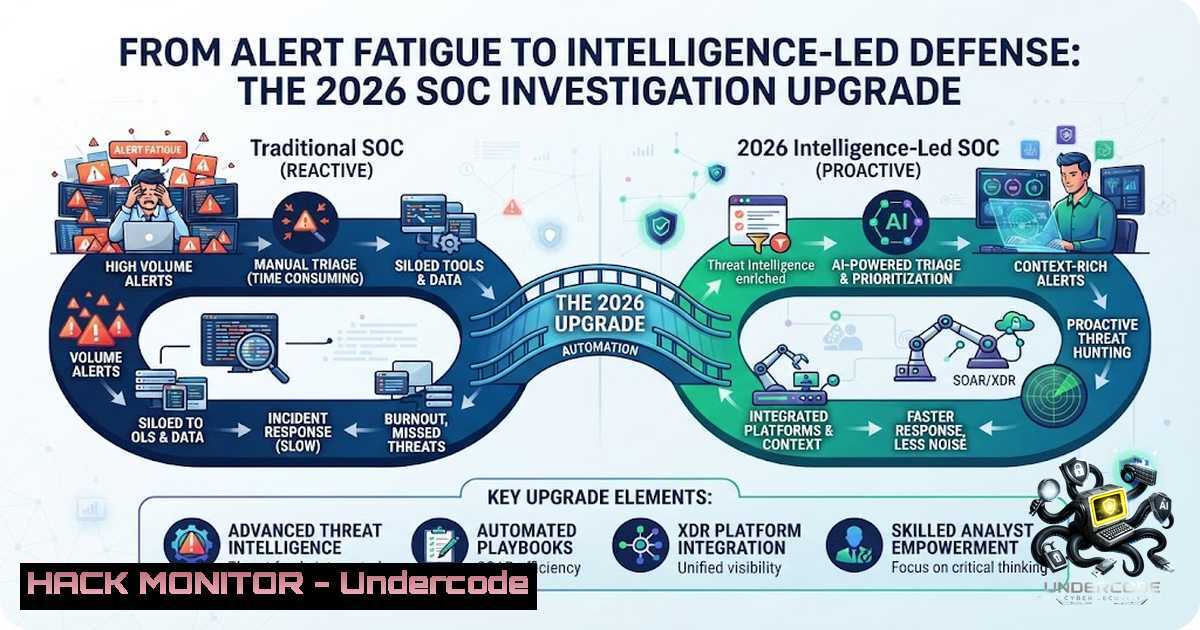
Introduction:
The modern Security Operations Center (SOC) faces an impossible paradox: alert volumes are exploding while analyst headcount remains stagnant. Traditional SOCs operate as reactive machines—processing alerts, investigating anomalies, and responding to what they find, all with limited context about who is behind the activity or what they are trying to accomplish. The shift from standard to mature SOC operations isn’t about buying more tools; it’s about embedding actionable threat intelligence as the central nervous system of every investigation, transforming the SOC from a reactive monitoring unit into an intelligence-driven defense capability.
Learning Objectives:
- Master the transition from alert-centric triage to intelligence-led decision-making across SOC workflows
- Implement automated threat intelligence enrichment to reduce mean time to triage (MTTT) and investigation
- Deploy practical Linux, Windows, and cloud hardening commands used in mature SOC environments
- Operationalize threat intelligence platforms (TIPs) with SIEM/SOAR integrations for contextual investigations
- Understanding the Maturity Gap: Why Standard SOC Investigations Fall Short
A security operations center without integrated threat intelligence is fundamentally a reactive machine. It processes alerts at volume, under time pressure, with limited context about adversary intent. The gap between standard and mature SOC operations is not a technology gap—it is a knowledge gap.
In standard SOC models, analysts receive raw alerts stripped of adversary context. An alert arrives with an IP address and nothing else—forcing the analyst to manually pivot between six different tools to assemble basic intelligence. This context-switching tax consumes the majority of investigation time. Mature SOCs, by contrast, deliver enriched alerts that carry adversary attribution, campaign association, and confidence scoring before the analyst ever opens the case.
The problem is compounded by alert severity labels that rarely indicate true risk. According to Intezer’s recent analysis, security alert severity labels reflect tool-specific opinions generated in isolation. When security teams focus only on high and critical alerts, they implicitly accept unquantified risk in lower-severity alerts where real threats can still reside. This is why mature SOCs adopt an “investigate everything” approach—turning assumed risk into evidenced risk and exposing detection gaps.
Step-by-Step: Assessing Your SOC Maturity Level
- Audit your alert triage process – Calculate the average time from alert generation to initial triage. If it exceeds 15 minutes, context enrichment is likely missing.
- Map your intelligence sources – List all threat intelligence feeds, TIPs, and enrichment tools. Identify which are integrated vs. siloed.
- Measure context availability – For a random sample of 100 alerts, determine what percentage include adversary attribution, campaign context, or asset criticality.
- Calculate the context-switching tax – Track how many tools an analyst must access to resolve a single alert. Mature SOCs aim for one unified view.
-
Operationalizing Threat Intelligence: From Data Feeds to Decision Engines
Threat intelligence works best when it is built into Security Operations. At higher maturity levels (levels three to five in most SOC capability models), TI becomes deeply embedded in daily workflows—informing detection engineering, threat hunting, and incident response.
The transformation requires moving beyond simple indicator ingestion. Raw security alerts and indicators often lack meaning on their own—they are just data points. Threat intelligence adds the extra details analysts need: why, who, and what is behind an alert. For example, a suspicious IP becomes far more valuable when TI reveals its geolocation, associated malware families, C2 or botnet cluster membership, and links to past campaigns. A malware alert tied to a known APT is no longer “just another alert”—it could be the start of an adversary’s campaign.
Step-by-Step: Integrating Threat Intelligence into SOC Workflows
- Deploy automated alert enrichment – Configure SOAR playbooks to query your TIP for every associated indicator and populate cases with adversary context, campaign association, and confidence levels before the analyst opens the alert.
- Enable bidirectional indicator management – Push high-confidence indicators from the TIP to SIEM detection rules, firewall blocklists, and EDR policies automatically, retiring stale indicators on a cadence that maintains detection currency.
- Embed adversary profiles in case management – Ensure analysts can access adversary TTP profiles directly within the investigation environment, guiding scope decisions with knowledge of which lateral movement techniques and persistence mechanisms specific adversaries favor.
- Align detection engineering with intelligence – Prioritize detection coverage of techniques identified through TI, translating attacker tactics into SIEM correlation rules and analytics.
3. Linux Command Line Toolkit for SOC Investigations
Mature SOC analysts must be proficient with command-line investigation tools. The following commands represent the essential toolkit for Linux-based threat hunting and incident response.
Log Analysis and System Monitoring
 View real-time system logs with filtering
tail -f /var/log/syslog | grep -i "failed|error|unauthorized"

Search authentication logs for brute force patterns
grep "Failed password" /var/log/auth.log | awk '{print $9}' | sort | uniq -c | sort -1r

Examine recent sudo usage (potential privilege escalation)
grep "sudo" /var/log/auth.log | tail -50

Check for unusual cron jobs (persistence mechanism)
cat /etc/crontab && ls -la /etc/cron.
Process and Network Investigation
 Enumerate all running processes in hierarchical view
ps -eFH  Identifies suspicious parent-child relationships

List network connections with process details
ss -tulpn | grep LISTEN

Find processes listening on non-standard ports
ss -tulpn | awk '{print $4}' | cut -d: -f2 | sort -1 | uniq

Check for hidden processes (common rootkit technique)
ps -ef | awk '{print $2}' | sort -1 | uniq -d
File Integrity and Malware Discovery
 Find recently modified files (potential indicator of compromise)
find / -type f -mtime -1 -ls 2>/dev/null

Check for suspicious SUID binaries
find / -perm -4000 -type f 2>/dev/null

Generate file hashes for integrity verification
sha256sum /etc/passwd /etc/shadow /etc/sudoers
Threat Intelligence Enrichment from the Terminal
 Query VirusTotal for IOC enrichment (requires API key)
curl --request GET --url "https://www.virustotal.com/api/v3/ip_addresses/{IP_ADDRESS}" \
--header "x-apikey: YOUR_API_KEY"

Perform WHOIS lookup for domain IOCs
whois suspicious-domain.com
These commands are drawn from SOC Linux Command cheat sheets used in professional security operations. Mastery of grep, awk, and sed enables analysts to scrutinize various log types, detect suspicious activities, and uncover potential weak points.
4. Windows PowerShell Commands for SOC Analysts
Windows environments require a different investigative approach. PowerShell provides the native toolkit for Windows log analysis, process investigation, and incident response.
Windows Event Log Analysis
 Query Security Event Log for failed logins (Event ID 4625)
Get-WinEvent -FilterHashtable @{LogName='Security'; ID=4625} -MaxEvents 100 |
Format-Table TimeCreated, Message -AutoSize

Investigate account lockouts (Event ID 4740)
Get-WinEvent -FilterHashtable @{LogName='Security'; ID=4740} -MaxEvents 50

Check for suspicious service installations (Event ID 4697)
Get-WinEvent -FilterHashtable @{LogName='Security'; ID=4697} -MaxEvents 50

PowerShell log analysis for encoded commands (common evasion)
Get-WinEvent -FilterHashtable @{LogName='Microsoft-Windows-PowerShell/Operational'; ID=4104} |
Where-Object {$<em>.Message -match "-e" -or $</em>.Message -match "EncodedCommand"}
Process and Persistence Investigation
 List all running processes with full details
Get-Process | Select-Object Name, CPU, WorkingSet, StartTime | Sort-Object CPU -Descending

Find processes running from suspicious directories
Get-Process | Where-Object {$_.Path -match "Temp|Users|Downloads|AppData"}

Check scheduled tasks for persistence
Get-ScheduledTask | Where-Object {$_.State -1e "Disabled"}

Examine Windows Registry run keys
Get-ChildItem "HKLM:\SOFTWARE\Microsoft\Windows\CurrentVersion\Run"
Get-ChildItem "HKCU:\SOFTWARE\Microsoft\Windows\CurrentVersion\Run"
Network and File Triage
 Display active network connections
Get-1etTCPConnection | Where-Object {$_.State -eq "Established"}

Find recently modified files
Get-ChildItem -Path C:\ -Recurse -File | Where-Object {$_.LastWriteTime -gt (Get-Date).AddDays(-1)}

Calculate file hashes for IOC comparison
Get-FileHash -Path "C:\Windows\System32\drivers\etc\hosts" -Algorithm SHA256
PowerShell commands like these cover approximately 90% of what SOC analysts perform during triage, investigation, and response. They enable rapid identification of suspicious parent-child relationships, encoded commands, and processes running from suspicious directories.
5. Cloud Security Hardening for Intelligence-Led SOCs
Modern SOC investigations increasingly span cloud environments. In 2026, the bar is runtime proof—cloud security controls must show what is enforced, where it drifted, and whether the fix actually landed. AWS, Azure, and GCP secure the platform, but your team still owns IAM, configuration, workload hardening, logging, data exposure, and remediation.
AWS Security Hardening Commands (AWS CLI)
 Audit IAM users with unused access keys (potential dormant credentials)
aws iam list-users --query 'Users[].UserName' | while read user; do
aws iam list-access-keys --user-1ame $user --query 'AccessKeyMetadata[?Status==<code>Active</code>]'
done

Check security groups for overly permissive rules
aws ec2 describe-security-groups --filters Name=ip-permission.cidr,Values='0.0.0.0/0' \
--query 'SecurityGroups[].{GroupName:GroupName,Ports:IpPermissions[].FromPort}'

Enable CloudTrail for all regions
aws cloudtrail create-trail --1ame SOC-Audit-Trail --s3-bucket-1ame your-audit-bucket \
--is-multi-region-trail --enable-log-file-validation

List unencrypted S3 buckets
aws s3api list-buckets --query 'Buckets[].Name' | while read bucket; do
aws s3api get-bucket-encryption --bucket $bucket 2>/dev/null || echo "$bucket: UNENCRYPTED"
done
Azure Security Checks (Azure CLI)
 Check for storage accounts with public access
az storage account list --query "[?allowBlobPublicAccess == 'true'].name"

Audit network security groups for open RDP/SSH
az network nsg list --query "[].{Name:name, Rules:securityRules[?contains(destinationPortRange, '3389') || contains(destinationPortRange, '22')]}"

Enable Defender for Cloud on all subscriptions
az security pricing create --1ame VirtualMachines --tier Standard
GCP Security Commands (gcloud)
 List all service accounts and their keys
gcloud iam service-accounts list --format='table(email,disabled)'
gcloud iam service-accounts keys list --iam-account=YOUR_SA_EMAIL

Check for publicly accessible Cloud Storage buckets
gsutil ls -p YOUR_PROJECT | while read bucket; do
gsutil iam get $bucket | grep -i "allUsers|allAuthenticatedUsers"
done
6. API Security Hardening for Modern SOCs
APIs represent a critical attack surface that mature SOCs must monitor. NIST has published comprehensive guidelines for secure RESTful API deployment, covering everything from authentication to input validation.
API Security Hardening Checklist
- Authentication and Identity Management – Implement OAuth2/OIDC with proper scope validation
- Authorization and Access Control – Prevent BOLA (Broken Object Level Authorization) vulnerabilities through proper object-level permission checks
- Input Validation – Validate all payloads against strict schemas to prevent injection attacks
- Transport Layer Protection – Enforce TLS 1.2+ with proper certificate validation
- Rate Limiting – Implement graduated rate limiting to prevent brute force and DoS attacks
- Logging and Monitoring – Log all API access with sufficient detail for forensic investigation
API Investigation Commands
 Test for BOLA vulnerability
curl -X GET "https://api.example.com/users/123" -H "Authorization: Bearer $TOKEN"

Check API response headers for security misconfigurations
curl -I "https://api.example.com/endpoint"

Monitor API rate limit headers
curl -v "https://api.example.com/endpoint" 2>&1 | grep -i "rate|limit|remaining"
7. Vulnerability Exploitation and Mitigation in 2026
The vulnerability landscape has shifted dramatically. In 2025 alone, 48,185 CVEs were published—a 263% increase. Attackers are exploiting known and zero-day vulnerabilities faster than many teams can respond. Proofpoint has already identified 12 actively exploited 2026 CVEs.
Prioritization Framework for Mature SOCs
- CISA KEV Catalog – Vulnerabilities with evidence of real-world exploitation must be patched within three days
- EPSS Probability – Use Exploit Prediction Scoring System to prioritize based on likelihood of exploitation
- Business Context – Factor in asset criticality, internet exposure, and data sensitivity
- Runtime Intelligence – Most vulnerabilities will never be exploited; use runtime context to focus on what matters
Practical Mitigation Commands
 Linux: Check for vulnerable packages (Debian/Ubuntu)
apt list --upgradable | grep -i security

Linux: Check for vulnerable packages (RHEL/CentOS)
yum list updates --security

Windows: Check installed patches
Get-HotFix | Sort-Object InstalledOn -Descending | Select-Object -First 20

Windows: Check for missing security updates
Get-WindowsUpdate -Category "Security" -1otInstalled
What Undercode Say:
- Key Takeaway 1: The shift from standard to mature SOC operations is fundamentally about closing the knowledge gap, not the technology gap. Organizations that embed threat intelligence as the central nervous system of SOC decisions see faster triage, more accurate prioritization, and reduced analyst burnout.
-
Key Takeaway 2: Context is the ultimate differentiator in modern security operations. Alerts without adversary context, asset criticality, and business impact are just noise. Mature SOCs automate enrichment so analysts spend time on investigation, not data gathering.
Analysis: The SOC evolution from alert factory to decision engine is accelerating in 2026. AI-driven investigation engines now perform contextual, hypothesis-driven investigation across multiple telemetry sources—work traditionally dependent on experienced L2 or L3 analysts. This capability changes the operating model, not just its speed. Organizations that fail to upgrade their SOC investigations risk being overwhelmed by alert volume while missing sophisticated, multi-signal attacks that consume the most analyst time. The technical commands and hardening practices outlined above represent the operational foundation upon which intelligence-led SOCs are built—without these fundamentals, even the best threat intelligence cannot be operationalized effectively.
Prediction:
- +1 Intelligence-led SOC operations will become the baseline standard for enterprise security by 2028, driven by AI-powered investigation engines that investigate every alert rather than a sampled few.
-
+1 Automated threat intelligence enrichment will reduce mean time to triage by 60-70% in mature SOCs, freeing analysts to focus on threat hunting and proactive defense rather than manual correlation.
-
-1 Organizations that maintain standard, alert-centric SOC models will face increasing breach costs. IBM’s 2025 data shows AI and automation users saved $1.9 million per breach compared to those without—the gap will widen as attack complexity increases.
-
-1 The shortage of skilled SOC analysts will intensify as AI-driven attacks compress the window between exposure and exploitation. Organizations must invest in both technology and continuous training (SANS SEC450, EC-Council CCSA) to close the capability gap.
-
+1 Cloud-1ative SOC architectures with integrated TIP-SIEM-SOAR pipelines will become the dominant deployment model by 2027, replacing legacy on-premises solutions.
▶️ Related Video (76% Match):
https://www.youtube.com/watch?v=1HetJDdvrvQ
🎯Let’s Practice For Free:
🎓 Live Courses & Certifications:
Join Undercode Academy for Verified Certifications
🚀 Request a Custom Project:
Secure, high-velocity infrastructure and disruptive technological engineering. Contact our engineering team for high-tier development and proprietary systems:
[email protected]
💎 Smart Architecture | 🛡️ Secure by Design | ⭐ Trusted by Thousands
IT/Security Reporter URL:
Reported By: %F0%9D%97%A8%F0%9D%97%BD%F0%9D%97%B4%F0%9D%97%BF%F0%9D%97%AE%F0%9D%97%B1%F0%9D%97%B2 %F0%9D%98%86%F0%9D%97%BC%F0%9D%98%82%F0%9D%97%BF – Hackers Feeds
Extra Hub: Undercode MoN
Basic Verification: Pass ✅


