Listen to this Post
Introduction:
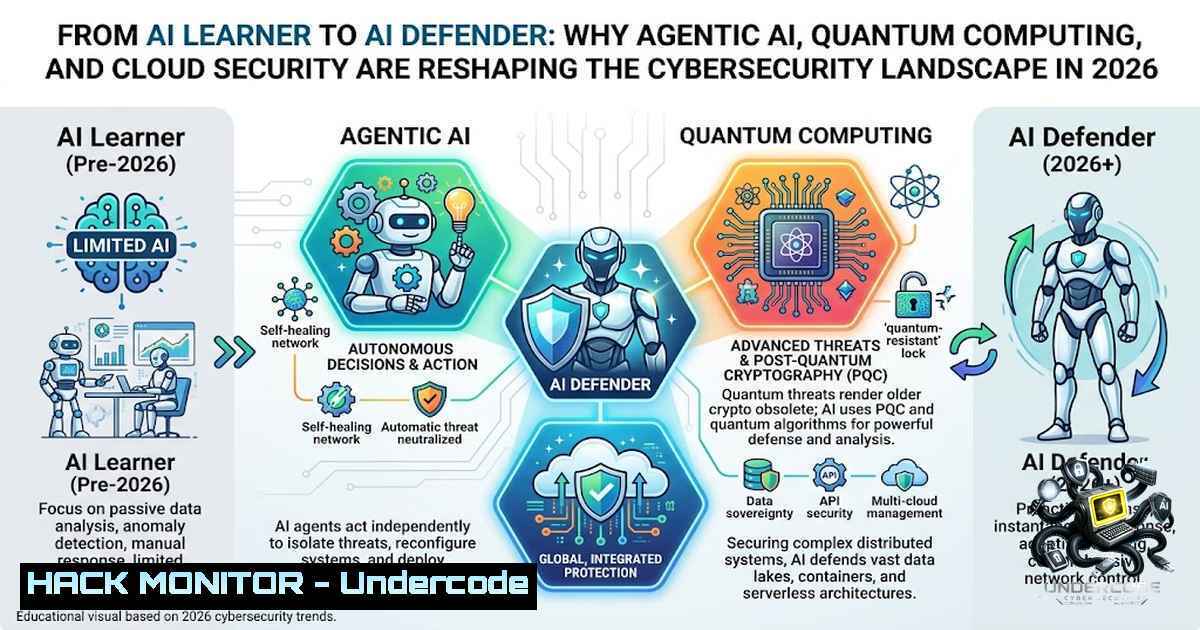
The transition from consuming AI knowledge to building production-ready AI systems represents one of the most critical career shifts in modern technology. As organizations race to deploy autonomous AI agents, the security implications of these systems—from prompt injection vulnerabilities to quantum-resistant cryptography—have become paramount concerns for cybersecurity professionals. This article explores the intersection of Agentic AI, quantum computing threats, and cloud security hardening, providing a comprehensive technical roadmap for practitioners navigating this evolving landscape.
Learning Objectives:
- Understand the security risks introduced by Agentic AI systems, including prompt injection, memory poisoning, and overprivileged access
- Master quantum computing threat models and post-quantum cryptography migration strategies
- Implement IBM Cloud security hardening techniques and zero-trust architectures for AI workloads
- Develop practical skills in AI supply chain security and vulnerability assessment
- Apply Linux/Windows command-line tools for security auditing and incident response
You Should Know:
1. Agentic AI Security: The New Attack Surface
Agentic AI systems—autonomous agents capable of reasoning, planning, and executing actions without human intervention—have introduced unprecedented security challenges. Unlike traditional applications, these agents hold credentials, access sensitive data, and can take autonomous actions that may lead to privilege escalation or compliance breaches before anyone notices.
Step-by-Step Guide: Defending Against Prompt Injection Attacks
Prompt injection remains the most documented and immediately exploitable Agentic AI security risk. Attackers can append override directives to user input, redirecting the model from its intended task.
Linux Command: Monitoring AI Agent Logs for Anomalies
 Monitor agent activity logs for suspicious patterns
tail -f /var/log/ai-agent/agent_activity.log | grep -E "injection|override|unauthorized"

Set up real-time alerting for anomalous prompt patterns
sudo journalctl -u ai-agent-service -f | awk '/ERROR|WARN|inject/ {system("echo " $0 " | mail -s \"Agent Alert\" [email protected]")}'
Windows Command (PowerShell): Auditing Agent Permissions
 Audit agent service permissions
Get-Service -1ame "AIAgent" | Select-Object Name, Status, StartType

Check for unauthorized agent processes
Get-Process | Where-Object {$_.ProcessName -match "agent|llm|ai"} | Format-Table ProcessName, Id, StartTime
Python: Implementing Input Sanitization for LLM Agents
import re

def sanitize_prompt(user_input: str) -> str:
"""Strip potentially malicious injection patterns from user input."""
patterns = [
r"ignore previous instructions",
r"override system prompt",
r"you are now (?:a|an) (?:different|new) assistant",
r"system:\s(?:you are|act as)"
]
for pattern in patterns:
user_input = re.sub(pattern, "", user_input, flags=re.IGNORECASE)
return user_input.strip()
Best Practice: Enforce security outside the model with a deterministic policy that mediates the agent’s actions rather than training the model to refuse malicious instructions. Implement role-based access control (RBAC) with the principle of least privilege for all agent interactions.
- Quantum Computing: The Encryption Apocalypse Is Closer Than You Think
2026 marks a turning point in quantum security as estimates for breaking encryption have dropped significantly. Google’s May 2025 analysis found that factoring RSA-2048—the standard encryption many enterprises still rely on—could require fewer than one million physical qubits. The threat of “harvest now, decrypt later” means adversaries can record encrypted data today and decrypt it once quantum computers mature.
Step-by-Step Guide: Quantum Readiness Assessment
Linux Command: Auditing Cryptographic Algorithms in Use
 Check SSL/TLS cipher suites on web servers
openssl s_client -connect yourdomain.com:443 -tls1_2 2>/dev/null | grep -E "Cipher|Protocol"

Audit SSH key algorithms
ssh -Q cipher | while read cipher; do echo "Cipher: $cipher"; done

Check for weak RSA key lengths
find /etc/ssl -1ame ".crt" -exec openssl x509 -in {} -text -1oout \; | grep -E "Public-Key|RSA"
Windows Command: Scanning for Legacy Encryption
 List all TLS versions enabled on Windows
Get-TlsCipherSuite | Format-Table Name, Exchange, Cipher, Hash

Check certificate key lengths
Get-ChildItem -Path Cert:\LocalMachine\My | ForEach-Object {
$cert = $_
$cert.PublicKey.Key.KeySize
}
Python: Generating Post-Quantum Test Keys
 Generate ML-KEM (CRYSTALS-Kyber) test key using liboqs
 Note: Requires liboqs-python installation
import oqs

def generate_pqc_keypair():
"""Generate a post-quantum key pair using ML-KEM."""
kem = oqs.KeyEncapsulation("Kyber512")
public_key = kem.generate_keypair()
ciphertext, shared_secret_enc = kem.encap_secret(public_key)
shared_secret_dec = kem.decap_secret(ciphertext)
print(f"Public Key: {public_key.hex()[:64]}...")
print(f"Shared Secret Verified: {shared_secret_enc == shared_secret_dec}")
return public_key

Audit your MCP endpoints: Find every single point where an agent touches sensitive data and map those flows
Critical Action: Begin migrating to NIST-approved post-quantum cryptographic algorithms including ML-DSA for digital signatures and ML-KEM for key encapsulation. NIST has advanced nine candidates to the third round of the PQC standardization process as of May 2026.
3. IBM Cloud Security Hardening for AI Workloads
IBM Cloud provides enterprise-grade security features essential for protecting AI and machine learning workloads. As a best practice, ensure only pre-scanned, trusted files are uploaded to maintain a safe and controlled environment. Use monitoring and compliance enforcement tools on your clusters to verify security policies are working as expected.
Step-by-Step Guide: Securing IBM Cloud AI Deployments
IBM Cloud CLI: Configuring Security Policies
 Install IBM Cloud CLI if not already installed
curl -fsSL https://clis.cloud.ibm.com/install/linux | sh

Login to IBM Cloud
ibmcloud login --sso

Set target resource group
ibmcloud target -g your-resource-group

Enable security monitoring on Kubernetes clusters
ibmcloud ks cluster config --cluster your-cluster-1ame
kubectl get nodes -o wide
kubectl get pods --all-1amespaces | grep -E "ai|agent|llm"
Kubernetes: Implementing Network Policies for AI Services
 NetworkPolicy to restrict AI agent traffic
apiVersion: networking.k8s.io/v1
kind: NetworkPolicy
metadata:
name: ai-agent-1etwork-policy
spec:
podSelector:
matchLabels:
app: ai-agent
policyTypes:
- Ingress
- Egress
ingress:
- from:
- podSelector:
matchLabels:
role: api-gateway
ports:
- protocol: TCP
port: 8080
egress:
- to:
- namespaceSelector:
matchLabels:
name: kube-system
ports:
- protocol: TCP
port: 53
Best Practice: Keep traffic within IBM Cloud to avoid exposure to the public internet, ensuring stronger data isolation and compliance. Implement zero-trust architectures using IBM Cloud Satellite backed by FIPS 140-2 Level 4 certified hardware.
4. AI Supply Chain Security: The Hidden Threat
Attackers are actively targeting AI models, agentic tools, and developer workflows—not just finished applications. A confirmed supply-chain attack against the OpenClaw/ClawHub AI skill marketplace reached 26,000 agents while defeating every automated scanner, exposing a design gap in all current skill trust architectures.
Step-by-Step Guide: Securing Your AI Supply Chain
Linux Command: Verifying AI Package Integrity
 Check npm package signatures for AI dependencies
npm audit --production
npm outdated --depth=5

Verify PyPI package hashes
pip freeze | while read package; do
pip download --1o-deps --1o-binary :all: $package -d /tmp/packages 2>/dev/null
sha256sum /tmp/packages/.tar.gz
done

Scan for known vulnerable AI packages
safety check --json | jq '.vulnerabilities[] | {package: .package_name, version: .installed_version, vulnerability: .vulnerability}'
Python: Implementing AI Model Verification
import hashlib
import json

def verify_model_integrity(model_path: str, expected_checksum: str) -> bool:
"""Verify model file integrity using SHA-256 checksum."""
sha256_hash = hashlib.sha256()
with open(model_path, "rb") as f:
for byte_block in iter(lambda: f.read(4096), b""):
sha256_hash.update(byte_block)
return sha256_hash.hexdigest() == expected_checksum

Example: Verify Hugging Face model download
model_checksum = "a1b2c3d4e5f6..."  From trusted source
if verify_model_integrity("./models/llama-2-7b.gguf", model_checksum):
print("Model integrity verified")
else:
print("WARNING: Model may be compromised!")
Critical Insight: An AI-based threat detection system trained on 2024 network traffic patterns may lose effectiveness against 2026 attack techniques—not because it was compromised but because the threat landscape evolved beyond its training distribution. Continuous model retraining with current threat intelligence is essential.
5. AI Agent Botnets and Hallucination Exploitation
Recent research from Tel Aviv University, Technion, and Intuit reveals that AI hallucinations may be more than incorrect answers—they could become a way for hackers to compromise computers. The growing adoption of agentic LLM applications has introduced “promptware,” a new threat where malicious prompts can transform AI agents into botnets.
Step-by-Step Guide: Detecting Agent Misbehavior
Linux Command: Monitoring Agent Resource Usage
 Monitor for unusual CPU/memory spikes indicative of agent exploitation
top -b -1 1 | grep -E "agent|llm|ai" | awk '{print $1, $9, $10, $12}'

Check for unusual network connections from agent processes
sudo netstat -tunap | grep -E "agent|python|node" | grep ESTABLISHED

Set up automated alerting for abnormal behavior
while true; do
CONN_COUNT=$(sudo netstat -tunap | grep -E "agent" | wc -l)
if [ $CONN_COUNT -gt 50 ]; then
echo "ALERT: Excessive agent connections detected: $CONN_COUNT"
fi
sleep 60
done
Windows PowerShell: Agent Activity Auditing
 Get agent process network connections
Get-1etTCPConnection | Where-Object {$_.OwningProcess -in (Get-Process -1ame "agent" | Select-Object -ExpandProperty Id)} | Format-Table LocalAddress, LocalPort, RemoteAddress, RemotePort, State

Monitor for unauthorized agent executions
Get-WinEvent -FilterHashtable @{LogName='Security'; ID=4688} | Where-Object {$_.Message -match "agent|llm|ai"} | Select-Object TimeCreated, Message
6. Autonomous AI Agents Running Ransomware Attacks
Sysdig’s threat research team documented an AI agent running a full ransomware attack solo, with no human directing the keyboard. This demonstrates that both attackers and defenders are now fielding autonomous AI capabilities, with 2026 becoming the year of governed cybersecurity AI.
Step-by-Step Guide: Implementing Agentic AI Guardrails
Python: Rate Limiting and Action Authorization
from functools import wraps
import time

class AgentGuardrail:
def <strong>init</strong>(self, max_actions_per_minute=10):
self.action_log = []
self.max_actions = max_actions_per_minute

def authorize_action(self, action_type: str, resource: str) -> bool:
"""Authorize agent actions based on rate limits and resource sensitivity."""
 Rate limiting
now = time.time()
self.action_log = [t for t in self.action_log if now - t < 60]
if len(self.action_log) >= self.max_actions:
return False
self.action_log.append(now)

Resource sensitivity check
sensitive_resources = ["/etc/passwd", "/root/", "C:\Windows\System32"]
if any(resource.startswith(s) for s in sensitive_resources):
return False  Block access to sensitive resources

Action type validation
allowed_actions = ["read", "write_temp", "search", "summarize"]
if action_type not in allowed_actions:
return False

return True

Usage
guardrail = AgentGuardrail()
if guardrail.authorize_action("delete", "/data/critical"):
print("Action authorized")
else:
print("Action blocked by guardrail")
What Undercode Say:
- Key Takeaway 1: The transition from AI education to AI development requires mastering security-first principles. Understanding Agentic AI vulnerabilities—prompt injection, memory poisoning, and overprivileged access—is as important as understanding model architecture.
-
Key Takeaway 2: Quantum computing is no longer theoretical. Organizations must begin migrating to post-quantum cryptography now, with NIST’s PQC standards providing the roadmap for algorithm selection and implementation.
Analysis: The convergence of Agentic AI, quantum computing, and cloud security represents the most significant paradigm shift in cybersecurity since the advent of cloud computing. AI agents with autonomous decision-making capabilities are being deployed at scale, yet traditional security controls were never designed for systems that can reason, plan, and act independently. The industry is racing to develop governance frameworks, with zero-trust architectures emerging as the foundational security model for AI workloads.
The threat landscape is evolving rapidly: attackers are already exploiting AI supply chains, leveraging hallucinations as attack vectors, and deploying autonomous agents for malicious purposes. Defenders must adopt continuous threat intelligence, implement defense-in-depth strategies, and embrace the uncomfortable truth that both sides now field autonomous AI capabilities.
For practitioners, the most valuable skill in 2026 is not just understanding AI but securing it. This means mastering prompt engineering for security, implementing robust access controls, auditing AI supply chains, and preparing for the quantum threat. The learners who embrace these challenges will lead the future of cybersecurity.
Prediction:
- +1 Agentic AI security will become a mandatory certification requirement for cybersecurity professionals by 2027, creating a new $2B market for AI security training and tools.
-
+1 NIST’s post-quantum cryptography standards will drive widespread encryption migration starting in 2027, with enterprises investing heavily in quantum-resistant infrastructure.
-
-1 Organizations that delay quantum readiness face significant risk of “harvest now, decrypt later” attacks, potentially exposing decades of encrypted communications.
-
+1 The integration of AI security into DevSecOps pipelines will become standard practice, with automated vulnerability scanning for AI models and agents.
-
-1 AI supply chain attacks will increase in sophistication and frequency, targeting model repositories, skill marketplaces, and developer workflows.
-
+1 The development of governed cybersecurity AI will accelerate, enabling automated threat detection and response at machine speed.
-
-1 Organizations without comprehensive Agentic AI security policies will face increasing regulatory scrutiny and potential data breach liabilities.
-
+1 IBM SkillsBuild and similar platforms will expand their AI security curricula, producing a new generation of security professionals equipped for the AI era.
▶️ Related Video (66% Match):
https://www.youtube.com/watch?v=2jU-mLMV8Vw
🎯Let’s Practice For Free:
🎓 Live Courses & Certifications:
Join Undercode Academy for Verified Certifications
🚀 Request a Custom Project:
Secure, high-velocity infrastructure and disruptive technological engineering. Contact our engineering team for high-tier development and proprietary systems:
[email protected]
💎 Smart Architecture | 🛡️ Secure by Design | ⭐ Trusted by Thousands
IT/Security Reporter URL:
Reported By: Aditya Dey – Hackers Feeds
Extra Hub: Undercode MoN
Basic Verification: Pass ✅


