Listen to this Post
Introduction:
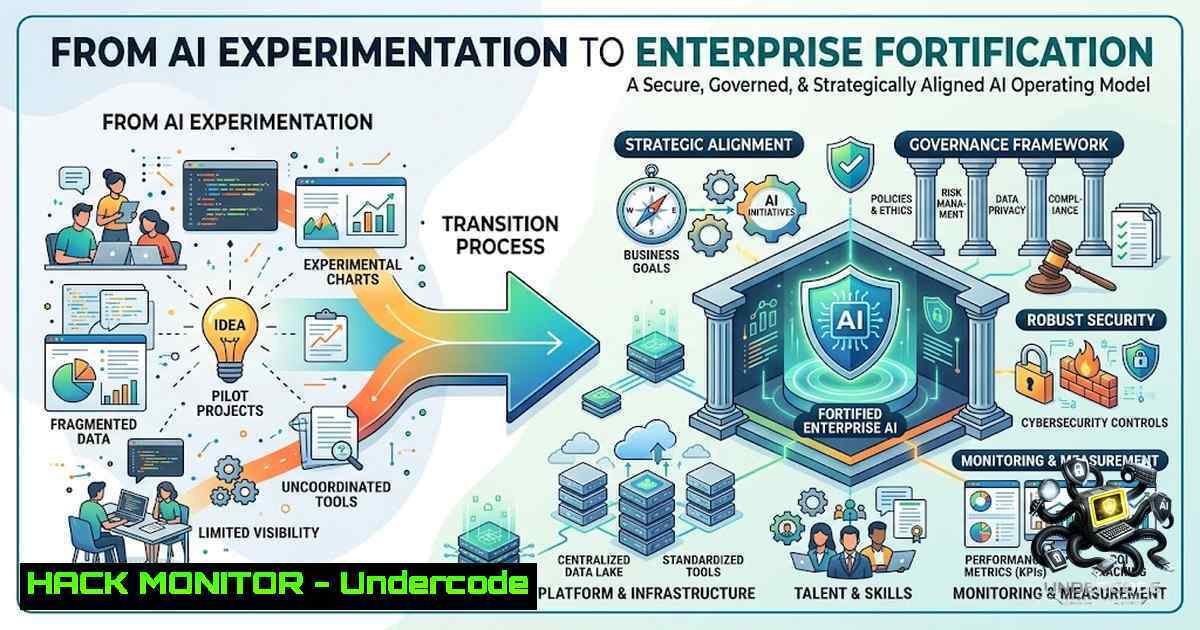
The euphoria surrounding generative AI is rapidly giving way to a sobering reality: isolated pilots and fragmented tool adoption are failing to deliver sustainable business value while simultaneously introducing unprecedented cybersecurity risks. As Mithun Sanghavi, a seasoned CISO with over 28 years of experience, aptly articulates, AI success doesn’t start with technology—it starts with strategy. This principle is the cornerstone of a resilient enterprise AI transformation. This article dissects the five interconnected pillars of a successful AI strategy—Strategy, Plan & Roadmap, Governance, Secure AI, and Managed AI (AIOps)—and provides a technical deep-dive into the practical implementation of these concepts, complete with actionable commands and configurations for security professionals and IT leaders.
Learning Objectives:
- Understand the five pillars of a comprehensive enterprise AI strategy and their interdependencies.
- Learn to identify and mitigate critical AI-specific threats, including prompt injection, model theft, and adversarial attacks.
- Acquire practical skills to implement AI security controls, governance frameworks, and continuous monitoring using Azure-1ative tools and open-source utilities.
- AI Strategy & Use Case Identification: Moving Beyond the Hype
A successful AI transformation begins with a clear-eyed assessment of business problems, not the allure of new technology. The Microsoft Cloud Adoption Framework provides a structured approach, emphasizing that the first step is to “surface meaningful opportunities” by identifying where AI can improve business outcomes.
Step-by-Step Guide to Framing Your AI Strategy:
- Start with Business Problems: Before considering AI, look for areas where the organization needs better results. Focus on “repeated manual effort or slow approvals”. Frame the search in plain terms like “where do results miss expectations”.
- Translate Problems into Use Cases: Convert each business problem into a short statement that names the activity and the expected result. For example, “help support agents answer from internal documents so resolution time drops”.
- Classify the Use Case: Determine how the use case creates value.
– Individual Work: Improves how individuals work inside existing tools (e.g., writing assistance). This aligns strongly with generative AI solutions like Microsoft 365 Copilot.
– Business Automation: Changes how the organization operates (e.g., automated customer routing). This often requires integration with other systems.
4. Consider the AI Type: Assess whether the use case requires a generative (non-deterministic) or nongenerative (deterministic) AI approach. Generative AI fits cases where inputs are unstructured, while nongenerative AI is suitable for tasks that depend on accuracy, such as anomaly detection.
- AI Governance & the NIST AI RMF: Building a Defensible Foundation
Effective governance is the bedrock of responsible AI. The NIST AI Risk Management Framework (AI RMF) has emerged as the de facto governance baseline, with 57–67% of CISOs adopting it by 2026. It is structured around four core functions: Govern, Map, Measure, and Manage. Unlike generic security frameworks, the NIST AI RMF is a governance framework that helps organizations move from accountability and context to evidence, prioritization, and action. This is complemented by the ISO/IEC 42001 standard, which specifies requirements for establishing, implementing, and continually improving an AI management system.
Step-by-Step Guide to Implementing AI Governance:
- Establish an AI Governance Committee: Form a cross-functional team including business leaders, technology teams, cybersecurity, legal, risk, compliance, and data governance.
- Create an AI Policy Framework: Develop policies that address accountability, risk management, ethics, compliance, and lifecycle oversight.
- Map AI Assets: Discover and classify all AI assets within your environment. Use tools like Microsoft Defender for Cloud to find AI workloads and generate an AI Bill of Materials (AI BOM).
- Measure and Manage Risk: Institute regular governance reviews that include risk assessments for AI-driven tools. Apply protective sensitivity labels to data to ensure protection follows the content.
3. Secure AI: Defending Against Emerging Cyber Threats
AI systems introduce a new attack surface that requires dedicated security controls. The Microsoft Cloud Security Benchmark v2 (MCSB v2) introduces a dedicated AI security domain with seven controls addressing platform security, application security, and monitoring. Key threats include:
- Prompt Injection: Attackers craft malicious inputs to manipulate an LLM’s output.
- Model Theft: Adversaries repeatedly query a model’s API to extract its functionality.
- Adversarial Attacks: Maliciously crafted inputs cause models to make errors.
- Data Leakage: Sensitive information is inadvertently exposed through model outputs.
Step-by-Step Guide to Hardening AI Security:
- Implement Input Sanitization and Filtering: Use multi-layered content filtering across input prompts, processing, and outputs. For a practical implementation, consider using structural detectors to catch attacks that don’t survive tokenization, such as chat-template control tokens or base64 payloads.
- Apply Model Weight Encryption: Encrypt all model files at rest using AES-256-GCM with envelope encryption. Use a cloud KMS for key management—never store encryption keys alongside encrypted models.
- Enforce Strict Access Controls: Restrict access to model APIs to authenticated, monitored clients only. Disable key-based access for AI services and enforce role-based access control (RBAC) using Azure Entra ID.
- Deploy Content Safety Guardrails: When deploying a hosted agent using the Azure Developer CLI (
azd), declare a guardrail on the `azure.ai.agent` service in the `azure.yaml` file.
 Example: azure.yaml snippet for adding a content safety guardrail
services:
agent:
project: ./src
host: containerapp
language: python
azure.ai.agent:
rai_config:
rai_policy_name: "strict-content-filter"
- Monitor for Model Extraction: Implement rate limiting, query auditing, and response watermarking to detect and prevent model theft attempts. Deploy detection models that flag query patterns consistent with model extraction attempts.
4. AI Technology Strategy & Secure Deployment Models
Microsoft offers four adoption models that trade customization for simplicity under a shared responsibility approach: ready-to-use Copilots, low-code SaaS development, managed PaaS development, and Azure infrastructure. As you move from the first model to the last, you gain control and give up speed.
Step-by-Step Guide to Selecting and Securing an AI Solution:
1. Evaluate the Four Models:
- Microsoft Copilots (SaaS): Fastest results, least customization. Examples include Microsoft 365 Copilot and role-based Copilots for Security, Sales, Service, and Finance.
- SaaS AI Development (Low-Code): Platforms like Copilot Studio allow business users to create AI assistants with natural language.
- AI on Azure Platforms (PaaS): The starting point for most custom apps. Choose this when low-code can’t give you enough customization. Microsoft manages the platform; you don’t maintain servers.
- AI on Azure Infrastructure: Full control over your own models and runtimes. Choose this when you must bring your own models or meet compliance needs that managed platforms can’t.
2. Assess Four Key Factors for Each Solution:
- Capabilities: Review the capabilities of Microsoft and Azure AI solutions to see if they meet the needs of your use case.
- Data Needed: Confirm the required data exists and is accessible.
- Skills Required: Validate that each use case is achievable with current capabilities.
- Cost: Assess whether the solution fits your budget.
- Apply Network Isolation: For highly sensitive workloads, use Azure Container Apps with serverless GPU support and configure environment/VNet configuration for network isolation.
5. Managed AI (AIOps): Continuous Monitoring and Improvement
AI is not a “set it and forget it” technology. Continuous monitoring of model performance, security, compliance, costs, and business impact is essential for driving continuous improvement. The Azure ecosystem provides a comprehensive suite of tools for this purpose.
Step-by-Step Guide to Establishing AIOps:
- Enable Visibility with Microsoft Defender for Cloud: Use Defender for Cloud to find AI workloads, identify configuration gaps, and enable threat protection for AI services.
- Implement Model-Level Guardrails: Use Microsoft Foundry to introduce model-level guardrails and observability. This includes the ability to monitor and manage the agent lifecycle from development to production.
- Secure Identities and Access: Use Microsoft Entra ID for centralized identity governance, conditional access policies, and multifactor authentication.
- Protect and Govern Data: Use Microsoft Purview to enforce data protection and governance across your AI estate.
- Continuously Evaluate and Optimize: Regularly review AI costs using tools like the Azure pricing calculator. Evaluate and optimize model performance, adjusting parameters and retraining as needed.
What Undercode Say:
- Key Takeaway 1: The most significant barrier to AI success is not technological capability but organizational readiness. Companies that rush to adopt AI without a strategic framework, robust governance, and integrated security controls are not just wasting investment—they are actively creating new cyber-risk vectors.
- Key Takeaway 2: Security must be embedded into the AI lifecycle from the very first use case identification, not bolted on as an afterthought. Leveraging established frameworks like the NIST AI RMF and ISO/IEC 42001, alongside cloud-1ative security tools, provides a defensible and scalable approach to responsible AI innovation.
Prediction:
- -1 The proliferation of Shadow AI—unsanctioned AI tools and models used by employees—will become the next major insider threat vector, outpacing traditional data leakage concerns by 2027.
- +1 The integration of AI-specific security controls into mainstream cloud security benchmarks (like MCSB v2) will rapidly professionalize the field, leading to a new generation of “AI Security Engineers” and standardized certification paths.
- +1 Organizations that successfully implement a comprehensive AI operating model—integrating strategy, governance, security, and operations—will achieve a 30-40% faster time-to-value for their AI investments compared to those relying on isolated pilots.
- -1 The economic pressure to adopt AI will lead to a “race to the bottom” in security for many SMBs, making them prime targets for AI-specific supply chain attacks and model theft.
- +1 The convergence of AI and cybersecurity will create powerful new defensive capabilities, with AI-driven threat detection and response systems becoming the standard for enterprise security operations centers (SOCs) by 2028.
▶️ Related Video (76% Match):
🎯Let’s Practice For Free:
🎓 Live Courses & Certifications:
Join Undercode Academy for Verified Certifications
🚀 Request a Custom Project:
Secure, high-velocity infrastructure and disruptive technological engineering. Contact our engineering team for high-tier development and proprietary systems:
[email protected]
💎 Smart Architecture | 🛡️ Secure by Design | ⭐ Trusted by Thousands
IT/Security Reporter URL:
Reported By: Mithunsanghavi Artificialintelligence – Hackers Feeds
Extra Hub: Undercode MoN
Basic Verification: Pass ✅


