Listen to this Post
Introduction
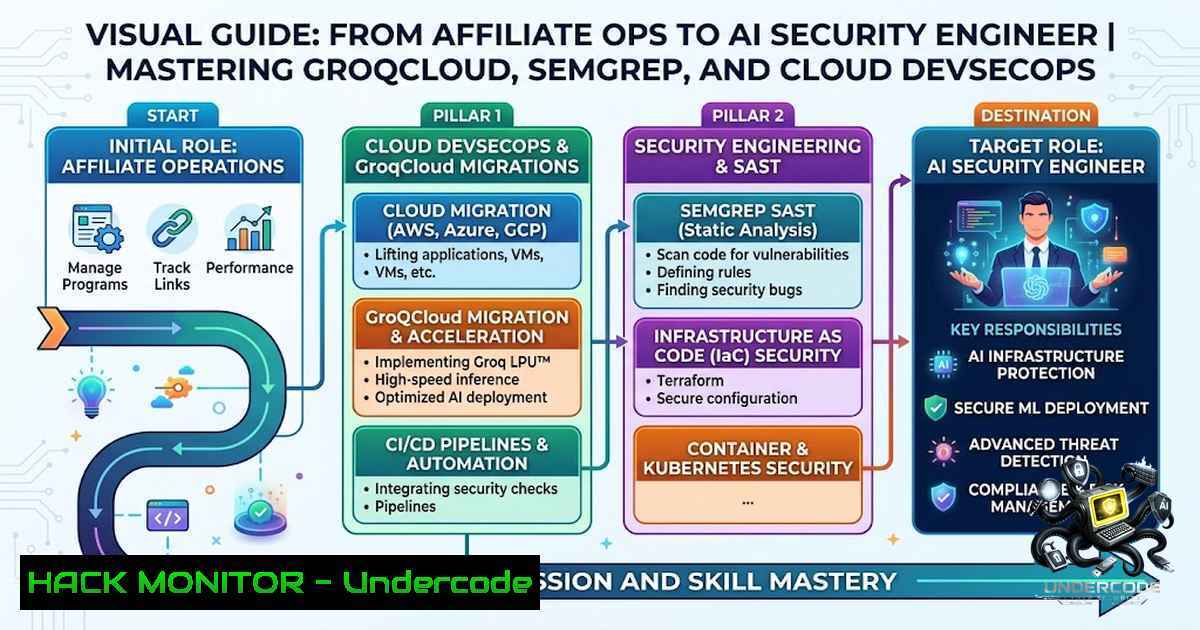
The modern security operations landscape no longer distinguishes between “marketing technology” and “security infrastructure.” When a digital operations specialist manages high-volume affiliate payouts, negotiates commission structures, and simultaneously executes AI model migrations across GroqCloud architectures while hardening GitHub Codespaces with Semgrep static analysis, they are practising a hybrid discipline that forward-thinking organisations desperately need. This article deconstructs the technical stack behind this convergence—GroqCloud’s LPU-accelerated inference, Semgrep’s pattern-based vulnerability detection, and the security implications of cloud development environments—to provide a blueprint for operations professionals seeking to embed security into their technical workflows.
Learning Objectives
- Master GroqCloud API integration and model migration strategies between Llama 4 Scout, Llama 3.1, and GPT-OSS architectures
- Implement Semgrep static application security testing (SAST) in CI/CD pipelines to detect vulnerabilities before deployment
- Harden GitHub Codespaces configurations against supply-chain attacks and credential exfiltration vectors
- Apply defensive security principles to affiliate and payment operations workflows
You Should Know
- GroqCloud API Migration: From Llama to GPT-OSS Architectures
GroqCloud provides ultra-fast inference on open-weight models using custom Language Processing Unit (LPU) silicon, delivering industry-leading tokens-per-second with an OpenAI-compatible interface. The platform supports Llama 4 Scout, Llama 4 Maverick, Llama 3.3 70B, and GPT-OSS 20B/120B models. Migrating workloads from Llama to GPT-OSS requires careful attention to system prompts, context windows, and cost structures—GPT-OSS 120B offers ~25% higher accuracy and ~50% fewer mistakes compared to previous generations, while Llama 4 Scout on Groq runs at roughly $0.11 per million tokens.
Step-by-Step Migration Guide
- Audit existing inference patterns: Document all API calls, system prompts, and expected output formats from your current Llama deployment.
-
Set up GroqCloud API access: Obtain an API key from the GroqCloud console and configure the base URL: `https://api.groq.com/openai/v1`.
3. Test GPT-OSS 120B with a representative payload:
curl -X POST https://api.groq.com/openai/v1/chat/completions \
-H "Authorization: Bearer $GROQ_API_KEY" \
-H "Content-Type: application/json" \
-d '{
"model": "openai/gpt-oss-120b",
"messages": [{"role": "user", "content": "Analyze this affiliate commission structure for fraud indicators"}],
"temperature": 0.3,
"max_tokens": 1024
}'
- Benchmark performance: Compare token-per-second rates (GPT-OSS 120B achieves ~500 tps) and output quality against your Llama baseline.
-
Update system prompts: When migrating from Llama to GPT-OSS, create system prompts that maintain similar behavioural characteristics. Test with edge cases, particularly those involving structured data extraction for payment operations.
-
Implement fallback logic: Deploy a hybrid routing layer that can switch between models based on latency requirements and cost constraints.
2. Hardening GitHub Codespaces Against Supply-Chain Attacks
GitHub Codespaces provides cloud-hosted Visual Studio Code environments backed by Ubuntu containers with built-in GitHub authentication. However, these environments are vulnerable to remote code execution (RCE) through malicious repositories or pull requests, potentially exfiltrating GitHub authentication tokens and Codespaces secrets. Attackers can also inject malicious instructions in GitHub Issues that are automatically processed when launching a Codespace.
Step-by-Step Hardening Guide
- Audit VS Code configuration files: Configuration files (
.devcontainer/devcontainer.json,.vscode/settings.json,.github/codespaces) are automatically executed when a repository or pull request is opened. Review these files for any untrusted or unnecessary automation. -
Restrict repository access: Implement repository rulesets that limit which users and organisations can trigger Codespaces on sensitive repositories.
-
Monitor for credential exposure: Run the following command to detect hardcoded secrets in your Codespaces environment:
 Scan for GitHub tokens and API keys in environment variables
env | grep -E "GITHUB_TOKEN|SECRET|KEY|PASSWORD" --color=always
- Implement least-privilege tokens: Ensure Codespaces sessions use GitHub tokens scoped only to the specific repository, not organisation-wide tokens.
-
Enable audit logging: Configure GitHub Advanced Security to log all Codespace creation events and associated IP addresses.
6. Create a secure devcontainer configuration:
{
"name": "Secure Dev Environment",
"image": "mcr.microsoft.com/devcontainers/base:ubuntu",
"features": {
"ghcr.io/devcontainers/features/security:1": {}
},
"customizations": {
"vscode": {
"extensions": ["semgrep.semgrep"]
}
},
"postCreateCommand": "semgrep --version"
}
3. Implementing Semgrep SAST in CI/CD Pipelines
Semgrep Community Edition (CE) is an open-source static analysis tool that identifies insecure coding patterns and security vulnerabilities in source code. It maps findings to OWASP and CWE frameworks and can be integrated directly into GitHub Actions for automated security scanning.
Step-by-Step CI/CD Integration
1. Install Semgrep locally:
 Install via pipx
pipx install semgrep

Or via uv
uv tool install semgrep

Verify installation
semgrep --version
- Create a test file and run an initial scan:
 Create a vulnerable Python file
echo 'import os; os.system("curl http://malicious.com")' > test.py

Run Semgrep scan
semgrep scan --config auto test.py
- Add Semgrep to GitHub Actions: Create `.github/workflows/semgrep.yml` in your repository:
name: Semgrep Security Scan

on:
push:
branches: [ main, develop ]
pull_request:
branches: [ main ]

jobs:
semgrep-scan:
runs-on: ubuntu-latest
container:
image: semgrep/semgrep:latest
steps:
- name: Checkout code
uses: actions/checkout@v4
- name: Run Semgrep scan
run: semgrep ci --config auto
- Enable diff-aware scanning: Use `semgrep –diff` to scan only modified code in pull requests, reducing noise and focusing on new vulnerabilities.
-
Write custom rules: Create `.semgrep/` directory and define YAML rules for organisation-specific security patterns, such as detecting hardcoded affiliate credentials or payment API keys.
4. Defensive Security for Affiliate and Payment Operations
Digital operations handling high-volume affiliate commissions and payment payouts are prime targets for fraud and credential theft. Applying ethical hacking fundamentals—reconnaissance, vulnerability assessment, and exploitation mitigation—to payment workflows reduces exposure.
Step-by-Step Operational Hardening
- Conduct OSINT on your affiliate exposure: Use tools like `theHarvester` to enumerate email addresses and subdomains associated with your affiliate domains.
theHarvester -d example.com -b google,bing,linkedin
- Audit API authentication: Ensure all payment and affiliate APIs use OAuth 2.0 or API keys with granular scope restrictions, not static passwords.
-
Implement rate limiting: Configure WAF rules to detect and block anomalous API request patterns indicative of credential stuffing or enumeration attacks.
-
Encrypt sensitive data in transit and at rest: Use TLS 1.3 for all API communications and AES-256 for stored commission data.
-
Regularly rotate secrets: Automate rotation of API keys and webhook secrets using HashiCorp Vault or GitHub Actions secrets management.
5. Cloud Development Environment Security: The Shift-Left Imperative
The shift from local development to cloud-hosted environments changes the supply-chain threat model fundamentally. A Codespaces session has access to repository-scoped GitHub tokens and any secrets provisioned by the organisation. This creates a single point of failure—if an attacker compromises a Codespace, they gain access to the entire repository’s secrets and potentially upstream dependencies.
Mitigation Strategy
- Implement ephemeral environments: Destroy Codespaces immediately after pull request merges to limit exposure windows.
-
Scan all incoming pull requests: Use Semgrep in CI to automatically block PRs containing vulnerable code patterns before they reach production.
-
Educate developers on supply-chain risks: Provide training on identifying malicious VS Code extensions and devcontainer configurations.
-
Monitor for unusual Codespace activity: Set up alerts for Codespace creation from unexpected IP ranges or at unusual times.
What Undercode Say
-
Key Takeaway 1: The convergence of digital operations and cybersecurity is not optional—it is inevitable. Professionals who can navigate affiliate payment systems, AI model migrations, and static code analysis simultaneously are uniquely positioned to bridge the gap between business operations and security engineering.
-
Key Takeaway 2: Cloud development environments like GitHub Codespaces introduce new attack surfaces that traditional perimeter defences cannot address. Organisations must adopt a “secure by design” mindset, treating every Codespace as a potentially compromised environment and building zero-trust controls accordingly.
-
Key Takeaway 3: Semgrep and other SAST tools democratise security testing, enabling operations teams to find and fix vulnerabilities before they reach production. The barrier to entry is low—a single command (
semgrep scan --config auto) can reveal critical security flaws in existing codebases. -
Key Takeaway 4: AI model migration is not merely a performance exercise—it is a security exercise. Different models have different hallucination rates, prompt injection susceptibilities, and output sanitisation requirements. Operations teams must treat model selection as a security control, not just a cost optimisation.
-
Key Takeaway 5: The affiliate and payment operations space is under-regulated but highly targeted. Implementing basic ethical hacking principles—reconnaissance, vulnerability scanning, and patch management—can reduce fraud exposure by orders of magnitude without requiring a full security team.
Analysis: Tanzid Hasan Tahsin’s profile exemplifies the emerging “SecOps Generalist”—a professional who understands that security is not a separate function but an integral component of every technical workflow. His experience with GroqCloud migrations, Semgrep integration, and GitHub Codespaces configurations demonstrates practical, hands-on security engineering, not just theoretical knowledge. The inclusion of cybersecurity fundamentals coursework from Educate360, which offers Ethical Hacker Bootcamp covering OSINT, Active Directory exploitation, and AI Hacking 101, suggests a structured learning pathway that complements his operational experience. For organisations struggling to find specialised security talent, this hybrid profile represents a cost-effective alternative—someone who can secure payment systems, harden cloud environments, and optimise AI workloads without needing a dedicated security engineer for each domain.
Prediction
- +1: The democratisation of SAST tools like Semgrep will lead to a 40% reduction in production vulnerabilities by 2028, as operations teams integrate security scanning directly into their existing CI/CD workflows without requiring specialised security training.
-
+1: GroqCloud’s LPU architecture will become the default inference platform for cost-sensitive AI workloads, with model migration between Llama and GPT-OSS becoming a standard operations task rather than a research exercise.
-
-1: GitHub Codespaces will remain a primary vector for supply-chain attacks through 2027, as the automatic execution of VS Code configurations is a feature, not a bug, and organisations will struggle to balance developer productivity with security controls.
-
+1: The hybrid operations-security role will emerge as a formal career track, with certifications from Educate360 and similar providers gaining industry recognition as equivalent to traditional security credentials for operational contexts.
-
-1: Affiliate and payment platforms will continue to be prime targets for credential theft and API abuse, as the rapid growth of the creator economy outpaces the development of robust security standards in the space.
▶️ Related Video (78% Match):
https://www.youtube.com/watch?v=1-Dd3oIFVnE
🎯Let’s Practice For Free:
🎓 Live Courses & Certifications:
Join Undercode Academy for Verified Certifications
🚀 Request a Custom Project:
Secure, high-velocity infrastructure and disruptive technological engineering. Contact our engineering team for high-tier development and proprietary systems:
[email protected]
💎 Smart Architecture | 🛡️ Secure by Design | ⭐ Trusted by Thousands
IT/Security Reporter URL:
Reported By: Tanzid Hasan – Hackers Feeds
Extra Hub: Undercode MoN
Basic Verification: Pass ✅


