
Listen to this Post
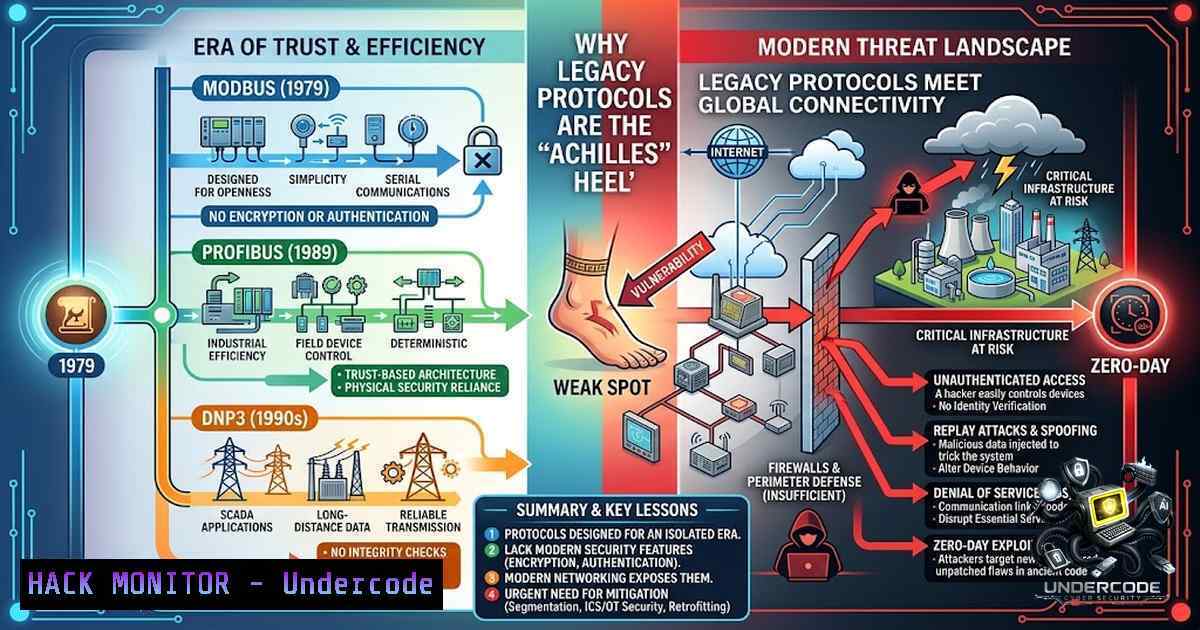
Introduction:
In 1979, Modbus was designed for reliability and deterministic communication—cybersecurity was never part of the equation. Fast forward to today, and these same legacy protocols—Modbus, Profibus, and DNP3—still power the world’s water plants, electrical grids, and manufacturing lines, yet they lack authentication, encryption, and basic access control. As Abdullah Al Shahid Chowdhury powerfully articulated, “When people hear Modbus, Profibus, or DNP3, they often think of communication protocols. I think of attack surfaces.” This article dissects the security realities of these industrial workhorses, provides hands-on defensive techniques, and maps a path forward using frameworks like IEC 62443.
Learning Objectives:
- Understand the inherent security weaknesses of Modbus, Profibus, and DNP3 and how they translate to exploitable attack surfaces in OT environments.
- Master practical command-line techniques for network segmentation, industrial protocol analysis, and device discovery using tools like
iptables,nftables,Wireshark, andNmap. - Learn to implement IEC 62443 zones and conduits, deploy defensive layers, and apply verified mitigation strategies to protect legacy industrial assets.
You Should Know:
- The Three Pillars of Insecurity: Modbus, Profibus, and DNP3
Modbus TCP operates on Port 502 with a master-slave architecture and zero device identity verification. If network segmentation is weak, unauthorized commands become a real operational risk. Profibus uses multi-master communication with token passing—strong on performance, but with no native authentication or encryption, unauthorized master devices and physical network access can compromise communications. DNP3, designed for power utilities, offers efficient exception-based reporting, and while Secure DNP3 (SAv5) adds authentication and AES-256 encryption, many legacy environments still operate without these enhancements.
The biggest misconception? These protocols are not insecure because they were poorly designed. They were designed for a world where availability mattered more than adversaries. The challenge today is protecting decades of reliable engineering against modern cyber threats.
2. The Attack in Action: Exploiting Modbus/TCP
Recent research demonstrates practical exploitation of Modbus/TCP vulnerabilities through a four-phase attack: reconnaissance (FC01), actuator manipulation (FC05), process monitoring (FC03), and setpoint tampering (FC06)—achieving 100% attack success rates across all phases. Wireshark analysis confirmed complete protocol transparency, exposing all function codes, addresses, and data values in plaintext. These attack phases map directly to nine MITRE ATT&CK for ICS techniques and correlate with real-world malware including FrostyGoop, INCONTROLLER, Industroyer, and VPNFilter.
For authorized security testing, frameworks like ModBusPwn provide a comprehensive toolkit for SCADA/ICS reconnaissance, fingerprinting, and exploitation:
 Install dependencies
pip install shodan pymodbus colorama pyfiglet

Shodan search for exposed Modbus devices
python3 ModBusPwn.py -s -a <YOUR_SHODAN_API_KEY> -c US -l 50 -p 2

Detect PLC firmware and hardware info
python3 ModBusPwn.py -t 192.168.1.10 --detect

Scan for writable registers
python3 ModBusPwn.py -t 192.168.1.10

Modify PLC registers (authorized testing only)
python3 ModBusPwn.py -t 192.168.1.10 -m 9999
3. Network Segmentation: The First Line of Defense
The Purdue Model enforces strict network segmentation between enterprise (IT) and control (OT) layers. Improperly configured firewalls are a leading cause of breaches. Here are verified commands for both Linux and Windows environments:
Linux (iptables):
 Set default policies to DROP all traffic
sudo iptables -P INPUT DROP
sudo iptables -P FORWARD DROP
sudo iptables -P OUTPUT DROP

Block inbound Modbus TCP (Port 502)
sudo iptables -A INPUT -p tcp --dport 502 -j DROP

Allow established and related traffic on OT segment
sudo iptables -A FORWARD -s 192.168.1.0/24 -m state --state ESTABLISHED,RELATED -j ACCEPT

Explicitly allow inbound SSH only from a jump host (10.0.0.5)
sudo iptables -A FORWARD -s 10.0.0.5 -d 192.168.1.0/24 -p tcp --dport 22 -j ACCEPT

Log any denied packets for auditing
sudo iptables -A FORWARD -s 192.168.1.0/24 -j LOG --log-prefix "OT-1ET-DENIED: "

Persist rules
sudo iptables-save > /etc/iptables/rules.v4
Linux (nftables – modern replacement for iptables):
 Create a table and chain for input filtering
nft add table inet filter
nft add chain inet filter input { type filter hook input priority 0\; policy drop\; }

Block Modbus TCP
nft add rule inet filter input tcp dport 502 drop

Allow SSH from jump host only
nft add rule inet filter input ip saddr 10.0.0.5 tcp dport 22 accept

List all rules
nft list ruleset
Windows Firewall (PowerShell):
 List all active firewall rules
Get-1etFirewallRule | Where-Object {$_.Enabled -eq 'True'} | Format-Table Name, DisplayName, Direction, Action

Create rule to block Modbus TCP
New-1etFirewallRule -DisplayName "Block Modbus TCP" -Direction Inbound -Protocol TCP -LocalPort 502 -Action Block

Enable the rule
Set-1etFirewallRule -DisplayName "Block Modbus TCP" -Enabled True
4. Industrial Protocol Analysis with Wireshark and TShark
Understanding the traffic flowing across your control network is non-1egotiable. Wireshark, with specialized dissectors, can decode industrial protocols to detect anomalies:
 Capture Modbus traffic on interface eth0
tshark -i eth0 -f "tcp port 502" -w modbus_capture.pcap

Read and display Modbus packets with verbose output
tshark -r modbus_capture.pcap -Y "modbus" -V

Capture DNP3 traffic
tshark -i eth0 -f "tcp port 20000" -w dnp3_capture.pcap
Wireshark Display Filters:
– `modbus` – Filter for all Modbus packets
– `dnp3` – Filter for DNP3 packets
– `s7comm` – Filter for Siemens S7 communication
– `modbus.func_code == 5` – Filter for write single coil (actuator manipulation)
– `modbus.func_code == 6` – Filter for write single register (setpoint tampering)
Step-by-step guide: Deploy a passive tap or SPAN port on a critical network segment. Use `tshark` to capture traffic specifically on industrial protocol ports, saving to a file for analysis. Open the capture in Wireshark’s GUI and apply relevant display filters. Analyze packets to understand normal “conversations” between PLCs and HMIs. Look for unauthorized commands, such as a write request from an unknown IP address, which could indicate a malicious actor attempting to manipulate a process.
- Exposure Discovery: Shodan and Nmap for OT Asset Identification
Shodan, often termed the “hacker’s search engine,” indexes banners from servers and critically, OT and ICS devices. Recent findings reveal a 146% increase in OT-focused disruptions, driven by internet-exposed devices and legacy system vulnerabilities. Over 15,000 ICS devices were reportedly discoverable. For defenders, the first step is to see what the attacker sees:
Shodan Search Queries:
– `port:502` – Find Modbus TCP devices
– `port:502 country:US` – Modbus devices in the United States
– `product:”simatic”` – Siemens SIMATIC S7 PLCs
– `port:44818` – EtherNet/IP devices
Nmap Validation:
 Service version scan on OT ports
nmap -sV -p 502,80,443,20000,102 <target_IP>

Siemens S7 PLC information script
nmap -p 102 --script s7-info.nse <target_IP>

Modbus information script
nmap -p 502 --script modbus-discover.nse <target_IP>

Manual banner grab
nc -1v <target_IP> 502
Automated Monitoring with Shodan API (Python):
import shodan

API_KEY = 'YOUR_API_KEY'
api = shodan.Shodan(API_KEY)

Search for Modbus devices in your organization's IP range
results = api.search('port:502 net:203.0.113.0/24')

for result in results['matches']:
print(f"IP: {result['ip_str']}")
print(f"Port: {result['port']}")
print(f"Data: {result['data']}")
- IEC 62443 Zones and Conduits: The Architectural Framework
IEC 62443 uses the zone-and-conduit model to organize security requirements. A zone is a group of assets that share similar security needs, and a conduit is the controlled path between zones. The model gives you a structured way to think about who needs access to what, how data should move, and where stronger controls are justified.
Implementation Steps:
- Asset Inventory and Risk Assessment: Identify all assets in your OT environment—PLCs, HMIs, engineering workstations, historians, and remote access points.
-
Zone Partitioning: Group assets by security requirements. For example:
– Zone 1 (Safety Critical): Safety Instrumented Systems (SIS)
– Zone 2 (Control): PLCs, DCS controllers, RTUs
– Zone 3 (Supervisory): SCADA servers, HMIs, engineering workstations
– Zone 4 (DMZ): Jump hosts, data historians, patch management
– Zone 5 (Enterprise IT): Business networks, ERP systems
- Conduit Definition: Define communication paths between zones with specific security controls. Each conduit should specify:
– Allowed protocols (e.g., only Modbus TCP from Zone 3 to Zone 2)
– Authentication requirements
– Encryption requirements
– Access control lists
- Security Level Assignment: Assign Security Level targets (SL-T) to each zone based on risk assessment. SL1 protects against casual attacks; SL4 protects against sophisticated, resourced attackers.
-
Continuous Monitoring and Update: Regularly review and update zone and conduit definitions as the environment evolves.
7. PLC Program Integrity Monitoring
Attackers may alter PLC logic to cause physical damage. Regularly checksumming the running logic provides a baseline for detecting unauthorized changes. For Siemens TIA Portal environments, consider using the `S7-1200/1500` security features or third-party integrity monitoring tools. For open-source environments, implement regular file integrity checks on PLC configuration files.
What Undercode Say:
- Key Takeaway 1: Legacy industrial protocols are not insecure by design flaw—they are products of an era when availability and reliability were the sole priorities. The real vulnerability lies not in the protocol itself but in the network architecture and operational practices surrounding it. As Viktor Fidanovski noted, “Modbus becomes a meaningful attack vector only when used to control and when physically accessible or exposed on the network.”
-
Key Takeaway 2: The answer is rarely replacing everything—it is building the right defensive layers: network segmentation between IT and OT, industrial monitoring and protocol-aware detection, IEC 62443 zones and conduits, and strong access control for industrial assets. Joe Miraglia rightly observed that “it’s never really about one protocol’s weaknesses, it’s whether the network around it was built with that in mind.”
Analysis: The industrial cybersecurity landscape is at a critical inflection point. With over 15,000 ICS devices directly exposed to the internet and attack frameworks like ModBusPwn making exploitation accessible to anyone with basic Python skills, the threat is no longer theoretical. The convergence of IT and OT has expanded the attack surface dramatically, yet many organizations still operate flat networks where a compromised engineering workstation can directly manipulate PLCs. The path forward requires a defense-in-depth approach that combines network segmentation, continuous monitoring, and architectural frameworks like IEC 62443. As Peter Rus provocatively asked, “We make modbus postquantum proof—what do you do?” The time for complacency has passed.
Prediction:
- +1 The increasing adoption of IEC 62443 and similar frameworks will drive a multi-billion dollar market for OT security solutions, with the global zero trust security market projected to expand from approximately USD 48.5 billion in 2026 to over USD 148 billion by the early 2030s.
-
+1 Secure variants of legacy protocols—Modbus/TCP Secure, DNP3 SAv5, and PROFINET with security features—will see accelerated adoption as regulatory requirements like the EU Cyber Resilience Act (CRA) mandate structured cybersecurity risk assessments for all products with digital elements.
-
-1 The installed base of legacy hardware will remain a significant liability for the next decade. As one commenter noted, “legacy hardware doesn’t get swapped out easily,” meaning that insecure protocols will continue to power critical infrastructure for years to come.
-
-1 The democratization of OT exploitation tools—from ModBusPwn to Metasploit’s ICS modules—will lower the barrier to entry for malicious actors. Combined with the 146% increase in OT-focused disruptions, we can expect more frequent and sophisticated attacks on critical infrastructure.
-
+1 The emergence of AI-powered protocol fuzzing and adaptive testing frameworks, such as ALA Fuzzer, will enable defenders to identify vulnerabilities before attackers do, shifting the balance toward proactive security rather than reactive patching.
▶️ Related Video (76% Match):
https://www.youtube.com/watch?v=8AOag6yib_Q
🎯Let’s Practice For Free:
🎓 Live Courses & Certifications:
Join Undercode Academy for Verified Certifications
🚀 Request a Custom Project:
Secure, high-velocity infrastructure and disruptive technological engineering. Contact our engineering team for high-tier development and proprietary systems:
[email protected]
💎 Smart Architecture | 🛡️ Secure by Design | ⭐ Trusted by Thousands
IT/Security Reporter URL:
Reported By: Shahidaac Otsecurity – Hackers Feeds
Extra Hub: Undercode MoN
Basic Verification: Pass ✅


