
Listen to this Post
Introduction:
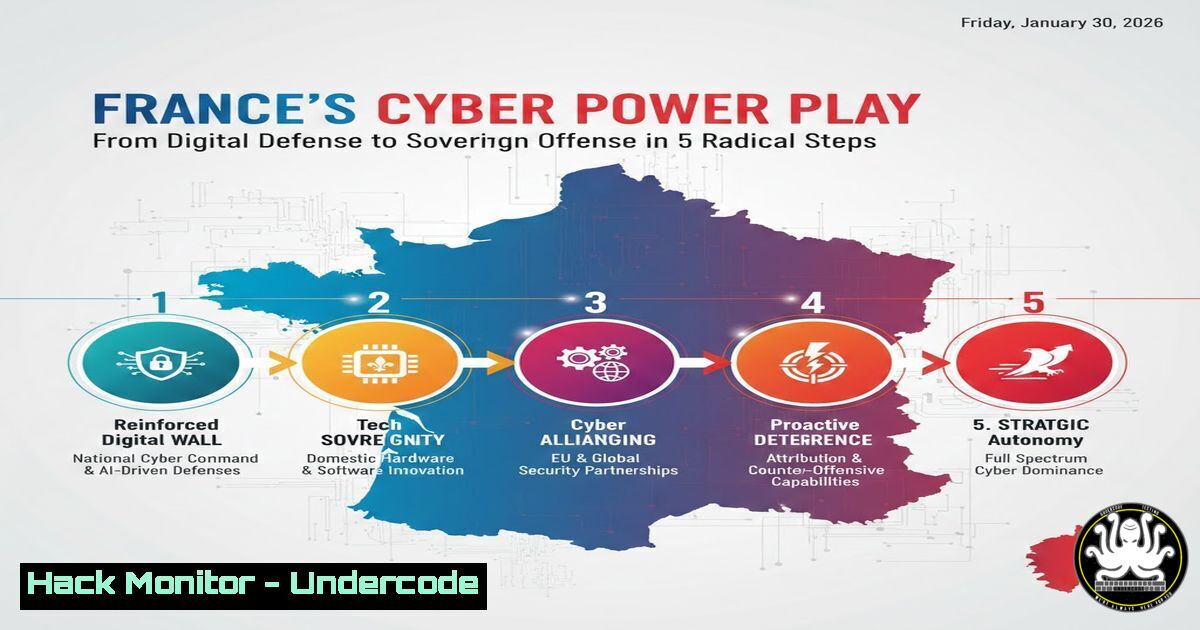
France’s newly unveiled National Cybersecurity Strategy 2026-2030 marks a seismic shift from a reactive posture to a proactive, sovereign-driven industrial policy. This framework, built on five strategic axes, explicitly intertwines technological mastery—in cloud, AI, and encryption—with national resilience and offensive capabilities, signaling that cybersecurity is now a cornerstone of economic and geopolitical power.
Learning Objectives:
- Decipher the five core pillars of France’s 2026-2030 strategy and their technical implications for organizations.
- Implement immediate, actionable hardening measures for cloud, AI systems, and network perimeters in alignment with the new sovereign principles.
- Develop a skill-building roadmap for your team to capitalize on the massive demand for cyber talent anticipated by the strategy.
You Should Know:
- Axis 1: Mass Talent Development & The Hands-On Lab Imperative
The strategy calls for moving beyond elite experts to cultivate a broader base of skilled practitioners. This demands a “learning by doing” approach within organizations.
Step‑by‑step guide:
Step 1: Set Up a Isolated Lab Environment. Use virtual machines or containerized networks to create a safe playground. On Linux, leverage `KVM` or VirtualBox. On Windows, enable Hyper-V.
 Linux - Install KVM and create a virtual network
sudo apt update && sudo apt install qemu-kvm libvirt-daemon-system virtinst bridge-utils
sudo systemctl enable --now libvirtd
virsh net-define /usr/share/libvirt/networks/default.xml
virsh net-start default
Step 2: Deploy Vulnerable Practice Environments. Use platforms like VulnHub or deploy intentionally vulnerable Docker containers (e.g., docker pull vulhub/nginx:unsafe) to practice secure configuration and penetration testing techniques in a controlled setting.
Step 3: Automate Attack & Defense Simulations. Use frameworks like `Caldera` (MITRE ATT&CK) or `Atomic Red Team` to simulate adversarial techniques and practice detection and response using your SIEM (e.g., Wazuh, Elastic SIEM).
- Axis 2 & 4: Building Sovereign Resilience & Controlling Critical Tech (Cloud Hardening)
“Souveraineté Numérique” means asserting control over critical infrastructure like cloud. This translates to stringent hardening of cloud deployments, regardless of provider.
Step‑by‑step guide:
Step 1: Enforce Infrastructure-as-Code (IaC) Security Scanning. Before deploying any cloud template (Terraform, AWS CloudFormation), scan it with tools like Checkov, Terrascan, or cfn-nag.
 Scan a Terraform directory for misconfigurations
checkov -d /path/to/terraform/code
Step 2: Implement Zero-Trust Network Principles. Segment cloud networks ruthlessly. Use native network security groups or firewalls to allow only specific, necessary traffic. For example, an Azure NSG rule should not allow `0.0.0.0/0` to management ports (SSH 22, RDP 3389).
Step 3: Encrypt Everything, Manage Keys Sovereignly. Enable encryption at-rest for all storage (blob, disk, database) and use a managed Key Vault (e.g., Azure Key Vault, AWS KMS). For maximum sovereignty, investigate the use of customer-managed keys (CMK) or hardware security modules (HSM) hosted in-region.
3. Axis 4: Securing the AI Pipeline
The strategy highlights control over AI. This involves securing the entire ML pipeline from data to deployment.
Step‑by‑step guide:
Step 1: Secure Training Data and Models. Isolate your training environment. Use differential privacy libraries (e.g., TensorFlow Privacy) or federated learning to protect sensitive training data. Sign and encrypt model artifacts before storage.
 Example using hashlib to generate a model checksum for integrity verification
import hashlib
def get_model_hash(model_path):
with open(model_path, 'rb') as f:
bytes = f.read()
return hashlib.sha256(bytes).hexdigest()
Step 2: Harden Model Serving Infrastructure. Treat your model API endpoint like any critical web service. Implement strict input validation to prevent adversarial examples, enforce authentication/authorization (OAuth2, API keys), and use a Web Application Firewall (WAF).
Step 3: Monitor for Model Drift & Adversarial Attacks. Deploy continuous monitoring to detect data drift that degrades model performance and set up alerts for anomalous inference request patterns that could indicate exploitation attempts.
- Axis 3: Complicating Adversaries’ Lives (Active Defense & Threat Hunting)
Moving beyond prevention to active disruption involves sophisticated monitoring and threat hunting.
Step‑by‑step guide:
Step 1: Deploy Endpoint Detection and Response (EDR) Across All Assets. Ensure EDR agents are installed on every server and workstation. Configure policies to detect living-off-the-land binaries (LOLBins) like powershell.exe, wmic.exe, or `bash` being used in suspicious sequences.
Step 2: Establish 24/7 SOC with SOAR Integration. Centralize logs (EDR, firewall, cloud trails) into a SIEM. Use a Security Orchestration, Automation, and Response (SOAR) platform to automate responses to common alerts, such as automatically isolating a host upon a high-confidence malware detection.
Step 3: Proactive Threat Hunting with MITRE ATT&CK. Regularly query your SIEM for tactics not caught by alerts. For example, hunt for instances of `T1059.003 – Windows Command Shell` where the parent process is an unexpected application like a web browser.
- Axis 5: Collective EU Play & Regulatory Alignment (NIS2/CRA Readiness)
The strategy emphasizes EU-wide rules like NIS2 and the Cyber Resilience Act (CRA). Compliance is now a technical necessity.
Step‑by‑step guide:
Step 1: Map Assets to Essential/Important Entity Classifications. Inventory all digital assets, data flows, and supply chain dependencies. Classify them according to NIS2 criteria to understand your regulatory scope.
Step 2: Conduct a Gap Analysis Against Key Requirements. Audit your current policies and tech against specific articles. For example, NIS2 21 mandates basic computer security practices for all personnel. Implement mandatory, role-based security training campaigns.
Step 3: Implement Technical Measures for CRA Compliance. For product manufacturers, this means building a Software Bill of Materials (SBOM) for all products. Use tools like `CycloneDX` or `SPDX` to generate and manage SBOMs.
 Generate an SBOM for a Node.js project using CycloneDX
npx @cyclonedx/bom cyclonedx:make -o sbom.json
What Undercode Say:
- Key Takeaway 1: France’s strategy reframes cybersecurity as a sovereign industry, not an IT cost center. This creates immense opportunity for vendors, integrators, and professionals who can build, audit, and operate sovereign, resilient systems. The demand for practical, hands-on skill sets will explode.
- Key Takeaway 2: The technical burden on organizations, especially critical infrastructure and digital product makers, will increase dramatically. Proactive hardening of cloud and AI systems, investment in active defense, and granular compliance automation are no longer optional but foundational to operating in the French and EU market.
This strategy is a direct response to an increasingly hostile cyber “Far West.” Its success hinges on translating high-level political will into operational technical excellence across the entire economy. The organizations that treat this as a blueprint for investment, rather than a compliance checklist, will not only be more secure but will gain significant competitive advantage. The predicted “massive training” push must focus on creating practitioners, not just theorists, to bridge the looming skills gap.
Prediction:
Within the 2026-2030 timeframe, we predict the emergence of a “French Tech Cyber” ecosystem, with certified sovereign tools (especially in cloud, encryption, and AI security) becoming mandatory for public contracts and highly favored in the private sector. This will fragment the global vendor landscape, creating a protected EU market. Furthermore, the focus on offensive capabilities and judicial tools will lead to more publicized “hack-back” operations or disruptive counter-cyber actions against threat actors, backed by state authority, fundamentally altering the risk calculus for adversaries targeting French interests.
▶️ Related Video (80% Match):
🎯Let’s Practice For Free:
IT/Security Reporter URL:
Reported By: Davidlegeay Strategie – Hackers Feeds
Extra Hub: Undercode MoN
Basic Verification: Pass ✅


