
Listen to this Post
Introduction
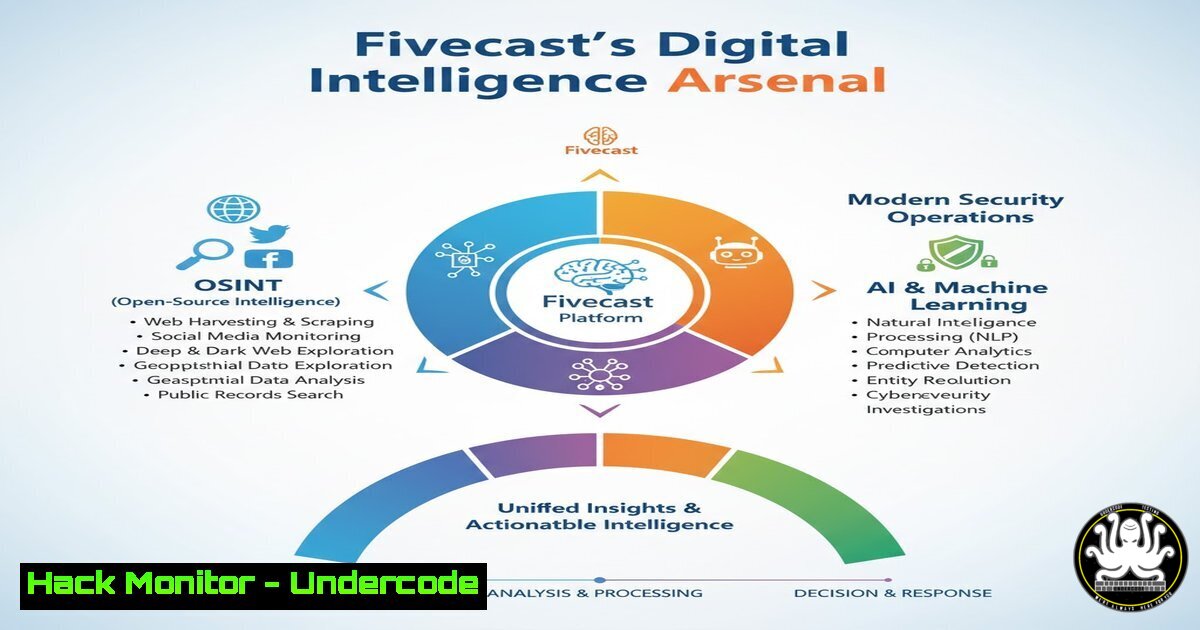
At the Security and Policing 2026 event, Fivecast showcased its advanced digital intelligence solutions, highlighting the convergence of Open-Source Intelligence (OSINT), Artificial Intelligence (AI), and data science. For cybersecurity professionals, this represents a shift toward automated, large-scale data analysis for threat detection and investigation. This article dissects the core technologies behind such platforms, providing a technical guide on the tools, commands, and methodologies used to collect, process, and analyze digital intelligence from publicly available sources.
Learning Objectives
- Understand the foundational OSINT techniques and command-line tools used for data collection.
- Learn how to apply AI and machine learning models to analyze unstructured data from the surface, deep, and dark web.
- Master step-by-step procedures for configuring digital intelligence gathering environments and securing the data pipelines.
You Should Know:
1. Reconnaissance & Data Collection: The OSINT Foundation
Digital intelligence begins with data aggregation. Modern platforms like those hinted at by Fivecast automate the collection of data from social media, news outlets, and the dark web. Before automation, professionals rely on core OSINT tools.
Step‑by‑step guide to setting up a basic OSINT collector using theHarvester and Recon-ng:
- Installation (Linux):
sudo apt update
sudo apt install theharvester recon-ng -y
- Using theHarvester for Email and Domain Discovery:
This tool gathers emails, subdomains, hosts, and employee names from public sources (Google, Bing, LinkedIn).theharvester -d example.com -b google -l 500
-d: Target domain.-b: Data source (google, bing, linkedin, etc.).-l: Limit the number of results.- Automating with Recon-ng:
Recon-ng provides a framework similar to Metasploit for reconnaissance.recon-ng marketplace install all workspace create security_policing_demo use recon/domains-hosts/google_site_web set source example.com run
This runs a module to find hosts related to the target domain via Google.
- AI-Driven Analysis: Natural Language Processing (NLP) for Threat Detection
Once data is collected, AI models parse text for sentiment, threats, or specific keywords. This is critical for monitoring chatter about potential attacks or vulnerabilities.
Step‑by‑step guide to running a basic NLP model using Python (Hugging Face Transformers):
- Environment Setup:
pip install transformers torch pandas
- Python Script for Threat Classification:
This script uses a pre-trained model to classify text as potentially threatening or neutral.from transformers import pipeline Load a sentiment-analysis pipeline (can be fine-tuned for cybersecurity) classifier = pipeline("sentiment-analysis", model="distilbert-base-uncased-finetuned-sst-2-english") Sample OSINT text data texts = [ "The new encryption protocol is unbreakable.", "Exploit released for CVE-2025-1234, targeting critical infrastructure.", "Planning a DDoS attack on the main gov portal this Friday." ]</p></li> </ul> <p>for text in texts: result = classifier(text) print(f"Text: {text}\nAnalysis: {result}\n")For specific threat detection, models like `cybert/bert-base-uncased-cybersecurity` can be used to identify exploit discussions.
3. Dark Web Monitoring: Configuring Tor and Crawlers
Digital intelligence platforms often include dark web monitoring. Accessing .onion sites requires specific network configurations.
Step‑by‑step guide to setting up a secure Tor proxy for crawling:
- Install Tor Service (Linux):
sudo apt install tor torsocks -y
sudo systemctl start tor
sudo systemctl enable tor
- Verify Tor is working:
torsocks curl https://check.torproject.org/api/ip
This should return a response indicating you are connected to Tor.
- Using Python with Tor (requests + socks proxy):
pip install requests requests[bash]
import requests

Configure requests to use Tor SOCKS proxy
proxies = {
'http': 'socks5h://127.0.0.1:9050',
'https': 'socks5h://127.0.0.1:9050'
}

Example: Accessing a clean onion link (Replace with a real, safe test site)
try:
response = requests.get('http://exampleonion.onion', proxies=proxies, timeout=30)
print(response.text)
except Exception as e:
print(f"Error accessing .onion: {e}")
Note: `socks5h` ensures DNS resolution is also done over Tor, preventing leaks.
4. Data Visualization and Link Analysis
Raw data is useless without context. Tools like Maltego or Gephi help visualize relationships between entities (people, domains, IPs).
Step‑by‑step guide to creating a link graph with Maltego (Community Edition):
- Install Maltego CE: Download from the official site.
- Create a Graph:
- Drag an “Email Address” or “Domain” entity onto the graph.
- Right-click the entity -> “Run Transform” -> “To DNS Name” or “To Email Addresses”.
- Transforms query public data sources to find connections.
– Export for Analysis:
Graphs can be exported as GraphML for use in other analytical tools.5. API Security: Protecting the Intelligence Pipeline
The data collected by intelligence platforms is often accessed via APIs. Securing these endpoints is paramount to prevent data leaks.
Step‑by‑step guide to hardening a Flask-based intelligence API:
- Implement Rate Limiting:
pip install flask-limiter
from flask import Flask, jsonify
from flask_limiter import Limiter
from flask_limiter.util import get_remote_address</li>
</ul>

app = Flask(<strong>name</strong>)
limiter = Limiter(get_remote_address, app=app, default_limits=["200 per day", "50 per hour"])

@app.route('/api/v1/osint/domain/<domain>')
@limiter.limit("5 per minute")  Strict limit for this endpoint
def get_domain_intel(domain):
 Your intelligence gathering logic here
return jsonify({"domain": domain, "status": "intel gathered"})
– Enforce API Key Authentication:
Never expose raw OSINT data without checking credentials.
6. Cloud Hardening for Digital Intelligence Platforms
Deploying platforms like Fivecast’s requires hardened cloud infrastructure. Misconfigured S3 buckets are a primary source of data leaks.
Step‑by‑step guide to securing AWS S3 for intelligence storage:
- Block Public Access (AWS CLI):
aws s3api put-public-access-block \
--bucket your-intel-bucket \
--public-access-block-configuration BlockPublicAcls=true,IgnorePublicAcls=true,BlockPublicPolicy=true,RestrictPublicBuckets=true
- Enable Encryption at Rest:
aws s3api put-bucket-encryption \ --bucket your-intel-bucket \ --server-side-encryption-configuration '{"Rules":[{"ApplyServerSideEncryptionByDefault":{"SSEAlgorithm":"AES256"}}]}' - Audit Bucket Permissions:
aws s3api get-bucket-acl --bucket your-intel-bucket
aws s3api get-bucket-policy --bucket your-intel-bucket
7. Exploitation and Mitigation: Simulating Adversary Tactics
Understanding how adversaries use OSINT is key. They often search for exposed credentials.
Step‑by‑step guide to scanning for exposed secrets in public repos (GitLab/GitHub) using truffleHog:
- Installation:
pip install truffleHog
- Scan a Repository:
trufflehog --regex --entropy=True https://github.com/your-target-org/repo.git
This searches for high-entropy strings (passwords, API keys) and regular expression matches.
- Mitigation: Immediately revoke any exposed keys and implement pre-commit hooks (e.g.,
git-secrets) to prevent future leaks.
What Undercode Say:
- Key Takeaway 1: Digital intelligence is no longer passive. The integration of AI with OSINT allows for predictive threat modeling, moving from “what happened” to “what will happen.” Security teams must adopt these automated collection and analysis pipelines to keep pace with adversary speed.
- Key Takeaway 2: The security of the intelligence platform itself is critical. As seen in the technical sections, securing APIs, cloud storage, and data-in-transit is as important as the data being collected. A breach of an intelligence platform provides adversaries with a blueprint of your investigation strategies.
Prediction:
Within the next 18 months, we will see a surge in “AI-driven OSINT-as-a-Service” platforms. This will democratize access to high-level intelligence, allowing smaller security firms and even red teams to conduct investigations previously only possible by nation-states. However, this will also lead to an arms race, where threat actors deploy adversarial AI to poison OSINT data sources with false flags and misinformation, forcing platforms like Fivecast to develop robust data verification and provenance layers.
▶️ Related Video (78% Match):
🎯Let’s Practice For Free:
IT/Security Reporter URL:
Reported By: Securityandpolicing Digitalintelligence – Hackers Feeds
Extra Hub: Undercode MoN
Basic Verification: Pass ✅🔐JOIN OUR CYBER WORLD [ CVE News • HackMonitor • UndercodeNews ]
📢 Follow UndercodeTesting & Stay Tuned:
- Block Public Access (AWS CLI):
- Install Tor Service (Linux):


