
Listen to this Post
Introduction
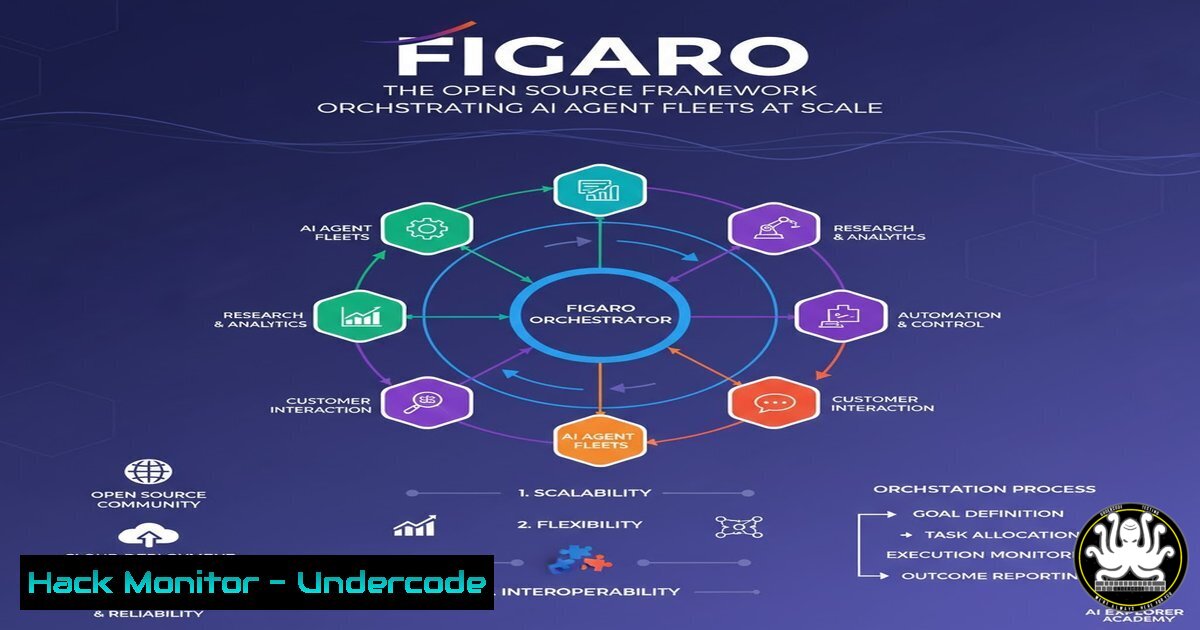
In a groundbreaking move that bridges the gap between artificial intelligence and大规模 infrastructure management, Marcello S. from Palo Alto Networks has released Figaro as an open source project. This sophisticated orchestration framework enables security professionals and IT engineers to deploy, manage, and coordinate fleets of Code and Computer Use agents across diverse environments including containers, virtual machines, and physical devices. Figaro represents a paradigm shift in how we approach automated security operations, allowing for human-in-the-loop collaboration at unprecedented scale while maintaining real-time visibility and control through an intuitive UI and even Telegram-based natural language commands.
Learning Objectives
- Understand the architecture and capabilities of Figaro for multi-agent orchestration
- Learn to deploy and configure agents across heterogeneous infrastructure
- Master the implementation of self-healing task scheduling and fleet management
You Should Know
1. Understanding Figaro’s Core Architecture
Figaro operates as a distributed orchestration engine that can simultaneously manage tens or hundreds of -powered agents. Think of it as OpenClaw on steroids – capable of connecting to and controlling any desktop environment via VNC, RDP, or SSH. The framework provides a unified dashboard where administrators can view live streams of all connected machines in real-time and interact with them directly.
The architecture consists of three primary components:
- Orchestration Server: The central management plane that coordinates agent deployment and task distribution
- Agent Instances: -powered workers deployed across target environments
- Control Interfaces: Web-based UI for direct manipulation and Telegram bot for natural language commands
2. Deploying Your First Figaro Fleet
Let’s walk through the initial setup process for deploying Figaro in a test environment:
Prerequisites:
- Docker and Docker Compose installed
- Python 3.9+ with pip
- API access credentials
- Basic understanding of containerization
Installation Steps:
 Clone the Figaro repository
git clone https://github.com/your-repo/figaro.git
cd figaro

Install Python dependencies
pip install -r requirements.txt

Configure environment variables
cp .env.example .env
 Edit .env with your API keys and Telegram bot token

Launch the orchestration server
docker-compose up -d

Verify the deployment
docker-compose ps
3. Configuring Agent Deployment Across Environments
Figaro supports multiple deployment targets. Here’s how to configure agents for different environments:
For Docker Containers:
 Deploy an agent container
figaro-cli deploy --type container \
--image -computer-use:latest \
--name agent-01 \
--memory 4GB \
--cpu 2
For VM Deployment (using libvirt):
 Create VM agent configuration
cat > vm-agent-config.yaml << EOF
name: vm-agent-01
type: kvm
memory: 8192
vcpus: 4
disk: 50G
network: bridge
_config:
max_tokens: 4096
temperature: 0.7
EOF

figaro-cli deploy --config vm-agent-config.yaml
For Physical Device Management via SSH:
 Add SSH target
figaro-cli target add \
--name workstation-01 \
--type ssh \
--host 192.168.1.100 \
--user admin \
--key ~/.ssh/id_rsa

Deploy agent to physical device
figaro-cli agent deploy --target workstation-01
4. Implementing Human-in-the-Loop Workflows
One of Figaro’s most powerful features is its human-in-the-loop collaboration capability. Here’s how to set up interactive workflows:
 Example workflow configuration
from figaro import Workflow, HumanStep

security_scan = Workflow("vulnerability-assessment")
security_scan.add_step({
"agent": "scanner-01",
"task": "perform network reconnaissance",
"scope": "192.168.1.0/24"
})
security_scan.add_step(HumanStep({
"prompt": "Review scan results and approve remediation actions",
"timeout": 300,
"escalation": "auto-rollback"
}))
security_scan.add_step({
"agent": "remediation-01",
"task": "apply approved patches",
"condition": "human_approved == True"
})

Execute the workflow
figarlo workflow run security_scan
5. Real-Time Monitoring and Fleet Management
The Figaro UI provides comprehensive real-time monitoring capabilities. Access the dashboard at `http://localhost:8080` after deployment. Key monitoring features include:
Live Stream Viewer:
// WebSocket connection for real-time updates
const ws = new WebSocket('ws://figaro-server:8080/stream/agent-01');
ws.onmessage = (event) => {
const frame = JSON.parse(event.data);
document.getElementById('agent-display').src = frame.screenshot;
};
Fleet Health Monitoring:
 Check fleet status via CLI
figaro-cli fleet status --format json

Output example
{
"total_agents": 50,
"active": 48,
"degraded": 2,
"offline": 0,
"tasks_completed": 1234,
"avg_response_time": 234
}
6. Telegram Integration for Natural Language Control
Figaro’s Telegram bot enables fleet management through natural language commands. Here’s the setup process:
 Telegram bot configuration
TELEGRAM_BOT_TOKEN = "your-bot-token"
ALLOWED_CHAT_IDS = ["chat-id-1", "chat-id-2"]

Define command handlers
@bot.message_handler(commands=['deploy'])
def handle_deploy(message):
"""Deploy new agents via Telegram"""
args = message.text.split()[1:]
if len(args) >= 2:
agent_type = args[bash]
count = int(args[bash])
fleet.deploy(agent_type, count)
bot.reply_to(message, f"Deploying {count} {agent_type} agents...")

@bot.message_handler(commands=['status'])
def handle_status(message):
"""Get fleet status"""
status = fleet.get_status()
bot.reply_to(message, format_status(status))
7. Self-Healing Task Scheduling
Implement autonomous remediation with Figaro’s self-healing capabilities:
 self-healing-policy.yaml
policies:
- name: "high-cpu-mitigation"
trigger:
metric: "cpu_usage"
threshold: 85
duration: "5m"
actions:
- type: "scale_out"
count: 2
- type: "notify"
channel: "telegram"
message: "Auto-scaling triggered due to high CPU"

<ul>
<li>name: "failed-task-recovery"
trigger:
event: "task_failure"
count: 3
window: "10m"
actions:</li>
<li>type: "redeploy_agent"</li>
<li>type: "task_redistribution"</li>
<li>type: "log_analysis"

Apply policy
figaro-cli policy apply --file self-healing-policy.yaml
8. Security Considerations and Hardening
When deploying Figaro in production environments, implement these security measures:
Network Segmentation:
 Create isolated network for agent communication
docker network create \
--driver bridge \
--subnet 172.20.0.0/16 \
--ip-range 172.20.1.0/24 \
figaro-internal

Apply network policies
figaro-cli network policy add \
--name "agent-isolation" \
--rule "deny all from external" \
--rule "allow from orchestration-server"
Access Control Configuration:
 rbac-config.yaml
roles:
- name: "viewer"
permissions: ["read:fleet", "read:logs"]
- name: "operator"
permissions: ["read:", "write:tasks", "execute:workflows"]
- name: "admin"
permissions: [""]

users:
- username: "security-team"
role: "operator"
mfa_required: true
- username: "automation-bot"
role: "viewer"
api_key: "${API_KEY}"
What Undercode Say
Key Takeaway 1: Figaro represents a fundamental shift in automated security operations, moving from single-agent automation to大规模 coordinated AI fleets. This capability enables organizations to scale their security monitoring and response capabilities exponentially while maintaining human oversight through the intuitive human-in-the-loop design.
Key Takeaway 2: The combination of multi-environment support (containers, VMs, physical) with natural language control interfaces (Telegram, web UI) makes Figaro accessible to both technical and non-technical stakeholders, democratizing advanced automation capabilities across the organization.
The release of Figaro as open source software democratizes access to enterprise-grade AI orchestration capabilities that were previously available only to large tech companies with substantial R&D budgets. By leveraging ‘s computer use capabilities, organizations can now automate complex workflows that require visual understanding and GUI interaction – tasks that were historically difficult to automate. The framework’s architecture, with its emphasis on real-time visibility and human collaboration, addresses the critical trust gap in autonomous systems by ensuring that humans remain in the decision-making loop for sensitive operations.
From a security perspective, Figaro introduces both opportunities and challenges. While it enables unprecedented automation of security tasks like vulnerability scanning, patch management, and incident response, it also creates a new attack surface that must be carefully secured. The framework’s ability to control hundreds of endpoints through a central orchestration server makes it a high-value target for attackers, necessitating robust authentication, network segmentation, and continuous monitoring.
The self-healing capabilities built into Figaro represent a significant advancement in system resilience. By automatically detecting and remediating common failure conditions, organizations can reduce operational overhead while improving service availability. This is particularly valuable in security operations, where rapid response to incidents is critical.
Prediction
Within the next 18 months, we anticipate Figaro-like frameworks becoming the standard infrastructure layer for enterprise AI operations. The convergence of large language models with distributed orchestration will enable fully autonomous security operations centers that can detect, analyze, and remediate threats with minimal human intervention. However, this shift will also drive demand for new security specialties focused on AI fleet security and adversarial machine learning, as attackers inevitably begin targeting these orchestration frameworks. The organizations that successfully implement Figaro today will gain a significant competitive advantage in security operations efficiency and effectiveness.
🎯Let’s Practice For Free:
IT/Security Reporter URL:
Reported By: Byt3bl33d3r I – Hackers Feeds
Extra Hub: Undercode MoN
Basic Verification: Pass ✅


