Listen to this Post
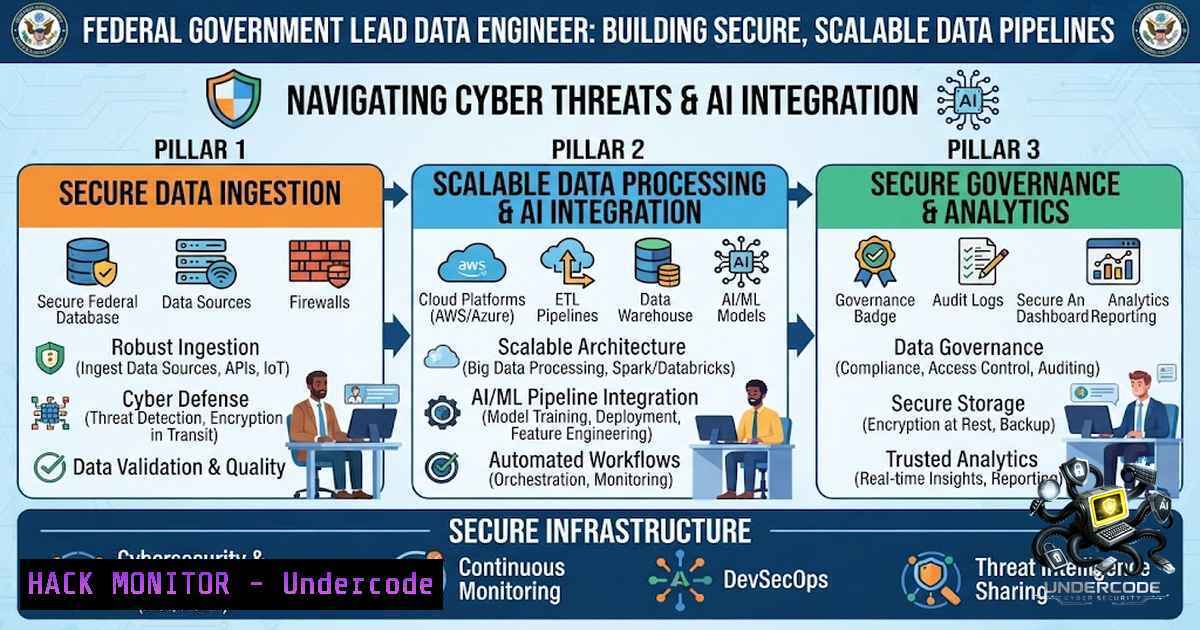
Introduction:
As federal government agencies accelerate their digital transformation journeys, the role of the Lead Data Engineer has evolved from a purely technical position into a critical cybersecurity and governance function. In Canberra’s federal government landscape, where sensitive citizen data and classified intelligence intersect with modern cloud architectures, the Lead Data Engineer must architect data pipelines that are not only scalable and performant but also resilient against sophisticated cyber threats and compliant with stringent regulatory frameworks. This article explores the technical depth, security imperatives, and emerging AI-driven capabilities required for federal government data engineering leadership.
Learning Objectives:
- Master the design and implementation of secure, end-to-end data pipelines using Apache Spark, Kafka, and Airflow in government cloud environments
- Implement zero-trust architectures, encryption-by-default, and automated compliance validation across data ingestion, processing, and storage layers
- Integrate AI/ML capabilities and DevSecOps practices into data engineering workflows while maintaining federal security postures
- Architecting Secure Data Pipelines for Federal Government Environments
Federal government data engineering demands a security-first approach from the ground up. The Lead Data Engineer must design pipelines that ingest data from multiple sources—including internal security telemetry, cyber intelligence vendors, and legacy government systems—while normalizing and enriching data using scalable transformation frameworks. Modern data architecture must incorporate security standards such as data minimization, zero trust architecture, encryption as default, role-based access controls, and immutable audit logging directly into pipeline design.
Step-by-Step Guide: Building a Secure Data Ingestion Pipeline
- Establish Secure Data Sources: Configure encrypted connections using SFTP/FTPS or TLS-enabled APIs for all data ingestion points. For AWS, use S3 with bucket policies enforcing encryption; for Azure, leverage Blob Storage with managed identities.
-
Implement Data Validation and Sanitization: Before processing, validate incoming data against schema definitions and sanitize inputs to prevent injection attacks. Use Apache Kafka with SSL/TLS and SASL authentication for streaming data.
-
Apply Encryption at Rest and in Transit: Utilize AWS KMS, Azure Key Vault, or GCP Cloud KMS for key management. Enable server-side encryption for all storage layers and enforce TLS 1.3 for all network communications.
-
Deploy Zero-Trust Access Controls: Implement fine-grained IAM policies with least-privilege principles. Use HashiCorp Vault for dynamic secrets management and tokenization of sensitive data such as PII and payment card information.
-
Enable Comprehensive Audit Logging: Configure immutable logging across all pipeline components—ingestion, processing, and storage—to support forensic investigations and compliance reporting.
Linux Commands for Secure Pipeline Deployment:
 Generate TLS certificates for Kafka encryption
openssl req -1ew -x509 -keyout kafka-server.key -out kafka-server.crt -days 365 -1odes

Configure Kafka with SSL and SASL authentication
 Add to server.properties:
ssl.keystore.location=/var/private/ssl/kafka.server.keystore.jks
ssl.keystore.password=your_password
ssl.key.password=your_password
security.inter.broker.protocol=SSL
sasl.enabled.mechanisms=PLAIN
sasl.mechanism.inter.broker.protocol=PLAIN

Set up immutable audit logging with rsyslog
echo ".info;mail.none;authpriv.none;cron.none /var/log/audit/immutable.log" >> /etc/rsyslog.conf
chattr +a /var/log/audit/immutable.log
- Cloud Security and Compliance Across AWS, Azure, and GCP
Federal government clients typically operate across multiple cloud providers, each with distinct security and compliance capabilities. The Lead Data Engineer must navigate this multi-cloud complexity while maintaining consistent security postures. AWS, Azure, and GCP all offer enhanced security and compliance add-ons supporting FedRAMP, HIPAA, and PCI-DSS workloads.
Step-by-Step Guide: Multi-Cloud Security Hardening
- Establish Cloud-1ative Security Baselines: For AWS, enable GuardDuty and Security Hub; for Azure, activate Defender for Cloud and Sentinel; for GCP, deploy Security Command Center. Configure continuous monitoring and threat detection across all environments.
-
Implement Identity and Access Management (IAM): Define centralized identity federation using Azure AD or AWS IAM Identity Center. Apply conditional access policies requiring multi-factor authentication and device compliance checks.
-
Deploy Data Governance and Lineage Tools: Use AWS Glue Data Catalog, Azure Purview, or GCP Data Catalog to maintain data lineage and enforce governance policies across hybrid cloud environments.
-
Configure Network Security: Implement VPC peering, private endpoints, and service mesh architectures to prevent public exposure of data services. Use AWS PrivateLink, Azure Private Endpoint, or GCP Private Service Connect.
-
Automate Compliance Validation: Integrate policy-as-code tools like AWS Config, Azure Policy, or GCP Organization Policy to continuously validate compliance against FedRAMP and IRAP frameworks.
Windows Commands for Azure Security Configuration:
 Enable Azure Defender for all subscriptions
az security pricing create -1 VirtualMachines --tier Standard

Configure Azure Policy for data encryption enforcement
az policy definition create --1ame "encrypt-storage-accounts" --rules '{
"if": {
"field": "type",
"equals": "Microsoft.Storage/storageAccounts"
},
"then": {
"effect": "deny",
"details": {
"type": "Microsoft.Storage/storageAccounts/encryption"
}
}
}'

Set up Azure Sentinel workspace with FedRAMP compliance
az sentinel workspace manager create -g myResourceGroup -w myWorkspace --enable-fedramp true
- AI Integration and Advanced Analytics in Data Engineering
With the emergence of generative AI and large language models, federal data engineering is rapidly evolving. The Lead Data Engineer must now integrate AI capabilities—including Open AI and ChatGPT integration—into data processing workflows. This involves building data pipelines that can ingest, process, and serve training data for AI models while maintaining strict data privacy and security controls.
Step-by-Step Guide: Integrating AI into Secure Data Pipelines
- Design Data Preparation Workflows: Build pipelines that clean, transform, and label data for AI model training. Use Apache Spark for large-scale data processing and feature engineering.
-
Implement Privacy-Preserving Techniques: Apply data masking, tokenization, and differential privacy before data reaches AI models. Use one-way irreversible polymorphic encryption for PII protection.
-
Deploy Model Monitoring and Drift Detection: Implement continuous monitoring of AI model performance and data drift using tools like Apache Airflow for orchestration.
-
Establish AI Governance Frameworks: Define policies for responsible AI use, including bias detection, explainability, and human oversight for federal government applications.
-
Secure Model Endpoints: Deploy AI models behind API gateways with authentication, rate limiting, and input validation to prevent model poisoning and adversarial attacks.
Python Code for Secure AI Data Pipeline:
import pandas as pd
from pyspark.sql import SparkSession
from cryptography.fernet import Fernet

Initialize Spark with security configurations
spark = SparkSession.builder \
.appName("SecureAIPipeline") \
.config("spark.sql.adaptive.enabled", "true") \
.config("spark.sql.adaptive.coalescePartitions.enabled", "true") \
.getOrCreate()

Load and encrypt sensitive data
key = Fernet.generate_key()
cipher_suite = Fernet(key)

def encrypt_sensitive_column(df, column_name):
return df.withColumn(column_name,
encrypt_udf(df[bash]))

Read data with encryption at rest
df = spark.read.option("header", "true") \
.option("encryption", "AES256") \
.csv("s3a://secure-bucket/sensitive-data/")

Apply differential privacy for AI training
from diffprivlib.models import GaussianNB
clf = GaussianNB(epsilon=1.0)
4. DevSecOps and CI/CD Security for Data Pipelines
Modern data engineering demands the integration of security into every stage of the development lifecycle. DevSecOps practices automate security checks within CI/CD pipelines, preventing vulnerable code from reaching production. Early adopters of zero trust frameworks in CI/CD pipelines report a 54% reduction in mean time to detect security incidents.
Step-by-Step Guide: Implementing DevSecOps for Data Pipelines
- Integrate Static Application Security Testing (SAST): Use tools like SonarQube or Checkmarx to scan data pipeline code for vulnerabilities before deployment.
-
Automate Dependency Scanning: Implement SCA (Software Composition Analysis) tools to identify known vulnerabilities in open-source libraries used in data engineering stacks.
-
Configure Infrastructure as Code (IaC) Security: Use Terraform with security scanning tools like Checkov or Terrascan to validate cloud infrastructure configurations.
-
Implement Continuous Monitoring: Deploy SIEM solutions and real-time alerting for pipeline anomalies and security events.
-
Establish Incident Response Playbooks: Define automated rollback strategies and incident response procedures for data pipeline security breaches.
Terraform Security Validation Example:
 main.tf with security controls
resource "aws_s3_bucket" "data_lake" {
bucket = "federal-data-lake-${var.environment}"
acl = "private"

versioning {
enabled = true
}

server_side_encryption_configuration {
rule {
apply_server_side_encryption_by_default {
sse_algorithm = "AES256"
}
}
}
}

resource "aws_s3_bucket_public_access_block" "data_lake_block" {
bucket = aws_s3_bucket.data_lake.id

block_public_acls = true
block_public_policy = true
ignore_public_acls = true
restrict_public_buckets = true
}

Checkov validation command
 checkov -f main.tf --framework terraform
5. Performance Optimization and Large-Scale Data Processing
Federal government data engineering involves processing massive datasets—often petabytes in scale—requiring sophisticated performance optimization techniques. The Lead Data Engineer must master performance tuning, query optimization, and distributed computing frameworks.
Step-by-Step Guide: Optimizing Large-Scale Data Pipelines
- Implement Partitioning and Bucketing: In Apache Spark, use appropriate partitioning strategies to minimize shuffle operations and optimize query performance.
-
Leverage Columnar Storage Formats: Use Parquet or ORC formats with compression to reduce storage costs and improve I/O performance.
-
Enable Query Optimization: Use materialized views, query caching, and predicate pushdown to accelerate analytical queries.
-
Configure Resource Management: Tune Spark executor memory, cores, and dynamic allocation based on workload characteristics.
-
Monitor and Debug Performance: Implement performance monitoring dashboards and use Spark UI for bottleneck identification.
Linux Commands for Performance Tuning:
 Monitor Spark application performance
spark-submit --master yarn \
--conf spark.executor.memory=8g \
--conf spark.executor.cores=4 \
--conf spark.dynamicAllocation.enabled=true \
--conf spark.dynamicAllocation.maxExecutors=100 \
--conf spark.sql.shuffle.partitions=200 \
--conf spark.sql.adaptive.enabled=true \
--conf spark.sql.adaptive.coalescePartitions.enabled=true \
your_data_pipeline.py

Monitor system resources during pipeline execution
htop
iostat -x 1
vmstat 1

Check HDFS block distribution
hdfs fsck /data/pipeline -files -blocks -locations
What Undercode Say:
- Key Takeaway 1: The Lead Data Engineer in federal government must be a cybersecurity practitioner first and a data engineer second—security cannot be an afterthought in modern data pipeline architecture.
-
Key Takeaway 2: Multi-cloud proficiency across AWS, Azure, and GCP is essential, but the real differentiator lies in the ability to maintain consistent security postures and compliance across these disparate environments.
-
Key Takeaway 3: AI integration is not optional; it’s a mandatory capability. However, it introduces new attack surfaces that must be secured through tokenization, differential privacy, and rigorous governance frameworks.
-
Key Takeaway 4: DevSecOps practices in data engineering are proving their worth—organizations implementing zero trust in CI/CD pipelines see dramatic reductions in detection times and improved security postures.
-
Key Takeaway 5: Performance optimization and security are not mutually exclusive; modern architectures with columnar storage, encryption, and intelligent partitioning can achieve both goals simultaneously.
Analysis: The federal government data engineering landscape is undergoing a fundamental transformation. The convergence of AI, cloud computing, and cybersecurity demands a new breed of Lead Data Engineer who can bridge technical expertise with security governance. As agencies accelerate their digital transformation initiatives, the demand for professionals who can architect secure, scalable, and AI-ready data platforms will continue to surge. This role is no longer just about building pipelines—it’s about safeguarding national data assets while enabling data-driven decision-making at scale. The successful Lead Data Engineer will be one who views every data flow through a security lens, implements defense-in-depth strategies, and continuously adapts to emerging threats and technologies.
Prediction:
- +1 Federal government agencies will increasingly mandate security-first certifications (e.g., FedRAMP, IRAP) as non-1egotiable requirements for Lead Data Engineer roles by 2027
-
+1 AI-powered security automation will become standard in data pipelines, reducing manual security configuration efforts by 40% within the next 18 months
-
-1 The skills gap in secure data engineering will widen, creating critical vulnerabilities in government data infrastructure as legacy systems struggle to integrate modern security practices
-
+1 Integration of zero-trust architectures into CI/CD pipelines will become mandatory for federal contracts, driving adoption of DevSecOps practices across all government data projects
-
-1 The increasing complexity of multi-cloud data engineering will introduce new attack vectors, requiring continuous investment in security training and tooling
▶️ Related Video (74% Match):
https://www.youtube.com/watch?v=6A63iTaO1o8
🎯Let’s Practice For Free:
🎓 Live Courses & Certifications:
Join Undercode Academy for Verified Certifications
🚀 Request a Custom Project:
Secure, high-velocity infrastructure and disruptive technological engineering. Contact our engineering team for high-tier development and proprietary systems:
[email protected]
💎 Smart Architecture | 🛡️ Secure by Design | ⭐ Trusted by Thousands
IT/Security Reporter URL:
Reported By: Leaddataengineer Share – Hackers Feeds
Extra Hub: Undercode MoN
Basic Verification: Pass ✅


