Listen to this Post
Introduction:
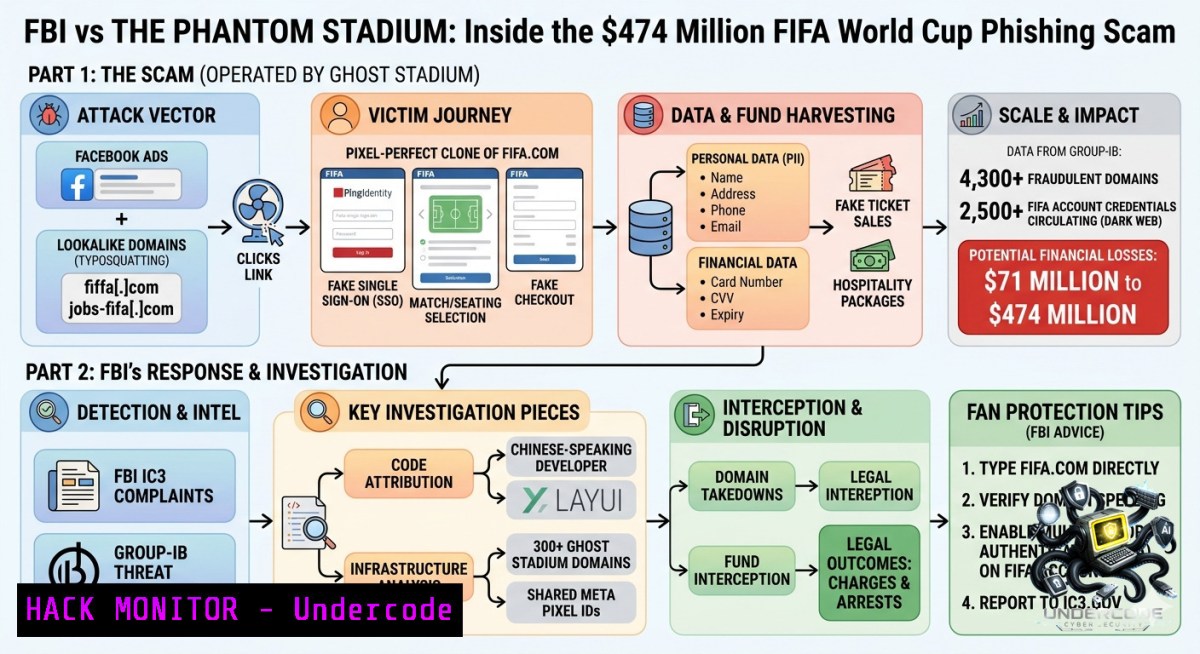
As the world counts down to the 2026 FIFA World Cup, a silent but deadly cyber campaign is already well into its second half. Cybercriminals, led by the notorious “GHOST STADIUM” actor, have registered over 4,300 fraudulent domains to steal PII and sell fake tickets. This coordinated ecosystem of spoofing, typosquatting, and Phishing-as-a-Service (PhaaS) infrastructure has the potential to defraud fans of billions, targeting the global excitement surrounding the tournament.
Learning Objectives:
- Understand the specific tactics of typosquatting, domain impersonation, and SSO replication used in the FIFA spoofing campaign.
- Learn to identify compromised infrastructure indicators and analyze the malware and phishing kits deployed.
- Master proactive defense strategies, including DNS filtering, passive OSINT techniques, and threat intelligence sharing to mitigate large-scale brand impersonation.
You Should Know:
1. Decoding the GHOST STADIUM Phishing Kit
The GHOST STADIUM campaign leverages a meticulously engineered phishing kit rather than a crude, generic page. It is a pixel-perfect clone of the official FIFA site, built with the Chinese open-source UI library Layui 2.7.6m, which is virtually unknown outside the Chinese developer community. This kit does not just mimic the look; it replicates the behavior of the legitimate site, down to the Single Sign-On (SSO) authentication flow provided by PingIdentity. When a user attempts to log in, the fake page captures the credentials and then silently redirects the user back to the real FIFA website, creating the illusion of a successful login. Furthermore, the kit requests a password reset parameter, allowing the attacker to immediately lock the victim out of their own FIFA account and resell any legitimate tickets attached to it.
Step-by-step guide to detecting this specific phishing kit:
- Check for “Layui” Footprints: Inspect a suspicious page’s source code (Ctrl+U). Search for “layui” or look for CSS/JS paths containing “/layui/”. This is a strong indicator of the GHOST STADIUM kit.
- Analyze the Login Flow: Attempt a dummy login (e.g., `[email protected]` /
password123). Do not use real credentials. Observe the network traffic (F12 -> Network tab). Look for a POST request that sends the credentials to a fraudulent domain, followed by a `302 Redirect` to the legitimatefifa.com. - Look for Shared Meta Pixels: GHOST STADIUM uses shared Facebook advertising infrastructure. Use a tool like Meta Pixel Helper (a browser extension) on the suspicious page. If you see a Pixel ID that has also been reported in threat intel feeds (e.g., as part of IOC lists), the site is malicious.
- Check for Password Reset Parameters: In the POST request or the URL parameters of the phishing page, look for variables like `password_reset=1` or
reset_token=. This is a unique identifier of the GHOST STADIUM kit.
5. Automated Detection with Python:
import requests
from bs4 import BeautifulSoup

def check_ghost_stadium(url):
try:
response = requests.get(url, timeout=10)
soup = BeautifulSoup(response.text, 'html.parser')
 1. Check for Layui
if 'layui' in response.text:
print(f"[!] Potential GHOST STADIUM kit detected: Layui found.")
 2. Check for Meta Pixel
meta_pixels = soup.find_all('img', {'src': lambda x: x and 'facebook.com/tr' in x})
if meta_pixels:
print(f"[!] Facebook Pixel found: {meta_pixels[bash].get('src', '')}")
 3. Check for redirect to fifa.com
if 'window.location' in response.text and 'fifa.com' in response.text:
print("[!] Detected post-login redirect to legitimate fifa.com")
except Exception as e:
print(f"Error scanning {url}: {e}")

check_ghost_stadium("http://potential-phish-domain.xyz")
2. Advanced IOC Hunting and Infrastructure Tracing
The scale of the operation is massive, with over 4,300 domains registered since August 2025, of which over 300 are actively running fraudulent infrastructure. However, the entire fraud ecosystem is tied together by shared digital fingerprints, including SSL certificates, WHOIS data, and hosting providers. By tracing these IOCs, defenders can uncover the entire network and preemptively block dormant domains (3,800+ of them) before they are activated. A significant portion of these malicious domains (about 80.6%) is hosted behind Cloudflare, which serves as a reverse proxy to obscure the real origin servers.
Step-by-step guide to mapping the fraudulent FIFA domain network:
1. Certificate Transparency Log Search: Use crt.sh to search for SSL certificates issued for “.fifa.com” or common typos. Look for certificates that include brand names like “fifa” in the Subject Alternative Name (SAN) field but are issued to suspicious entities.
curl -s "https://crt.sh/?q=%.fifa.com&output=json" | jq '.[] | select(.name_value | contains("fifa")) | .name_value' | sort -u
2. Passive DNS Replication: Use SecurityTrails or VirusTotal to query historical DNS records. Search for A records associated with known malicious FIFA domains. Often, multiple malicious domains resolve to the same IP address (e.g., the top address found hosted 8 separate fraudulent sites).
– Linux Command (using `dig` to check for co-hosting):
 Resolve a known malicious domain to an IP
dig +short malicious-fifa-domain.xyz
 Then, reverse DNS lookup to find other domains on that IP
dig -x 203.0.113.5
3. Registrar OSINT: The two most exploited registrars for this campaign are GNAME.COM (42% of domains) and GoDaddy (19%). Query WHOIS databases for these registrars’ handles to find other recently registered domains with similar creation patterns.
whois domain.name | grep -E "Registrar|Creation Date|Name Server"
4. Tracking PhaaS Supply Chains: Monitor dark web forums for the sale of “FIFA World Cup phishing kits.” Many operators are not custom-coding but buying ready-made kits. The supply chain includes infostealer campaigns (e.g., Vidar and Lumma families) that have already swept up ~2,500 FIFA logins now trading on dark-web markets. Track hashes of these stealers and block execution via EDR.
5. Automated Blocking via DNS Filtering: Implement a DNS sinkhole (using Pi-hole or a commercial solution) that blocks all newly registered domains matching patterns like fifa.xyz, fifa.online, worldcup.shop, and fiffa.com. Use TI feeds to dynamically update these lists.
3. Defensive Measures: Typo-Squatting Mitigation
The primary attack vector is typosquatting, where attackers rely on users making common typing errors when entering a URL. For example, users intending to visit `fifa.com` might type `filfa.org` or fiffa.com. Attackers also use visual deception, such as using `wvvw-fifa.com` (with three ‘w’s) which appears visually similar to www.fifa.com. This social engineering trick leverages the high-stakes urgency of the ticket sales window, where fans are rushing and less likely to scrutinize URLs.
Step-by-step guide for endpoint and user-level defense:
- Policy Enforcement: Configure all corporate and personal browsers to use a safe search provider (like Google SafeSearch) and enforce the use of bookmarks for critical sites. Deploy a Group Policy Object (GPO) in Windows to block access to a list of known TLDs commonly used in spoofing (.xyz, .click, .live, .cab, .pink, .beer).
– Windows PowerShell (to add hosts to the hosts file for blocking):
 Run as Administrator
$hostsPath = "$env:windir\System32\drivers\etc\hosts"
$blockedDomains = @("fifa.cab", "fifa.pink", "fifa.ceo", "filfa.org")
foreach ($domain in $blockedDomains) {
Add-Content -Path $hostsPath -Value "127.0.0.1 $domain"
}
2. User Training and Simulated Phishing: Conduct training specifically on “domain deception.” Show examples of the FBI-identified spoofed domains, such as `jobs-fifa.com` and fifa-careerhub.com, which target job seekers. Run simulated phishing campaigns that send emails offering “FIFA 2026 Hospitality Packages” to test user awareness.
3. Technical Safeguards:
- Deploy DNSSEC: Ensure DNSSEC is validated at your resolver to prevent DNS spoofing and cache poisoning.
- Implement DMARC: For organizations, implement DMARC, DKIM, and SPF to prevent email spoofing. Attackers have configured domains like `f-ifa.de` to send spoofed emails without DMARC protections.
- Browser Isolation: Use remote browser isolation (RBI) technologies to render all untrusted links in a disposable container, preventing any data from reaching the user’s endpoint.
4. Monitoring Dark Web and Financial Fraud
The end goal of the GHOST STADIUM campaign is monetization. This is achieved through six parallel fraud schemes: credential phishing, fake ticket sales (with premium tickets priced between $1,500 and $10,000), counterfeit merchandise storefronts, fake streaming platforms, fraudulent betting sites, and infostealer-driven credential theft. Payments are funneled through a cryptocurrency on-ramp, making funds virtually impossible to recover. The operation uses shared Meta Pixel IDs across hundreds of domains, indicating the same advertising accounts are driving traffic via Facebook Ads, bypassing traditional web filtering.
Step-by-step guide for financial and infrastructure takedown:
- Crypto Wallet Tracing: If a fake ticketing site demands cryptocurrency payment, trace the wallet address using blockchain explorers like Blockchain.com or Etherscan. Look for common addresses used across multiple scam domains and report them to exchange compliance teams.
– Command (using `curl` to check a Bitcoin address balance via API):
curl -s "https://blockchain.info/rawaddr/1A1zP1eP5QGefi2DMPTfTL5SLmv7DivfNa" | jq '.total_received'
2. Reporting to Law Enforcement and Registrars: File a complaint with the FBI’s IC3 at ic3.gov, providing the malicious domain, screenshots of the scam, and the interaction history. For immediate takedown, prioritize bulk abuse reporting to GNAME.COM and GoDaddy, as these two registrars control ~61% of the fraudulent FIFA domains.
3. Ad Intelligence: Monitor Meta’s Ad Library for ads promoting “FIFA World Cup Tickets.” Look for advertisers with a history of creating new pages or those located in high-risk jurisdictions. Report any suspicious ad that links to a domain not ending in fifa.com.
4. Passive Credential Monitoring: Use services like Have I Been Pwned or Google’s Password Checkup to see if your FIFA account credentials have been leaked. If you suspect you entered credentials on a fake site, immediately change your password and enable MFA on your real FIFA account.
5. Block Facebook Pixel Trackers: For network defenders, extract the list of Meta Pixel IDs from threat intel reports and add them to your web proxy blocklists. This will break the attacker’s ability to track their campaign’s success and retarget victims.
What Undercode Say:
- Key Takeaway 1: This campaign is not a simple phishing operation; it is a coordinated, multi-actor fraud economy. The existence of a PhaaS supply chain and four distinct threat groups working the same event simultaneously signals a shift towards industrial-scale cybercrime.
- Key Takeaway 2: The use of a pixel-perfect SSO clone combined with social media advertising (Facebook Ads) represents a dangerous evolution in social engineering. Attackers are no longer just sending spam; they are buying prime ad placement to target their victims directly.
Analysis: The GHOST STADIUM campaign highlights a perfect storm of event-driven hype and technical sophistication. The estimated potential financial losses (up to $474 million from premium tickets alone) demonstrate that major sporting events have become high-value targets for nation-state-aligned or highly organized crime groups. The strategic use of shared advertising and content delivery networks (CDNs) to host the malicious infrastructure makes detection and takedown significantly more challenging for traditional security tools. This forces a paradigm shift: organizations must move from reactive, domain-by-domain takedowns to proactive, intelligence-led disruption based on shared infrastructure indicators. The window for defense is closing rapidly with the tournament’s start.
Expected Output:
Introduction:
The 2026 FIFA World Cup has become a cyber battleground, with threat actors like GHOST STADIUM launching a massive spoofing campaign to harvest data and sell fake tickets. The FBI’s PSA warns of typosquatting and domain impersonation techniques that exploit users’ trust and urgency. This article provides a technical deep-dive into the attack infrastructure, offering actionable defensive strategies and OSINT techniques to protect users and brands from large-scale event-driven fraud.
What Undercode Say:
- Key Takeaway 1: The GHOST STADIUM campaign’s success lies in its industrial-scale approach, combining ready-made phishing kits with paid social media advertising to bypass traditional spam filters.
- Key Takeaway 2: Defenders must shift focus from individual malicious domains to shared infrastructure like SSL certificates, registrar accounts, and Meta Pixel IDs to preemptively block the entire network.
Expected Output:
Prediction:
- -N As the 2026 World Cup approaches, the volume of fraudulent domains will continue to spike, with attackers activating the 3,800+ pre-registered dormant domains to exploit the peak traffic period. This will lead to a surge in identity theft and financial fraud cases post-tournament.
- -N The success of this campaign will set a precedent for future global events (e.g., Olympics, elections), inspiring a new wave of sophisticated PhaaS kits that replicate complex SSO flows, making phishing nearly indistinguishable from legitimate authentication.
- +P However, the collective pressure from law enforcement (FBI, IC3) and the coordinated takedown efforts targeting major registrars (GoDaddy, GNAME) will force a crackdown on domain registration anonymity, leading to stricter WHOIS verification policies globally.
▶️ Related Video (80% Match):
🎯Let’s Practice For Free:
IT/Security Reporter URL:
Reported By: Divya Kumari – Hackers Feeds
Extra Hub: Undercode MoN
Basic Verification: Pass ✅
🎓 Live Courses & Certifications:
Join Undercode Academy for Verified Certifications
🚀 Request a Custom Project:
Secure, high-velocity infrastructure and disruptive technological engineering. Contact our engineering team for high-tier development and proprietary systems:
[email protected]


