Listen to this Post
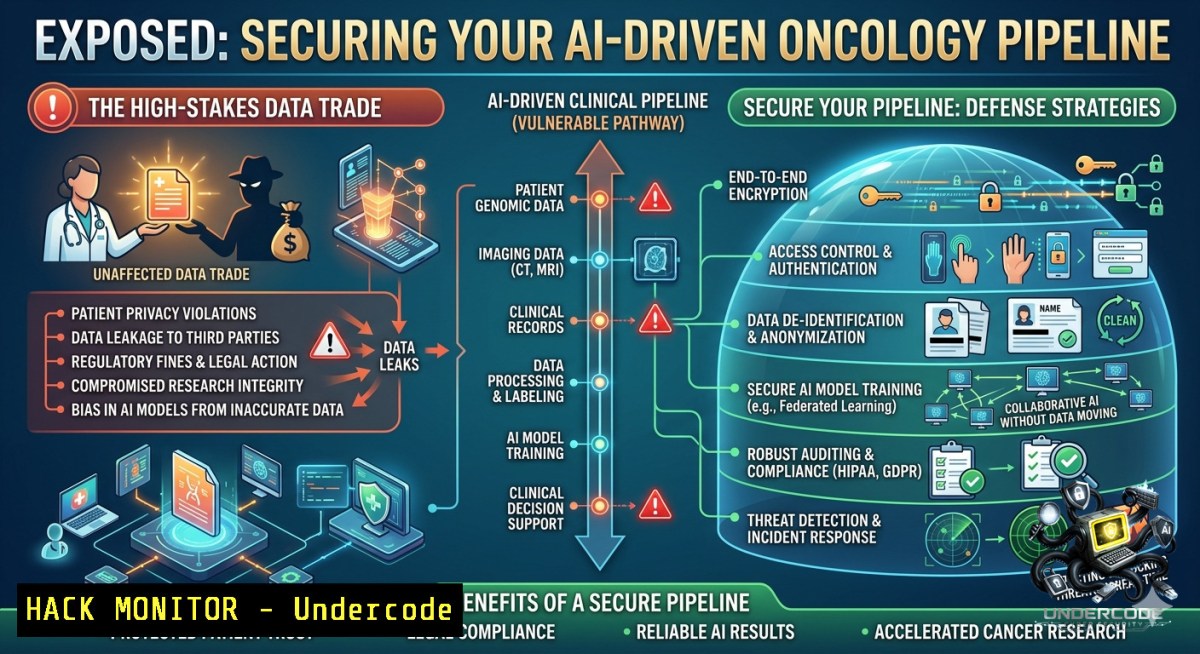
Introduction:
The digitization of oncology research has created a goldmine of sensitive clinical trial data, biomarker insights, and competitive intelligence, making platforms like LARVOL—which leverages AI to transform this data into actionable insights for pharma innovation—prime targets for cyber threats. As the American Society of Clinical Oncology (ASCO) 2026 showcases the latest breakthroughs, understanding how to secure, access, and analyze this data ecosystem is not just an IT concern but a critical component of patient safety and corporate strategy.
Learning Objectives:
- Master the cybersecurity architecture required to protect AI-driven clinical data platforms, including AWS cloud hardening and HIPAA compliance.
- Implement hands-on techniques for extracting and analyzing oncology trial data using APIs, command-line tools, and Python.
- Apply secure training methodologies for medical affairs teams on AI strategy and data storytelling.
You Should Know:
- From Conference Abstract to Actionable Intelligence: Extracting ASCO 2026 Data Programmatically
The core of LARVOL’s offering is its CLIN platform, which curates historical and active clinical trial data, allowing researchers to search and analyze data across specific cancer types. This section provides a step-by-step guide to programmatically access conference data, similar to how LARVOL’s tools prepare users for events like ASCO 2026.
Step‑by‑step guide:
- Identify the Data Source: Navigate to the LARVOL CLIN platform for ASCO 2026 abstracts (e.g., `https://clin.larvol.com/conference/abstract/ASCO%202026`). This interface allows you to filter by trials, conferences, modalities, drugs, and biomarkers.
- Browser Automation with Python (Selenium): Since many clinical data portals are dynamic, use Selenium to automate data extraction.
from selenium import webdriver
from selenium.webdriver.common.by import By
import time

Setup WebDriver
driver = webdriver.Chrome()
driver.get("https://clin.larvol.com/conference/abstract/ASCO%202026")
time.sleep(5)  Allow page to load

Example: Extract trial titles
trials = driver.find_elements(By.CSS_SELECTOR, ".trial-title")
for trial in trials:
print(trial.text)

driver.quit()
- API Data Harvesting (if available): LARVOL’s platform likely uses APIs for data delivery. Use `curl` or Python’s `requests` to interact with these endpoints, ensuring you handle authentication tokens.
curl -X GET "https://api.larvol.com/v1/trials?cancer_type=lung&year=2026" \
-H "Authorization: Bearer YOUR_API_TOKEN" \
-H "Content-Type: application/json"
- Data Analysis with Pandas: Convert extracted data into a structured format for analysis.
import pandas as pd
import json

Assuming you have a JSON response
data = json.loads(response.text)
df = pd.DataFrame(data['trials'])
 Filter for Phase III trials
phase_iii_trials = df[df['phase'] == 'III']
print(phase_iii_trials[['trial_id', 'title', 'status']])
What this does: This process automates the collection of real-time conference intelligence, allowing researchers to quickly identify key presentations, emerging biomarkers, and competitive compounds without manual data entry.
- Securing the Oncology Data Pipeline: A Deep Dive into LARVOL’s AWS Security Architecture
LARVOL’s infrastructure, built on AWS, provides a model for securing sensitive healthcare data. To achieve a 15% reduction in data breach risks and improve HIPAA compliance, they implemented a layered security architecture.
Step‑by‑step guide:
- Network Perimeter Security (AWS WAF): Deploy AWS WAF to filter malicious traffic. A core rule is to block SQL injection attempts.
{
"Name": "block-sqli",
"Priority": 1,
"Action": { "Block": {} },
"VisibilityConfig": { "SampledRequestsEnabled": true, "CloudWatchMetricsEnabled": true, "MetricName": "block-sqli" },
"Statement": {
"SqliMatchStatement": {
"FieldToMatch": { "AllQueryArguments": {} },
"TextTransformations": [{ "Priority": 0, "Type": "NONE" }]
}
}
}
- Data Encryption in Transit and at Rest: Use AWS Certificate Manager (ACM) to provision SSL/TLS certificates, enabling efficient encryption for the platform.
 Request a certificate (AWS CLI)
aws acm request-certificate --domain-1ame ".larvol.com" --validation-method DNS
- Secrets Management with AWS Secrets Manager: Securely store API keys, database credentials, and third‑party tokens. Rotate secrets automatically.
 Retrieve a secret
aws secretsmanager get-secret-value --secret-id larvol/api/clinicaltrials-gov
- Compliance Monitoring (AWS CloudWatch & Config): Monitor configuration changes for compliance with security policies. Set up alerts for unauthorized changes.
 Create a CloudWatch alarm for unauthorized API calls
aws cloudwatch put-metric-alarm --alarm-1ame "UnauthorizedAPICalls" \
--metric-1ame "UnauthorizedAttempts" --1amespace "Larvol/Security" \
--statistic "Sum" --period 300 --threshold 1 \
--comparison-operator "GreaterThanThreshold"
What this does: This configuration hardens a healthcare data platform against common threats (SQLi, MiTM, credential leakage) and ensures continuous compliance with HIPAA and other regulations by providing audit trails and automated remediation.
- AI and LLM Integration: Unlocking Insights from Oncology Data with Secure Python
LARVOL actively leverages Generative AI and Large Language Models (LLMs) to decode its extensive cancer dataset, discussing both successes and failures in their podcast. This tutorial demonstrates how to build a secure RAG (Retrieval-Augmented Generation) pipeline for clinical trial data.
Step‑by‑step guide:
- Environment Setup: Create a virtual environment and install necessary libraries.
python -m venv oncology_ai
source oncology_ai/bin/activate  Linux/macOS
pip install pandas transformers torch faiss-cpu sentence-transformers
- Data Loading (CSV from API): Load clinical trial data obtained from your API extraction.
import pandas as pd
df = pd.read_csv('asco2026_trials.csv')
documents = df['trial_description'].tolist()
- Create Embeddings and Vector Store: Use a Sentence Transformer to embed documents and FAISS for efficient similarity search.
from sentence_transformers import SentenceTransformer
import faiss
import numpy as np

model = SentenceTransformer('all-MiniLM-L6-v2')
embeddings = model.encode(documents)
dimension = embeddings.shape[bash]
index = faiss.IndexFlatL2(dimension)
index.add(np.array(embeddings))
- Query with an LLM (Secure Mode): Implement a local LLM (e.g., GPT4All or Llama.cpp) to avoid sending sensitive data to external APIs.
 Example using a local LLM via Ollama
import requests
query = "Find trials for non-small cell lung cancer with PDL1 inhibitor"
query_embedding = model.encode([bash])
distances, indices = index.search(np.array(query_embedding), k=3)
retrieved_docs = [documents[bash] for i in indices[bash]]
prompt = f"Based on these trials: {retrieved_docs}, answer: {query}"
response = requests.post('http://localhost:11434/api/generate', json={'model': 'llama2', 'prompt': prompt})
print(response.json()['response'])
What this does: This pipeline allows secure, offline analysis of proprietary clinical data using LLMs, minimizing the risk of data leakage associated with cloud-based AI services. It directly reflects LARVOL’s approach to transparently applying AI to oncology.
- Training Medical Affairs Teams on AI and Data Storytelling
LARVOL emphasizes training confident medical affairs teams, focusing on storytelling, AI, and strategy. This section outlines a training module for transforming raw data into strategic narratives.
Step‑by‑step guide (Creating a Training Module):
1. Define Learning Objectives:
- Understand the data lifecycle: from raw clinical trial data to KOL insights.
- Apply AI tools for trend analysis.
- Build a competitive landscape presentation.
2. Hands‑on Activity with Synthetic Data:
- Dataset: Provide a CSV (
clinical_landscape.csv) with columns:Therapy,Phase,Sponsor,Biomarker,Publication_Date. - Task: Use Python’s `pandas` to group by `Therapy` and count trials per
Phase.
import pandas as pd
df = pd.read_csv('clinical_landscape.csv')
landscape = df.groupby(['Therapy', 'Phase']).size().unstack(fill_value=0)
landscape.to_csv('competitive_landscape.csv')
print(landscape)
- AI‑Assisted Insight Generation: Use a secure, local LLM to draft an executive summary based on the generated landscape.
- Data Storytelling Workshop: Have teams convert the AI-generated summary into a compelling slide deck, focusing on strategic implications for their pipeline.
What this does: This training bridges the gap between raw data analytics and executive decision-making, empowering medical affairs teams to leverage AI responsibly and communicate complex data clearly.
- Understanding and Mitigating Risks in KOL Data Aggregation
LARVOL’s Omni tool aggregates professional activity for over 20,000 Key Opinion Leaders (KOLs) from public sources. While valuable, this creates privacy and security risks. This section outlines how to audit and secure such data collection pipelines.
Step‑by‑step guide:
- Audit Data Sources: Use a web crawler to verify that collected data originates only from permitted public sources (e.g., clinicaltrials.gov, PubMed, public social media).
- Implement Data Minimization: Apply filters to ensure only professional (not personal) data is stored.
 Pseudocode for data minimization
allowed_fields = ['work_email', 'institution', 'publication_list', 'trial_involvement']
filtered_data = {k: v for k, v in raw_kol_data.items() if k in allowed_fields}
- Encrypt PII at Rest: Use AWS KMS to encrypt all KOL-related data stored in RDS.
- Regular Compliance Checks: Run automated scripts to check for compliance with GDPR and CCPA, including honoring opt-out requests.
-- SQL query to identify KOLs who have opted out
SELECT kol_id FROM kol_consent WHERE consent_given = FALSE;
What this does: This process ensures that KOL data aggregation remains legally compliant, respects privacy rights, and reduces the risk of data breaches involving professional contacts.
6. Command-Line Monitoring for Clinical Trial Data Integrity
Clinical trial data must maintain integrity (ALCOA++ principles). Use command-line tools to monitor data pipelines for anomalies.
Step‑by‑step guide:
- Check for Data Completeness: Use `wc -l` and `awk` to verify record counts.
 Count expected vs. actual records in a CSV
expected=1000
actual=$(wc -l < clinical_trials_2026-05-30.csv)
if [ $actual -lt $expected ]; then echo "Data Incomplete"; fi
- Validate Date Formats: Use `grep` to ensure date columns are ISO 8601 compliant.
grep -E '[0-9]{4}-[0-9]{2}-[0-9]{2}' clinical_trials.csv || echo "Date format error"
- Monitor Logs for Unauthorized Access: Use `journalctl` on Linux or `Get-EventLog` on Windows to review access logs.
 Linux: Check for failed SSH attempts
sudo journalctl _COMM=sshd | grep "Failed password"

Windows PowerShell: Check for failed logins
Get-EventLog -LogName Security -InstanceId 4625
What this does: These basic CLI commands provide a quick, scriptable way to ensure the integrity and security of clinical trial data pipelines, forming the first line of defense against data corruption or unauthorized access.
What Undercode Say:
- Key Takeaway 1: The intersection of oncology and AI creates immense value but also expands the attack surface; securing the data pipeline from extraction (ASCO 2026) to analysis (LLMs) is as critical as the research itself.
- Key Takeaway 2: Practical, hands-on training that combines data science, cybersecurity, and regulatory compliance is essential for building resilient medical affairs teams in the AI era.
Analysis: LARVOL’s model demonstrates that competitive advantage in precision oncology increasingly depends on the secure integration of AI, cloud infrastructure, and real-time data. The company’s transparent discussion of LLM failures highlights a mature, risk-aware culture. The AWS security stack they employ (WAF, ACM, Secrets Manager) is not merely a checklist but an adaptive framework that scales with data volume and regulatory demands. For cybersecurity professionals, the key insight is that healthcare AI platforms must be designed with “security as code” from the outset—embedding encryption, access controls, and monitoring into the CI/CD pipeline. For IT leaders, the emphasis on training and KOL data governance underscores that technology alone is insufficient; human factors and legal compliance are equally critical. As ASCO 2026 unfolds, the ability to rapidly ingest, secure, and derive insights from conference data will separate market leaders from followers, making these technical and training investments a strategic necessity.
Prediction:
- +1 By 2027, most major oncology conference data will be streamed via secure, FHIR-compliant APIs, enabling real-time, AI-driven meta-analyses that accelerate trial design and patient matching.
- -1 The increased use of LLMs on sensitive clinical data without robust local deployment (air‑gapped models) will lead to at least three major data leaks in the biopharma sector within the next 18 months, prompting stricter regulatory action.
▶️ Related Video (80% Match):
🎯Let’s Practice For Free:
🎓 Live Courses & Certifications:
Join Undercode Academy for Verified Certifications
🚀 Request a Custom Project:
Secure, high-velocity infrastructure and disruptive technological engineering. Contact our engineering team for high-tier development and proprietary systems:
[email protected]
💎 Smart Architecture | 🛡️ Secure by Design | ⭐ Trusted by Thousands
IT/Security Reporter URL:
Reported By: Asco26 Larvol – Hackers Feeds
Extra Hub: Undercode MoN
Basic Verification: Pass ✅


