Listen to this Post
Introduction:
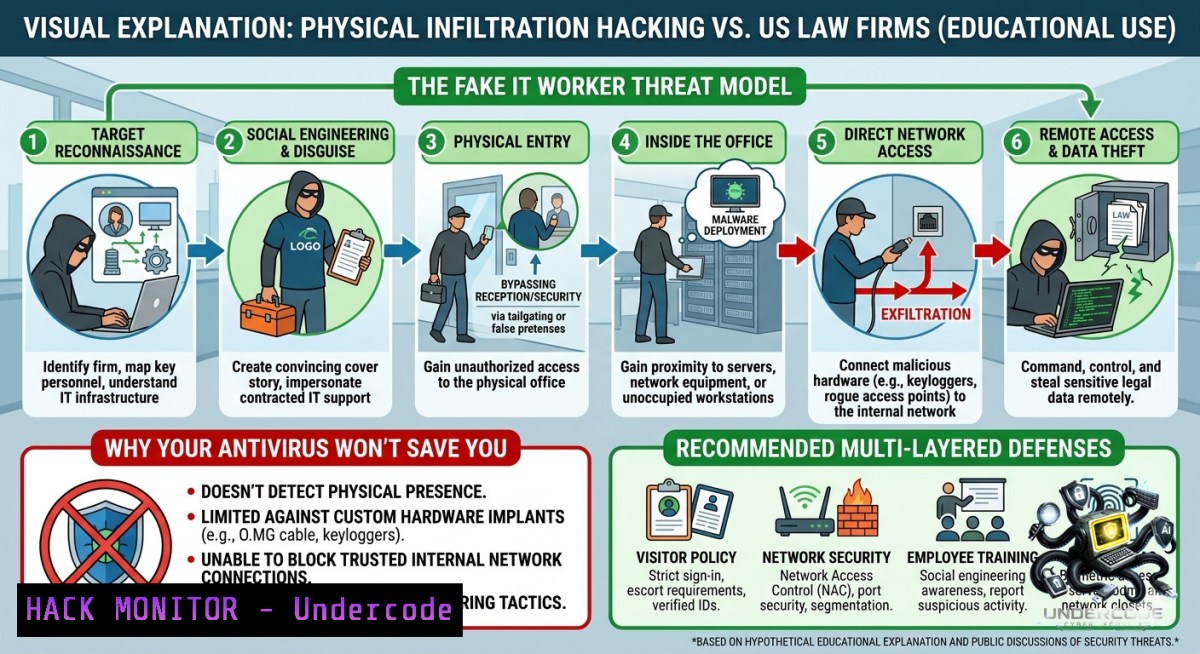
From January through May 2026, Mandiant identified a financially motivated data theft extortion campaign executed by the threat cluster UNC3753, also tracked as “Luna Moth,” “Chatty Spider,” and “Silent Ransom Group” (SRG), targeting dozens of organizations across professional, legal, and financial services in the United States. Unlike traditional ransomware actors, UNC3753 focuses solely on stealing sensitive data without deploying file-encrypting malware, leveraging a combination of aggressive social engineering and physical infiltration. The group’s use of legitimate remote monitoring and management (RMM) tools and in-person “IT support” impersonation allows them to bypass standard security measures, leaving few forensic artifacts and evading traditional antivirus products entirely.
Learning Objectives:
– Understand the unique TTPs (Tactics, Techniques, and Procedures) of UNC3753/SRG, including callback phishing, vishing, physical infiltration, and DNS Fast Flux evasion.
– Identify key Indicators of Compromise (IoCs) and learn how to hunt for signs of this threat using specific Windows and Linux commands.
– Implement actionable mitigation strategies, including disabling external drives, enforcing phishing-resistant MFA, and monitoring for known RMM tool abuse.
You Should Know:
1. The Hybrid Extortion Machine: From Vishing to Physical Infiltration
The UNC3753 campaign lifecycle reflects an optimized, fast-tempo operational model, with the entire attack sequence—from initial contact to data theft and extortion—often occurring within a single business day. Recently, Mandiant observed data searches, staging, and theft initiated in under an hour.
Step‑by‑step guide explaining what this does and how to use it.
– Phase 1: Initial Contact & Pretexting: The group uses benign, invoice-themed email lures sent from actor-controlled consumer email accounts. These messages contain no links or malicious attachments, serving only as a pretext for a follow-up call.
– Phase 2: Vishing & RMM Abuse: Actors call targeted employees, posing as internal IT helpdesk or security team members. Under the guise of addressing a security issue or data migration, they convince targets to download and install legitimate remote access software. Commonly abused tools include AnyDesk, Zoho Assist, Quick Assist, RustDesk, Splashtop, and Atera.
– Phase 3: Data Exfiltration: Once access is established, actors use WinSCP or renamed versions of Rclone to exfiltrate sensitive data, often staging it on legitimate cloud services like Microsoft OneDrive or Google Drive to blend in with normal business activity.
– Phase 4: In-Person Escalation: If remote access attempts fail, SRG operatives physically enter corporate offices, posing as IT technicians. They insert external hard drives or USBs directly into victim computers to steal data, often telling the victim they need to “image the device or create a backup”.
– Phase 5: Extortion & Leak Site Pressure: After exfiltrating data, SRG sends a ransom email threatening to sell or publish the data. They also call employees and clients to pressure the victim, using their data leak site (DLS) to shame non-payers. Resecurity first uncovered the SRG’s Fast Flux network infrastructure, which hides their DLS behind a rotating network of compromised IoT devices and routers in over a dozen countries.
2. Hunting for the Silent Intruder: Detection & IoCs
SRG operations leave few artifacts on compromised machines, making traditional EDR and antivirus solutions largely ineffective. However, proactive hunting can uncover signs of their activity. The following observables have been linked to Silent Ransom Group and can be utilized in mitigation or prevention strategies.
Key Indicators of Compromise (IoCs):
– IP Addresses:
– `141.95.65.152`
– `91.132.92.115`
– File Hashes (SHA256):
– `cf183b9e219814abf5f463c4045b2b1dd2acbe95`
– `782d5b9bf21d8ba6b7a9380876f884e24c2de75b`
– `4493c03e9c6c154a27902ba52bb2cbf5e8040759`
– `f11e10e6a4e1a23b87f09285d92fd89c9b9066f6`
Detection Commands & Scripts:
– Identify RMM Tool Installations (Windows PowerShell):
Get-WmiObject -Class Win32_Product | Where-Object {$_.Name -match "AnyDesk|Zoho|RustDesk|Splashtop|Atera|Quick Assist"} | Format-List Name, Version, InstallDate
– Find Unauthorized WinSCP/Rclone Usage (Linux):
sudo grep -r -E "WinSCP|rclone" /var/log/ /home//.bash_history /home//.zsh_history 2>/dev/null
– Audit USB Storage Mount Events (Linux – log recent USB insertions):
sudo dmesg | grep -i "usb" | grep -i "new high-speed"
3. Fortifying Your Digital & Physical Perimeter: Hardening Strategies
The FBI advises organizations to disable external drive connections, block port 22, require phishing-resistant multifactor authentication (MFA), and verify IT support credentials.
– Disable USB Mass Storage (Windows Group Policy):
Navigate to: Computer Configuration -> Administrative Templates -> System -> Removable Storage Access -> “All Removable Storage classes: Deny all access” -> Enabled.
Command Line (Run as Administrator):
reg add HKLM\SYSTEM\CurrentControlSet\Services\USBSTOR /v Start /t REG_DWORD /d 4 /f
– Block Outbound RMM Tool Ports (Firewall – Linux iptables):
Block common outbound ports for AnyDesk (7070, 21115-21119) and other tools. Replace `
sudo iptables -A OUTPUT -p tcp --dport 7070 -j DROP
sudo iptables -A OUTPUT -p tcp --dport 21115:21119 -j DROP
– Implement Phishing-Resistant MFA (Microsoft Entra ID):
Require certificate-based authentication or FIDO2 security keys (e.g., YubiKey) for all administrative accounts. Disable phone call/SMS MFA methods which are vulnerable to SIM-swapping and social engineering.
What Undercode Say:
– The evolution from purely digital attacks to a hybrid model incorporating physical infiltration marks a dangerous new frontier in cyber extortion, forcing organizations to rethink their security paradigms.
– The group’s strategy of using only legitimate tools and avoiding malware entirely highlights a critical failure in signature-based detection, reinforcing the need for behavior-based analytics and strict application whitelisting.
Expected Output:
The battle against UNC3753 is a defensive arms race against an adversary that has perfected the art of social manipulation. The group’s ability to pivot between remote and physical intrusion, combined with their use of living-off-the-land techniques, makes them a formidable threat. Defenders must prioritize employee security awareness training focused on social engineering, enforce strict physical access controls, and deploy advanced endpoint detection and response (EDR) solutions capable of identifying anomalies in RMM tool behavior. The legal sector, in particular, must harden its defenses, as the highly sensitive nature of client data makes it a prime and persistent target.
Prediction:
– -1 Expect to see a surge in “physical pentesting” and “social engineering” as a service offerings on darknet markets, lowering the barrier for entry for less-sophisticated attackers to replicate these hybrid tactics.
– -P The private sector will respond by developing new security frameworks and insurance policies that specifically address “physical breach” scenarios, leading to a boom in integrated physical and cybersecurity training programs.
– -1 Legal and financial services firms will face a wave of class-action lawsuits from clients whose confidential data was stolen in these breaches, potentially reshaping data liability laws.
– -P The increased focus on this threat will accelerate the adoption of Zero Trust architecture and USB port control policies across regulated industries, closing a long-standing gap in endpoint security.
– -1 However, the reliance on human psychology as the primary attack vector means that no purely technical solution will fully mitigate the risk, ensuring that these extortion campaigns will remain effective for the foreseeable future.
▶️ Related Video (76% Match):
🎯Let’s Practice For Free:
🎓 Live Courses & Certifications:
[Join Undercode Academy for Verified Certifications](https://undercode.co.uk/certifications/)
🚀 Request a Custom Project:
Secure, high-velocity infrastructure and disruptive technological engineering. Contact our engineering team for high-tier development and proprietary systems:
[[email protected]](mailto:[email protected])
💎 Smart Architecture | 🛡️ Secure by Design | ⭐ Trusted by Thousands
IT/Security Reporter URL:
Reported By: [Jamie Williams](https://www.linkedin.com/posts/jamie-williams-108369190_lock-your-doors-seeking-counsel-ongoing-share-7468688846403219456-a0kQ/) – Hackers Feeds
Extra Hub: Undercode MoN
Basic Verification: Pass ✅
🔐JOIN OUR CYBER WORLD [ CVE News • HackMonitor • UndercodeNews ]
[💬 Whatsapp](https://undercode.help/whatsapp) | [💬 Telegram](https://t.me/UndercodeCommunity)
📢 Follow UndercodeTesting & Stay Tuned:
[𝕏 formerly Twitter 🐦](https://x.com/undercodeupdate) | [@ Threads](https://www.threads.net/@undercodetesting) | [🔗 Linkedin](https://www.linkedin.com/company/undercodetesting/) | [🦋BlueSky](https://bsky.app/profile/undercode.bsky.social)


