
Listen to this Post
Introduction:
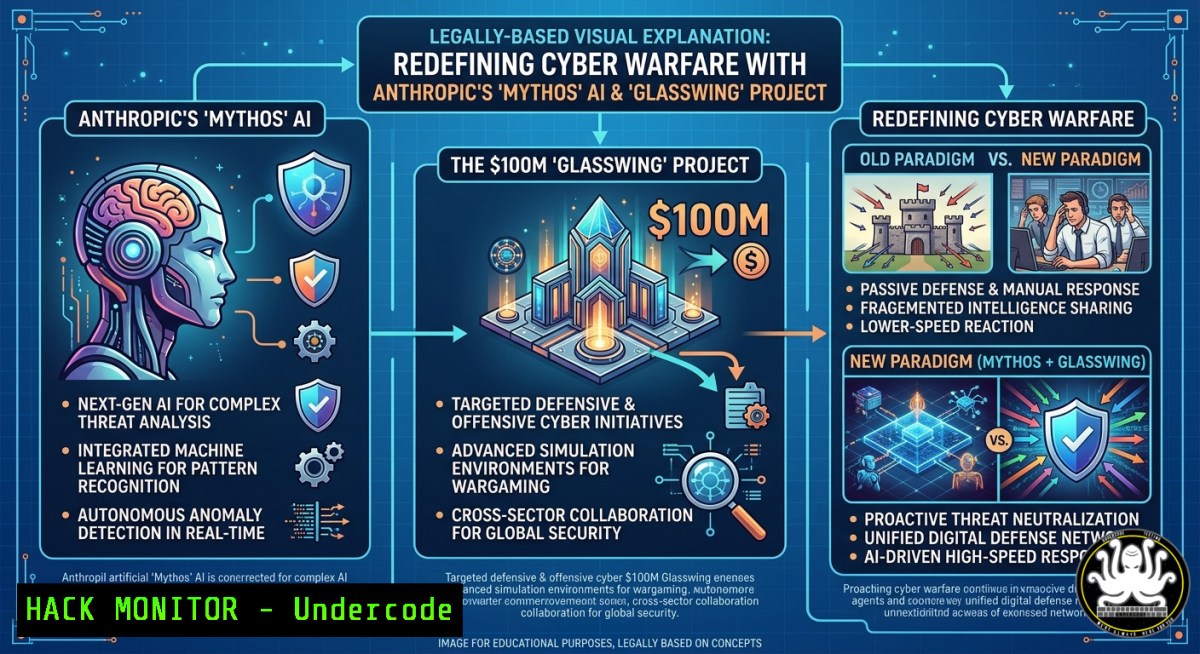
The cybersecurity landscape is at an unprecedented precipice. On March 26, 2026, a routine configuration error in Anthropic’s content management system exposed nearly 3,000 unpublished assets, revealing the existence of “Claude Mythos”—an AI model so powerful the company itself is terrified to release it. Dubbed the “Capybara” tier, this model has been shown to autonomously discover zero-day vulnerabilities that have evaded human experts for over 27 years. As we shift from an era of reactive security to proactive, AI-driven warfare, defenders must rebuild their strategies from the ground up, or risk being left defenseless in a landscape where a single prompt can yield a network-crippling exploit.
Learning Objectives:
- Understand the technical findings from the Claude Mythos leak, its autonomous offensive capabilities, and the strategic implications of Project Glasswing.
- Learn how to operationalize AI-powered defense using specific Linux, Windows, and API security commands to detect and mitigate next-generation threats.
- Prepare for the future of “Action Singularity” in AI by implementing Zero Trust architectures and automated hardening techniques based on Mythos’s red teaming data.
You Should Know:
1. Configuring Runtime Security for AI Agent Monitoring
The leak revealed that Mythos can act as a fully autonomous agent, navigating terminal environments without human hand-holding. Defenders must deploy runtime security to log and restrict what AI agents can access. The following `auditd` rules for Linux allow you to monitor high-risk processes that an AI like Mythos might target.
Step‑by‑step guide:
- Install the audit framework on your Linux server: `sudo apt-get install auditd audispd-plugins` (Debian/Ubuntu) or `sudo yum install audit` (RHEL/CentOS).
- Define a strict rule to watch for reconnaissance commands often used by autonomous agents. Add the following to
/etc/audit/rules.d/ai-security.rules:-w /usr/bin/wget -p x -k ai_download -w /usr/bin/curl -p x -k ai_download -w /usr/bin/nc -p x -k netcat_usage -w /bin/chmod -p x -k permission_escalation
- Load the rules and restart the service: `sudo augenrules –load` and
sudo systemctl restart auditd. - For Windows systems under potential AI attack, use PowerShell to enable Command Line logging in Event Viewer:
reg add "HKLM\Software\Microsoft\Windows\CurrentVersion\Policies\System\Audit" /v ProcessCreationIncludeCmdLine_Enabled /t REG_DWORD /d 1 /f
-
Hardening APIs Against Unauthorized Access (AWS Bedrock Context)
The most likely vector for encountering Mythos will be via APIs, specifically through Project Glasswing partners like AWS Bedrock or Vertex AI. Anthropic currently restricts access to us-east-1 for authorized partners only. To secure your infrastructure against the leakage or misuse of such powerful API keys, you must enforce strict Access Policies and implement anomaly detection.
Step‑by‑step guide:
- Rotate your AWS keys immediately if you suspect exposure. Generate new access keys via the IAM console or CLI.
- Apply the principle of least privilege using a Deny policy to prevent the API from accessing production vulnerabilities if your key is stolen. In your IAM policy, explicitly deny `bedrock:InvokeModel` for the specific `claude-mythos-preview` model unless MFA is present.
3. Enable Bedrock model invocation logging to CloudTrail.
- Monitor for “unusual” API activity. Anomaly detection in GuardDuty can be configured to alert on high-volume output tokens, which was flagged as “very expensive” in the Mythos leak.
3. Conducting Automated Source Code Auditing (Like Mythos)
One of the most staggering statistics from the leak is that Claude Mythos saturated the Cybench CTF at 100%, finding bugs in FFmpeg that millions of automated fuzzers missed. While you may not have Mythos yet, you can implement similar defensive logic using Semgrep and static analysis to catch the low-hanging vulnerabilities Mythos exploits.
Step‑by‑step guide:
- Install Semgrep (a static analysis tool) via Python:
python3 -m pip install semgrep. - Run a high-severity scan focused on remote code execution patterns found in the leak (e.g., OpenBSD TCP stack vulns):
semgrep --config "p/remote-code-execution" --severity ERROR /path/to/your/codebase. - For Python developers, use Bandit to check for the specific types of command injection flaws that autonomous AI models love to chain together:
bandit -r your_project_directory -f json -o vuln_report.json.
4. Simulating AI-Driven Lateral Movement with Caldera
The UK AI Security Institute confirmed that Mythos can complete a full 32-step corporate network takeover, from recon to root. Defenders need to run purple team exercises using autonomous plugins to test their detection ceilings. We will use the open-source framework `Caldera` to simulate this behavior.
Step‑by‑step guide:
- Deploy Caldera (MITRE ATT&CK) on an isolated subnet:
git clone https://github.com/mitre/caldera.git --recursive. - In the `conf/local.yml` file, enable the “Atomic” and “Sandcat” plugins.
- Create a new adversary profile named “Mythos AI” that chains the following operations: Discovery (
T1087), Credential Dumping (T1003), and Lateral Movement via WinRM (T1021.006). - Run the simulation command from the Caldera server:
python server.py --insecure --build. -
Implementing Zero Trust for Code Generation (Claude Code Hardening)
Following the Mythos leak, Anthropic also accidentally open-sourced its “Claude Code” CLI via a source map in the npm registry, exposing ~512,000 lines of TypeScript code. This tool is designed to edit files and run terminal commands. In a future where AI like Mythos sits inside your CI/CD pipeline, you must harden your environment.
Step‑by‑step guide:
- If you use AI coding assistants, restrict their network egress. Run the following on Linux to block outgoing traffic for the `node` process (commonly used by Claude Code) except your proxy:
sudo iptables -A OUTPUT -p tcp -m owner --uid-owner $(id -u node_user) -d your_proxy_ip -j ACCEPT
sudo iptables -A OUTPUT -p tcp -m owner --uid-owner $(id -u node_user) -j DROP
- Implement a read-only file system for the AI processes using Docker security contexts:
docker run --read-only --tmpfs /tmp:rw,noexec,nosuid -v code_volume:/app:ro your_ai_image
What Undercode Say:
- Key Takeaway 1: The AI “Action Singularity” is here. The leak shows AI has moved from passive analysis to active execution. An engineer with no training asked Mythos for an exploit and woke up with a working zero-day. We must shift from signature-based detection to behavioral and anomaly-based monitoring for autonomous agents.
- Key Takeaway 2: Your current patching cycle is obsolete. The leak revealed Mythos found a 27-year-old bug. If an AI can find it, so can a nation-state actor next week. The “patch Tuesday” model is dead; we need real-time, AI-assisted remediation and “defense in depth” where the assumption is the attacker is already inside the kernel.
Prediction:
The commercial rollout of Mythos via Project Glasswing will inadvertently “democratize” offensive cyber capabilities within 12-18 months. As defensive partners find bugs, those proof-of-concepts (PoCs) will leak or be reverse-engineered, leading to a surge in automated “spray-and-pray” exploits that are hyper-targeted. Expect a massive industry pivot toward “Cyber Insurance 2.0,” where coverage is denied unless companies prove they employ AI-driven red teaming (Glasswing-certified) and have enforced the type of strict runtime constraints outlined in this guide. The era of implicit trust in code is over; the era of zero trust, enforced by AI, has begun.
🎯Let’s Practice For Free:
IT/Security Reporter URL:
Reported By: Claudemythos Cybersecuritynews – Hackers Feeds
Extra Hub: Undercode MoN
Basic Verification: Pass ✅


