
Listen to this Post
Introduction:
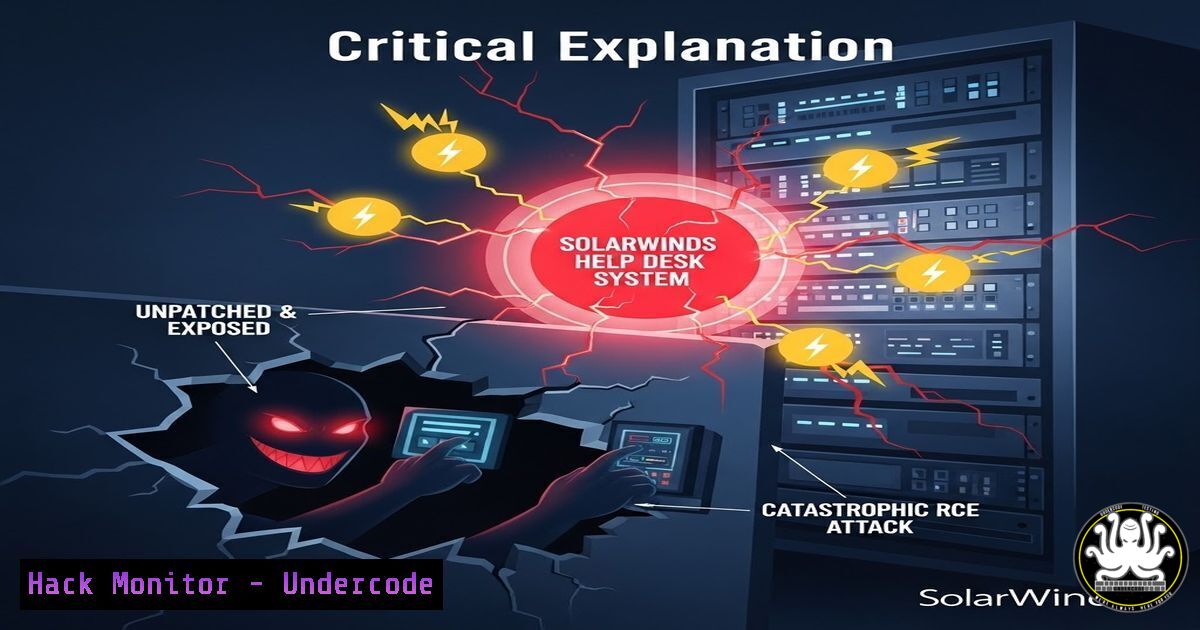
A critical remote code execution vulnerability in SolarWinds Web Help Desk, tracked as CVE-2025-40551, is actively being exploited, threatening unpatched IT service management systems globally. With a severity score of 9.8, this unauthenticated deserialization flaw allows attackers to execute arbitrary code without needing credentials. Despite patches being available, over 170 installations remain exposed online, prompting urgent action from security teams to identify, isolate, and remediate vulnerable instances.
Learning Objectives:
- Understand the mechanics and critical risk of the CVE-2025-40551 deserialization vulnerability.
- Learn practical steps to detect vulnerable SolarWinds Web Help Desk instances on your network.
- Master the immediate containment, patching, and hardening procedures to protect your environment.
You Should Know:
- Decoding the Threat: Why CVE-2025-40551 is a “Critical” 9.8
The core of CVE-2025-40551 is an insecure deserialization flaw in the SolarWinds Web Help Desk application. Serialization is the process of converting an object into a format that can be transmitted or stored. Deserialization is the reverse. When an application deserializes untrusted or tampered-with data without proper validation, it can be tricked into instantiating malicious objects that execute code. This flaw is particularly dangerous because it is “unauthenticated,” meaning an attacker can exploit it without any login credentials, simply by sending a crafted network request to the vulnerable endpoint.
Step-by-Step Guide to Understanding the Attack Flow:
- Reconnaissance: Attackers scan the internet (e.g., using Shodan, Censys) for systems running SolarWinds Web Help Desk on default ports.
- Crafting the Payload: They create a malicious serialized object designed to run a command (like `cmd.exe /c whoami` or
/bin/bash -c 'id') when deserialized by the target system. - Delivery: This payload is embedded within an HTTP request sent to a specific vulnerable API or web endpoint in the Help Desk application.
- Exploitation: The vulnerable application receives the request, deserializes the malicious object, and executes the embedded command with the same privileges as the application service (often high-level SYSTEM or root).
- Persistence: Initial access is typically used to deploy web shells, establish reverse shells for continuous control, or move laterally within the network.
-
Detection & Recon: Finding Vulnerable Instances on Your Network
Before patching, you must find all instances. Attackers are already doing this via internet-wide scans.
Step-by-Step Guide for Internal Network Detection:
- Port Scanning: The Web Help Desk web interface typically runs on TCP ports 8081, 8080, or 443. Use network scanners to find hosts with these ports open.
Nmap Command (Linux/Windows):
nmap -p 8081,8080,443 --open -sV -oA solarwinds_scan 192.168.1.0/24
Analysis: The `-sV` flag will attempt to identify the service version. Look for banners containing “SolarWinds” or “Web Help Desk.”
2. HTTP Fingerprinting: Manually or via script, check the suspected web interface.
cURL Command to Check Response Headers:
curl -I http://<TARGET_IP>:8081
Look for: Headers like `Server: SolarWinds` or unique cookies.
3. Version Identification: If you have access, log into the admin console and navigate to Help > About to find the exact version. Any version prior to 2026.1 is vulnerable.
4. External Exposure Check (Defensive): Use threat intelligence platforms to see if your company’s IP ranges have exposed SolarWinds services. The Shadowserver report likely stems from such non-intrusive, banner-checking scans.
3. Immediate Containment: Isolating the Threat Before Patching
If you find a vulnerable system that cannot be patched immediately, you must contain it.
Step-by-Step Guide for Network Containment:
- Segment: Immediately place the vulnerable host in an isolated VLAN or behind a firewall that blocks all inbound traffic except from strictly necessary, trusted management IPs.
- Harden Firewall Rules: Apply strict network access control lists (ACLs).
Example Linux iptables Rule (to only allow your admin subnet):iptables -A INPUT -p tcp --dport 8081 -s 10.0.1.0/24 -j ACCEPT iptables -A INPUT -p tcp --dport 8081 -j DROP
Windows Firewall (via PowerShell): Create a restrictive rule.
New-NetFirewallRule -DisplayName "Block WHD External" -Direction Inbound -Protocol TCP -LocalPort 8081 -Action Block
- Web Application Firewall (WAF): If available, deploy a virtual patch. Configure the WAF to block HTTP requests containing patterns associated with Java or .NET deserialization payloads. This is a temporary mitigation, not a fix.
- Monitor Logs Aggressively: Enable verbose logging on the host and network device. Look for unusual outbound connections (reverse shells) or exploit pattern signatures in web logs.
4. Patching and Remediation: The Definitive Fix
The only complete remedy is applying the official SolarWinds patch.
Step-by-Step Patching Guide:
- Download: Obtain SolarWinds Web Help Desk version 2026.1 or later from the official SolarWinds customer portal. Always verify checksums.
- Backup: Perform a full backup of the application, its database, and configuration files. Document all custom settings.
- Apply Patch: Follow SolarWinds’ official upgrade guide. This typically involves running an installer or deployment package.
- Validate: After patching, verify the version in the admin console. Conduct a safe, authorized test to confirm the exploit path is closed (e.g., internal penetration test or vulnerability scan).
- CISA KEV Compliance: Federal agencies were mandated to patch by February 6, 2026. All organizations should use this as a benchmark for urgency.
-
Post-Exploitation Forensics: What to Do If You Suspect a Breach
Assuming the worst is crucial. If you find an unpatched system that was internet-facing, assume compromise.
Step-by-Step Guide for Incident Response:
- Isolate & Image: Do not turn the system off. Disconnect it from the network and create a forensic disk image (
ddon Linux, FTK Imager on Windows) for later analysis.
2. Check for Obvious Artifacts:
Webshells: Scan the web root directory for unfamiliar .jsp, .asp, .aspx, .php, or `.war` files.
Linux find command example:
find /var/www/ -type f ( -name ".jsp" -o -name ".war" ) -newermt 2026-01-01
User Accounts: Check for new, unexpected user accounts on the host OS.
Scheduled Tasks/Cron Jobs: Look for malicious persistence mechanisms.
3. Analyze Logs: Scour web server logs (e.g., access.log) for requests to strange files, long parameters, or patterns matching exploit tools like ysoserial.
4. Credential Rotation: Reset all credentials that were stored on or accessible from the compromised system, including database passwords, service accounts, and administrator logins.
5. Hunt Laterally: Use EDR and network monitoring tools to search for lateral movement from the compromised host’s IP.
What Undercode Say:
- Patching Deadline is a Cliff, Not a Guideline: CISA’s KEV catalog deadline (February 6, 2026) has passed. Any exposed, unpatched system is not just at risk—it is actively being compromised. The time for planning is over; the only action is isolation or patching.
- ITSM Systems are Crown Jewels: Attackers don’t just want a shell; they want the IT service management (ITSM) platform. Compromising it provides a treasure trove of internal network diagrams, user privilege data, asset lists, and trusted communication channels perfect for sophisticated, long-term phishing and lateral movement campaigns.
The criticality of CVE-2025-40551 cannot be overstated. It represents a perfect storm: a flaw in a widely used enterprise software, an exploit that requires zero interaction or privilege, and a payload that grants full control. The existence of over 170 exposed instances days after patches and mandates reveals a dangerous gap in vulnerability management processes. This is not a theoretical threat; the “actively exploited” designation and CISA’s swift action mean automated exploitation scripts are already in circulation. Defenders must transition from a patch management mindset to a patch urgency mindset for critical internet-facing systems.
Prediction:
The active exploitation of CVE-2025-40551 will accelerate the automation of software supply chain attacks. Threat actors, seeing the success in targeting a fundamental IT operations tool, will increasingly shift focus from end-user applications to the administrative and DevOps backbones of organizations. We predict a rise in the discovery and weaponization of similar unauthenticated RCE flaws in other IT service management (ITSM), remote monitoring and management (RMM), and network management platforms throughout 2026. This will force a fundamental re-architecture of these critical tools, moving them away from public internet exposure by default and towards zero-trust network access (ZTNA) models, even for administrative interfaces. Organizations that fail to adapt will face relentless targeting of their most sensitive operational technology.
▶️ Related Video (82% Match):
🎯Let’s Practice For Free:
IT/Security Reporter URL:
Reported By: Krehlik More – Hackers Feeds
Extra Hub: Undercode MoN
Basic Verification: Pass ✅


