Listen to this Post
Introduction:
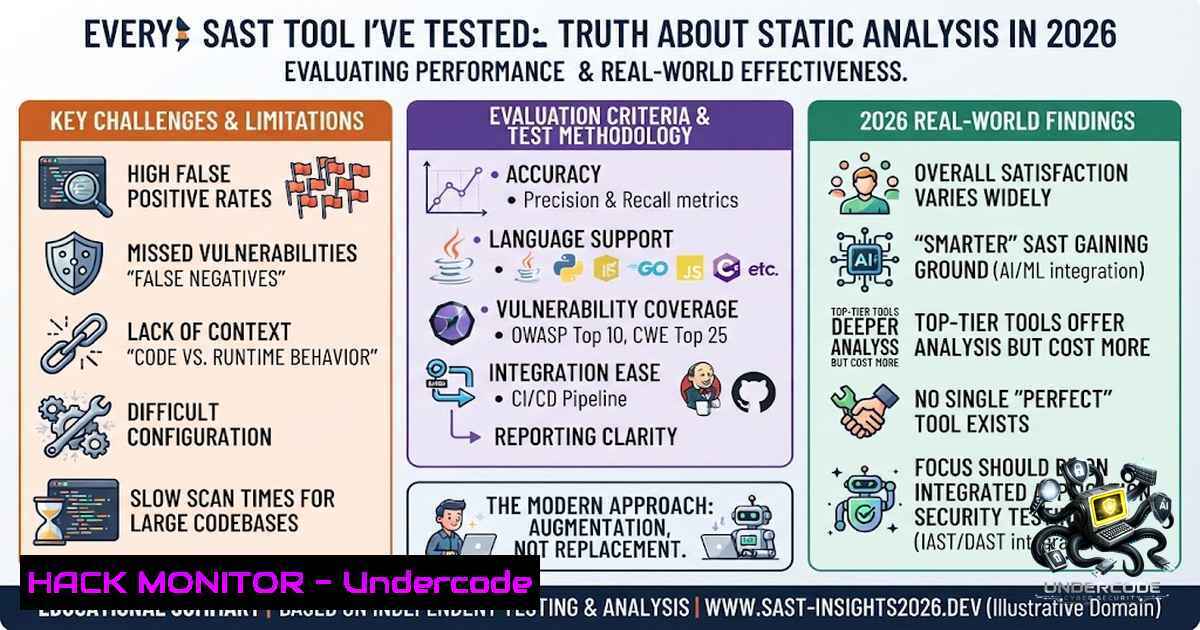
Static Application Security Testing (SAST) has become the cornerstone of modern DevSecOps, yet the landscape has shifted dramatically. With AI-generated code flooding repositories and attack surfaces expanding exponentially, security leaders face a critical challenge: how to keep up without sacrificing developer velocity. Recent benchmarks reveal a three-tier hierarchy among scanners, with security-specialized tools outperforming rule-based SAST by nearly 4x under real-world conditions. This article distills hands-on testing across 15 scanners on 26 vulnerable repositories, delivering actionable insights for building a resilient SAST program.
Learning Objectives:
- Understand the current SAST tool landscape and how to evaluate scanners against real-world benchmarks
- Master CI/CD pipeline integration for automated security scanning across GitHub Actions, GitLab CI, and Jenkins
- Learn practical commands and configurations for Semgrep, CodeQL, Bandit, and Fortify across Linux and Windows environments
You Should Know:
- The SAST Tool Hierarchy: What the Benchmarks Actually Reveal
The recently released RealVuln benchmark—the first open-source comparison of Rule-Based SAST, General-Purpose LLMs, and Security-Specialized scanners—tested 15 tools on 796 hand-labeled vulnerabilities across 26 intentionally vulnerable Python repositories. The results are staggering.
Under F3 scoring (weighting recall 9x over precision), the Security-Specialized scanner achieved 73.0, followed by the best General-Purpose LLM (Claude Sonnet 4.6) at 51.7—nearly 3x higher than the best Rule-Based tool, Semgrep at 17.7. However, under F1 scoring, Sonnet 4.6 actually leads with 60.9, demonstrating that tool rankings shift significantly depending on your prioritization of false positives versus missed vulnerabilities. The three-tier hierarchy, however, remains consistent across all weightings.
For enterprises, the Forrester Wave Q3 2025 evaluated 10 vendors including Checkmarx, GitHub, GitLab, Snyk, and Sonar, noting that SAST has matured into a market where differentiation increasingly revolves around AI integration, speed, and developer experience. Fortify SCA, while often cited as one of the most expensive options with enterprise deals exceeding $50,000–$100,000 annually, ranked highest in reporting and usability. Meanwhile, Sparrow SAST demonstrated the best detection performance in a separate comparative study on Java test cases.
Key insight: No single tool solves all problems. Organizations must evaluate based on their specific stack, risk tolerance, and whether they prioritize minimizing false positives (F1) or catching every possible vulnerability (F3).
2. CI/CD Integration: Building Your Automated Security Pipeline
Integrating SAST into CI/CD pipelines represents one of the highest-ROI security controls a development team can implement. A well-configured SAST tool in CI should catch 20–40% of security bugs before code review—not 100%, and that’s acceptable. The goal is automating the obvious ones so human reviewers focus on subtle business logic flaws.
GitHub Actions with Semgrep (Fast, Any Language):
name: SAST
on:
push:
branches: [bash]
pull_request:
jobs:
semgrep:
runs-on: ubuntu-latest
container:
image: semgrep/semgrep
steps:
- uses: actions/checkout@v4
- name: Run Semgrep
run: |
semgrep scan \
--config=auto \
--error \
--severity=ERROR \
--output=semgrep-results.sarif \
--sarif .
- uses: github/codeql-action/upload-sarif@v3
if: always()
with:
sarif_file: semgrep-results.sarif
GitHub Actions with CodeQL (Deep Taint-Flow Analysis):
name: CodeQL
on:
push:
branches: [bash]
pull_request:
jobs:
analyze:
runs-on: ubuntu-latest
permissions:
security-events: write
strategy:
matrix:
language: [javascript, python]
steps:
- uses: actions/checkout@v4
- uses: github/codeql-action/init@v3
with:
languages: ${{ matrix.language }}
- uses: github/codeql-action/analyze@v3
GitLab CI (Built-in SAST Support):
include:
- template: Security/SAST.gitlab-ci.yml
Jenkins Pipeline Integration:
stage('SAST Scan') {
steps {
sh '''
docker run --rm -v $(pwd):/src semgrep/semgrep semgrep scan \
--config=auto \
--sarif \
--output=sast-results.sarif \
/src
'''
}
post {
always {
sarifReport pattern: 'sast-results.sarif'
}
}
}
Windows Environment (Semgrep CLI):
 Install Semgrep on Windows
python -m pip install semgrep

Run scan
semgrep scan --config=auto --sarif --output=results.sarif .
- Tool Selection: Matching SAST to Your Technology Stack
Choosing the right SAST tool depends heavily on your primary language and customization requirements:
- Semgrep — Open-source, polyglot (Python, JS/TS, Go, Java, Ruby, PHP, C/C++), fast, highly customizable YAML-based rules. Best default choice for most teams.
- CodeQL — GitHub’s static analysis engine with powerful taint-flow analysis. Available free for public repos via GitHub Advanced Security. Slower but highly accurate for Java, JS, Python, Go, and C/C++.
- Bandit — Python-only, extremely fast, excellent for common Python security issues. Pair with Semgrep for broader coverage.
- ESLint with eslint-plugin-security — JavaScript/TypeScript, integrates into existing ESLint configs. Ideal for React and Node.js codebases.
- Checkmarx — Best for enterprise SAST with comprehensive coverage.
- Snyk — Strongest in SCA (software composition analysis) but weaker on SAST code analysis.
Linux Command Examples:
 Semgrep installation and scan
python3 -m pip install semgrep
semgrep scan --config=p/security-audit --json --output=results.json .

Bandit for Python
bandit -r ./src -f json -o bandit-results.json

SonarQube scanner
sonar-scanner -Dsonar.projectKey=myproject -Dsonar.sources=. -Dsonar.host.url=http://localhost:9000

Fortify sourceanalyzer
sourceanalyzer -b mybuild -source 1.8 -cp ./lib/ ./src//.java
sourceanalyzer -b mybuild -scan -f report.fpr
Windows Command Examples:
 Semgrep
semgrep scan --config=auto --sarif --output=results.sarif .

Bandit
bandit -r .\src -f json -o bandit-results.json

Fortify (PowerShell)
sourceanalyzer -b mybuild -source 1.8 -cp .\lib\ .\src\.java
sourceanalyzer -b mybuild -scan -f report.fpr

Contrast Security SAST
contrast scan -f <filename>
- Tuning for Signal vs. Noise: The False Positive Challenge
The Ghost Security CAST report found a staggering 99.5% false positive rate for command-injection findings in Python/Flask applications, with 91% of all 2,166 findings being noise. This underscores SAST’s fundamental challenge: without proper tuning, tools become more of a nuisance than a security asset.
Best practices for reducing false positives:
- Conduct pilot runs before full rollout — Test on a representative repository and establish baseline metrics.
- Start with high-risk applications — Focus SAST efforts on applications handling sensitive data or facing the public internet.
- Set severity thresholds — Configure tools to fail builds only on critical/high findings; allow lower-severity issues to be tracked separately.
- Custom rule development — Use YAML-based rule engines (Semgrep) to create organization-specific patterns and suppress known false positives.
- Integrate with developer workflows — Provide remediation guidance directly in pull requests with clear, actionable fixes.
Semgrep custom rule example (suppressing false positives):
rules:
- id: custom-sql-injection
pattern-either:
- pattern: $X.execute("SELECT ... " + $INPUT)
- pattern: $X.execute(f"... { $INPUT } ...")
message: Potential SQL injection detected
severity: ERROR
languages:
- python
paths:
exclude:
- "tests/"
- "migrations/"
- AI and the Future of SAST: Remediation Automation
Modern SAST solutions are increasingly leveraging AI to triage, prioritize, and even automate remediation. The most advanced solutions send context to LLMs—including flawed code snippets and secure examples—to provide multiple fix options that developers can review and accept directly.
Several vendors now offer Model Context Protocol (MCP) servers to interact with LLMs generating code, identifying insecure patterns in real-time. Meanwhile, security-specialized scanners using deep learning approaches are demonstrating superior performance over both rule-based and general-purpose LLMs.
The emergence of tools like Codex Security (evolved from Aardvark, powered by GPT-5) has exposed structural blind spots in traditional SAST. In one notable benchmark, these tools discovered all 12 zero-day vulnerabilities in OpenSSL’s January 2026 security patch, including a stack buffer overflow (CVE-2025-15467).
What Undercode Say:
- Key Takeaway 1: The SAST landscape has clearly stratified into three tiers—Security-Specialized scanners lead, followed by General-Purpose LLMs (which outperform rule-based tools by nearly 3x), and traditional Rule-Based SAST bringing up the rear. Organizations should consider hybrid approaches combining multiple tool types.
-
Key Takeaway 2: CI/CD integration is non-1egotiable. Automated scanning on every pull request with build-fail thresholds catches 20–40% of vulnerabilities before they reach production. The configuration examples provided (GitHub Actions, GitLab CI, Jenkins) offer production-ready templates for immediate implementation.
Analysis: The conversation around SAST has matured beyond “which tool is best” to “how do we effectively operationalize static analysis in a world of AI-generated code.” The 99.5% false positive rate in Python/Flask environments is a wake-up call—tools are only as valuable as their configuration and tuning. The RealVuln benchmark’s open-source approach (all code, ground-truth data, and scoring scripts released under open-source license) represents a critical step toward transparency in security tool evaluation. Moving forward, successful organizations will adopt layered strategies: fast, rule-based scanners for immediate feedback on pull requests, deeper taint-analysis tools for pre-merge validation, and AI-enhanced scanners for comprehensive codebase audits. The key is not choosing a single tool but building a workflow that balances speed, accuracy, and developer experience.
Prediction:
- +1 SAST will increasingly shift from “finding vulnerabilities” to “automating remediation,” with AI-powered fix suggestions becoming the primary value proposition rather than detection capabilities.
- +1 The open-source benchmark movement (exemplified by RealVuln) will drive unprecedented transparency in tool evaluation, forcing vendors to compete on measurable accuracy rather than marketing claims.
- -1 The proliferation of AI-generated code will outpace traditional SAST capabilities, creating a “security debt” crisis where 40-60% of new vulnerabilities originate from LLM-generated code that rule-based tools cannot detect.
- +1 Security-specialized scanners using deep learning will become the new standard, with general-purpose LLMs serving as complementary analysis layers rather than primary detection engines.
- -1 Organizations that fail to implement CI/CD-integrated SAST with proper tuning will experience security breaches costing an average of $4.88 million per incident, as vulnerabilities reach production undetected.
▶️ Related Video (82% Match):
🎯Let’s Practice For Free:
🎓 Live Courses & Certifications:
Join Undercode Academy for Verified Certifications
🚀 Request a Custom Project:
Secure, high-velocity infrastructure and disruptive technological engineering. Contact our engineering team for high-tier development and proprietary systems:
[email protected]
💎 Smart Architecture | 🛡️ Secure by Design | ⭐ Trusted by Thousands
IT/Security Reporter URL:
Reported By: Cameronww7 Every – Hackers Feeds
Extra Hub: Undercode MoN
Basic Verification: Pass ✅


