Listen to this Post
Introduction:
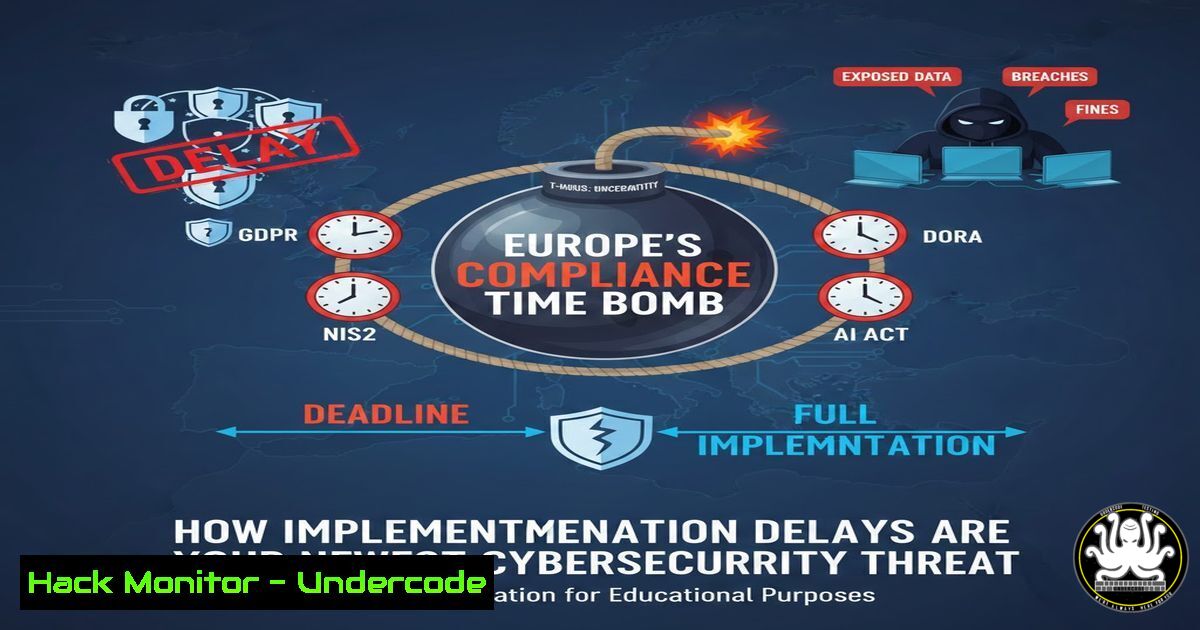
A silent crisis is brewing beneath Europe’s wave of new regulations. The frantic pace of legislation—from NIS2 and DORA to the AI Act—is creating a dangerous “implementation frontier” where theoretical compliance collides with operational reality. This gap isn’t just bureaucratic; it’s a critical intelligence signal exposing systemic vulnerabilities in cyber defenses, critical infrastructure, and platform security, turning regulatory delay into a measurable threat vector for organizations across the continent.
Learning Objectives:
- Understand how the Compliance Velocity Index (CVI) concept transforms implementation lag from an administrative issue into a tangible threat intelligence metric.
- Identify the specific cyber risks that accumulate in the gap between regulatory deadlines and operational hardening.
- Learn technical and procedural steps to accelerate your own compliance posture and mitigate the risks of being in a slow-implementing jurisdiction or sector.
You Should Know:
- Decoding the Delay: From Bureaucracy to Attack Surface
The core premise is that delayed implementation of directives like NIS2 creates uneven security postures. This inconsistency is exploitable. Adversaries can map regulatory publication timelines against national transposition registers and vulnerability disclosures to target sectors or nations lagging behind. The “attack surface” isn’t just your network; it’s the governance gap itself.
Step-by-step guide:
- Intelligence Gathering: Monitor official EUR-Lex for directive texts and track national implementation pages (e.g., BSI in Germany, ANSSI in France).
- Mapping the Gap: Create a simple tracking matrix. For each relevant regulation (e.g., DORA), list key technical requirements (e.g., advanced encryption, incident response playbooks) and your project’s completion status vs. the legal deadline.
- Threat Modeling: Use this matrix in your threat modeling sessions. Ask: “Which of our delayed control implementations would be most attractive to a ransomware group or state-sponsored actor?”
2. The Linux/Windows Security Hardening Lag
Many regulations mandate specific technical controls (e.g., multi-factor authentication, logging, patch management). Delay here equals prolonged exposure. For instance, NIS2’s “appropriate technical and organizational measures” map directly to system hardening.
Step-by-step guide for foundational hardening:
Linux (Ubuntu/Debian) Audit:
 Check for unapplied security updates
sudo apt list --upgradable | grep -security

Audit for unnecessary open ports
sudo ss -tulpn

Verify auditd is running for logging compliance
sudo systemctl status auditd

Check file integrity (AIDE example)
sudo aide --check
Windows (via PowerShell) Audit:
 Get critical security updates pending
Get-Hotfix | Select-Object -Property Description, HotFixID, InstalledOn

Check firewall status on all profiles
Get-NetFirewallProfile | Select-Object Name, Enabled

Audit enabled user accounts
Get-LocalUser | Where-Object Enabled -eq True | Select-Object Name
Action: Schedule weekly runs of relevant scripts, comparing outputs to flag delays in control application.
- Integrating CVI Metrics into Your SIEM and SOAR
Operationalize the concept by feeding “compliance health” data into your Security Information and Event Management (SIEM) system. A low “CVI score” for a specific control should elevate associated alerts.
Step-by-step guide:
- Data Source: Export your compliance project timeline (from section 1) as a JSON or CSV file.
- Ingest: Use a SIEM agent or API (e.g., Splunk HTTP Event Collector, Elastic Agent) to ingest this data.
3. Correlation Rule Example (Splunk SPL):
index=compliance control_id="NIS2_8.3" status="DELAYED"
| join type=left asset_id [ search index=network_logs sourcetype=ids_alert severity=HIGH ]
| table _time, asset_id, control_id, alert_name, dest_ip
This correlates delayed controls with high-severity alerts on affected assets.
- Cloud Configuration Drift as a Compliance Velocity Killer
Regulations like DORA heavily govern cloud resilience. In platforms like AWS, Azure, or GCP, manual configuration changes can “drift” away from a compliant baseline, recreating the gap.
Step-by-step guide using AWS Config & Azure Policy:
AWS: Enable AWS Config. Create a managed rule `required-tags` to enforce tagging for compliance (e.g., Regulation=NIS2). Remediate non-compliant resources automatically with AWS Lambda.
Azure: Create an Azure Policy Initiative. Assign the built-in `Audit VMs that do not use managed disks` policy. Use Azure Automation for remediation.
Command (AWS CLI to check compliance):
aws configservice describe-compliance-by-config-rule --config-rule-name required-tags
Action: Schedule daily reviews of compliance dashboards. Treat configuration drift as a P3 incident.
- Proactive API Security Testing Before the Deadline Hits
The delayed implementation of API security measures (under GDPR, PSD2, etc.) is a major risk. Proactive testing is non-negotiable.
Step-by-step guide with OWASP Amass & OWASP ZAP:
1. Discover API Endpoints:
amass enum -active -d yourdomain.com -config config.ini
2. Authenticate & Spider: Import discovered endpoints into OWASP ZAP. Configure authentication for authenticated testing.
3. Run an Active Scan: Use ZAP’s automated scanner against your API endpoints.
4. Test for Specific Flaws: Manually test for Broken Object Level Authorization (BOLA) using a tool like curl:
 Test for IDOR (replace with valid tokens and IDs)
curl -H "Authorization: Bearer <USER_A_TOKEN>" https://api.yourservice.com/v1/user/<USER_B_ID>/data
Action: Integrate this pipeline into your CI/CD, treating any critical finding as a blocker for deployment.
What Undercode Say:
- Key Takeaway 1: Regulatory implementation delay is no longer just a legal or project management concern; it is a quantifiable security metric. The longer a control is delayed, the higher the probability of its associated vulnerability being exploited.
- Key Takeaway 2: The threat is systemic and asymmetrical. Adversaries will inevitably develop “compliance-gap scanning” tools, automatically targeting organizations and sectors identifiable as laggards through public data, making accelerated, automated technical enforcement a competitive survival advantage.
The analysis reveals a paradigm shift. The “Compliance Velocity Index” is essentially a measure of an organization’s or nation’s attack surface maturity in the face of regulatory threats. Focusing solely on the final compliant state is a fatal error; the velocity of the journey there is now part of the risk equation. Security teams must integrate compliance timelines into their threat models and technical monitoring, bridging the perilous gap between the boardroom’s regulatory calendar and the SOC’s threat feed.
Prediction:
Within the next 18-24 months, we will see the emergence of commercial and underground “Regulatory Gap Intelligence” feeds. These will automatically correlate public implementation data with network scanner data and vulnerability databases to sell lists of “low-compliance-velocity targets” to threat actors. Consequently, insurance premiums and cyber risk ratings will increasingly incorporate real-time analysis of an entity’s publicly visible implementation pace, not just its stated policies. Organizations that automate compliance technical controls (Infrastructure as Code, Policy as Code, Security as Code) will not only be more secure but will also demonstrably reduce their risk profile in this new intelligence-led landscape.
▶️ Related Video (84% Match):
🎯Let’s Practice For Free:
IT/Security Reporter URL:
Reported By: Ivan Savov – Hackers Feeds
Extra Hub: Undercode MoN
Basic Verification: Pass ✅


