Listen to this Post
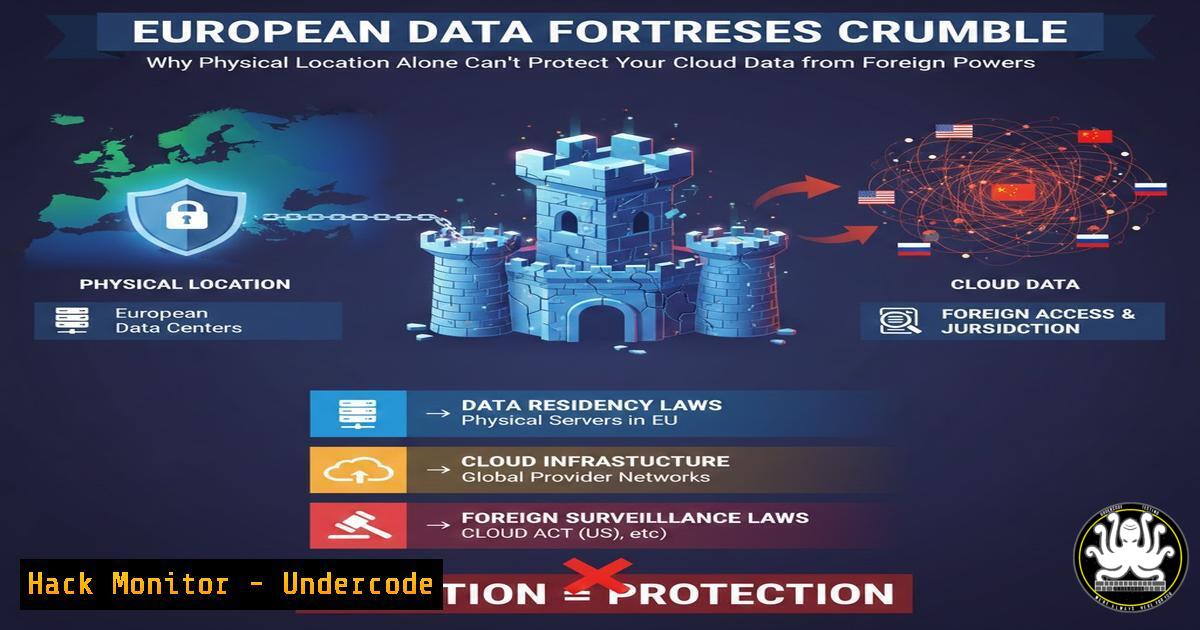
Introduction: A recent explosive German report has sent shockwaves through the European cybersecurity and data privacy landscape, asserting a sobering truth: merely storing data within European borders is no longer a sufficient safeguard against foreign access, particularly from the United States. This revelation critically undermines the foundational premise of many “sovereign cloud” initiatives and forces a fundamental reevaluation of technical data protection strategies in an era of extraterritorial laws and advanced cyber operations.
Learning Objectives:
- Understand the legal and technical mechanisms (e.g., U.S. CLOUD Act, MLATs) that enable cross-border data access, rendering geography obsolete as a primary control.
- Learn and implement robust, in-transit and at-rest encryption strategies that put control of data access back into the hands of the data owner, regardless of storage location.
- Architect a defense-in-depth cloud security posture focusing on identity, network segmentation, and encryption key management to mitigate sovereign risk.
- Sovereign Shield or Illusion? Demystifying Legal Data Access Frameworks
The core misunderstanding lies in confusing data residency (where bits are physically stored) with data sovereignty (which jurisdiction’s laws apply). A server in Frankfurt is subject to German law, but if the company controlling it is a U.S.-owned cloud provider, it may also be compelled by U.S. statutes like the CLOUD Act to hand over data. Conversely, European authorities use Mutual Legal Assistance Treaties (MLATs) to request data from U.S. companies. The step-by-step reality is:
Step-by-Step Guide:
- The Trigger: A U.S. law enforcement agency investigates a crime with a digital footprint believed to be in a European data center operated by a U.S. provider (e.g., “US-Corp Cloud”).
- The Legal Instrument: Instead of a slow MLAT request to the host country, prosecutors issue a CLOUD Act order directly to “US-Corp Cloud”‘s headquarters.
- The Provider’s Dilemma: “US-Corp Cloud” is legally obligated to “preserve, backup, or disclose” the data, even if its disclosure would violate EU GDPR. They are often prohibited from notifying the affected customer.
- The Technical Handover: The provider’s global security/legal team accesses the target data through privileged administrative channels or backup systems and transfers it to the authorities.
2. Taking Real Control: Implementing End-to-End Encryption (E2EE)
The most effective technical countermeasure is to ensure data is cryptographically inaccessible to the cloud provider itself. End-to-End Encryption (E2EE) means data is encrypted on the client-side before it is uploaded, and only the client holds the keys.
Step-by-Step Guide (Using Open Source Tools):
- Tool Selection: Choose a library like `libsodium` (modern, audited) for encryption operations.
- Key Generation: Never let the cloud provider generate your keys. Generate them locally:
Linux/macOS: Generate a secure 256-bit key for AES-GCM encryption
openssl rand -base64 32 > data_encryption.key
Securely store this key in a hardware security module (HSM) or a managed service like AWS KMS, Azure Key Vault, or Google Cloud KMS where YOU control access policies.
- Client-Side Encryption Before Upload: Write a script to encrypt files before syncing to cloud storage (e.g., S3, Blob Storage).
Example Python snippet using cryptography.fernet (simplified)
from cryptography.fernet import Fernet
import boto3

Load YOUR key (not the cloud's)
key = open('data_encryption.key', 'rb').read()
cipher = Fernet(key)</p></li>
</ol>

<p>with open('sensitive_data.pdf', 'rb') as f:
encrypted_data = cipher.encrypt(f.read())

Now upload the encrypted ciphertext
s3_client = boto3.client('s3')
s3_client.put_object(Bucket='my-bucket', Key='sensitive_data.pdf.enc', Body=encrypted_data)
4. Consequence: The cloud provider stores only unreadable ciphertext. A legal order to them yields no usable data, as they lack the decryption keys.
- Fortifying the Gates: Hardening Identity and Access Management (IAM)
If an adversary (or a compelled administrator) can gain privileged access to your cloud console, they can bypass many controls. Locking down IAM is critical.
Step-by-Step Guide (AWS Example):
- Eradicate Root Keys: Never use root account access keys. Create an IAM user with administrative permissions.
- Enable MFA EVERYWHERE: Enforce Multi-Factor Authentication for all users, especially root and admin accounts. Use a hardware device (YubiKey) or TOTP app, not SMS.
- Implement the Principle of Least Privilege (PoLP): Replace broad policies like `AdministratorAccess` with custom, granular policies.
{ "Version": "2012-10-17", "Statement": [ { "Effect": "Allow", "Action": [ "s3:GetObject", "s3:PutObject" ], "Resource": "arn:aws:s3:::my-encrypted-bucket/", "Condition": { "IpAddress": {"aws:SourceIp": "192.0.2.0/24"}, "BoolIfExists": {"aws:MultiFactorAuthPresent": "true"} } } ] } - Use Role-Based Access for Services: Don’t put access keys on EC2 instances. Use IAM Roles with specific, time-bound permissions.
-
Segment and Obscure: Advanced Network Security in the Cloud
Prevent lateral movement and limit the “blast radius” if one component is compromised. This makes targeted data extraction more difficult.
Step-by-Step Guide (Azure Example):
- Architect with Hub-Spoke VNet: Place shared security services (firewalls) in a hub VNet. Connect application workloads in isolated spoke VNets.
- Implement Network Security Groups (NSGs) & Application Security Groups (ASGs): Define micro-segmentation rules.
Azure CLI example: Create an NSG rule allowing only HTTPS from a front-end ASG to a back-end ASG
az network nsg rule create \
--nsg-name my-backend-nsg \
--name allow-https-from-frontend-asg \
--priority 100 \
--source-application-security-groups /subscriptions/.../my-frontend-asg \
--destination-application-security-groups /subscriptions/.../my-backend-asg \
--destination-port-ranges 443 \
--protocol Tcp \
--access Allow
-
Use Private Endpoints: For PaaS services like Azure Storage or SQL Database, use Private Endpoints. This ensures traffic stays within Microsoft’s backbone and never exposes a public IP, dramatically reducing the external attack surface.
-
The Policy and Audit Lifeline: Technical Governance for Sovereignty
Technical controls must be enforced and proven through continuous governance.
Step-by-Step Guide:
- Define Guardrails with SCPs/CAPs: Use Service Control Policies (AWS) or Conditional Access Policies (Azure) at the tenant/organization level to enforce rules like “all S3 buckets must be encrypted with KMS” or “no resources can be deployed outside the EU West region.”
- Automate Compliance Scanning: Use tools like AWS Config, Azure Policy, or open-source CIS Benchmarks scanners to continuously check for deviations from your sovereignty-hardened baseline.
- Enable Unalterable Logging: Stream all administrative logs (CloudTrail, Azure Activity Log) to a dedicated, highly secured “audit” account/subscription that has write-only access for most personnel. Use Immutable storage options.
AWS CLI: Create an S3 bucket with Object Lock for immutable CloudTrail logs
aws s3api create-bucket --bucket my-audit-logs --region eu-west-1 --object-lock-enabled-for-bucket
aws s3api put-object-lock-configuration \
--bucket my-audit-logs \
--object-lock-configuration '{ "ObjectLockEnabled": "Enabled", "Rule": { "DefaultRetention": { "Mode": "COMPLIANCE", "Days": 365 } } }'
What Undercode Say:
- Geography is a Moot Point in Cloud Security: The report confirms that the primary risk is legal jurisdiction over the provider, not the datacenter’s latitude and longitude. Your threat model must now include “compelled access by a foreign sovereign.”
- Encryption is the New Border: The only meaningful technical control for data sovereignty is client-side encryption with customer-managed keys (CMK). Without it, you are tacitly trusting the provider—and by extension, their home government—with your plaintext data.
The analysis is clear: relying on provider promises or data center stickers is a critical strategic flaw. The future belongs to architectures built on Zero-Trust principles applied to the infrastructure layer itself, where encryption and strict identity checks are mandatory, and the provider’s access is systematically eliminated. This shifts the battleground from physical borders to cryptographic ones.
Prediction: The fallout from this report will accelerate three trends: 1) The rapid adoption of Confidential Computing (encrypted data-in-use) as the gold standard for sensitive workloads, moving beyond just encryption at rest and in transit. 2) A surge in market share for European-owned and operated cloud providers (e.g., OVHcloud, Outscale) whose entire corporate and legal structure falls under EU jurisdiction, eliminating the foreign parent company risk. 3) Increased regulatory pressure for “Digital Sovereignty by Design” in legislation like the EU Data Act, mandating technical safeguards like CMK and verifiable audit logs as legal requirements, not just best practices.
▶️ Related Video (76% Match):
🎯Let’s Practice For Free:
IT/Security Reporter URL:
Reported By: Stephanerobert1 Un – Hackers Feeds
Extra Hub: Undercode MoN
Basic Verification: Pass ✅🔐JOIN OUR CYBER WORLD [ CVE News • HackMonitor • UndercodeNews ]
📢 Follow UndercodeTesting & Stay Tuned:
- Fortifying the Gates: Hardening Identity and Access Management (IAM)


