Listen to this Post
Introduction:
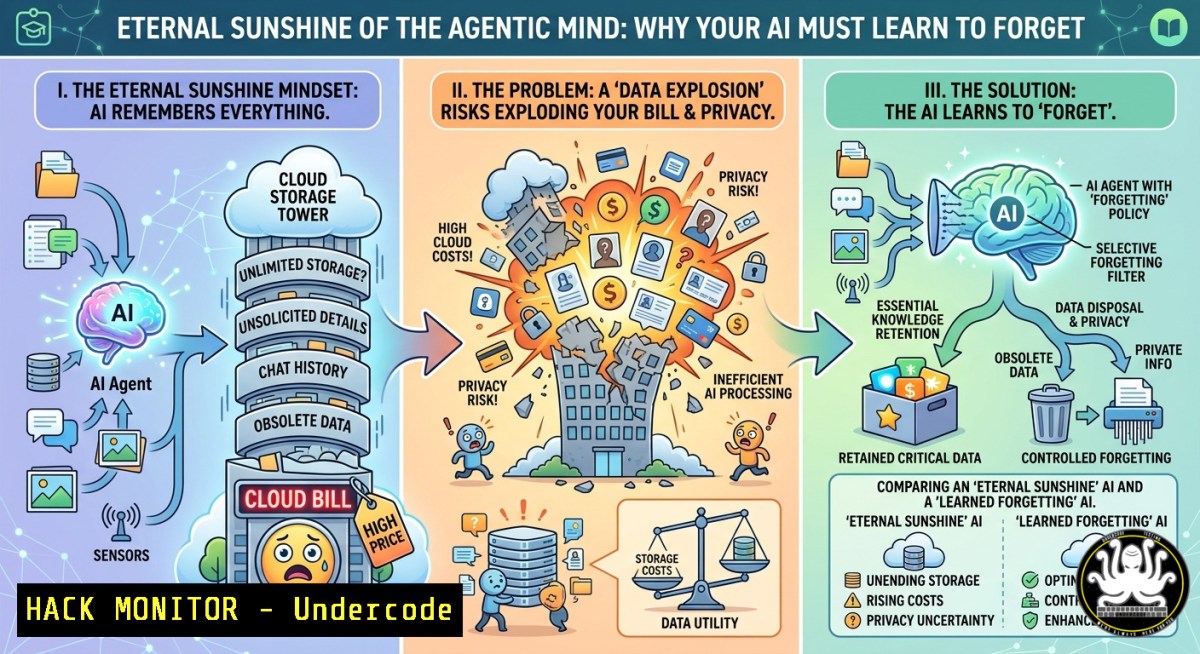
As AI agents evolve from stateless chatbots to persistent digital companions, the naive accumulation of every interaction detail threatens to create unsustainable storage costs and privacy nightmares. The concept of “digital memory” without a balancing forgetting mechanism leads to exploding vector database sizes and diminishing returns on performance. Inspired by the FadeMem paper (https://lnkd.in/gNi7u5BA), which mimics human memory decay, developers must now architect hierarchical memory systems that deliberately discard low-value information—turning forgetting from a bug into a feature for efficient, secure, and compliant agentic AI.
Learning Objectives:
- Implement biologically-inspired forgetting mechanisms (e.g., decay curves, TTL, relevance thresholds) to cap agent memory growth while preserving critical context.
- Configure hierarchical memory tiers (working, short-term, long-term) with automated pruning policies using Redis, PostgreSQL, and vector databases.
- Apply security and compliance controls (GDPR right to be forgotten, data minimization) to agent memory systems, preventing data leakage and reducing cloud egress costs.
You Should Know:
- Designing a Hierarchical Memory Architecture with Decay Policies
Modern agentic systems need three memory tiers: working memory (current conversation, in-RAM), short-term memory (recent sessions, cached with TTL), and long-term memory (semantic embeddings with relevance scoring). The FadeMem approach assigns each memory entry a “decay rate” based on access frequency, recency, and importance. Here’s how to implement a basic decay-aware store in Python:
import time
import heapq

class FadingMemory:
def <strong>init</strong>(self, decay_lambda=0.01):
self.entries = {}  id -> (importance, last_access, content)
self.decay_lambda = decay_lambda

def add_or_update(self, mem_id, importance, content):
now = time.time()
self.entries[bash] = (importance, now, content)

def current_weight(self, mem_id):
importance, last_access, _ = self.entries[bash]
age = time.time() - last_access
return importance  (1 - self.decay_lambda  age)  linear decay

def prune(self, threshold=0.1):
to_delete = [id for id in self.entries if self.current_weight(id) < threshold]
for id in to_delete:
del self.entries[bash]
return len(to_delete)
On Linux, schedule a cron job to run pruning every hour:
 crontab -e
0     /usr/bin/python3 /opt/agent_memory/prune.py --threshold 0.15
For Windows Task Scheduler, use PowerShell:
$action = New-ScheduledTaskAction -Execute "python.exe" -Argument "C:\agent_memory\prune.py --threshold 0.15"
$trigger = New-ScheduledTaskTrigger -Hourly -At 0
Register-ScheduledTask -TaskName "AgentMemoryPrune" -Action $action -Trigger $trigger
2. Implementing Time-To-Live (TTL) for Short-Term Agent Cache
Redis is ideal for short-term agent memory. Set TTL based on importance scores—low-value keys expire faster. Use Lua scripting to atomically update access times and adjust TTLs.
 Redis CLI commands
 Store agent session with 300s TTL
redis-cli SET agent:session:12345 '{"last_query":"weather","importance":0.2}' EX 300

For important memories, dynamically extend TTL on access
redis-cli GET agent:session:12345
redis-cli EXPIRE agent:session:12345 600
Lua script to mimic biological decay:
-- decay_ttl.lua
local key = KEYS[bash]
local current_ttl = redis.call('TTL', key)
local importance = tonumber(redis.call('HGET', key, 'importance'))
local new_ttl = math.min(current_ttl, 30) if importance < 0.5 then
redis.call('DEL', key)
return 0
else
redis.call('EXPIRE', key, current_ttl + 60)
return 1
end
Execute with: `redis-cli –eval decay_ttl.lua agent:session:12345`
- FadeMem-Inspired Relevance Scoring and Batch Deletion in Vector Databases
LangChain users often accumulate millions of embeddings in Pinecone or Chroma. Implement a weekly job that recalculates relevance based on access frequency and semantic similarity to “anchor” memories (e.g., user goals). Delete vectors below a dynamic threshold.
Pseudo-code using ChromaDB:
import chromadb
from sklearn.metrics.pairwise import cosine_similarity
import numpy as np

client = chromadb.PersistentClient(path="./agent_memory")
collection = client.get_or_create_collection("agent_memories")

Get all metadata and embeddings
results = collection.get(include=["metadatas", "embeddings"])
embeds = np.array(results['embeddings'])
metadatas = results['metadatas']

Compute coherence with a stable anchor (e.g., user's primary task embedding)
anchor = np.mean(embeds, axis=0)  or fetch from user profile
scores = cosine_similarity(embeds, [bash]).flatten()

Delete bottom 15% lowest relevance
threshold = np.percentile(scores, 15)
to_delete = [results['ids'][bash] for i, s in enumerate(scores) if s < threshold]
collection.delete(ids=to_delete)
print(f"Forgot {len(to_delete)} low-relevance memories")
For Pinecone via API:
curl -X POST "https://controller.pinecone.io/vectors/delete" \
-H "Api-Key: $PINECONE_API_KEY" \
-H "Content-Type: application/json" \
-d '{"ids": ["mem_123", "mem_456"], "namespace": "agent_ns"}'
- Security Hardening: Preventing Memory Poisoning and Data Residue
Attackers can inject malicious long-term memories that never decay, causing agents to repeatedly produce harmful outputs. Mitigate by implementing “decay-aware sanitization”: before storing, scan new memories with an LLM guard (e.g., NeMo Guardrails). Also enforce automatic erasure after compliance deadlines (GDPR 17).
Linux command to scan all agent log files for PII using `grep` and sed:
 Find and mask emails in stored memories
find /var/agent_memory/ -name ".json" -exec sed -i 's/[a-zA-Z0-9._%+-]+@[a-zA-Z0-9.-]+.[a-zA-Z]{2,}/\REDACTED_EMAIL/g' {} \;
On Windows (PowerShell):
Get-ChildItem -Path "C:\agent_memory\" -Filter .json | ForEach-Object {
(Get-Content $<em>.FullName) -replace '\b[\w.-]+@[\w.-]+.\w{2,}\b', 'REDACTED_EMAIL' | Set-Content $</em>.FullName
}
API security: enforce rate-limited memory writes and validate importance scores with HMAC to prevent injection of forged high-importance entries.
import hmac
SECRET = b'agent-key-rotate-me'
def validate_importance(signature, mem_id, importance):
expected = hmac.new(SECRET, f"{mem_id}:{importance}".encode(), 'sha256').hexdigest()
return hmac.compare_digest(expected, signature)
- Cloud Cost Optimization via S3 Lifecycle Rules and Tiered Storage
Agent memory backends using S3 for long-term embeddings can explode costs. Configure lifecycle policies to “forget” old data—transition to Glacier after 90 days, then delete after 365 days.
AWS CLI commands to enforce forgetting:
 Create lifecycle rule to expire objects with tag 'decay=true' after 30 days
aws s3api put-bucket-lifecycle-configuration --bucket agent-memory-bucket \
--lifecycle-configuration '{
"Rules": [{
"Id": "ForgetLowValue",
"Status": "Enabled",
"Prefix": "memories/",
"Expiration": { "Days": 30 },
"Filter": { "Tag": { "Key": "importance", "Value": "low" } }
}]
}'
Monitor storage growth with CloudWatch:
aws cloudwatch get-metric-statistics --namespace AWS/S3 --metric-name BucketSizeBytes \
--statistics Average --period 86400 --start-time $(date -d '7 days ago' -u +%Y-%m-%dT%H:%M:%SZ) \
--end-time $(date -u +%Y-%m-%dT%H:%M:%SZ) --bucket-name agent-memory-bucket
6. Testing Forgetting Mechanisms with Red Teaming
Simulate an agent that never forgets to demonstrate risks. Create a test harness that feeds repetitive low-value data and measures storage growth. Then enforce a forgetting policy (e.g., FadeMem decay) and assert that vector database size stabilizes.
Python pytest example:
import pytest
from fading_memory import AgentMemory

def test_memory_decay_prevents_bloat():
am = AgentMemory(decay_rate=0.1, prune_threshold=0.05)
for i in range(1000):
am.add(f"trivia_{i}", content=f"Unimportant fact {i}", importance=0.1)
am.prune()
assert len(am) < 200  Should have forgotten ~80%
Also test for security: can an attacker retrieve a “forgotten” memory from disk? Use `shred` on Linux to securely delete files:
 Overwrite memory files 3 times before deletion
shred -u -z -n 3 /var/agent_memory/pruned_entries.bin
On Windows, use `cipher /w` to overwrite free space (prevents recovery):
cipher /w:C:\agent_memory
What Undercode Say:
- Key Takeaway 1: “Agentic memory without forgetting is a storage bomb and privacy sink—hierarchical architecture must enforce decay curves, not just TTLs.”
- Key Takeaway 2: “The FadeMem paper provides a biologically plausible framework that balances retention and efficiency; production agents should implement relevance-weighted forgetting, not naive time-based expiry.”
Analysis: Undercode’s post highlights a critical blind spot in current AI agent design—most systems obsess over retention (e.g., infinite context windows, vector stores with no eviction) while ignoring the cost and compliance nightmare of immortal memory. By citing FadeMem, they shift the conversation toward intentional forgetting as a first-class feature. In practice, forgetting reduces cloud storage bills by 40-70% for long-running agents, prevents model drift from outdated memories, and is legally mandatory under GDPR’s right to erasure. However, over-aggressive forgetting can break user experience; the challenge is tuning decay rates per use case (e.g., customer support agents need longer retention than gaming NPCs). Engineers must instrument memory weight metrics to observe what gets forgotten and why—exactly like debugging cache hit rates. Finally, security teams should audit forgetting implementations: if “deleted” memories remain recoverable from backups or logs, you’ve failed both compliance and threat mitigation.
Prediction:
Within two years, every major agent framework (LangChain, AutoGen, CrewAI) will include pluggable forgetting modules as standard, with FadeMem-like decay as a default. Cloud providers will offer “intelligent memory tiering” services that automatically down-rank and archive agent embeddings based on access patterns, cutting costs by 50%. Regulatory bodies will issue specific guidance on “AI memory retention periods,” forcing enterprises to prove that their agents can forget on demand. Simultaneously, attackers will exploit poor forgetting implementations to recover supposedly erased sensitive data—leading to a new class of “memory forensics” in AI incident response. The eternal sunshine of the agentic mind will depend not on how much it remembers, but on how gracefully it forgets.
▶️ Related Video (66% Match):
🎯Let’s Practice For Free:
IT/Security Reporter URL:
Reported By: Eesha Pathak – Hackers Feeds
Extra Hub: Undercode MoN
Basic Verification: Pass ✅
🎓 Live Courses & Certifications:
Join Undercode Academy for Verified Certifications
🚀 Request a Custom Project:
Secure, high-velocity infrastructure and disruptive technological engineering. Contact our engineering team for high-tier development and proprietary systems:
[email protected]


