
Listen to this Post
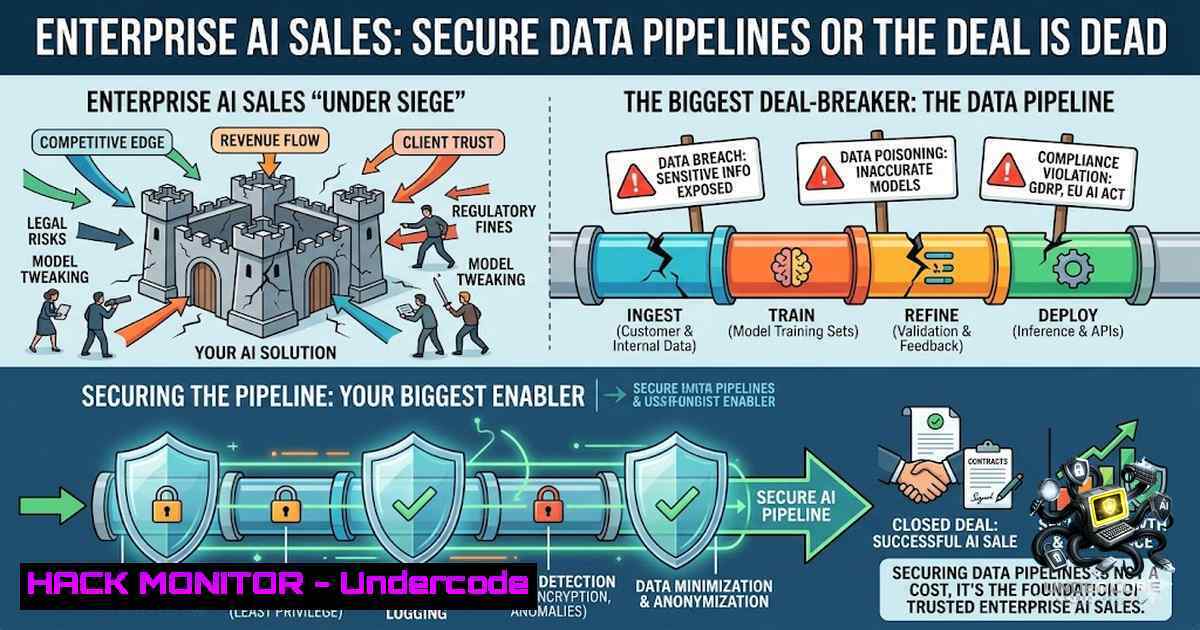
Introduction:
The modern enterprise is drowning in data, and the rush to monetize it through AI has created a cybersecurity battlefield where sales and security teams must operate as one unit. As Method Recruitment Group actively seeks an Enterprise BDM for a Data/AI Consultancy, the underlying technical reality is that every lucrative AI deal now hinges on robust data governance, pipeline security, and compliance frameworks that go far beyond traditional CRM demos. This article serves as a technical deep-dive into the security stack required to support enterprise AI sales, providing IT professionals and aspiring BDMs with the command-line artillery and architecture knowledge needed to close deals without compromising the client’s digital fortress.
Learning Objectives:
- Understand the core components of a secure enterprise AI data pipeline, from ingestion to inference.
- Master essential Linux and Windows commands for auditing data access and securing APIs.
- Learn to configure and implement key security tools for cloud AI environments, ensuring compliance and threat mitigation.
- Harden Your Data Gateway: Securing the Ingestion Layer
The first step in any enterprise AI project is data ingestion, often the most vulnerable phase where raw data is pulled from disparate sources. For a BDM, this translates to understanding how a consultancy secures its clients’ data before it even reaches the AI model. This involves implementing robust authentication, transport encryption, and access controls.
Step-by-step guide for securing data ingestion pipelines:
- Audit Source Access: Identify all data sources (databases, APIs, cloud storage) and ensure they are not exposed to the public internet. Use network scanning tools like `nmap` to verify the attack surface.
- Enforce TLS 1.3: Ensure all data in transit is encrypted. For Linux servers handling data ingestion, enforce this by configuring `/etc/ssl/openssl.cnf` and ensuring your services are compiled with TLS 1.3 support.
- Implement Service Account Permissions: Use service accounts with the least privilege principle. On Windows Active Directory, audit service account permissions using `dsquery -filter “(objectClass=user)” -attr name userAccountControl` to find accounts with suspicious flags.
- Set Up Data Validation: Implement checksum validation for data integrity. A simple Linux command to verify file integrity before processing is
sha256sum data_file.csv.
Linux Commands for Audit:
 Check for open ports that could expose ingestion endpoints
sudo nmap -sT -O localhost

Verify SSL/TLS configuration for ingestion services
openssl s_client -connect datasource-host.com:443 -tls1_3
- Fortifying the AI Model Registry: Pipeline Security in Production
Once data is processed, it moves to the training and model registry phase. Here, the security focus shifts to preventing model poisoning, unauthorized access to proprietary algorithms, and ensuring the integrity of the ML models themselves. For a Data/AI Consultancy, offering a secure MLOps pipeline is a major selling point.
Step-by-step guide for securing the MLOps pipeline:
- Container Scanning: Regularly scan Docker images used for training and inference. Use `trivy image your-ml-image:latest` to identify vulnerabilities in the base OS and installed packages.
- API Key Rotation: Automate the rotation of API keys for model access. On Linux, use `aws secretsmanager` or `az keyvault` commands to programmatically rotate keys.
- Access Control Lists (ACLs) in Object Storage: For cloud-based model storage (e.g., S3 buckets), ensure ACLs are not public. Use `aws s3api get-bucket-acl –bucket your-model-bucket` to audit.
- Implement Model Signing: Use cryptographic signatures to verify model authenticity before deployment.
Windows PowerShell Commands for Azure/AWS:
 List all secrets in Azure Key Vault
Get-AzKeyVaultSecret -VaultName "AI-Model-Vault"

Get access policy for an Azure Storage Account
Get-AzStorageAccount -ResourceGroupName "RG-AI" | Get-AzStorageContainer -1ame "models"
- Securing the AI API Endpoint: The BDM’s Security Promise
The “Enterprise” part of an Enterprise BDM role involves selling AI solutions that integrate with the client’s core business applications. This is achieved via APIs, which are a primary attack vector. A knowledge of OAuth 2.0, API rate limiting, and threat protection tools is essential for technical credibility.
Step-by-step guide for hardening AI inference APIs:
- Rate Limiting: Implement rate limiting to prevent DDoS attacks and brute-force model extraction attempts. In an NGINX reverse proxy, you can set limits in `/etc/nginx/nginx.conf` using
limit_req_zone. - Input Sanitization: Protect against prompt injection. Use middleware like `express-validator` in Node.js or `WAF` features in Azure Application Gateway.
- JWT Validation: Always validate JSON Web Tokens. On a Linux backend, inspect JWT expiry and signature using `jq` and
openssl. - Use API Gateways: Configure an API Gateway like Kong or AWS API Gateway to act as a single entry point for all AI model requests, centralizing security policies.
Linux Command for JWT Inspection:
 Decode JWT to inspect claims (used for debugging security policies)
echo "eyJhbGciOiJIUzI1NiIsInR5cCI6IkpXVCJ9..." | cut -d. -f2 | base64 -d | jq .
- Cloud Hardening for AI Workloads: The Infrastructure Backbone
Most Data/AI Consultancies operate on public clouds. An Enterprise BDM must articulate how the consultancy secures its cloud footprint. This involves network segmentation, identity management, and specific security services like Azure Sentinel or AWS GuardDuty.
Step-by-step guide for multi-cloud AI security:
- Enable Cloud Logging: Ensure all cloud audit logs are enabled and sent to a SIEM. For AWS, use
aws cloudtrail create-trail --1ame AI-Audit --s3-bucket-1ame your-bucket. - Secure Cloud Storage: Set default encryption for storage buckets. In AWS,
aws s3api put-bucket-encryption --bucket your-bucket --server-side-encryption-configuration '{"Rules":[{"ApplyServerSideEncryptionByDefault":{"SSEAlgorithm":"AES256"}}]}'. - Network Segmentation: Use Virtual Private Clouds (VPCs) and subnets. Isolate the AI training environment (which may contain sensitive data) from the inference environment.
- Vulnerability Management: Deploy tools like Qualys or AWS Inspector to continuously scan for vulnerabilities in EC2 instances and container images.
Azure CLI Command for Security Audits:
 Run a security assessment on a VM
az vm assess-patches --resource-group RG-AI --1ame AI-Training-VM
- Breach Response and Compliance: The AI Sales Guardrails
Selling enterprise AI solutions inevitably involves handling regulated data (GDPR, HIPAA, etc.). The BDM and the consultancy must have a clear incident response plan and compliance posture. This section dives into the technical aspects of that preparedness.
Step-by-step guide for compliance and incident response:
- Data Discovery: Implement tools to find Personally Identifiable Information (PII) in data lakes. Open-source tools like `truffleHog` can be used to scan repositories for secrets.
- Automated Deletion Workflows: Create scripts to handle data deletion requests (Right to be Forgotten). This often involves querying databases and data lakes.
- Breach Simulation: Run tabletop exercises focused on AI-specific attacks (e.g., model theft or data poisoning).
- Data Encryption at Rest: Ensure all databases and storage systems are encrypted with customer-managed keys (CMK). For Linux, check LUKS encryption status with
sudo cryptsetup status.
Linux Command for Encryption Audit:
 Verify if a disk partition is encrypted
lsblk -f

Check system logs for suspicious access attempts (tail -f /var/log/auth.log)
tail -f /var/log/auth.log | grep "Failed password"
6. The Human Element: Privileged Access Management (PAM)
Finally, security comes down to user identity. AI systems often hold vast amounts of critical data, making privileged accounts a prime target. For a Data/AI Consultancy, implementing PAM is non-1egotiable.
Step-by-step guide for implementing PAM:
- Set Up a Jump Host: Use a bastion host as a single entry point for SSH access to AI infrastructure.
- Enforce MFA: Implement Multi-Factor Authentication for all administrative access to cloud consoles and critical servers.
- Session Recording: Use tools like `sudo` with syslog to record all admin commands.
- Audit Group Policies: On Windows, use `gpresult /v` to find user privileges and identify accounts with “SeBackupPrivilege” or “SeDebugPrivilege” which are high-risk.
Windows PowerShell Command for PAM:
 Get all users in a specific AD group that has admin access to AI servers
Get-ADGroupMember -Identity "AI-Server-Admins" | Get-ADUser -Properties LastLogon
What Undercode Say:
- Key Takeaway 1: The technical security of the data pipeline is no longer a “post-sales” implementation detail; it is the core differentiator that wins or loses the contract in the enterprise AI space.
- Key Takeaway 2: For professionals targeting BDM or similar roles, the ability to speak fluently about cloud hardening, API security, and compliance (not just sales metrics) is becoming an unskippable requirement, directly linked to the high OTE packages offered.
Analysis:
The recruitment drive by Method Recruitment Group for an Enterprise BDM with a Data/AI Consultancy highlights a significant market shift. The role is no longer about cold calling; it’s about solution consultancy. The $400k+ OTE reflects the immense value of a BDM who can bridge the gap between a client’s business problem and a secure, compliant, and scalable technical solution. The vulnerability lies in sales cycles where security is an afterthought—leading to deal stagnation or, worse, post-sale breaches that cost millions. The consultancy and the BDM must act as security ambassadors, ensuring that the AI engine is built on a foundation of zero-trust principles. The future of enterprise AI sales belongs to those who can demonstrate, with concrete technical examples, how they will protect a client’s most valuable asset—their data—while delivering the promised AI-powered business outcomes.
Prediction:
+1 The demand for BDMs with deep AI and data security acumen will skyrocket, leading to a new hybrid role of “Security Sales Architect” that commands even higher premiums in the job market.
-1 If consultancies and BDMs fail to prioritize security in their proposals, we will see a surge in high-profile data breaches involving AI systems, which could trigger a regulatory backlash that temporarily slows enterprise AI adoption and significantly complicates sales cycles.
▶️ Related Video (80% Match):
🎯Let’s Practice For Free:
🎓 Live Courses & Certifications:
Join Undercode Academy for Verified Certifications
🚀 Request a Custom Project:
Secure, high-velocity infrastructure and disruptive technological engineering. Contact our engineering team for high-tier development and proprietary systems:
[email protected]
💎 Smart Architecture | 🛡️ Secure by Design | ⭐ Trusted by Thousands
IT/Security Reporter URL:
Reported By: Enterprise Bdm – Hackers Feeds
Extra Hub: Undercode MoN
Basic Verification: Pass ✅


