Listen to this Post
Introduction:
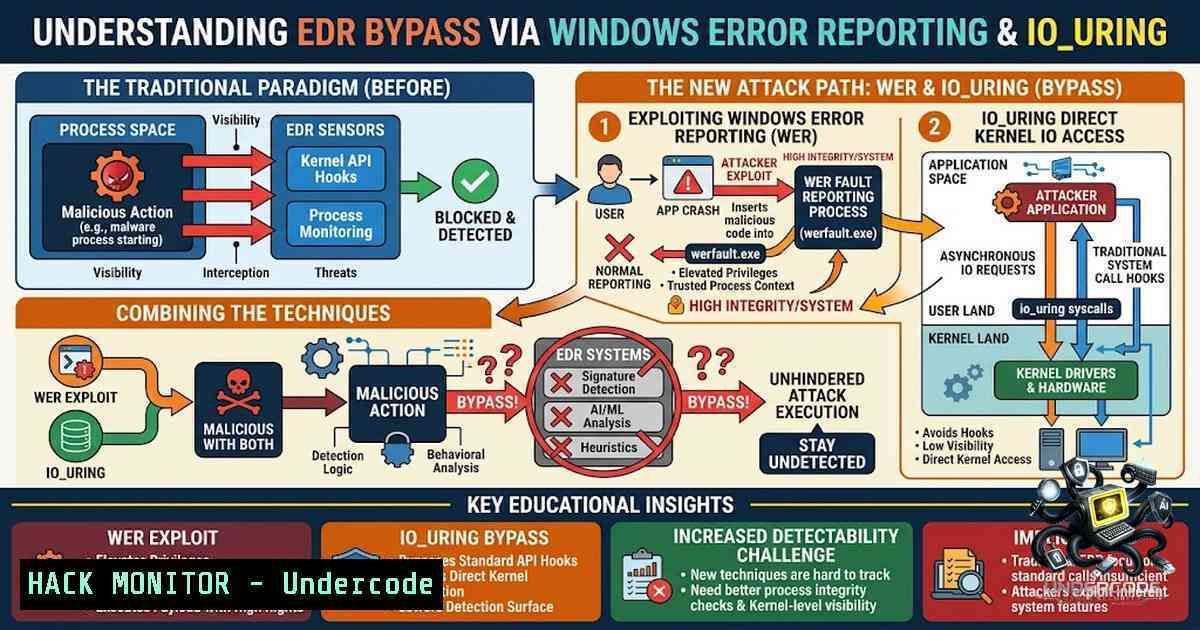
Endpoint Detection and Response (EDR) systems have become the cornerstone of modern enterprise security, offering deep visibility into endpoint activities through behavioral analysis and system call monitoring. However, a new wave of sophisticated evasion techniques is challenging the effectiveness of these defenses, with attackers shifting from kernel-level driver exploits to stealthy user-mode attacks and asynchronous I/O operations that leave minimal forensic footprints. This article explores the latest EDR bypass methods, including the EDR-Freeze technique leveraging Windows Error Reporting (WER) and the RingReaper agent exploiting Linux’s io_uring interface, providing security professionals with the technical knowledge needed to understand and defend against these emerging threats.
Learning Objectives:
- Understand the mechanics of user-mode EDR evasion techniques, including the EDR-Freeze race condition attack and command-line spoofing.
- Learn how Linux-based adversaries are leveraging io_uring to bypass traditional syscall monitoring and EDR hooks.
- Acquire practical commands and detection strategies for Windows and Linux environments to identify and mitigate EDR bypass attempts.
- EDR-Freeze: Putting Security Agents into a Coma Using Windows Error Reporting
The EDR-Freeze technique, discovered by researcher TwoSevenOneThree (Zero Salarium), represents a paradigm shift in EDR evasion. Unlike traditional “Bring Your Own Vulnerable Driver” (BYOVD) attacks that require smuggling and exploiting a kernel driver, EDR-Freeze operates entirely from user mode by abusing legitimate Windows components. The attack targets Windows Error Reporting (WER) and the `MiniDumpWriteDump` API, which are designed to generate crash dumps of processes for debugging purposes. During a dump operation, `MiniDumpWriteDump` suspends all threads of the target process to ensure memory consistency. The attacker exploits this by spawning `WerFaultSecure` as a Protected Process Light (PPL), instructing it to dump a security process (e.g., Windows Defender), and then suspending `WerFaultSecure` itself mid-operation. This leaves the target EDR process suspended indefinitely—effectively in a “coma”.
Step‑by‑step guide for EDR-Freeze (Proof-of-Concept):
- Spawn WerFaultSecure as PPL: Use `CreateProcessAsPPL` to launch `WerFaultSecure.exe` with WinTCB protection level.
- Trigger the Dump: Pass parameters to `WerFaultSecure` so that it calls `MiniDumpWriteDump` on the target EDR process ID (PID).
- Monitor Suspension: Poll the target process until it becomes suspended by the dump operation.
- Freeze the Dumper: Immediately open `WerFaultSecure` with `PROCESS_SUSPEND_RESUME` privileges and call `NtSuspendProcess` to freeze the dumper, preventing it from resuming the target.
Detection and Mitigation Commands (Windows):
To monitor for suspicious WER activity, security teams can use the following PowerShell and command-line tools:
 Monitor WER service start events
Get-WinEvent -LogName "System" | Where-Object { $<em>.Id -eq 1001 -and $</em>.Message -match "WerFault" }

Check for protected process launches
Get-WinEvent -LogName "Security" | Where-Object { $<em>.Id -eq 4688 -and $</em>.Message -match "WerFaultSecure" }

List running PPL processes
tasklist /fi "PID eq <PID>" /v
Linux Equivalent (Monitoring Suspicious Process Freezes):
While Linux lacks a direct WER equivalent, similar techniques can be monitored using `ptrace` and process state tracking:
 Monitor process states for STOP signals
ps aux | grep -E "T|t"  T indicates stopped/traced state
 Check for process suspension via SIGSTOP/SIGTSTP
sudo auditctl -a always,exit -F arch=b64 -S kill -k process_signal
- RingReaper: Evading Linux EDRs with io_uring and Asynchronous I/O
On the Linux front, attackers are exploiting io_uring, an asynchronous I/O interface introduced in kernel 5.1, to bypass traditional syscall monitoring. RingReaper, a post-exploitation agent developed by MatheuZSecurity, replaces critical syscalls such as read, write, recv, send, and `connect` with asynchronous I/O operations (io_uring_prep_), drastically reducing exposure to EDR hooks and event tracing. The tool’s commands—including file transfer (get, put), privilege escalation search (privesc), and process listing (ps)—are designed to operate with minimal traditional syscall usage, making it highly stealthy against EDRs that rely on syscall interception.
Step‑by‑step guide for deploying and using RingReaper (Authorized Testing Only):
- Clone and Build: Download the RingReaper repository from GitHub and compile the agent for the target Linux environment.
- Deploy the Agent: Transfer the binary to the target system and execute it with appropriate privileges.
- Establish C2 Communication: Configure the agent to connect to a command-and-control server for issuing commands.
- Execute Post-Exploitation Tasks: Use built-in commands like `get` (file download), `put` (file upload), `killbpf` (disable BPF tracing), and `privesc` (SUID binary search) while maintaining stealth.
Detection Commands for Linux Security Teams:
 Monitor for io_uring usage (requires kernel tracing)
sudo perf trace -e 'io_uring' -a -- sleep 60

Check for unusual io_uring file descriptors
lsof | grep -E "io_uring|eventfd"

Audit process creation with io_uring context
sudo auditctl -a always,exit -F arch=b64 -S io_uring_enter -k io_uring_monitor

Inspect /proc for processes with io_uring rings
for pid in /proc/[0-9]; do ls -la $pid/fd | grep -q "anon_inode:io_uring" && echo $pid; done
Linux EDR Hardening Recommendations:
- Configure eBPF-based agents (e.g., Tetragon, Falco) to monitor `io_uring_enter` syscalls using LSM hooks or Kprobes.
- Implement custom kernel modules to log io_uring operations where native support is lacking.
- Regularly audit for unauthorized processes using `io_uring` via file descriptor inspection.
- Command-Line Spoofing: Manipulating Process Arguments to Evade EDR
Command-line spoofing is a well-known yet under-documented technique that allows attackers to hide malicious intent by modifying a process’s command-line arguments after creation. On Windows, the command line is stored in the Process Environment Block (PEB) as a `UNICODE_STRING` structure. By starting a process in a suspended state, an attacker can modify the `Buffer` pointer within the PEB to point to a benign-looking command string before resuming execution. This allows malicious commands (e.g., downloading a payload via PowerShell) to appear as benign operations in EDR logs that cache command-line arguments at process creation.
Step‑by‑step guide for command-line spoofing (PoC):
- Create Suspended Process: Use `CreateProcess` with the `CREATE_SUSPENDED` flag to launch a legitimate binary (e.g.,
powershell.exe). - Locate PEB: Retrieve the PEB address of the suspended process using
NtQueryInformationProcess. - Modify Command Line: Write a new benign-looking command string into the process memory and update the `UNICODE_STRING` fields (
Length,MaximumLength,Buffer) in the PEB. - Resume Process: Call `ResumeThread` to execute the process with the spoofed command line.
Detection and Mitigation (Windows):
 Monitor for CREATE_SUSPENDED flag usage
Get-WinEvent -LogName "Security" | Where-Object { $<em>.Id -eq 4688 -and $</em>.Message -match "CREATE_SUSPENDED" }

Use Sysmon to log command-line changes (Event ID 1)
 Enable command-line auditing in Group Policy
 Configure EDR to perform post-execution command-line validation
- Curing Rootkit: A Fully Functional io_uring-Based Linux Rootkit
The Curing rootkit, developed by Armo researchers, demonstrates the real-world risk of io_uring-based evasion. Built entirely on io_uring, Curing performs tasks such as file reads, network communication, and command execution without making traditional syscalls, rendering syscall-monitoring EDRs blind. The rootkit has been tested against popular security tools including Falco, Tetragon, and Microsoft Defender, with many failing to detect its operations.
Step‑by‑step guide for Curing deployment (Research Only):
- Load the Module: Compile and load the Curing kernel module using
insmod. - Establish C2 Channel: Configure the rootkit to communicate with a remote C2 server using io_uring-based network operations.
- Execute Commands: Pull commands from the C2 and execute them without syscall visibility.
- Maintain Persistence: Use io_uring for file operations to avoid detection by file integrity monitoring (FIM) tools.
Detection Commands for Linux Security Teams:
 Monitor for unusual kernel module loads
lsmod | grep -v "^Module" | awk '{print $1}' | while read mod; do modinfo $mod | grep -q "Curing" && echo "Suspicious module: $mod"; done

Audit io_uring usage by processes
sudo bpftrace -e 'tracepoint:syscalls:sys_enter_io_uring_enter { printf("%s (PID %d) using io_uring\n", comm, pid); }'

Check for hidden processes via /proc scanning
for pid in /proc/[0-9]; do if [ ! -d "/proc/$(basename $pid)" ]; then echo "Hidden process detected: $pid"; fi; done
- Kernel Callback Removal: Bypassing EDR at the Kernel Level
Another advanced technique involves removing kernel callbacks that EDRs use to monitor system events. By overwriting callback functions, attackers can prevent the EDR from receiving notifications about process creation, file writes, or registry modifications. This method, demonstrated in projects like kernel-callback-removal, allows attackers to operate with near-total invisibility.
Step‑by‑step guide for kernel callback removal (Research Only):
- Identify Callback Structures: Locate the EDR’s registered callback functions in the kernel (e.g.,
PsSetCreateProcessNotifyRoutine). - Overwrite Callback Pointers: Use kernel memory manipulation to replace the callback pointers with no-op functions.
- Bypass Verification: Implement techniques to avoid kernel-level integrity checks.
Detection and Mitigation (Windows):
 Use Driver Verifier to monitor callback integrity
verifier /standard /all

Monitor for unauthorized kernel memory modifications
 Use Microsoft's PatchGuard (on x64 systems) to detect kernel patching
Linux Equivalent (Kernel Module Unhooking):
Attackers can also unhook kernel modules to disable EDR functionality.
 Check for modified kernel symbols
sudo cat /proc/kallsyms | grep -E "sys_call_table|security_ops"
 Use kallsyms to verify integrity of critical kernel functions
- API Hooking and Indirect Syscalls: Advanced Windows Evasion
Modern EDRs often hook critical Windows APIs (e.g., NtCreateFile, NtWriteVirtualMemory) to monitor malicious activity. Attackers bypass these hooks using indirect syscalls, where the syscall is invoked directly from user mode without passing through the hooked API functions. Tools like DoomSyscalls and NullGate implement clean indirect syscalls with dynamic System Service Number (SSN) resolution and return address spoofing to evade detection.
Step‑by‑step guide for implementing indirect syscalls (PoC):
- Resolve SSNs: Dynamically retrieve syscall numbers from the native API.
- Bypass Hooks: Use inline assembly or shellcode to invoke syscalls directly.
- Spoof Return Address: Manipulate the return address to avoid stack-based detection.
Detection and Mitigation (Windows):
 Monitor for unusual syscall patterns using ETW
 Enable Sysmon Event ID 10 (ProcessAccess) to detect cross-process memory operations
 Use API monitoring tools like API Monitor to detect direct syscalls
- Cloud Hardening and API Security in EDR Evasion Context
As organizations migrate to the cloud, EDR evasion techniques are extending to cloud workloads and APIs. Attackers are leveraging misconfigured cloud permissions and API vulnerabilities to disable or bypass EDR agents deployed on cloud instances. Security teams must adopt a multi-layered approach that includes:
- Immutable Infrastructure: Deploy EDR agents as part of golden images with integrity checks.
- API Rate Limiting and Monitoring: Detect unusual API calls that could indicate EDR tampering.
- Zero Trust Architecture: Restrict EDR management interfaces to trusted IPs and enforce MFA.
Cloud-Specific Commands (AWS/Azure/GCP):
 AWS: Monitor for EDR agent termination
aws cloudtrail lookup-events --lookup-attributes AttributeKey=EventName,AttributeValue=StopInstances

Azure: Audit VM extension changes
az monitor activity-log list --query "[?contains(operationName.value, 'VirtualMachineExtension')]"

GCP: Check for serial console access (potential EDR disablement)
gcloud compute instances get-serial-port-output <instance-1ame> --zone <zone>
What Undercode Say:
- EDR-Freeze highlights a fundamental design flaw in Windows Error Reporting, where legitimate system components can be weaponized to indefinitely suspend security processes without requiring kernel-level privileges.
- Linux EDRs must evolve to monitor asynchronous I/O interfaces like io_uring, as traditional syscall interception is no longer sufficient against advanced rootkits.
- Defenders should adopt a defense-in-depth strategy that includes behavioral monitoring, integrity checks, and anomaly detection rather than relying solely on EDRs.
Analysis:
The landscape of EDR evasion is rapidly shifting from noisy kernel exploits to sophisticated user-mode and asynchronous techniques that are harder to detect and attribute. The EDR-Freeze technique, which abuses Windows’ own error reporting mechanism, underscores the reality that even trusted system components can become attack vectors when their intended functionality is chained in unexpected ways. Similarly, the emergence of io_uring-based rootkits like Curing and RingReaper signals a new era of Linux threats that bypass the very foundations of syscall monitoring. For security teams, this means investing in layered detection strategies—combining EDR with network monitoring, behavioral analytics, and threat hunting—while also hardening operating system configurations to limit the abuse of legitimate features. The arms race between attackers and defenders continues, and staying ahead requires continuous learning, tooling, and proactive incident response planning.
Prediction:
- -1 The proliferation of user-mode EDR bypass techniques will likely lead to a surge in sophisticated ransomware attacks that can disable security controls without triggering alerts, increasing the average dwell time of threats.
- -1 As more Linux environments adopt EDR solutions, attackers will increasingly exploit io_uring and other asynchronous interfaces, potentially outpacing vendor detection capabilities for the next 12–18 months.
- +1 The security community will respond with enhanced detection frameworks, including eBPF-based monitoring for io_uring and improved Windows ETW providers for WER activity, driving innovation in endpoint security.
- -1 The complexity of these evasion techniques may widen the skills gap, as defenders require deeper knowledge of operating system internals and kernel-level forensics to effectively combat advanced threats.
- +1 Open-source projects like RingReaper and EDR-Freeze will serve as valuable training tools for red teams and security researchers, ultimately leading to more resilient EDR products through adversarial testing.
- -1 Cloud environments, where EDR agents are often deployed as virtual appliances, may see an increase in attacks targeting the underlying hypervisor or management APIs to disable endpoint protections.
▶️ Related Video (72% Match):
🎯Let’s Practice For Free:
🎓 Live Courses & Certifications:
Join Undercode Academy for Verified Certifications
🚀 Request a Custom Project:
Secure, high-velocity infrastructure and disruptive technological engineering. Contact our engineering team for high-tier development and proprietary systems:
[email protected]
💎 Smart Architecture | 🛡️ Secure by Design | ⭐ Trusted by Thousands
IT/Security Reporter URL:
Reported By: Aleborges Edr – Hackers Feeds
Extra Hub: Undercode MoN
Basic Verification: Pass ✅


