Listen to this Post
Introduction:
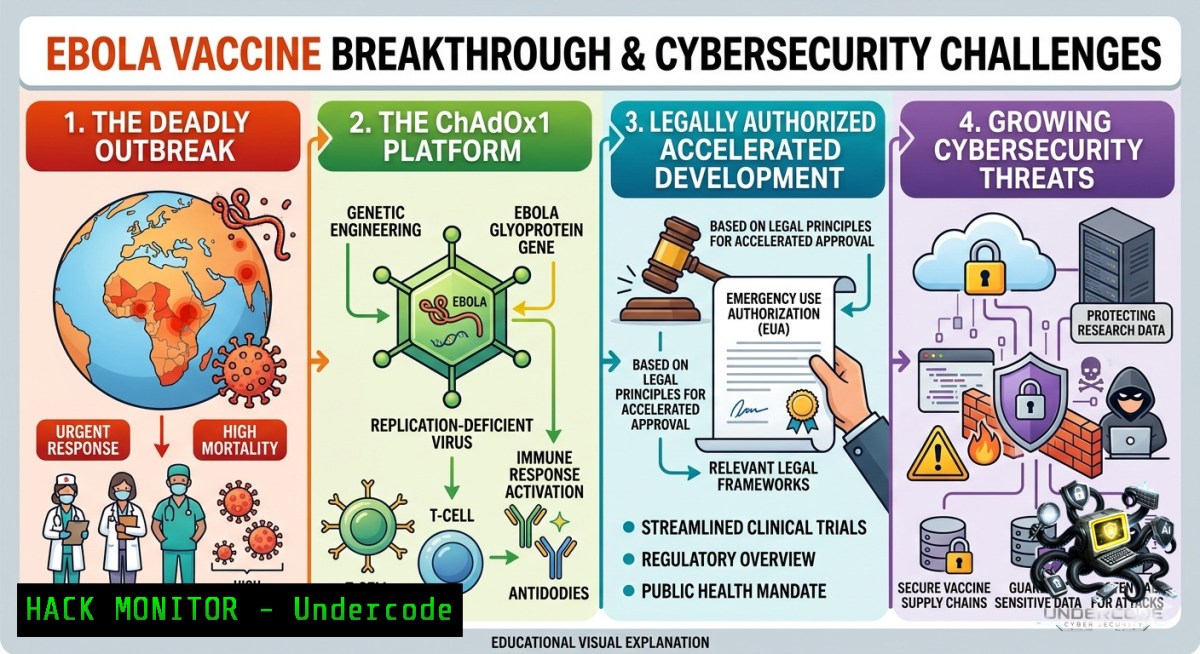
As the Bundibugyo ebolavirus (BDBV) outbreak in the Democratic Republic of the Congo and Uganda escalates, with over 900 suspected cases and more than 220 deaths, the global health community is in a race against time. At the forefront of this effort is a new vaccine candidate from the University of Oxford, based on its ChAdOx1 viral vector platform. This same technology, which was instrumental in the Oxford/AstraZeneca COVID-19 vaccine, is now being fast-tracked with a recent $8.6 million investment from CEPI, highlighting both the promise and the peril of modern biotechnological platforms, from development to distribution.
Learning Objectives:
– Understand the core technology behind the Oxford ChAdOx1 adenoviral vector platform and how it is being deployed to combat the Bundibugyo Ebola strain.
– Analyze the cybersecurity vulnerabilities inherent in the global vaccine supply chain, from data theft to biomanufacturing process exploitation.
– Learn practical Linux and Windows commands to audit and secure endpoints against targeted social engineering attacks that mimic health organizations.
You Should Know:
1. The ChAdOx1 Viral Vector Platform: A Cybersecurity and Biotech Primer
The Oxford vaccine candidate utilizes a replication-deficient simian adenovirus vector, ChAdOx1, which is engineered to deliver genetic material from the target pathogen to train the immune system without causing disease. This platform is a “true platform technology,” allowing rapid adaptation to new threats, as seen with its previous use against COVID-19 and Nipah virus. The virus is genetically modified by deleting the E1 gene, rendering it incapable of replicating in humans, and it is manufactured in specialized E1 complementing cell lines.
Step-by-step guide to simulate basic endpoint hardening against threat actors mimicking WHO or CEPI:
This process is critical as threat actors have previously used “Adenovirus vector.pdf” files as malware lures during the COVID-19 pandemic.
– Verify Digital Signatures (Windows PowerShell):
This command checks the digital signature of a file to confirm its origin before opening.
Get-AuthenticodeSignature -FilePath "C:\Users\Public\Documents\CEPI_Funding_Notice.pdf"
Expected output: A `SignerCertificate` status of `Valid` indicates the file is from a trusted source and unaltered.
– Isolate Suspicious Processes (Linux):
Use `strace` to monitor a suspicious process’s system calls, a common technique in security sandboxes to analyze potential malware behavior.
sudo strace -p $(pgrep -f "adobe_reader") -o /tmp/analysis.log
What this does: This attaches to a running process (e.g., a PDF reader) and logs all system calls, revealing if it attempts to access unauthorized network resources or execute hidden scripts.
– Monitor Outbound Connections (Windows Netstat):
Run this command to detect if a compromised application is trying to “phone home” to a command-and-control server.
netstat -ano | findstr "ESTABLISHED"
Analysis: This lists all established network connections with their associated Process IDs (PIDs), which can be cross-referenced in Task Manager to identify rogue processes.
2. Master Virus Seed Stock and Supply Chain Integrity
The CEPI funding will support the creation of a Master Virus Seed (MVS) stock, the critical starting biological material for vaccine manufacturing. This seed stock will be used to manufacture clinical-grade doses at the Serum Institute of India (SII). The integrity of this MVS is paramount; any cyber intrusion that alters its genetic sequence could have catastrophic consequences, turning a life-saving countermeasure into a biological threat. The dual-use nature of such viral vector technologies is a major biosecurity concern, as research on them could potentially enable the engineering of more dangerous pathogens.
Step-by-step guide to implement file integrity monitoring (FIM) for critical data:
This protects against unauthorized modification of any data, including vaccine formulas, intellectual property, or patient information, which has been a prime target for state-sponsored hackers.
– Linux FIM using `AIDE` (Advanced Intrusion Detection Environment):
Initialize the database: Run this to create a baseline of critical directories like `/etc` or sensitive research data.
sudo aideinit
Run a comparison: After creating the baseline, use this to detect any changes (added, removed, or modified files).
sudo aide --check
Actionable insight: Any unexpected changes to files containing genomic sequences or manufacturing protocols should trigger an immediate security incident response.
– Windows FIM using PowerShell:
This script generates a hash (a unique digital fingerprint) of a critical file, allowing you to verify its integrity later.
Get-FileHash -Path "C:\VaccineResearch\ChAdOx1_Plasmid_Map.txt" -Algorithm SHA256 | Export-Csv -Path "baseline.csv"
Verification: Compare the current hash with the stored baseline. If they differ, the file has been tampered with.
– Track Process and File Changes (Sysmon – Windows):
Microsoft Sysmon is a powerful tool to log detailed process and file creation events, which is crucial for forensic analysis.
<!-- Example Sysmon config to log all file creations -->
<Sysmon schemaversion="4.22">
<FileCreateTime onmatch="exclude">
</FileCreateTime>
</Sysmon>
After installing Sysmon with a configuration file, events are logged in the Windows Event Log for analysis.
3. Cloud Hardening for International Collaborative Research
The Oxford vaccine development involves global partners, including CEPI, SII, and local health authorities in the DRC and Uganda. This distributed, cloud-based collaborative environment expands the attack surface significantly. Poorly configured cloud storage buckets, weak API security on partner portals, and unpatched virtual machines used for genomic sequencing are all potential entry points for adversaries.
Step-by-step guide to basic cloud security posture assessment:
– Check for open S3 Buckets (using AWS CLI):
This command tests if a cloud storage bucket intended for private data is accidentally open to the public internet.
aws s3api get-bucket-acl --bucket oxford-vaccine-data
What to look for: A `Grantee` with a `URI` of `http://acs.amazonaws.com/groups/global/AllUsers` indicates a public bucket and a critical misconfiguration.
– API Security Check with `curl` (Linux/macOS):
Verify that an API endpoint requires proper authentication and returns expected data, preventing data leakage.
curl -X GET https://api.cepi.net/v1/vaccine_status \
-H "Authorization: Bearer YOUR_API_KEY" \
-H "Accept: application/json"
Analysis: An unauthenticated request that returns sensitive data reveals a vulnerability. Always use redacted API keys (e.g., `YOUR_API_KEY`) in documentation to prevent accidental exposure.
4. Mitigating Phishing Attacks Impersonating Health Organizations
The urgency and global visibility of the Ebola outbreak make it a perfect theme for sophisticated phishing campaigns, similar to those seen during the COVID-19 pandemic where malicious attachments like “Adenovirus vector.pdf” were distributed. Cybercriminals will impersonate CEPI, the WHO, the Africa CDC, or the University of Oxford to steal credentials or deliver ransomware to research institutions and logistics partners.
Step-by-step guide to email header analysis (Linux/Unix):
– Extract email headers using `grep` and `awk`:
Save the full email source to a file (e.g., `email.txt`) and run the following command to filter for key routing information.
cat email.txt | grep -E "Received:|From:|Return-Path:|Authentication-Results:"
Analyzing the output: Look for multiple `Received` hops. The first `Received` entry is often the originating server. Mismatches between the `From:` address and the `Return-Path:` are major red flags. `Authentication-Results` should show `spf=pass` and `dkim=pass`.
– Check for malicious links without clicking (Windows PowerShell):
Use `Resolve-DnsName` to see where a suspicious link redirects to before opening it.
Resolve-DnsName -1ame "bit[.]ly/Vaccine_Update" -Type A
This helps verify: If the short link resolves to an IP address or domain known for malware distribution, it should be blocked.
What Undercode Say:
– Key Takeaway 1: The ChAdOx1 platform’s strength as a rapid-response tool is also its greatest vulnerability from a dual-use perspective. The same “plug-and-play” design that allows quick vaccine creation could theoretically be misused to engineer pathogens with enhanced capabilities.
– Key Takeaway 2: The global vaccine supply chain, now a high-value digital and physical target, requires a unified defense strategy. We cannot afford a fragmented approach where a breached logistics provider’s system leads to the compromise of a master virus seed stock’s integrity.
Analysis: The intersection of cutting-edge biotechnology and global cybersecurity is no longer a theoretical concept; it is a battlefield. The race to deploy the Oxford Ebola vaccine is not just against the virus but also against state-sponsored hackers, cybercriminals, and the inherent risks of dual-use research. Key security gaps include the lack of standardized, mandatory cybersecurity audits for all partners in pandemic preparedness, weak API security in cross-border data sharing, and the persistent human factor in phishing susceptibility. Closing these gaps is not an IT issue but a critical component of global health security, requiring a governance structure that bridges biosecurity and cyber-defense protocols.
Prediction:
– +1 Immediate global biotech cybersecurity protocols will be upgraded, integrating blockchain for supply chain integrity and AI-driven threat detection, spurred by the high visibility of this Ebola vaccine campaign.
– -1 State-sponsored actors will intensify their targeting of biologics manufacturing facilities and related IP, viewing the ChAdOx1 platform not just as a vaccine blueprint but as a potential template for asymmetric biological attacks.
– +1 The collaboration between CEPI, Oxford, and SII will serve as a powerful model for “secure-by-design” pandemic response, where cybersecurity funding becomes as standard as money for clinical trials.
– -1 A major cybersecurity incident, such as a ransomware attack on a contract manufacturing organization (CMO), will temporarily disrupt vaccine distribution, creating dangerous public health delays and eroding trust in response systems.
▶️ Related Video (78% Match):
🎯Let’s Practice For Free:
🎓 Live Courses & Certifications:
[Join Undercode Academy for Verified Certifications](https://undercode.co.uk/certifications/)
🚀 Request a Custom Project:
Secure, high-velocity infrastructure and disruptive technological engineering. Contact our engineering team for high-tier development and proprietary systems:
[[email protected]](mailto:[email protected])
💎 Smart Architecture | 🛡️ Secure by Design | ⭐ Trusted by Thousands
IT/Security Reporter URL:
Reported By: [New An](https://www.linkedin.com/posts/new-an-oxford-developed-vaccine-candidate-share-7467190743699206144-tcab/) – Hackers Feeds
Extra Hub: Undercode MoN
Basic Verification: Pass ✅
🔐JOIN OUR CYBER WORLD [ CVE News • HackMonitor • UndercodeNews ]
[💬 Whatsapp](https://undercode.help/whatsapp) | [💬 Telegram](https://t.me/UndercodeCommunity)
📢 Follow UndercodeTesting & Stay Tuned:
[𝕏 formerly Twitter 🐦](https://x.com/undercodeupdate) | [@ Threads](https://www.threads.net/@undercodetesting) | [🔗 Linkedin](https://www.linkedin.com/company/undercodetesting/) | [🦋BlueSky](https://bsky.app/profile/undercode.bsky.social)


