Listen to this Post
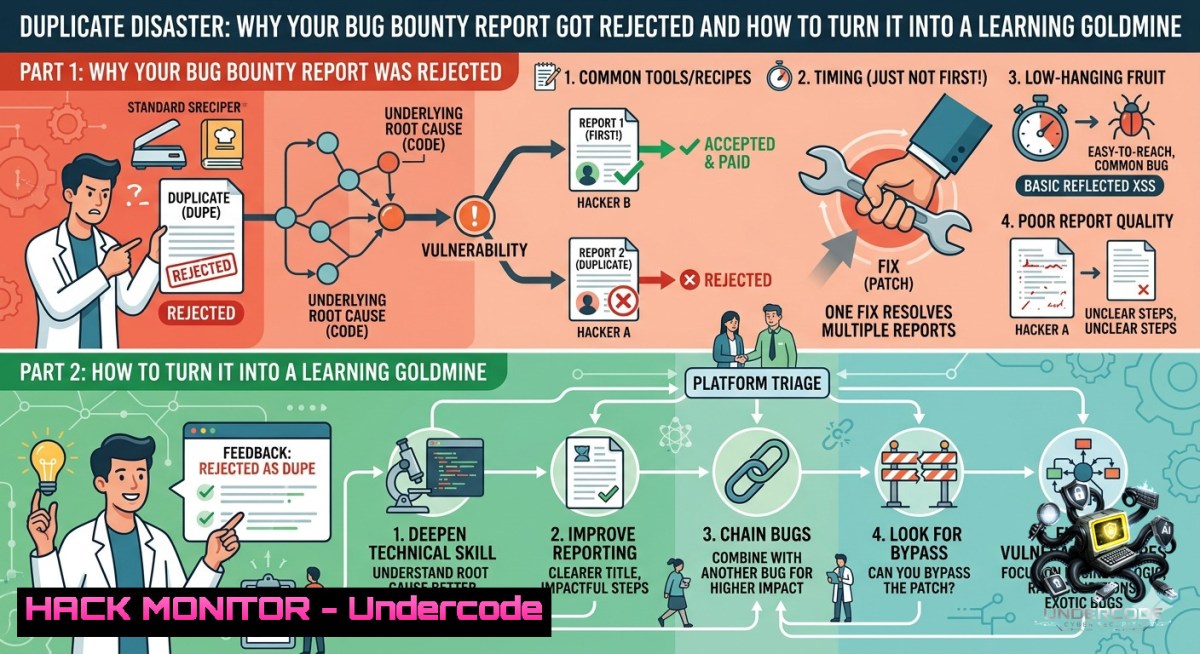
Introduction:
In bug bounty programs, seeing your vulnerability report closed as “DUPLICATE” is one of the most frustrating outcomes — but it’s also a hidden opportunity. The Bugzilla platform, widely used for tracking software defects, often marks duplicate submissions when multiple researchers find the same flaw. Instead of treating a duplicate as wasted effort, cybersecurity professionals can reverse-engineer the decision, cross-reference public bugs, and build a more disciplined reconnaissance workflow.
Learning Objectives:
– Understand how duplicate detection works in Bugzilla and commercial bug bounty platforms
– Learn to query and analyze closed duplicate reports to improve your own testing methodology
– Master command-line techniques for comparing vulnerability fingerprints and automating duplicate avoidance
You Should Know:
1. Decoding Bugzilla’s Duplicate Workflow
Bugzilla uses a combination of human triage and metadata matching to flag duplicates. When a report is marked “DUPLICATE as final decision,” it means the issue already exists in the database, often with a higher-priority or earlier submission. For a knowledge hunter — not necessarily a bug bounty hunter — this is valuable intel.
Step‑by‑step guide to querying Bugzilla for duplicates (Linux/macOS):
 Use curl to interact with Bugzilla's REST API (example with public Bugzilla instance)
curl -X GET "https://bugzilla.example.com/rest/bug?product=YourProduct&status=RESOLVED&resolution=DUPLICATE" \
-H "Accept: application/json" | jq '.bugs[] | {id, summary, dupe_of}'

 Extract duplicate relationships and build a local graph
curl -s "https://bugzilla.example.com/rest/bug?resolution=DUPLICATE" | jq -r '.bugs[] | "\(.id) -> \(.dupe_of)"' > dupes.txt

 Windows PowerShell equivalent
Invoke-RestMethod -Uri "https://bugzilla.example.com/rest/bug?resolution=DUPLICATE" | Select-Object -ExpandProperty bugs | ForEach-Object { "$($_.id) -> $($_.dupe_of)" } | Out-File dupes.txt
What this does: It pulls all resolved duplicate bugs, showing which bug IDs were merged into which master issue. You can then study the master issue to understand what the triage team considered the authoritative finding.
How to use it in your recon:
– Filter dupes by component (e.g., authentication, API endpoints)
– Build a “duplicate heatmap” — components with many dupes often have low-hanging fruit but require novel variation to avoid rejection
– Use the `dupe_of` field to trace the original researcher’s technique
2. Fingerprinting Vulnerabilities to Avoid Duplicates
Most duplicates happen because researchers trigger the same observable behavior (e.g., same error message, same HTTP response code, same parameter injection). By fingerprinting your finding against existing public duplicates, you can pivot to a different attack surface.
Step‑by‑step guide to fingerprinting with command line tools (Linux):
 Capture the unique behavior of your finding
echo "SQLi on id param -> ' OR '1'='1" > payload.txt
md5sum payload.txt  Create a hash signature

 Query Bugzilla for similar signatures (simplified – real world would use grep on descriptions)
 Assuming you've downloaded bug summaries via API:
curl -s "https://bugzilla.example.com/rest/bug?status=RESOLVED&resolution=DUPLICATE" | jq -r '.bugs[].summary' > bug_summaries.txt
grep -i "sql injection" bug_summaries.txt  Quick similarity check

 Advanced: Use diff against known duplicate reports (if you have local copies)
for bug in $(cat dupes.txt | cut -d' ' -f1); do
curl -s "https://bugzilla.example.com/rest/bug/$bug/comment" | jq -r '.bugs[].text' > ${bug}.txt
done
 Then compare your own report draft using `diff` or `similarity` tools
Windows (WSL or PowerShell with diff):
 PowerShell: compute fuzzy similarity with Compare-Object
$yourReport = Get-Content -Path "my_report.txt" -Raw
$existingReport = Get-Content -Path "known_duplicate.txt" -Raw
$similarity = (Compare-Object -ReferenceObject ($yourReport -split "`n") -DifferenceObject ($existingReport -split "`n") | Where-Object { $_.SideIndicator -eq "==" }).Count
Write-Host "Line matches: $similarity"
Pro tip: Change your injection vectors, use different bypass techniques (e.g., case variation, URL encoding, JSON nesting) to create a distinct fingerprint. Many triage systems only detect exact or near-exact duplicates.
3. API Security: Leveraging Duplicate Reports for Hardening
Duplicate reports often cluster around API endpoints with insufficient rate limiting, broken object-level authorization (BOLA), or mass assignment. Studying duplicates reveals which API paths are repeatedly attacked.
Step‑by‑step guide to extract API endpoints from duplicate bugs:
 Use grep to find URL patterns in Bugzilla comments (downloaded via earlier methods)
grep -Eo "(http|https)://[a-zA-Z0-9./?=_-]" .txt | sort | uniq -c | sort -1r | head -20

 For API-specific paths (REST)
grep -Eo "/api/v[0-9]+/[a-zA-Z0-9/_-]+" .txt | sort | uniq -c | sort -1r

 Linux: Build a cloud hardening rule based on duplicate frequency
 Example: If /api/v1/users/{id} appears in >10 duplicates, implement WAF rule
echo "SecRule REQUEST_URI '@streq /api/v1/users/' 'id:100,phase:1,deny,status:403,msg:\'Duplicate-prone endpoint\''" >> modsec_custom.conf
Windows (PowerShell regex):
Select-String -Path ".txt" -Pattern "https?://[a-zA-Z0-9./?=_-]" -AllMatches | ForEach-Object { $_.Matches.Value } | Group-Object | Sort-Object Count -Descending | Select-Object -First 20
Mitigation for defenders: If you see the same endpoint duplicated across many bug reports, implement per-user API rate limiting (e.g., 100 requests/minute) and input validation. For red teamers, use the duplicate data to avoid wasting time on already-patched endpoints.
4. Training Courses and Knowledge Hunting from Bugzilla
The phrase “Knowledge Hunter (not bug bounty hunter)” suggests a shift from chasing payouts to systematic learning. Bugzilla’s public duplicates are a free, underutilized training resource. You can simulate the triage process.
Step‑by‑step guide to creating a personal vulnerability lab from duplicates:
 Step 1: Download all duplicate reports for a specific component (e.g., authentication)
curl -s "https://bugzilla.example.com/rest/bug?product=Auth&resolution=DUPLICATE&limit=100" | jq -r '.bugs[].id' > auth_dupes.txt

 Step 2: For each duplicate ID, fetch the original (master) bug
while read dupe_id; do
master=$(curl -s "https://bugzilla.example.com/rest/bug/$dupe_id" | jq -r '.bugs[bash].dupe_of')
curl -s "https://bugzilla.example.com/rest/bug/$master/comments" | jq -r '.bugs[bash].comments[].text' >> master_comments.txt
done < auth_dupes.txt

 Step 3: Convert into a training exercise (create a vulnerable Docker container)
docker run -d --1ame vulnerable_auth -p 8080:80 vulnerables/web-dvwa
 Then apply the exact PoC from master_comments.txt
For Windows or without Docker, set up a local XAMPP environment and manually inject the duplicate payloads. This builds muscle memory for recognizing patterns that lead to duplicates — so you can avoid them or intentionally reproduce them for training.
5. Cloud Hardening Using Duplicate Patterns
When duplicate reports involve cloud misconfigurations (e.g., open S3 buckets, excessive IAM roles), you can harden your own cloud infrastructure.
Step‑by‑step guide for AWS:
 Extract S3 bucket names from duplicate bug descriptions
grep -Eo "s3://[a-zA-Z0-9.-]+" master_comments.txt | sort -u | tee s3_buckets.txt

 Check if your own buckets have similar misconfigurations (Linux with awscli)
for bucket in $(cat s3_buckets.txt); do
aws s3api get-bucket-acl --bucket $bucket --region us-east-1 2>/dev/null || echo "$bucket not owned"
done

 Remediation: block public access if the duplicate showed public listing
aws s3api put-public-access-block --bucket your-bucket-1ame --public-access-block-configuration "BlockPublicAcls=true,IgnorePublicAcls=true,BlockPublicPolicy=true,RestrictPublicBuckets=true"
Windows (using AWS CLI in PowerShell):
Get-Content s3_buckets.txt | ForEach-Object { aws s3api get-bucket-acl --bucket $_ --region us-east-1 } | Out-1ull
aws s3api put-public-access-block --bucket your-bucket-1ame --public-access-block-configuration BlockPublicAcls=true,IgnorePublicAcls=true,BlockPublicPolicy=true,RestrictPublicBuckets=true
What Undercode Say:
– Key Takeaway 1: A “DUPLICATE” verdict on Bugzilla is not a failure — it’s a free intelligence feed. The final decision reveals what the vendor prioritizes and where your research overlaps with the crowd.
– Key Takeaway 2: Systematic analysis of duplicate reports across API, cloud, and authentication components can replace years of unstructured training. You become a “knowledge hunter” by converting someone else’s obsolete finding into your own curriculum.
Undercode’s analysis: The shift from bug bounty hunter to knowledge hunter reflects a maturing industry. Chasing duplicates is inefficient; instead, use automated queries (`curl + jq`) to build a local database of rejected submissions. This provides a realistic attack simulation without competition. Moreover, duplicate-heavy components (like legacy API endpoints) often indicate design flaws that require novel chaining — not the same payload. Embrace the duplicate as a signpost: “this path is crowded, go left.” Over 12 months, a knowledge hunter can map an entire organization’s weak spots by simply mining duplicate resolutions, then craft unique, previously unseen attacks. The real value lies in the metadata — the `dupe_of` chain, timestamps, and comment threads — which reveal the triage team’s reasoning. This is cybersecurity’s equivalent of open-source intelligence (OSINT) applied to vulnerability management.
Expected Output:
Introduction:
In bug bounty programs, seeing your vulnerability report closed as “DUPLICATE” is one of the most frustrating outcomes — but it’s also a hidden opportunity. The Bugzilla platform, widely used for tracking software defects, often marks duplicate submissions when multiple researchers find the same flaw. Instead of treating a duplicate as wasted effort, cybersecurity professionals can reverse-engineer the decision, cross-reference public bugs, and build a more disciplined reconnaissance workflow.
What Undercode Say:
– Key Takeaway 1: A “DUPLICATE” verdict on Bugzilla is not a failure — it’s a free intelligence feed. The final decision reveals what the vendor prioritizes and where your research overlaps with the crowd.
– Key Takeaway 2: Systematic analysis of duplicate reports across API, cloud, and authentication components can replace years of unstructured training. You become a “knowledge hunter” by converting someone else’s obsolete finding into your own curriculum.
Prediction:
+1 The increasing automation of duplicate detection will lead to AI triage bots that instantly classify reports, forcing hunters to develop more nuanced, chained exploits rather than single-vector findings.
+1 Public Bugzilla duplicates will become a standard dataset for training junior analysts, spawning “reverse bounty” platforms where researchers are paid to reproduce and document historical duplicates for educational content.
-1 As duplicate rates exceed 60% on popular bug bounty programs, individual researchers may face diminishing returns, pushing the ecosystem toward private invites and exclusive access — exacerbating inequality in open security research.
-1 Attackers will weaponize duplicate metadata to infer which vulnerabilities remain unreported, using the absence of duplicates in a component as a signal to focus manual testing there, potentially outpacing defenders.
▶️ Related Video (72% Match):
🎯Let’s Practice For Free:
🎓 Live Courses & Certifications:
[Join Undercode Academy for Verified Certifications](https://undercode.co.uk/certifications/)
🚀 Request a Custom Project:
Secure, high-velocity infrastructure and disruptive technological engineering. Contact our engineering team for high-tier development and proprietary systems:
[[email protected]](mailto:[email protected])
💎 Smart Architecture | 🛡️ Secure by Design | ⭐ Trusted by Thousands
IT/Security Reporter URL:
Reported By: [Sans1986 Just](https://www.linkedin.com/posts/sans1986_just-saw-on-bugzilla-also-duplicate-as-final-share-7468335013303005184-239U/) – Hackers Feeds
Extra Hub: Undercode MoN
Basic Verification: Pass ✅
🔐JOIN OUR CYBER WORLD [ CVE News • HackMonitor • UndercodeNews ]
[💬 Whatsapp](https://undercode.help/whatsapp) | [💬 Telegram](https://t.me/UndercodeCommunity)
📢 Follow UndercodeTesting & Stay Tuned:
[𝕏 formerly Twitter 🐦](https://x.com/undercodeupdate) | [@ Threads](https://www.threads.net/@undercodetesting) | [🔗 Linkedin](https://www.linkedin.com/company/undercodetesting/) | [🦋BlueSky](https://bsky.app/profile/undercode.bsky.social)


