Listen to this Post
Introduction:
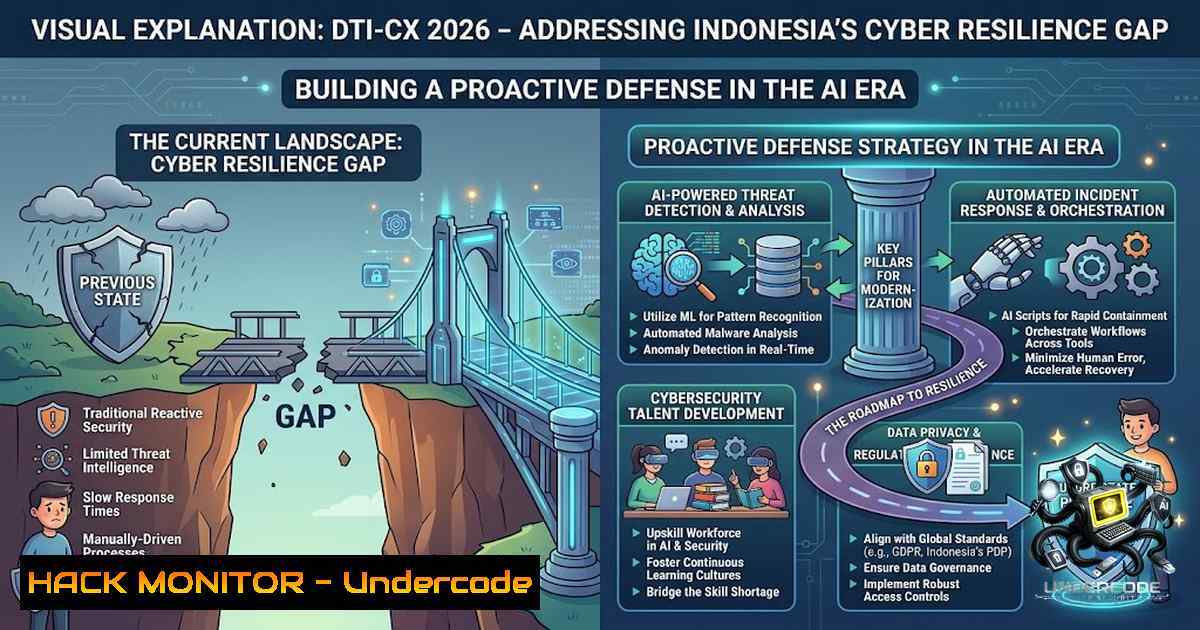
As Indonesia accelerates its digital transformation toward the “Indonesia Emas 2045” vision, the Digital Transformation Indonesia Conference & Expo (DTI-CX) 2026, held on 5–6 August at JICC Jakarta, brought together over 260 technology leaders, government officials, and industry practitioners. While the event showcased more than 450 technology solutions across AI, cloud computing, and cybersecurity, it also laid bare a critical reality: the gap between digital adoption and cyber resilience is widening. With 69% of Indonesian organizations expressing concern over AI-based threats and a regional bank losing Rp143 billion in a single auto-debit attack in February 2026, the message from DTI-CX 2026 was clear – reactive security is no longer sufficient.
Learning Objectives:
- Master the Continuous Threat Exposure Management (CTEM) framework to move beyond reactive vulnerability patching.
- Deploy AI-powered threat detection and automated incident response pipelines across hybrid cloud environments.
- Implement verified Linux and Windows command-line techniques for rapid IOC discovery, log analysis, and forensic investigation.
You Should Know:
- Continuous Threat Exposure Management (CTEM) – The 2026 Paradigm Shift
Traditional vulnerability management, built on scheduled scans and compliance-driven patching, cannot keep pace with today’s threat landscape. In 2025 alone, more than 48,000 new CVEs were registered – a 20% increase from 2024 and a 750% increase over the last decade. The average time-to-exploit has dropped to approximately five days, meaning attackers can weaponize newly disclosed vulnerabilities faster than most organizations can patch them.
Gartner’s CTEM framework addresses this gap through five continuous stages: Scoping, Discovery, Prioritization, Validation, and Mobilization. The key differentiator is Validation – establishing that identified vulnerabilities are genuinely exploitable in practice, rather than treating every CVE as equally urgent.
Step-by-step guide to implementing CTEM:
Step 1: Scoping – Define your attack surface. Identify all assets, including cloud services, third-party providers, shadow IT, and exposed identities. Use asset discovery tools like `nmap` for network mapping:
 Linux - Network discovery
nmap -sS -p- -T4 192.168.1.0/24
 Windows - Active Directory asset enumeration
Get-ADComputer -Filter  | Select-Object Name, OperatingSystem
Step 2: Discovery – Continuously scan for vulnerabilities and misconfigurations. Integrate threat intelligence feeds to correlate external threat data with internal exposures.
 Linux - Check for open ports and services
ss -tulpn | grep LISTEN
 Windows - Check listening ports
netstat -ano | findstr LISTENING
Step 3: Prioritization – Move beyond CVSS scores. Prioritize based on exploitability, business impact, and active threat actor activity. Focus on exposures that could actually be used against your organization.
Step 4: Validation – Use breach and attack simulation (BAS) tools to validate whether prioritized vulnerabilities are genuinely exploitable in your environment.
Step 5: Mobilization – Automate remediation workflows. Deploy patch management automation and integrate with SIEM/SOAR platforms for rapid response.
- Building an AI-Ready SOC – From Alert Fatigue to Intelligent Defense
Fortinet’s research reveals that 64% of Asia-Pacific organizations view security tool complexity as their primary operational challenge, while 46% are overwhelmed by alert volumes. Only 29% have deployed integrated security platforms, though this is projected to reach 60% within 12–24 months.
Dark AI – the use of unrestricted large language models for malicious purposes – represents an emerging threat vector. Threat actors are weaponizing AI to automate malware production, launch hyper-realistic phishing campaigns, and generate deepfakes. A notable case saw scammers use AI-generated audio and video to impersonate a CFO and steal $25 million.
Step-by-step guide to building an AI-ready SOC:
Step 1: Deploy a SIEM with AI-powered analytics – Implement log aggregation and correlation. For a hands-on lab, deploy Wazuh on Ubuntu 24:
 Linux - Install Wazuh manager
curl -s https://packages.wazuh.com/key/GPG-KEY-WAZUH | apt-key add -
echo "deb https://packages.wazuh.com/4.x/apt/ stable main" | tee /etc/apt/sources.list.d/wazuh.list
apt-get update && apt-get install wazuh-manager
systemctl start wazuh-manager
Step 2: Deploy endpoint agents – Install Wazuh agents on Windows and Linux endpoints:
 Windows (PowerShell as Administrator)
Invoke-WebRequest -Uri "https://packages.wazuh.com/4.x/windows/wazuh-agent-4.7.0-1.msi" -OutFile "$env:tmp\wazuh-agent.msi"
msiexec.exe /i "$env:tmp\wazuh-agent.msi" /q WAZUH_MANAGER="YOUR_SIEM_IP" WAZUH_REGISTRATION_SERVER="YOUR_SIEM_IP"

Linux
curl -s https://packages.wazuh.com/key/GPG-KEY-WAZUH | apt-key add -
echo "deb https://packages.wazuh.com/4.x/apt/ stable main" | tee /etc/apt/sources.list.d/wazuh.list
apt-get update && apt-get install wazuh-agent
sed -i 's/MANAGER_IP/YOUR_SIEM_IP/g' /var/ossec/etc/ossec.conf
systemctl start wazuh-agent
Step 3: Configure threat intelligence integration – Enrich SIEM alerts with external threat feeds. Configure syslog forwarding:
 Linux - Configure rsyslog to forward to SIEM
echo ". @YOUR_SIEM_IP:514" >> /etc/rsyslog.conf
systemctl restart rsyslog
Step 4: Implement automated alert triage – Use AI to prioritize alerts based on MITRE ATT&CK mapping and business context, reducing false positives and analyst fatigue.
- Cloud Security Hardening – Preventing the Next Rp143 Billion Breach
The February 2026 attack on an Indonesian regional bank exposed critical failures: obsolete IT systems not updated since 2012, weak governance without 24/7 SOC coverage, and unmanaged vendor risks. In cloud environments, compromised identities now underpin 83% of major intrusions, with attackers exploiting vishing, Auth token theft, and CI/CD pipeline abuse to gain administrative access within hours.
Step-by-step guide to hardening cloud environments:
Step 1: Enforce phishing-resistant MFA – Deploy hardware-backed multi-factor authentication with context-aware access controls.
Step 2: Harden IAM policies – Implement least-privilege access across AWS, Azure, and GCP:
 AWS - Enforce MFA for all IAM users
aws iam create-policy --policy-1ame EnforceMFAPolicy --policy-document file://mfa-policy.json

Azure - Require MFA for all users
Connect-AzAccount
$policy = Get-AzPolicyDefinition | Where-Object {$_.Properties.DisplayName -eq "Require MFA"}
New-AzPolicyAssignment -1ame "MFA-Enforcement" -PolicyDefinition $policy -Scope "/subscriptions/YOUR_SUB_ID"

GCP - Enforce organization policy
gcloud resource-manager org-policies set-policy policy.yaml --organization=YOUR_ORG_ID
Step 3: Automate WAF deployment – Deploy Web Application Firewalls to block threats at the edge before software updates are applied:
 AWS - Deploy WAF ACL
aws wafv2 create-web-acl --1ame MyWAF --scope REGIONAL --default-action Allow={} --visibility-config SampledRequestsEnabled=true,CloudWatchMetricsEnabled=true,MetricName=MyWAFMetric

Azure - Deploy Application Gateway WAF
az network application-gateway waf-policy create --1ame MyWAFPolicy --resource-group MyRG
Step 4: Implement CSPM – Deploy Cloud Security Posture Management tools to continuously monitor for misconfigurations.
- Incident Response Playbook – First 10 Minutes of a Breach
Modern threat actors actively destroy logs and backups. Organizations must deploy automated cloud incident response pipelines with AI-augmented analysis to reduce containment times from days to minutes.
Step-by-step guide for first-response forensic collection:
Linux forensic commands (first 10 minutes):
 Capture running processes
ps auxf > /tmp/ps_$(date +%Y%m%d_%H%M%S).txt
 Capture network connections
ss -tulpn > /tmp/netstat_$(date +%Y%m%d_%H%M%S).txt
 Capture recent file modifications
find / -type f -mtime -1 -ls 2>/dev/null > /tmp/recent_files_$(date +%Y%m%d_%H%M%S).txt
 Capture scheduled tasks
crontab -l > /tmp/crontab_$(date +%Y%m%d_%H%M%S).txt 2>/dev/null
 Check for unauthorized sudo usage
grep sudo /var/log/auth.log | tail -100
 Capture login history
last -100 > /tmp/last_$(date +%Y%m%d_%H%M%S).txt
Windows forensic commands (PowerShell as Administrator):
 Capture running processes
Get-Process | Out-File "C:\temp\processes_$(Get-Date -Format yyyyMMdd_HHmmss).txt"
 Capture network connections
netstat -ano | Out-File "C:\temp\netstat_$(Get-Date -Format yyyyMMdd_HHmmss).txt"
 Capture scheduled tasks
schtasks /query /fo LIST /v | Out-File "C:\temp\schtasks_$(Get-Date -Format yyyyMMdd_HHmmss).txt"
 Capture recent file modifications
Get-ChildItem -Path C:\ -Recurse -ErrorAction SilentlyContinue | Where-Object {$<em>.LastWriteTime -gt (Get-Date).AddDays(-1)} | Out-File "C:\temp\recent_files</em>$(Get-Date -Format yyyyMMdd_HHmmss).txt"
 Capture event logs (Security)
Get-WinEvent -LogName Security -MaxEvents 1000 | Out-File "C:\temp\security_logs_$(Get-Date -Format yyyyMMdd_HHmmss).txt"
 Check for unusual user accounts
Get-LocalUser | Where-Object {$_.Enabled -eq $true}
Containment commands:
 Linux - Isolate host via iptables
iptables -A INPUT -j DROP
iptables -A OUTPUT -j DROP

Windows - Block all inbound/outbound via Windows Firewall
New-1etFirewallRule -DisplayName "EmergencyBlock" -Direction Inbound -Action Block
New-1etFirewallRule -DisplayName "EmergencyBlock" -Direction Outbound -Action Block
- API Security Hardening – Securing the Digital Backbone
As organizations adopt microservices and API-first architectures, API security becomes paramount. OWASP API Security Top 10 vulnerabilities – including broken object-level authorization, broken authentication, and excessive data exposure – remain the most common attack vectors.
Step-by-step guide to API hardening:
Step 1: Implement rate limiting – Protect authentication and public endpoints from brute-force and DoS attacks:
 Nginx rate limiting configuration
limit_req_zone $binary_remote_addr zone=login:10m rate=5r/m;
limit_req zone=login burst=10 nodelay;
Step 2: Enforce schema validation – Validate all API inputs using Zod, Joi, or equivalent libraries to prevent injection attacks.
Step 3: Deploy API security scanning – Use CLI tools to lint API specifications for OWASP API Security Top 10 violations:
 Install and run API security linter
npm install -g @impart-security/impart-cli
impart lint spec.yaml --ruleset owasp-api-top-10
Step 4: Implement positive security models – Block API requests that fall outside expected patterns.
- Threat Hunting – Proactive Detection of Advanced Persistent Threats
Proactive threat hunting requires moving beyond alert-driven responses. Security teams must develop hypotheses based on threat intelligence and actively search for indicators of compromise.
Step-by-step threat hunting workflow:
Step 1: Develop a hypothesis – Based on current threat intelligence, formulate a hypothesis about adversary behavior. Example: “Are attackers using living-off-the-land binaries (LOLBins) for lateral movement?”
Step 2: Hunt using osquery – Deploy osquery for cross-platform forensic collection:
 Linux - Install osquery
apt-get install osquery
 Query for suspicious processes
osqueryi "SELECT pid, name, path, cmdline FROM processes WHERE name IN ('powershell.exe','wmic','wscript','cscript','rundll32')"
 Query for persistence mechanisms
osqueryi "SELECT  FROM crontab"
osqueryi "SELECT  FROM startup_items"
Step 3: Hunt using PowerShell (Windows) :
 Check for suspicious scheduled tasks
Get-ScheduledTask | Where-Object {$<em>.Actions.Execute -match "powershell|cmd|cscript|wscript"}
 Check for suspicious services
Get-Service | Where-Object {$</em>.StartType -eq "Auto" -and $<em>.Status -eq "Running"} | Select-Object Name, DisplayName, PathName
 Check for unusual network connections
Get-1etTCPConnection | Where-Object {$</em>.State -eq "Established" -and $_.RemotePort -gt 1024} | Select-Object LocalAddress, LocalPort, RemoteAddress, RemotePort, OwningProcess
Step 4: Correlate findings with MITRE ATT&CK – Map observed behaviors to ATT&CK techniques for standardized threat intelligence reporting.
What Undercode Say:
- Key Takeaway 1: The DTI-CX 2026 conference underscores that Indonesia’s digital transformation is accelerating, but cyber resilience is not keeping pace. The Rp143 billion bank breach is a stark warning – organizations must transition from reactive patching to proactive exposure management.
-
Key Takeaway 2: AI is a double-edged sword. While 92% of Indonesian organizations have adopted AI for productivity, threat actors are equally leveraging Dark AI for automated attacks. Defenders must deploy AI-powered detection and response capabilities to level the playing field.
Analysis: The convergence of rapid digital adoption, complex multi-cloud environments, and AI-weaponized threats creates an unprecedented risk landscape. Traditional security models – siloed tools, manual patching cycles, and compliance-driven vulnerability management – are failing. The CTEM framework offers a path forward, but successful implementation requires organizational commitment to continuous validation, automated remediation, and integrated security platforms. As Fortinet notes, only 29% of organizations have deployed integrated security platforms – a gap that must close rapidly. The BSSN’s emphasis on cyber resilience at DTI-CX 2026 signals that this is now a national priority.
Prediction:
- +1 CTEM adoption will become mandatory – Within 24–36 months, regulatory frameworks in Indonesia will mandate CTEM-aligned exposure management programs, similar to GDPR’s impact on data protection.
-
+1 AI-powered SOCs will become the default – By 2028, organizations that fail to deploy AI-augmented SIEM and automated incident response will be unable to compete with attackers leveraging Dark AI, leading to a surge in MSSP adoption.
-
-1 The window for proactive defense is closing – With average exploit time dropping to five days, organizations that delay CTEM implementation face an elevated risk of catastrophic breaches. The next major breach could exceed Rp143 billion in losses.
-
-1 Talent shortages will intensify – The demand for skilled SOC analysts, threat hunters, and cloud security engineers will outpace supply, driving up costs and creating a competitive disadvantage for organizations unable to attract and retain cybersecurity talent.
-
+1 Collaboration ecosystems will emerge – As emphasized at DTI-CX 2026, cross-sector collaboration between government, BUMN, private sector, and academia will accelerate the development of Indonesia’s cyber defense ecosystem, creating new opportunities for threat intelligence sharing and joint incident response exercises.
▶️ Related Video (70% Match):
https://www.youtube.com/watch?v=2jU-mLMV8Vw
🎯Let’s Practice For Free:
🎓 Live Courses & Certifications:
Join Undercode Academy for Verified Certifications
🚀 Request a Custom Project:
Secure, high-velocity infrastructure and disruptive technological engineering. Contact our engineering team for high-tier development and proprietary systems:
[email protected]
💎 Smart Architecture | 🛡️ Secure by Design | ⭐ Trusted by Thousands
IT/Security Reporter URL:
Reported By: Funda Denoya – Hackers Feeds
Extra Hub: Undercode MoN
Basic Verification: Pass ✅


