Listen to this Post
Introduction:
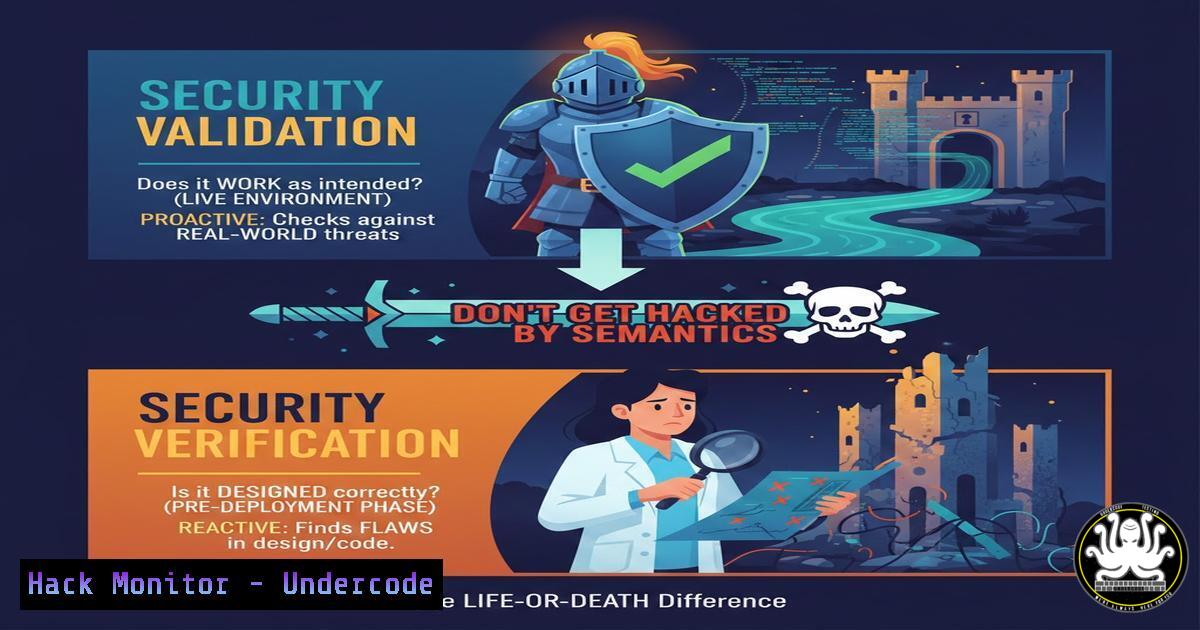
In the high-stakes arena of cybersecurity, a subtle linguistic confusion can lead to catastrophic system failures. Two pillars of secure software development—verification and validation—are often mistakenly used interchangeably, creating critical blind spots in defense strategies. Understanding that verification ensures you are “building the product right” while validation confirms you are “building the right, secure product” is fundamental to defending against modern threats. This article deconstructs this distinction with tactical guidance for IT professionals, developers, and security architects.
Learning Objectives:
- Define and differentiate between security verification and validation with concrete examples.
- Implement practical verification techniques using static analysis and unit testing.
- Deploy real-world validation methodologies like penetration testing and threat modeling.
- Integrate both processes into a Secure Development Lifecycle (SDLC).
- Identify common vulnerabilities that slip through verification but are caught by validation.
You Should Know:
1. The Foundational Divide: Code vs. Reality
Verification is an internal check: does the code adhere to its specification? Validation is an external check: does the system safely operate in the real world against malicious actors? Consider a login API endpoint.
Verification Example: Checking that the code correctly hashes passwords using bcrypt before storage, as per the design doc.
Validation Example: Testing if the same endpoint is vulnerable to SQL injection via the username parameter, even if the input is later hashed.
Step-by-Step Guide: Basic Verification with Static Analysis
- Tool Selection: Choose a static application security testing (SAST) tool like `Bandit` for Python, `Semgrep` for multiple languages, or built-in IDE analyzers.
- Integration: Integrate the tool into your CI/CD pipeline. For a Python project using Bandit:
Install Bandit
pip install bandit

Run Bandit recursively on your code directory
bandit -r ./src -f json -o results.json

Review findings for common issues like hardcoded secrets, shell injection risks.
- Analyze Output: The tool verifies code against a set of security rules, flagging deviations. This is pure verification—it checks the code against a predefined “secure coding” specification.
2. Verification in Action: Unit Testing Security Logic
Verification often manifests as security-focused unit tests. These tests confirm that a specific, intended security control functions correctly in isolation.
Step-by-Step Guide: Writing a Verification Unit Test
Let’s verify a password complexity function.
 Function to verify (in security.py)
def validate_password(password):
 Spec: Minimum 12 chars, one upper, one lower, one digit, one special char
if len(password) < 12:
return False
if not any(c.isupper() for c in password):
return False
if not any(c.islower() for c in password):
return False
if not any(c.isdigit() for c in password):
return False
if not any(c in '!@$%^&' for c in password):
return False
return True

Verification Test (in test_security.py)
import unittest
from security import validate_password

class TestPasswordVerification(unittest.TestCase):
def test_valid_password(self):
 This verifies the function works per spec
self.assertTrue(validate_password("SecurePass123!"))

def test_short_password(self):
self.assertFalse(validate_password("Short1!"))

def test_missing_special(self):
self.assertFalse(validate_password("NoSpecialChar123"))
Run these tests. If they pass, verification succeeds. However, this does not validate if “SecurePass123!” is resilient to brute-force attacks.
3. Validation Through Offensive Security: Penetration Testing
Validation requires an attacker’s mindset. Penetration testing validates controls by attempting to bypass them. Using the same password function, a validator would ask: Can we attack the system around this function?
Step-by-Step Guide: Validating with a Simple Brute-Force Test
- Identify the Target: The login endpoint accepting the password.
- Tool Up: Use a tool like `Hydra` or a custom script to test for rate limiting—a critical validation check missing from the specification.
Example Hydra command to test for brute-force vulnerability on a HTTP POST form
hydra -L userlist.txt -P rockyou.txt -t 4 -W 3 -V target.com http-post-form "/login:username=^USER^&password=^PASS^:F=incorrect"
- Analyze Result: If this attack succeeds quickly, the system is insecure, even though the password function (verification) passed. This validates (or invalidates) the overall security posture.
4. Threat Modeling: Proactive Validation
Threat modeling is a structured validation exercise that identifies threats before code is written. Use the STRIDE model (Spoofing, Tampering, Repudiation, Information Disclosure, Denial of Service, Elevation of Privilege).
Step-by-Step Guide: A Quick STRIDE Session
- Diagram: Create a data flow diagram of your application (e.g., User -> Browser -> Web Server -> API -> Database).
- STRIDE Analysis: For each element and data flow, ask STRIDE questions.
Spoofing: Can an attacker spoof the API server to the user? (Validate with certificate pinning).
Tampering: Can the user tamper with the session cookie? (Validate with proper signing/encryption).
Information Disclosure: Does the API error leak stack traces? (Validate by fuzzing inputs). - Mitigation Plan: Document required mitigations. This validates that your architecture addresses real-world threats.
5. API Security: A Validation Playground
APIs are where verification-vs-validation gaps are most dangerous. Verified input sanitization can fail validation under complex attack chains.
Step-by-Step Guide: Validating API Security with OWASP Amass & FFUF
1. Reconnaissance (Discover Endpoints): Use tools to find hidden or undocumented API endpoints that may not have undergone verification.
 Subdomain/enumeration can reveal API gateways
amass enum -d target.com -passive -o subdomains.txt
2. Fuzzing (Validate Input Handling): Fuzz discovered endpoints with malicious payloads.
 Fuzz a POST parameter with a wordlist of attack payloads
ffuf -u https://api.target.com/v1/user/FUZZ -w sqli-payloads.txt -X POST -d 'id=1' -H "Content-Type: application/json" -mr "error"
3. Analysis: Any unexpected response (errors, data leaks) indicates a validation failure—the system behaves unsafely despite potentially verified code.
6. Cloud Hardening: Beyond Verified Configuration
Infrastructure as Code (IaC) templates can be verified for syntax, but their security must be validated against cloud-specific threat landscapes.
Step-by-Step Guide: Validating AWS S3 Bucket Security
- Verified Config: A Terraform script correctly deploys an S3 bucket (verification).
- Validation Check: Use `Prowler` or the AWS CLI to validate it’s not publicly accessible.
Check for public S3 buckets
aws s3api get-bucket-acl --bucket my-bucket-name
Look for grants to "AllUsers" or "AuthenticatedUsers"
- Remediate: If public, this is a validation failure. The code worked, but the outcome is insecure.
7. The Convergence: Integrating Both into CI/CD
The final step is weaving verification and validation into your pipeline for continuous security.
Step-by-Step Guide: A Simple DevSecOps Pipeline Stage
1. Stage 1 – Verification (On Commit):
SAST Scan (`semgrep –config auto`)
Security Unit Tests (`pytest test_security.py`)
2. Stage 2 – Validation (Pre-Production):
Dynamic Analysis (DAST) with `ZAP` baseline scan.
Dependency Check for known vulns (`OWASP Dependency-Check`).
Infrastructure Scan (`tfsec` or `checkov` for IaC).
- Gating: Fail the build on critical validation failures. This ensures only validated, not just verified, code deploys.
What Undercode Say:
- Verification is a Checklist, Validation is a Battlefield. You can check every box on your security spec (verification) and still field a system full of holes. Validation is the live-fire exercise that finds those holes.
- Security is an Emergent Property. It arises from the interaction of components under hostile conditions. Verification tests components; validation tests the emergent property.
Analysis:
The post correctly identifies the core theoretical distinction but stops short of the operational imperative. In practice, over-reliance on verification creates a false sense of security. It’s a developer-centric, internal process. Validation is threat-centric and external. The most secure organizations budget more for continuous validation (bug bounties, red teams, chaos engineering) than for verification alone. The rise of AI-powered code generators exacerbates this: they can produce verified-correct code that flawlessly implements insecure patterns, making rigorous, adversarial validation more critical than ever.
Prediction:
The convergence of AI-generated code and increasing automation will widen the gap between verification and validation. Verification will become increasingly automated and trivial, potentially leading to complacency. Simultaneously, AI-powered offensive security tools will make validation more complex and continuous. Organizations that fail to invest proportionally in robust, automated validation pipelines will suffer an increasing rate of breaches originating from “verified-secure” code. The future of security lies not in perfecting the spec, but in relentlessly challenging the system in production-like environments.
▶️ Related Video (82% Match):
🎯Let’s Practice For Free:
IT/Security Reporter URL:
Reported By: Hasmukhgehlot Securitytesting – Hackers Feeds
Extra Hub: Undercode MoN
Basic Verification: Pass ✅


