Listen to this Post
Introduction:
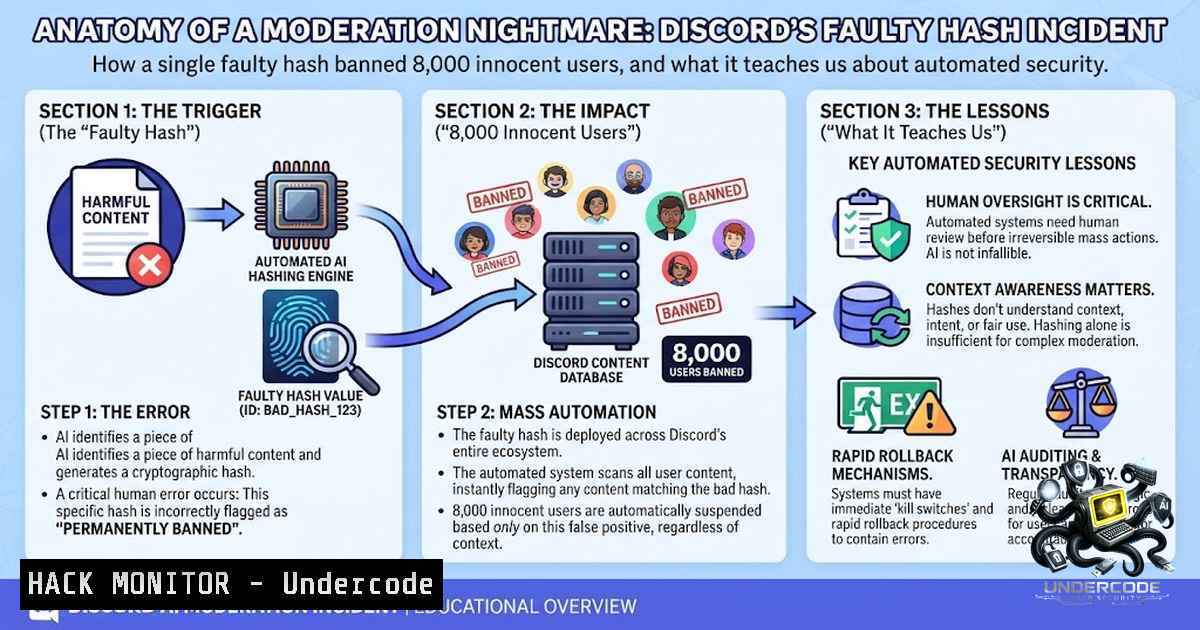
In a cautionary tale that underscores the perils of over-reliance on automated security systems, Discord recently admitted that a bug in its content moderation pipeline led to the wrongful suspension of more than 8,000 user accounts between May and July 2026. The incident, triggered by harmless images containing grid patterns—including chessboards, Minecraft inventory screenshots, and spreadsheet layouts—exposed a critical failure in how machine learning and hash-matching systems can produce catastrophic false positives when not properly governed. This event serves as a stark reminder for cybersecurity professionals, IT administrators, and AI engineers: automated systems are only as reliable as the safeguards built around them.
Learning Objectives:
- Understand the technical root causes behind Discord’s false-positive ban wave, including hash-matching flaws and pipeline bypasses.
- Learn how to audit and harden automated content moderation and security pipelines to prevent similar failures.
- Gain practical knowledge of hash-based detection systems, image analysis techniques, and incident response strategies for false-positive events.
You Should Know:
- The Anatomy of a False-Positive Catastrophe: How Two Bugs Broke Discord’s Moderation Pipeline
Discord’s safety system was designed with a seemingly robust workflow: uploaded images are scanned using hash-based similarity matching against databases of known harmful content, including CSAM (Child Sexual Abuse Material). When a match is detected, the system is supposed to pause the upload and queue the account for manual review by the Trust & Safety team. However, two critical bugs derailed this process:
- Bug One: The system bypassed the upload-pause stage entirely and issued permanent bans without any human intervention.
- Bug Two: Even when Trust & Safety staff reviewed and cleared flagged accounts, the bans remained locked in place, preventing automatic reinstatement.
The underlying technical issue was a single faulty hash entry that incorrectly matched innocent grid patterns with known harmful material. This wasn’t an autonomous AI model freely banning users—it was a flawed hash value breaking an otherwise human-supervised pipeline. The incident affected approximately 8,200 accounts, with an additional 200 users banned over a single weekend before Discord finally acknowledged the problem.
Step‑by‑Step Guide: Auditing Your Hash-Based Detection Pipeline
To prevent similar failures, security engineers should implement the following audit procedures:
- Review Hash Database Integrity: Regularly validate hash entries against known benign samples to detect false-positive patterns. Use tools like `ssdeep` for fuzzy hashing or `md5sum` for exact matches.
- Implement Canary Tests: Deploy synthetic benign images (e.g., grid patterns, chessboards) into your upload pipeline to verify that they are not incorrectly flagged.
- Monitor Bypass Events: Set up SIEM alerts for any moderation actions that skip the human-review queue. Example Splunk query:
index=moderation "action=ban" "review_status=pending". - Automate Reversal Workflows: Ensure that when a human reviewer clears a flagged item, an automated script reinstates the account. Sample Python script using Discord’s API:
import requests def reinstate_user(user_id, token): headers = {"Authorization": f"Bot {token}"} response = requests.post(f"https://discord.com/api/v9/guilds/{guild_id}/members/{user_id}/unban", headers=headers) return response.status_code == 204 - Conduct Regular Red-Team Exercises: Simulate false-positive scenarios to test system resilience and response times.
-
Hash Matching vs. AI: Understanding the Technical Distinction
Discord’s CTO Stanislav Vishnevskiy was careful to distinguish the incident from a failure of “AI” moderation, pointing instead to a faulty hash entry. This distinction is crucial for cybersecurity professionals. Hash-based matching is a deterministic process: it compares the cryptographic or perceptual hash of an uploaded image against a database of known harmful hashes. When a match occurs, the system triggers an action.
However, hash matching is inherently brittle. Perceptual hashing (e.g., pHash, blockhash) can produce false positives when visually similar but benign images share structural patterns with harmful content—exactly what happened with grid-like images. In contrast, AI-based moderation uses machine learning models that classify content based on learned features, which can be more flexible but also more opaque and prone to adversarial attacks.
Step‑by‑Step Guide: Implementing and Testing Perceptual Hash Algorithms
For security engineers building similar systems:
- Choose a Perceptual Hash Library: Use `ImageHash` (Python) or `OpenCV` for pHash generation.
- Generate Hashes for a Test Set: Create a dataset of benign grid images (chessboards, UI layouts) and known harmful images.
- Calculate Similarity Scores: Use Hamming distance to compare hashes. Example:
from imagehash import phash from PIL import Image hash1 = phash(Image.open('chessboard.png')) hash2 = phash(Image.open('harmful_reference.png')) distance = hash1 - hash2 Hamming distance if distance < threshold: flag_as_match() - Tune Thresholds: Adjust similarity thresholds to minimize false positives while maintaining detection rates.
- Log All Matches: Implement comprehensive logging to track every match and the resulting action for post-incident analysis.
-
The Human Factor: Why Manual Review Pipelines Must Be Fail-Safe
Discord’s system was designed to include human review, but the bugs effectively nullified this safeguard. This highlights a fundamental principle in security engineering: automated systems must have fail-safe mechanisms that default to human review when anomalies are detected. In Discord’s case, the system not only bypassed review but also prevented reversal after review.
For IT administrators and security architects, this incident underscores the importance of building “circuit breakers” into automated pipelines. These can include:
- Time-Based Escalation: If a ban is issued without human review within a defined window, automatically escalate to a senior moderator.
- Rate-Limiting Alerts: Sudden spikes in bans (e.g., 200 in a weekend) should trigger immediate alerts for manual investigation.
- Reversal Guarantees: Ensure that any action taken by automation can be reversed by a human with a single click, without technical barriers.
Step‑by‑Step Guide: Building a Fail-Safe Moderation Pipeline
- Define Action Tiers: Classify moderation actions (e.g., flag, warn, temporary ban, permanent ban) and require human review for high-tier actions.
- Implement a Dead Man’s Switch: If a high-tier action is taken without review, automatically generate a ticket and notify the on-call team.
- Use Webhooks for Real-Time Alerts: Configure Discord webhooks (ironically) or Slack integrations to broadcast moderation events to a dedicated channel.
- Create a Reversal API Endpoint: Develop a secure API that allows authorized staff to reverse bans with audit logging.
- Test the Pipeline: Conduct regular drills where a simulated bug bypasses review, and verify that the fail-safe mechanisms trigger correctly.
-
Broader Implications: The Trust Deficit and Regulatory Scrutiny
This incident arrives at a time when Discord is already under fire for its aggressive age-verification push, which exposed around 70,000 users’ government ID documents in a separate breach. The combination of these events erodes user trust and invites regulatory scrutiny. Under frameworks like the EU’s Digital Services Act (DSA), platforms are required to have transparent and accountable moderation systems. False-positive ban waves that lack clear appeal mechanisms could be viewed as violations of due process.
For organizations operating in regulated environments, this incident serves as a case study in the importance of:
- Transparency: Clearly communicating how automated systems work and what users can do if they are falsely flagged.
- Appeals Processes: Providing a straightforward, human-reviewed appeals process for all automated actions.
- Audit Trails: Maintaining detailed logs of all moderation decisions, including the specific hashes or model outputs that triggered them.
Step‑by‑Step Guide: Implementing Compliance-Ready Moderation Logging
- Structured Logging: Use JSON format for all moderation events, including
timestamp,user_id,action,trigger_hash,review_status, andreviewer_id. - Retention Policies: Ensure logs are retained for a minimum period (e.g., 12 months) as required by regulations.
- Access Controls: Restrict log access to authorized personnel and implement encryption at rest.
- Regular Audits: Conduct quarterly audits of moderation logs to identify patterns of false positives or systemic biases.
- User Notification: Automatically notify users when an action is taken against their account, including the specific content that triggered the action and instructions for appeal.
-
Linux and Windows Commands for Forensic Analysis of Image Hashes
For security analysts investigating similar incidents, the following commands can be used to analyze image files and generate hashes for forensic comparison:
Linux Commands:
- Generate MD5 hash of an image: `md5sum image.png`
– Generate SHA-256 hash: `sha256sum image.png`
– Install and use `ssdeep` for fuzzy hashing: `ssdeep -b image.png`
– Extract EXIF metadata: `exiftool image.png`
– Compare two images using ImageMagick: `compare image1.png image2.png -metric MSE null:`
Windows Commands (PowerShell):
- Generate MD5 hash: `Get-FileHash -Algorithm MD5 .\image.png`
– Generate SHA-256: `Get-FileHash -Algorithm SHA256 .\image.png`
– Use `certutil` for hash generation: `certutil -hashfile image.png MD5`
Python Script for Batch Hash Analysis:
import os
import hashlib
from PIL import Image
import imagehash

def analyze_images(directory):
results = []
for filename in os.listdir(directory):
if filename.endswith(('.png', '.jpg', '.jpeg')):
path = os.path.join(directory, filename)
with open(path, 'rb') as f:
md5 = hashlib.md5(f.read()).hexdigest()
ph = imagehash.phash(Image.open(path))
results.append({'file': filename, 'md5': md5, 'phash': str(ph)})
return results
What Undercode Say:
- Key Takeaway 1: Automated security systems are only as robust as their failure modes. Discord’s incident demonstrates that even well-intentioned hash-matching pipelines can produce catastrophic false positives when bugs bypass human review and reversal mechanisms. Organizations must treat automation as a decision-support tool, not a replacement for human judgment.
-
Key Takeaway 2: The distinction between “AI” and “hash-based” moderation matters for accountability. While AI models are often blamed for overreach, this case shows that deterministic systems can be equally dangerous when misconfigured. Security teams should prioritize transparency, auditability, and fail-safe design in all automated pipelines.
Analysis: The Discord ban wave is a textbook example of how security automation can backfire without proper governance. The incident highlights several systemic vulnerabilities: inadequate testing of hash databases against benign patterns, missing circuit breakers for anomaly detection, and brittle reversal workflows. For cybersecurity professionals, the lesson is clear: automation must be accompanied by rigorous testing, continuous monitoring, and human oversight. As platforms increasingly deploy AI and automated systems for moderation, the risk of false positives will only grow. Organizations that fail to build robust fail-safe mechanisms will face not only user backlash but also regulatory penalties. The Discord case should serve as a wake-up call for the entire industry to prioritize resilience and transparency in automated security systems.
Prediction:
- -1: As platforms continue to scale automated moderation, we can expect more high-profile false-positive incidents, particularly as hash databases expand and perceptual hashing algorithms struggle with diverse visual content. Without industry-wide standards for testing and transparency, user trust will continue to erode.
-
-1: Regulators are likely to take notice of incidents like this, potentially leading to new mandates requiring platforms to provide clear appeals processes and human review for all automated bans. This could increase operational costs but ultimately improve accountability.
-
+1: On the positive side, this incident will drive innovation in “explainable AI” and fail-safe automation. We may see the emergence of new tools and frameworks for testing moderation pipelines, as well as best practices for designing systems that default to human review when anomalies are detected.
▶️ Related Video (66% Match):
https://www.youtube.com/watch?v=0vNt2Gk_57o
🎯Let’s Practice For Free:
🎓 Live Courses & Certifications:
Join Undercode Academy for Verified Certifications
🚀 Request a Custom Project:
Secure, high-velocity infrastructure and disruptive technological engineering. Contact our engineering team for high-tier development and proprietary systems:
[email protected]
💎 Smart Architecture | 🛡️ Secure by Design | ⭐ Trusted by Thousands
IT/Security Reporter URL:
Reported By: Cybersecuritynews Share – Hackers Feeds
Extra Hub: Undercode MoN
Basic Verification: Pass ✅


