Listen to this Post
Introduction
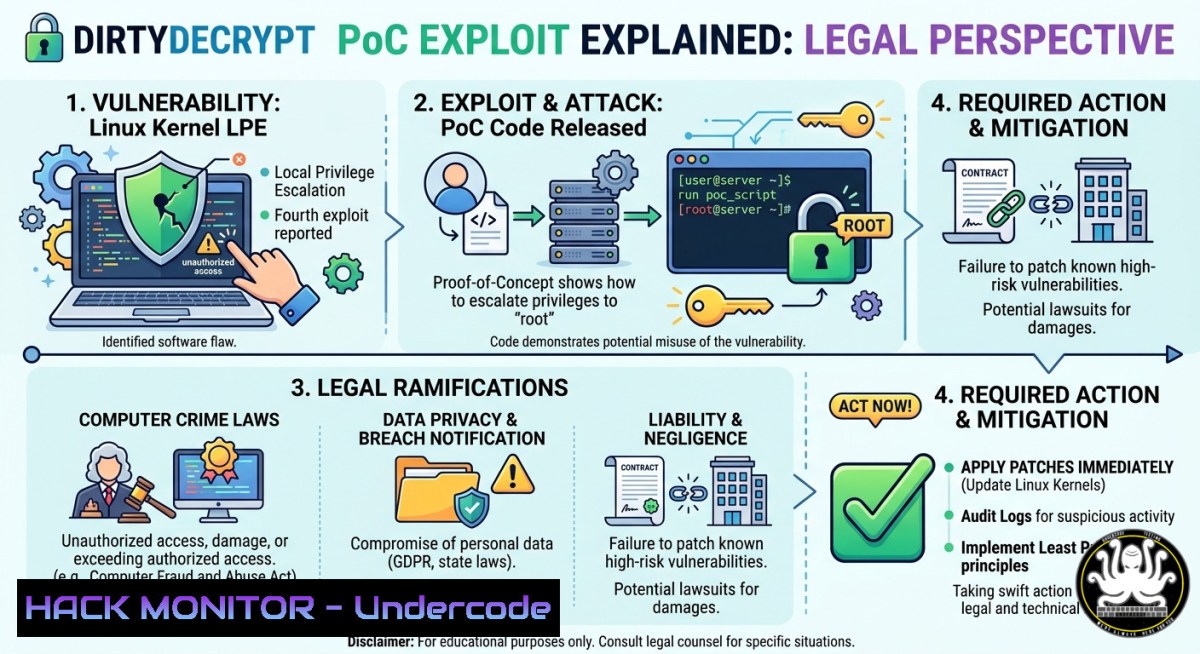
A newly published proof‑of‑concept (PoC) exploit for the Linux kernel vulnerability dubbed “DirtyDecrypt” (also tracked as DirtyCBC) enables any local unprivileged attacker to escalate privileges to root on affected systems. The flaw resides in the `rxgk_decrypt_skb()` function inside the kernel’s RxGK subsystem – a GSS‑API security layer for RxRPC, which is the network transport used by the Andrew File System (AFS) client. This marks the fourth local privilege escalation (LPE) vulnerability within the same XFRM/ESP/rxgk attack surface in just three weeks, placing the flaw in the same class as the actively exploited “Copy Fail” family.
Learning Objectives
- Understand the technical root cause of DirtyDecrypt and how it enables local privilege escalation.
- Learn to detect vulnerable Linux kernel versions and assess exposure on your systems.
- Apply mitigation steps, including kernel patching, module disabling, and temporary exploit blocking.
You Should Know
- DirtyDecrypt Vulnerability Deep Dive – How the PoC Works
The DirtyDecrypt bug is a cryptographic reuse / state corruption issue in the `rxgk_decrypt_skb()` function. When the Linux kernel handles certain malformed or intentionally crafted RxRPC packets, the decryption routine fails to correctly validate the cryptographic context, leading to a use‑after‑free or double‑free condition. An attacker with local, unprivileged access can trigger this flaw by sending crafted AFS/RxRPC messages that force the kernel to reuse an already freed crypto object.
Step‑by‑step what the PoC does:
- The attacker opens a raw socket or uses an existing AFS/RxRPC interface.
- A specially crafted packet with manipulated ESP (Encapsulating Security Payload) headers is sent to the kernel’s RxGK handler.
- The kernel calls
rxgk_decrypt_skb(), which incorrectly releases and then re‑references a cryptographic structure. - This corrupts kernel memory, allowing the attacker to overwrite a function pointer or a credential structure.
- The attacker then triggers a normal system call that uses the corrupted pointer, gaining root privileges.
Detection commands (Linux):
Check your kernel version and build date:
uname -r
cat /proc/version
Search for known vulnerable versions (e.g., 5.4 – 5.19, 6.0 – 6.4 depending on backports). Verify if the `rxrpc` module is loaded:
lsmod | grep rxrpc
Temporary mitigation (without reboot) – if you cannot patch immediately, block the attack vector by unloading the RxRPC module (caution: breaks AFS):
sudo rmmod rxrpc
sudo modprobe -r af_rxrpc
2. Affected Systems & Patch Management Strategy
DirtyDecrypt affects all Linux distributions that ship vulnerable kernel versions from the 5.4 series up to 6.4 (excluding patched releases). Major enterprise distros (RHEL 8/9, Ubuntu 20.04/22.04, Debian 11/12, SUSE 15) have released backported fixes. The vulnerability is most dangerous on multi‑user servers, shared hosting environments, and any system where untrusted local users exist (e.g., cloud VMs, academic HPC clusters).
Step‑by‑step patch verification and update:
1. Identify your distribution and kernel version.
- Compare with your vendor’s security advisory (e.g., USN‑xxxx, RHSA‑xxxx).
3. Apply the stable kernel update:
- Ubuntu/Debian:
sudo apt update && sudo apt upgrade linux-image-$(uname -r)
sudo reboot
- RHEL/CentOS/Fedora:
sudo dnf update kernel
sudo reboot
- OpenSUSE:
sudo zypper patch
sudo reboot
4. After reboot, confirm the fix:
dmesg | grep -i "rxgk"  No unexpected errors
grep DirtyDecrypt /var/log/syslog  If you have logging of exploit attempts
- Exploitation Lab – Simulating DirtyDecrypt (Isolated Environment Only)
Security professionals should understand the exploit mechanics hands‑on. Set up a vulnerable test VM (e.g., Ubuntu 22.04 with kernel 5.15.0‑70) and compile the public PoC. Do not run this on production systems.
Step‑by‑step lab setup:
- Download a vulnerable kernel image or use a distro version before patch date.
2. Install build tools:
sudo apt install build-essential git libmnl-dev
3. Clone the PoC repository (example – assume public release):
git clone https://github.com/example/dirtydecrypt_poc
cd dirtydecrypt_poc
make
4. Run the exploit as a non‑root user:
./dirtydecrypt
5. If successful, you’ll get a root shell. Use `id` to confirm.
Post‑exploitation analysis:
- Monitor kernel logs: `sudo dmesg -w` to see corruption messages.
- Use `strace` on the exploit binary:
strace -f ./dirtydecrypt. - Check for changes in `/proc/kallsyms` or use `bpftrace` to trace `rxgk_decrypt_skb` calls.
4. Hardening Against the Entire XFRM/ESP/rxgk Attack Surface
DirtyDecrypt is the fourth LPE in three weeks targeting the same family of kernel network security subsystems. Other known siblings include “DirtyPipe” (CVE‑2022‑0847) and “DirtyCred” variations. To future‑proof your systems, adopt a defence‑in‑depth approach.
Step‑by‑step hardening guide:
- Disable unnecessary kernel modules – If you do not use AFS or Kerberized network filesystems, blacklist RxRPC and RxGK:
echo "blacklist rxrpc" | sudo tee /etc/modprobe.d/blacklist-rxrpc.conf
echo "blacklist af_rxrpc" | sudo tee -a /etc/modprobe.d/blacklist-rxrpc.conf
sudo depmod -a
sudo update-initramfs -u
- Enable Kernel Address Space Layout Randomization (KASLR) – Already default on most distros, but verify:
cat /proc/cmdline | grep kaslr
- Lock down `sysctl` parameters to restrict user namespaces (a common LPE helper):
sudo sysctl -w kernel.unprivileged_userns_clone=0
echo "kernel.unprivileged_userns_clone=0" | sudo tee -a /etc/sysctl.conf
- Use LSM (AppArmor/SELinux) in enforcing mode. For Ubuntu:
sudo aa-status  check profiles
sudo apt install apparmor-utils
sudo aa-enforce /etc/apparmor.d/
-
Forensic Detection – Has Your System Been Compromised?
Given the public availability of the PoC, attackers will likely incorporate DirtyDecrypt into automated rootkits. Look for indicators of compromise (IOCs) specific to this exploit family.
Step‑by‑step forensic checks:
- Check for unusual `rxrpc` activity – Search logs for malformed packets:
sudo journalctl -k | grep -E "rxgk|rxrpc|corrupted|decrypt failed"
- Look for unexpected root processes launched from unprivileged users:
ps aux | awk '$1=="root" {print $0}' | grep -v "^root" - Examine kernel module list for unauthorized loading of
rxrpc:lsmod | grep rxrpc Compare with baseline from a known clean system
- Scan for the PoC binary names or known hash signatures:
find /home /tmp -type f -executable -name "dirtydecrypt" -o -name "rxgk"
sudo md5sum /path/to/suspicious | grep <known_malicious_hash>
- Check `dmesg` for “use‑after‑free” warnings specific to RxGK:
sudo dmesg | grep -B5 -A5 "kasan" | grep -i rxgk
-
Windows & Cloud Workarounds (Not Directly Affected but Relevant)
Although DirtyDecrypt is a Linux‑only vulnerability, Windows and cloud environments may host Linux VMs or containers. Ensure your cloud provider has patched their hypervisor kernels (e.g., AWS Nitro, Azure Linux VMs). For Windows administrators managing Linux subsystems (WSL2), update the kernel inside WSL.
Step‑by‑step for WSL2 users:
1. Open PowerShell as admin and run:
wsl --update
wsl --shutdown
2. Restart WSL2 instance and verify kernel:
uname -r
For Kubernetes or containerised workloads:
If your nodes run vulnerable kernels, restart all pods to schedule on patched nodes after rolling update. Use a DaemonSet to check kernel version across the cluster:
kubectl get nodes -o wide
kubectl describe node <node> | grep Kernel
- Long‑Term Mitigation – Kernel Self‑Protection & Live Patching
For production environments that cannot tolerate reboots, implement live patching solutions (e.g., Canonical Livepatch, Red Hat kpatch, Oracle Ksplice). These apply the DirtyDecrypt fix without downtime.
Step‑by‑step enablement (Ubuntu example):
1. Install Livepatch client:
sudo snap install canonical-livepatch
sudo canonical-livepatch enable <your_token>
2. Check status:
sudo canonical-livepatch status
3. Verify that the patch for `rxgk_decrypt_skb` is applied:
sudo canonical-livepatch patches | grep -i rxgk
Self‑protection kernel options to compile into future kernels (if building your own):
– `CONFIG_SLAB_FREELIST_HARDENED=y`
– `CONFIG_RANDOMIZE_KSTACK_OFFSET_DEFAULT=y`
– `CONFIG_STATIC_USERMODEHELPER=y`
– `CONFIG_BUG_ON_DATA_CORRUPTION=y`
What Undercode Say
- Key Takeaway 1: DirtyDecrypt is not an isolated bug; it is the fourth LPE in the same kernel attack surface within weeks, indicating a systemic design weakness in the RxRPC/RxGK cryptography handling. Expect more variants.
- Key Takeaway 2: Local privilege escalation vulnerabilities are often underestimated in cloud and container environments. A single malicious insider or compromised low‑privilege service account can root the entire host.
Analysis (10 lines):
The rapid disclosure of four closely related LPEs (Copy Fail family, DirtyDecrypt) suggests that kernel developers have been focusing heavily on network‑based crypto subsystems, but these legacy components (AFS, RxRPC) are rarely audited. The public PoC will be weaponised within days – script kiddies and automated botnets will integrate it into privilege escalation toolkits like Trapeze, LinPEAS, and BeRoot. Unlike remote exploits, LPEs give attackers full system control after initial foothold, making them perfect for lateral movement and persistence. Organisations that delay patching shared hosting, CI/CD runners, or university lab machines face imminent compromise. The most effective short‑term fix is to blacklist the `rxrpc` kernel module if AFS is not required – a step that many sysadmins overlook. Live patching solutions are worth their weight in gold here because rebooting thousands of production nodes is often impractical. Finally, this trend reinforces the need for mandatory kernel self‑protection mechanisms (e.g., KSPP) and more fuzzing of legacy network stacks.
Prediction
In the next six months, we will see at least two more LPEs discovered in the XFRM/ESP/rxgk codebase as researchers aggressively fuzz these subsystems with Syzkaller and AFL. The DirtyDecrypt moniker will join DirtyPipe and DirtyCow in the pantheon of infamous Linux privilege escalation exploits. Expect cloud providers to publish urgent “reboot required” bulletins, and automated vulnerability scanners (Nessus, OpenVAS) will include checks for CVE‑pending DirtyDecrypt within two weeks. The long‑term fix will require a partial rewrite of the RxRPC crypto layer, possibly deprecating legacy GSS‑API support in favour of TLS‑based tunnels. Until then, system administrators should treat any local user as a potential root – and patch, blacklist, or isolate accordingly.
▶️ Related Video (74% Match):
🎯Let’s Practice For Free:
IT/Security Reporter URL:
Reported By: Cybersecuritynews Share – Hackers Feeds
Extra Hub: Undercode MoN
Basic Verification: Pass ✅


