Listen to this Post
Introduction:
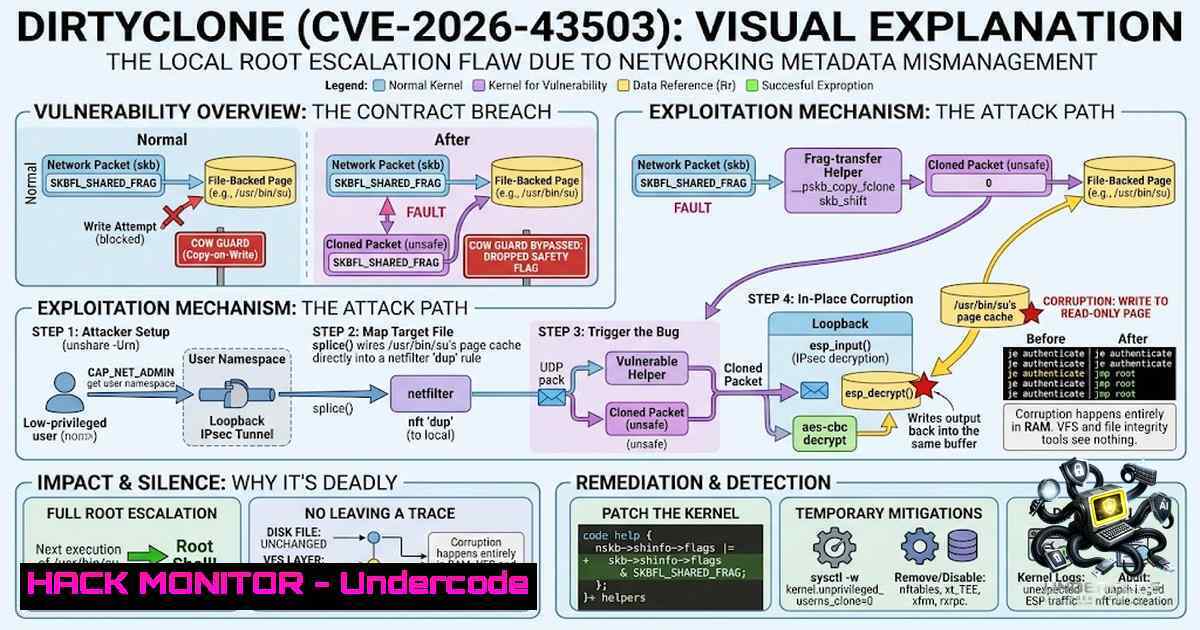
A newly discovered Linux kernel vulnerability, tracked as CVE-2026-43503 and dubbed “DirtyClone,” allows any unprivileged local user to escalate privileges to root by manipulating the kernel’s page cache through a cloned network packet. What makes this flaw exceptionally dangerous is that the attacker can overwrite privileged binaries like `/usr/bin/su` in memory without ever modifying the file on disk—leaving no audit trail and bypassing all file-integrity monitoring tools. This marks the fourth privilege escalation vulnerability with this exact failure mode to emerge in just two months, exposing a systemic weakness in the Linux kernel’s zero-copy networking stack.
Learning Objectives:
- Understand the technical root cause of CVE-2026-43503 and how the dropped `SKBFL_SHARED_FRAG` flag enables arbitrary page-cache writes.
- Learn to identify vulnerable systems and assess exposure in multi-tenant, containerized, and cloud environments.
- Master practical mitigation strategies, including kernel patching, namespace restrictions, and capability blocking.
- Explore step-by-step exploitation techniques and detection methods for red-team and defensive security operations.
You Should Know:
- Understanding the DirtyClone Attack Chain: The Missing Flag That Breaks the Kernel
The DirtyClone vulnerability resides in the Linux kernel’s networking subsystem, specifically within socket buffer (sk_buff) management code that handles packet coalescing and fragment transfer operations. When the kernel copies a network packet internally, two helper functions—__pskb_copy_fclone() and skb_shift()—fail to propagate the `SKBFL_SHARED_FRAG` flag in `skb_shinfo()->flags` when moving fragments from source to destination. This missing flag is the entire vulnerability.
An attacker exploits this by loading a privileged binary like `/usr/bin/su` into memory, wiring those memory pages into a network packet, and forcing the kernel to clone it. The cloned packet passes through an IPsec tunnel that the attacker controls, and the in-place ESP decryption step overwrites the binary’s login checks with attacker-chosen bytes. Because the modification lives only in the kernel’s in-memory copy (the page cache), the file on disk remains pristine, integrity tools miss it, and a reboot is required to restore the original binary.
Step‑by‑step guide to understanding the exploitation primitive:
- Load target binary into page cache: Execute `/usr/bin/su` or another setuid binary to map it into the kernel’s page cache.
- Create a network packet backed by the cached file pages: Use packet sockets or AF_PACKET to construct an `sk_buff` whose fragments point to the file-backed memory pages.
- Trigger a clone operation: Force the kernel to clone this `sk_buff` through a path that calls `__pskb_copy_fclone()` or
skb_shift(), which drops the `SKBFL_SHARED_FRAG` flag. - Route through a controlled IPsec tunnel: Configure a loopback IPsec tunnel (requiring
CAP_NET_ADMIN) and pass the cloned packet through ESP decryption. - Overwrite in memory: The in-place ESP decryption writes attacker-controlled data directly into the file-backed page cache, corrupting the binary’s logic.
- Execute the corrupted binary: Run `/usr/bin/su` again—the modified in-memory version hands over root privileges.
2. Identifying Vulnerable Systems and Assessing Exposure
CVE-2026-43503 carries a CVSS score of 8.8 (High) and affects a broad range of modern Linux distributions. The attack requires two key conditions: a vulnerable kernel and the ability to acquire CAP_NET_ADMIN. On Debian and Fedora, unprivileged user namespaces are enabled by default, allowing any local user to obtain this capability inside a new namespace. Ubuntu 24.04 and later restrict namespace creation via AppArmor, blocking the default exploit path.
Vulnerable distributions confirmed by JFrog:
- Debian (with default namespace configuration)
- Ubuntu (vulnerable unless AppArmor restrictions are in place)
- Fedora
Kernel versions at risk: Any kernel lacking the complete chain of fixes for the DirtyFrag vulnerability family. Specific vulnerable versions include 5.10.257, 5.15.208, 6.1.174, 6.6.141, 6.12.91, and 6.18.33.
Commands to check your system’s exposure:
 Check kernel version
uname -r

Check if unprivileged user namespaces are enabled
cat /proc/sys/user/max_user_namespaces

Check for CAP_NET_ADMIN in current user's capabilities
capsh --print | grep net_admin

Verify if the patch is applied (check for commit 48f6a5356a33)
zgrep "48f6a5356a33" /proc/config.gz 2>/dev/null || echo "Patch not found"
- Mitigation and Patching: Closing the Door on DirtyClone
The vulnerability was patched and merged into mainline on May 21, 2026, with commit `48f6a5356a33` (shipped in Linux v7.1-rc5 on May 24). The fix covers multiple frag-transfer helpers where the shared-frag flag could be lost, including `__pskb_copy_fclone()` and skb_shift().
Immediate recommendations:
- Patch immediately: Update to Linux v7.1-rc5 or apply the backported patch from your distribution’s repository.
2. If patching is not possible, apply workarounds:
- Block `CAP_NET_ADMIN` acquisition via unprivileged user namespaces.
- Disable unprivileged user namespaces entirely:
echo 0 > /proc/sys/user/max_user_namespaces. - Restrict namespace creation using AppArmor or SELinux policies.
- Deploy eBPF-based detection to monitor for anomalous `sk_buff` cloning patterns.
Distribution-specific patch commands:
 Debian/Ubuntu
sudo apt update && sudo apt upgrade linux-image-$(uname -r)

Fedora/RHEL/CentOS
sudo dnf update kernel

Verify patch presence
dmesg | grep -i "CVE-2026-43503" || echo "Check kernel changelog"
- Exploitation in Practice: PoC Analysis and Defensive Implications
Public proof-of-concept exploits for DirtyClone have been released on GitHub. The PoC by mooder1 demonstrates how an unprivileged user can patch `/etc/passwd` in the page cache to inject a uid-0 account and spawn a root shell—all without ever modifying the disk.
PoC execution (educational use only):
 Clone the PoC repository
git clone https://github.com/mooder1/dirtyclone-CVE-2026-43503.git
cd dirtyclone-CVE-2026-43503

Run as an unprivileged user
python3 CVE-2026-43503.py
 [] uid=1000 -> root
 [+] injected uid 0 account 'firefart' (password: pwned)
 uid=0(root) gid=0(root) groups=0(root)
 [+] root achieved
Requirements for the exploit:
- Unpatched kernel
- Unprivileged user namespaces enabled
– `python3` + `libcrypto` + `iproute2` + `iptables` installed
Defensive detection:
- Monitor for abnormal `sk_buff` cloning operations using BPF tracing.
- Audit for IPsec tunnel configurations created by non-root users.
- Implement file-integrity monitoring that checks runtime memory mappings against on-disk hashes.
- The Bigger Picture: A Systemic Failure in Zero-Copy Networking
DirtyClone is not an isolated incident—it is the fourth privilege escalation vulnerability with the same failure mode to emerge in two months. The sequence of CVEs tells a troubling story:
- Copy Fail (CVE-2026-31431): Late April, exploited the `algif_aead` module for a four-byte page-cache write.
- DirtyFrag (CVE-2026-43284 and CVE-2026-43500): May 7, chained IPsec ESP and RxRPC paths for a full write primitive.
- Fragnesia (CVE-2026-46300): May 13, bypassed the DirtyFrag patch through a flag-dropping bug in
skb_try_coalesce(). - DirtyClone (CVE-2026-43503): May 21 patch, demonstrating the same issue in
__pskb_copy_fclone().
The underlying problem is not one bad helper function—it is a contract problem. Every code path that moves `skb` fragments must preserve the shared-frag bit, every time. The kernel’s zero-copy networking lets file-backed memory serve as packet data, and a single dropped flag anywhere in the chain turns a performance optimization into a write primitive.
What Undercode Say:
- Key Takeaway 1: DirtyClone is a textbook example of how a seemingly minor implementation detail—a dropped flag in a helper function—can cascade into a full system compromise. The attack is silent, leaves no forensic evidence, and bypasses traditional integrity controls.
-
Key Takeaway 2: The repeated emergence of similar vulnerabilities (Copy Fail → DirtyFrag → Fragnesia → DirtyClone) indicates a systemic failure in the Linux kernel’s patch-review process for the networking stack. Each fix closed one code path while leaving others open—a whack-a-mole approach that leaves defenders perpetually one step behind.
Analysis: The DirtyClone vulnerability underscores a fundamental tension in modern operating system design: performance optimizations (zero-copy networking, page-cache sharing) inevitably expand the attack surface. The kernel’s networking stack was not designed with the security rigor required for multi-tenant environments where untrusted users can create namespaces. The fact that unprivileged user namespaces are enabled by default on major distributions makes this a supply-chain-level risk. For defenders, the lesson is clear: assume that any local user on a multi-tenant system is a potential attacker, and layer defenses accordingly. This includes not just patching but also restricting capabilities, monitoring for anomalous network operations, and reconsidering the default namespace policies.
Prediction:
- -1 The DirtyClone vulnerability family will continue to spawn new variants as researchers audit additional `sk_buff` processing paths. The kernel’s networking subsystem is vast, and the contract around `SKBFL_SHARED_FRAG` is difficult to enforce universally. Expect at least one more CVE in this class within the next six months.
- -1 Cloud providers and container orchestration platforms will face increased pressure to disable unprivileged user namespaces by default, potentially breaking legitimate workflows and forcing a painful trade-off between security and compatibility.
- +1 The security community’s focus on this vulnerability class will drive improved static analysis and fuzzing of the networking stack, leading to more robust patch-review processes and potentially preventing future variants.
▶️ Related Video (72% Match):
🎯Let’s Practice For Free:
🎓 Live Courses & Certifications:
Join Undercode Academy for Verified Certifications
🚀 Request a Custom Project:
Secure, high-velocity infrastructure and disruptive technological engineering. Contact our engineering team for high-tier development and proprietary systems:
[email protected]
💎 Smart Architecture | 🛡️ Secure by Design | ⭐ Trusted by Thousands
IT/Security Reporter URL:
Reported By: Mohit Hackernews – Hackers Feeds
Extra Hub: Undercode MoN
Basic Verification: Pass ✅


