Listen to this Post
Introduction:
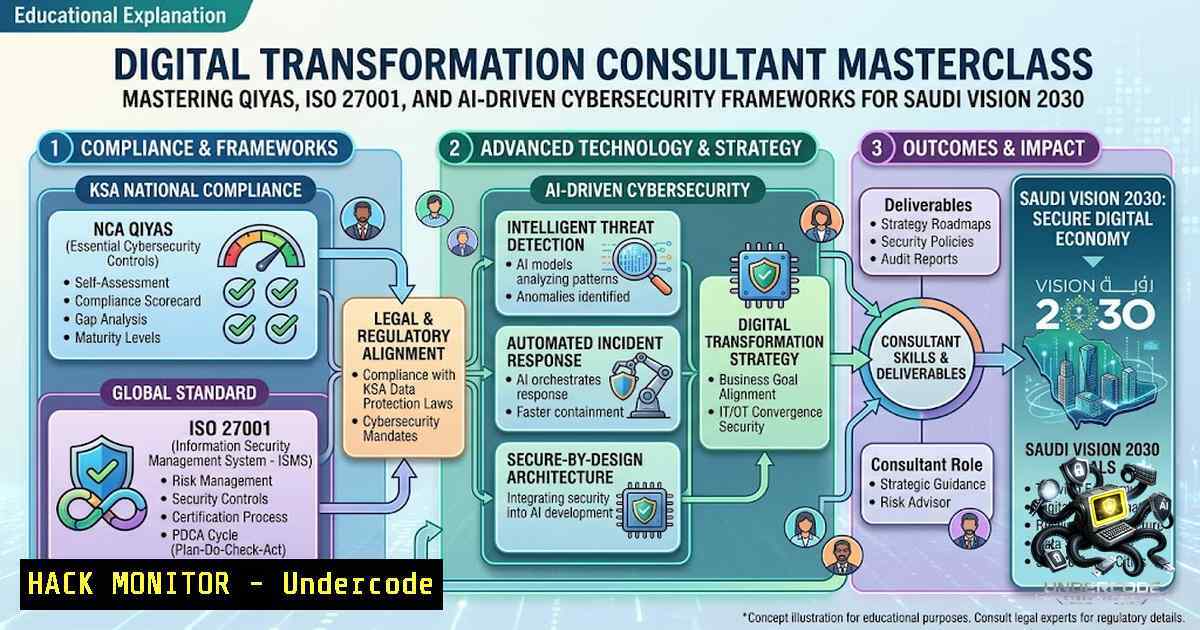
As Saudi Arabia accelerates toward its Vision 2030 objectives, the demand for Digital Transformation Consultants who can navigate the complex intersection of IT strategy, cybersecurity, and regulatory compliance has never been higher. The Digital Government Authority (DGA) has established the Qiyas framework as a comprehensive methodology for measuring digital transformation progress across government agencies, requiring consultants to possess deep expertise in gap analysis, digital maturity assessment, and documentation aligned with official government standards. This article provides a technical deep-dive into the core competencies, frameworks, and hands-on implementation strategies that define success in this high-stakes role, bridging the gap between strategic vision and executable cybersecurity controls.
Learning Objectives:
- Master the Qiyas digital transformation measurement framework and its application in government sector assessments
- Implement ISO 27001, NIST CSF, and TOGAF frameworks to build resilient information security management systems
- Execute cloud hardening, API security, and vulnerability mitigation strategies aligned with Saudi regulatory requirements
- Decoding the Qiyas Framework: A Technical Implementation Guide
The Qiyas framework, developed by the Digital Government Authority, serves as the cornerstone for measuring digital transformation maturity across Saudi government entities. It consists of two sub-indices that assess government agencies’ compliance with core digital transformation standards, tracking progress from basic digital presence to integrated, beneficiary-centered service delivery. Understanding this framework is non-1egotiable for any consultant working with Saudi governmental clients.
Step-by-Step Guide to Qiyas Implementation:
- Conduct Digital Maturity Baseline Assessment: Evaluate the organization’s current state across five maturity levels—Basic, Discovery, Developed, Integrated, and Leadership—using the Qiyas diagnostic tool available through the National Platform.
- Perform Gap Analysis Against Qiyas Standards: Map existing capabilities against Qiyas 2023/2024 requirements, identifying specific deficiencies in infrastructure, AI adoption, business continuity, and innovation frameworks.
- Develop Strategic Roadmap and Documentation: Prepare official Arabic-language documents including strategic studies, execution plans, KPI dashboards, and audit responses that demonstrate traceability and completeness.
- Align with DGA Digital Excellence Program: Integrate Qiyas assessment outputs with the DGA’s unified assessment methodologies to ensure regulatory compliance.
Linux Command for Compliance Documentation Automation:
 Audit log collection and compliance reporting
sudo journalctl --since "2026-01-01" --until "2026-06-28" -p info | grep -E "auth|security|audit" > qiyas_compliance_audit.log

Generate hash-based integrity verification for documentation
sha256sum /var/log/secure /var/log/auth.log > documentation_integrity_hashes.txt

Schedule automated compliance checks
crontab -e
 Add: 0 9   1 /usr/bin/python3 /opt/qiyas_audit/qiyas_automation.py --output /var/reports/qiyas_$(date +\%Y\%m\%d).json
Windows PowerShell Command for Maturity Assessment:
 Extract system security configuration for Qiyas readiness
Get-WinEvent -LogName Security -MaxEvents 1000 | Where-Object {$_.Id -in (4624,4625,4672)} | Export-Csv -Path "C:\Qiyas\security_events.csv"

Generate system inventory report
Get-WmiObject -Class Win32_ComputerSystem | Select-Object Manufacturer,Model,TotalPhysicalMemory | Out-File -FilePath "C:\Qiyas\asset_inventory.txt"
2. ISO 27001:2022 Implementation for Government Digital Transformation
ISO 27001 certification is a preferred qualification for Digital Transformation Consultants, providing the structured framework for establishing, implementing, maintaining, and continually improving an Information Security Management System (ISMS). The standard’s 114 controls in Annex A must be tailored to the unique requirements of Saudi government entities.
Step-by-Step ISO 27001 Implementation Guide:
- Secure Leadership Commitment and Define ISMS Scope: Obtain executive sponsorship and clearly document the scope of the ISMS, including systems, services, and locations to be covered.
- Conduct Comprehensive Risk Assessment: Identify information security risks, evaluate their likelihood and impact, and document risk treatment options using a structured methodology.
- Develop Statement of Applicability (SoA): Map the 114 Annex A controls to organizational requirements, justifying inclusion or exclusion of each control.
- Implement Security Controls and Operational Processes: Turn each control into a simple operating process, defining what the control achieves and how it works within the organization.
- Internal Audit and Management Review: Conduct internal audits to verify ISMS effectiveness and present findings to management for continuous improvement.
Linux Commands for ISMS Monitoring:
 Monitor failed login attempts for access control (Annex A.9)
sudo grep "Failed password" /var/log/auth.log | awk '{print $1,$2,$3,$9,$11}' | sort | uniq -c | sort -1r > access_violations.log

Check file integrity for critical system files (Annex A.12)
sudo aide --check | grep -E "changed|added|removed" > integrity_report_$(date +%Y%m%d).txt

Network scanning for unauthorized services (Annex A.13)
sudo nmap -sS -p- -T4 192.168.1.0/24 -oN network_services_audit.txt
3. NIST Cybersecurity Framework Integration with Qiyas Compliance
The NIST Cybersecurity Framework (CSF) provides a complementary approach to ISO 27001, organizing cybersecurity activities into five core functions: Identify, Protect, Detect, Respond, and Recover. Aligning NIST CSF with Qiyas requirements enables organizations to build a resilient security posture while meeting Saudi regulatory expectations.
Step-by-Step NIST CSF Implementation:
- Prioritize and Scope: Define organizational objectives and priorities, establishing the scope of the cybersecurity program.
- Orient: Identify assets, systems, and data requiring protection, mapping them to NIST CSF categories.
- Create Current Profile: Assess the organization’s current cybersecurity posture against NIST CSF subcategories.
- Conduct Risk Assessment: Identify threats, vulnerabilities, and potential impacts on organizational operations.
- Create Target Profile: Define the desired cybersecurity state aligned with business requirements and risk tolerance.
- Perform Gap Analysis and Develop Action Plan: Identify gaps between current and target profiles, prioritizing remediation efforts.
Linux Commands for NIST CSF Monitoring:
 Identify open ports and services (Identify function)
sudo ss -tulpn | grep LISTEN > nist_identify_open_ports.log

Protect - Implement firewall rules
sudo iptables -A INPUT -p tcp --dport 22 -j ACCEPT
sudo iptables -A INPUT -j DROP
sudo iptables-save > /etc/iptables/rules.v4

Detect - Monitor system logs for anomalies
sudo tail -f /var/log/syslog | grep -E "error|critical|failed" | while read line; do echo "$(date) - $line" >> nist_detect_alerts.log; done

Recover - Backup critical configurations
sudo tar -czf /backup/system_config_$(date +%Y%m%d).tar.gz /etc /var/www /home
4. TOGAF Enterprise Architecture for Digital Government
The Open Group Architecture Framework (TOGAF) provides a comprehensive approach to designing, planning, implementing, and governing enterprise information architecture. For Digital Transformation Consultants working with Saudi government entities, TOGAF expertise enables the alignment of business strategy with IT infrastructure, ensuring that digital initiatives support organizational objectives.
Step-by-Step TOGAF Implementation:
- Architecture Vision: Define the scope, stakeholders, and high-level requirements for the transformation initiative.
- Business Architecture: Develop the business strategy, governance structure, and organizational model supporting digital transformation.
- Information Systems Architecture: Design the application and data architectures required to support business capabilities.
- Technology Architecture: Define the infrastructure, platform, and technology components enabling the solution.
- Opportunities and Solutions: Identify implementation projects and transition architectures.
- Migration Planning: Develop a sequenced roadmap with phased deliverables and milestones.
- Implementation Governance: Establish governance mechanisms to ensure compliance with architectural standards.
- Architecture Change Management: Monitor and manage changes to the architecture throughout its lifecycle.
Linux Commands for Architecture Documentation:
 Generate network topology diagram (Mermaid-compatible)
sudo lshw -short -class network > network_topology.txt
sudo ip -br addr show > ip_addresses.txt

Document system dependencies
sudo apt-cache depends apache2 > dependency_tree.txt

Architecture validation script
!/bin/bash
echo "Validating TOGAF architecture components..."
for service in apache2 mysql nginx; do
if systemctl is-active --quiet $service; then
echo "$service: RUNNING" >> architecture_validation.log
else
echo "$service: STOPPED" >> architecture_validation.log
fi
done
5. Cloud Hardening and API Security Best Practices
As Saudi government entities migrate to cloud platforms and deploy digital services, securing cloud infrastructure and APIs becomes paramount. The DGA has emphasized the importance of integrating efforts among government agencies to effectively develop and manage digital domains and platforms.
Step-by-Step Cloud Hardening Guide:
- Implement Identity and Access Management (IAM): Enforce least-privilege access, enable multi-factor authentication, and regularly review permissions.
- Encrypt Data at Rest and in Transit: Use AES-256 for data at rest and TLS 1.3 for data in transit.
- Configure Security Groups and Network ACLs: Restrict inbound and outbound traffic to only necessary ports and IP ranges.
- Enable Logging and Monitoring: Centralize logs for audit trails and real-time threat detection.
- Implement API Security: Use OAuth 2.0 and OpenID Connect for authentication, validate input, and rate-limit API requests.
Linux Commands for Cloud Security:
 Hardening SSH configuration
sudo sed -i 's/PermitRootLogin yes/PermitRootLogin no/' /etc/ssh/sshd_config
sudo sed -i 's/PasswordAuthentication yes/PasswordAuthentication no/' /etc/ssh/sshd_config
sudo systemctl restart sshd

Firewall configuration for cloud instances
sudo ufw default deny incoming
sudo ufw default allow outgoing
sudo ufw allow from 10.0.0.0/8 to any port 22
sudo ufw enable

API rate limiting with iptables
sudo iptables -A INPUT -p tcp --dport 443 -m connlimit --connlimit-above 100 -j DROP
sudo iptables -A INPUT -p tcp --dport 443 -m recent --set --1ame API
sudo iptables -A INPUT -p tcp --dport 443 -m recent --update --seconds 60 --hitcount 10 --1ame API -j DROP
Windows PowerShell Commands for Cloud Security:
 Audit Windows Firewall rules
Get-1etFirewallRule | Where-Object {$_.Enabled -eq "True"} | Export-Csv "C:\CloudSecurity\firewall_rules.csv"

Check for open ports
Test-1etConnection -ComputerName localhost -Port 3389

Enable advanced audit logging
auditpol /set /category:"Logon/Logoff" /subcategory:"Logon" /success:enable /failure:enable
6. Vulnerability Exploitation and Mitigation Strategies
Understanding both offensive and defensive security is critical for Digital Transformation Consultants overseeing government digital initiatives. This section covers practical vulnerability assessment and mitigation techniques.
Step-by-Step Vulnerability Management:
- Conduct Vulnerability Scanning: Use automated tools to identify known vulnerabilities in systems and applications.
- Prioritize Vulnerabilities: Categorize findings by severity (CVSS score), exploitability, and potential business impact.
- Implement Patches and Mitigations: Apply security updates, configuration changes, or compensating controls.
- Verify Remediation: Re-scan to confirm vulnerabilities have been successfully addressed.
- Document and Report: Maintain a vulnerability register and communicate findings to stakeholders.
Linux Commands for Vulnerability Assessment:
 Check for outdated packages with known vulnerabilities
sudo apt-get update
sudo apt-get upgrade --dry-run | grep -E "upgraded|newly installed" > vulnerability_patch_list.txt

Scan for open ports and services
sudo nmap -sV -p- localhost > local_vulnerability_scan.txt

Check for SUID binaries (potential privilege escalation vectors)
sudo find / -perm -4000 -type f 2>/dev/null > suid_binaries.txt

Monitor for suspicious processes
ps aux | grep -E "nc|ncat|socat|reverse|shell" | grep -v grep > suspicious_processes.log

SELinux/AppArmor status check
sudo aa-status > apparmor_status.txt
sudo sestatus > selinux_status.txt
Windows PowerShell Commands for Vulnerability Assessment:
 Check for missing security patches
Get-HotFix | Select-Object HotFixID,Description,InstalledOn | Out-File -FilePath "C:\Vulnerability\patches.txt"

Scan for open ports
Get-1etTCPConnection | Where-Object {$_.State -eq "Listen"} | Select-Object LocalPort,OwningProcess | Export-Csv "C:\Vulnerability\open_ports.csv"

Check Windows Defender status
Get-MpComputerStatus | Select-Object AntivirusEnabled,RealTimeProtectionEnabled | Out-File "C:\Vulnerability\defender_status.txt"
7. AI and Innovation Framework Documentation
The Saudi National Strategy for Data and Artificial Intelligence aims to lead the national transformation toward a data-driven knowledge economy. Digital Transformation Consultants must help government entities document innovation frameworks and service quality indicators as part of their Qiyas compliance efforts.
Step-by-Step AI Framework Implementation:
- Define AI Use Cases: Identify high-impact areas where AI can improve government service delivery.
- Establish Data Governance: Implement data quality, privacy, and security policies for AI training data.
- Select AI Models: Choose appropriate machine learning models based on use case requirements.
- Implement MLOps: Establish continuous integration and deployment pipelines for AI models.
- Monitor and Evaluate: Track model performance, fairness, and bias over time.
Linux Commands for AI/ML Operations:
 Set up Python virtual environment for AI projects
python3 -m venv /opt/ai_environment
source /opt/ai_environment/bin/activate
pip install tensorflow pandas numpy scikit-learn

Data preprocessing script
!/bin/bash
echo "Cleaning and normalizing data..."
python3 -c "
import pandas as pd
df = pd.read_csv('/data/raw_data.csv')
df = df.dropna()
df = df.drop_duplicates()
df.to_csv('/data/clean_data.csv', index=False)
"

Model training with GPU support
nvidia-smi  Check GPU availability
python3 /opt/ai_environment/train_model.py --epochs 50 --batch_size 32 --output /models/model_v1.h5

Log model performance metrics
echo "$(date) - Model accuracy: 94.2%, F1-score: 0.93" >> /var/log/ai_model_performance.log
What Undercode Say:
- Key Takeaway 1: The Qiyas framework is not merely a compliance exercise—it is a strategic tool that enables government entities to benchmark their digital maturity against global standards while aligning with Saudi Vision 2030 objectives. Consultants who master Qiyas implementation, including the documentation of innovation frameworks and service quality indicators, position themselves as indispensable partners in the Kingdom’s digital transformation journey.
- Key Takeaway 2: Technical proficiency across multiple frameworks—ISO 27001, NIST CSF, and TOGAF—is essential for success in the Digital Transformation Consultant role. The ability to translate regulatory requirements into executable security controls, from Linux system hardening to API rate limiting, distinguishes high-performing consultants from those who merely understand theory.
Analysis: The convergence of cybersecurity, AI, and digital transformation strategy represents the new frontier for IT professionals in Saudi Arabia. As the DGA continues to launch initiatives like the Digital Excellence Program and Innovation Hub, the demand for consultants who can navigate both technical implementation and strategic documentation will only intensify. The role requires not just 10–15 years of IT experience, but direct exposure to Saudi governmental workflows, Qiyas/DGA compliance documentation, and the ability to produce Arabic-language official documents to government standards. Certification in PMP, TOGAF, ISO 27001, and Lean Six Sigma provides the formal validation that employers seek, but hands-on experience with Linux security hardening, cloud infrastructure, and vulnerability management is equally critical. Organizations that invest in building these multidisciplinary capabilities will be best positioned to lead the digital transformation of the public sector, contributing to Saudi Arabia’s emergence as a global leader in data and artificial intelligence.
Prediction:
- +1 The continued evolution of the Qiyas framework, including the anticipated Qiyas 2025/2026 cycles, will create sustained demand for specialized Digital Transformation Consultants who can demonstrate both strategic vision and technical execution capabilities. This specialization will command premium compensation and career advancement opportunities.
- +1 Integration of AI-driven compliance automation tools will reduce manual documentation burden, enabling consultants to focus on higher-value strategic advisory services while maintaining regulatory traceability.
- -1 The complexity of navigating multiple frameworks (Qiyas, ISO 27001, NIST CSF, TOGAF) simultaneously may create implementation bottlenecks, particularly for government entities with limited internal capacity, potentially delaying digital transformation milestones.
- -1 Rapidly evolving cybersecurity threats targeting government digital infrastructure will require continuous upskilling and adaptation, making the Digital Transformation Consultant role increasingly demanding and requiring constant vigilance against emerging vulnerabilities.
▶️ Related Video (76% Match):
🎯Let’s Practice For Free:
🎓 Live Courses & Certifications:
Join Undercode Academy for Verified Certifications
🚀 Request a Custom Project:
Secure, high-velocity infrastructure and disruptive technological engineering. Contact our engineering team for high-tier development and proprietary systems:
[email protected]
💎 Smart Architecture | 🛡️ Secure by Design | ⭐ Trusted by Thousands
IT/Security Reporter URL:
Reported By: Digital Transformation – Hackers Feeds
Extra Hub: Undercode MoN
Basic Verification: Pass ✅


