
Listen to this Post
Introduction:
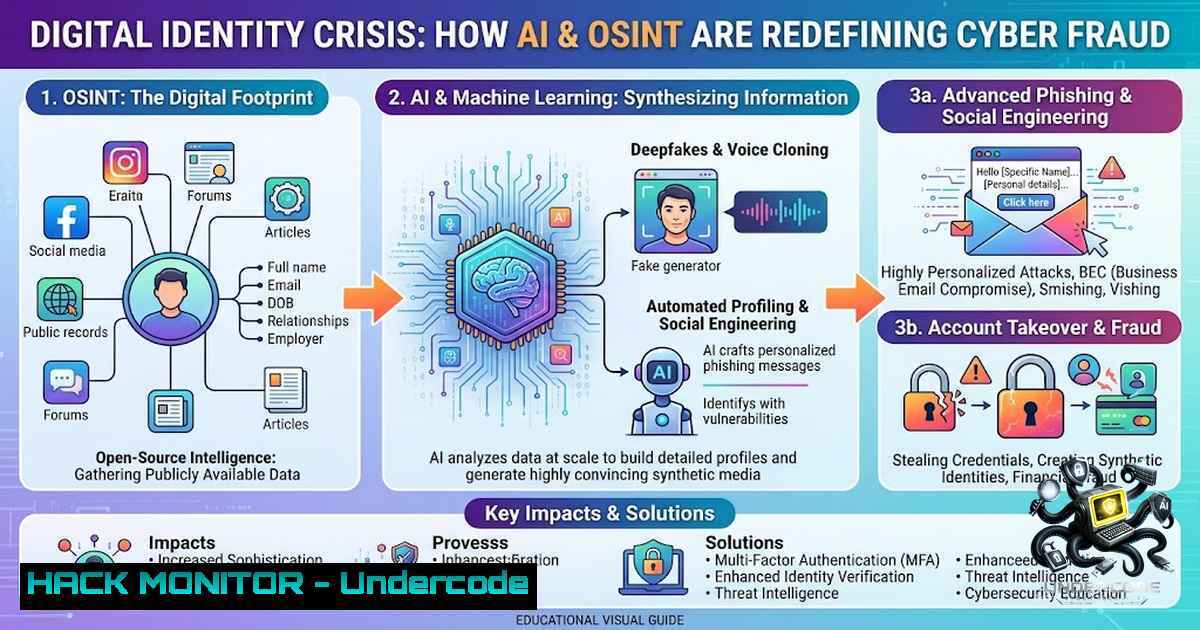
The modern threat landscape has evolved beyond malware and brute-force password attacks; the weakest link is now the vast digital footprint we leave behind. As highlighted by recent industry analysis, the rise of accessible generative AI has transformed publicly available data—from social media videos to corporate interviews—into potent weapons for identity theft and synthetic fraud. This convergence of OSINT and artificial intelligence creates a dangerous paradigm where a convincing digital impersonation no longer requires a single compromised credential, but rather a sophisticated orchestration of data points that define our online persona.
Learning Objectives & Secrets:
- Objective 1: The OSINT Attack Surface. Understand how fraudsters aggregate disparate data (voice samples, facial geometry, writing style) from public sources to build a comprehensive “digital twin” profile.
- Objective 2: Real-time Deepfake Synthesis. Secret tip: Attackers are now leveraging AI models that can generate a live video stream mimicking a target’s micro-expressions in under 5 minutes using just a handful of images, often bypassing liveness detection.
- Objective 3: Zero-Trust Behavioral Defense. Secret tip: Implement a “challenge-response” protocol based on non-public, ephemeral information (e.g., recent internal transactions) as a secondary authentication factor to counter AI-driven social engineering.
You Should Know:
- The OSINT Harvesting Phase: Beyond Simple Google Dorking
Modern fraud begins not with a hack, but with a meticulously planned data collection process. Attackers utilize automated scrapers to collect high-resolution images from LinkedIn, Instagram, and corporate “About Us” pages, while simultaneously extracting audio snippets from podcasts, YouTube interviews, and voicemail greetings. To simulate a reconnaissance workflow, security professionals can utilize `theHarvester` on Linux to map an organization’s public email infrastructure or use `gallery-dl` to archive image metadata. For Windows, tools like `OSINT-Framework` and `Recon-1g` provide GUI-driven modules to harvest geolocation and temporal data from social posts. This data is then fed into AI models to create a “behavioral fingerprint,” including typing cadence and speech patterns.
Step‑by‑step guide explaining what this does and how to use it:
1. Scrape Visual Data: On Linux, use gallery-dl -o "filename={id}.{extension}" https://instagram.com/[bash]` to download high-resolution profile images. on Windows/Linux to extract GPS and camera specifics, often used to verify the authenticity of a location claim.
2. Extract Audio: Use `yt-dlp -x --audio-format mp3 https://youtube.com/watch?v=[bash]` to rip audio for voice cloning.
3. Analyze Metadata: Run `exiftool -a -u [image.jpg]
4. Automate OSINT: Deploy `Recon-1g` with the `profiler` module to aggregate social media accounts: workspace create target; use recon/profiles-contacts/profiler; set source linkedin; run.
2. Voice Cloning and Audio Deepfake Generation
The democratization of AI has placed voice synthesis models like Tacotron 2 and VALL-E into the hands of malicious actors. By training a model on just 30 seconds of audio, fraudsters can generate convincing speech in real-time, capable of bypassing basic voice biometrics. To understand this mechanism, security teams should set up a sandboxed environment using the Coqui TTS toolkit. On Linux, install `pip install TTS` and run `tts –text “Hello, I am authorized to transfer funds.” –model_name tts_models/en/ljspeech/vits –vocoder_name vocoder_models/en/ljspeech/univnet –speaker_wav [target_audio.wav]` to generate a cloned audio file. This highlights the need for spectral analysis defenses—detecting artifacts in the high-frequency bands that generative models often struggle to reproduce accurately.
Step‑by‑step guide explaining what this does and how to use it:
1. Preparation: Ensure you have Python 3.9+ and install the necessary audio libraries: sudo apt install libsndfile1.
2. Clone Voice: Execute the TTS command with the specific speaker embedding (requires CUDA for speed).
3. Detection Testing: Use `sox [original.wav] [cloned.wav] spectrogram` to visually compare the spectrogram; look for missing high-frequency components (above 8kHz) as a red flag.
4. Mitigation: Implement audio watermarking and frequency hopping in corporate communication apps to break the baseline data needed for cloning.
3. Video Synthesis and “Liveness” Bypass
With the advancement of GANs and diffusion models, static images can be animated to produce realistic head movements and lip-sync. Tools like `FakeApp` and `DeepFaceLab` allow adversaries to create deepfake videos that can fool standard liveness checks. In a Windows environment, a Red Team exercise can utilize `DeepFaceLab` (requires NVIDIA GPU) to swap a face into a provided video sequence. The guide involves extracting frames (2) extract images from video data_src.bat), extracting faces, and then training the model for several hours. To counter this, organizations should deploy `Active Depth` analysis or IR-based liveness that maps 3D facial topography, which is far more resistant to 2D generative attacks.
Step‑by‑step guide explaining what this does and how to use it:
1. Setup: Download DeepFaceLab and place target image in `data_src` and destination video in data_dst.
2. Extract: Run `2) extract images from video data_src.bat` to convert video to frames.
3. Train: Execute 5) train H64.bat; monitor loss values (target <0.2 for realistic results).
4. Convert: Run `6) convert H64.bat` followed by `7) merge to mp4.bat` to output the deepfake.
5. Defensive Testing: Use Microsoft’s Video Authenticator to analyze the merged file, looking for subtle grayscale inconsistencies and flickering in the facial boundaries.
- API Security and Cloud Hardening Against AI Fraud
The infrastructure supporting these AI models often exposes APIs that can be targeted for credential stuffing or account takeover. Threat actors exploit misconfigured S3 buckets and exposed API keys in code repositories. A critical step in hardening cloud environments is auditing public exposure. On Linux, utilize `trivy config –severity HIGH,CRITICAL /path/to/terraform` to scan Infrastructure as Code for misconfigurations. For Windows Azure users, run the `Az PowerShell` module:Get-AzStorageAccount | Get-AzStorageContainer | Where-Object {$_.PublicAccess -1e "Off"}. This will identify publicly accessible containers that may store sensitive PII used in impersonation attacks. Additionally, implement mutual TLS (mTLS) for internal API calls to ensure that even with intercepted credentials, the client certificate validation prevents unauthorized data extraction of voice or image files.
Step‑by‑step guide explaining what this does and how to use it:
1. Scan Code: Use `gitleaks detect –source . –verbose` to find hardcoded secrets in Git repos.
2. Audit IAM: On AWS, run `aws iam list-users` and `aws iam list-attached-user-policies` to ensure no over-privileged accounts exist.
3. Implement WAF: Deploy AWS WAF with a rate-based rule to block scraping activities: aws wafv2 create-rule-group --1ame RateLimit --capacity 100.
4. Check Public Buckets: Use `aws s3api get-bucket-acl –bucket [bash]` to verify private access.
5. Harden Headers: Add `Content-Security-Policy` headers to web applications to prevent cross-site scripting that could leak session tokens.
- Vulnerability Exploitation and Mitigation via AI-Driven Log Analysis
To detect these attacks in progress, security operations centers must move beyond static rules and employ AI-driven anomaly detection on authentication logs. For example, a sudden influx of failed MFA attempts followed by a successful login from a new geolocation indicates a “MFA fatigue” attack often used in conjunction with a deepfake phone call. Using Elasticsearch (ELK stack) on Linux, you can deploy a Machine Learning job: `PUT _ml/anomaly_detectors/auth_anomaly` with a config that analyzes the `source.ip` and `user.name` fields. Windows-based defenders can utilize PowerShell to parse Event Logs:Get-WinEvent -LogName Security | Where-Object { $_.Id -eq 4624 -and $_.TimeCreated -gt (Get-Date).AddHours(-1) } | Group-Object -Property @{Expression={$_.Properties[bash].Value}}. This script groups successful logins by IP, allowing security teams to rapidly identify IP clusters indicative of a coordinated deepfake social engineering campaign.
Step‑by‑step guide explaining what this does and how to use it:
1. Linux (ELK): Install Elasticsearch and Kibana, configure the `auditbeat` module to ship Windows Event Logs.
2. Create Data View: In Kibana, go to Stack Management > Data Views, create a view for logs-.
3. Train Model: Under Machine Learning > Anomaly Detection, create a job with “Authentication” as the data source.
4. Windows (SIEM): Use `Set-ItemProperty -Path “HKLM:\SYSTEM\CurrentControlSet\Services\EventLog\Security” -1ame MaxSize -Value 104857600` to increase log size for forensic retention.
5. Automate Response: Configure a Sentinel playbook to automatically disable user accounts if 5 anomalies are detected within 10 minutes.
What Undercode Say:
– Key Takeaway 1: The perimeter has shifted from the network to the identity; PII and biometrics are the new privileged credentials that must be treated with zero-trust rigor.
– Key Takeaway 2: Defensive AI must be trained on synthetic data generated by offensive AI to understand the artifacts created by generative models, creating a cat-and-mouse feedback loop for detection.
Analysis: The attack chain is fundamentally a data aggregation problem, not a software vulnerability problem. The availability of open-source models reduces the barrier to entry, shifting the skill required from code development to social engineering. Consequently, Blue Teams must prioritize credential-less authentication methods, such as FIDO2 passkeys and behavioral biometrics, to break the reliance on static knowledge factors (passwords). Furthermore, the legal and regulatory landscape is lagging; companies must proactively implement “deepfake insurance” and crisis communication plans. The speed of AI generation currently outpaces manual forensic analysis, necessitating automated red teaming that constantly scrapes the web for copies of executive voice and image data, simulating a constant state of compromise.
Prediction:
– +1 The urgency to implement quantum-resistant cryptography will accelerate as AI’s ability to solve classical encryption puzzles improves, driving innovation in Zero-Knowledge Proofs.
– -1 The erosion of digital trust will cause a fragmentation of the internet into “verified identity” zones, leading to a digital dark age where anonymity is heavily penalized, stifling free speech.
– -1 We will see a surge in “Deepfake attribution” startups, but the lack of standard regulations for AI watermarking will lead to a chaotic meta where verifying a video’s authenticity is more expensive than creating the fake itself.
– +1 Security awareness training will evolve into immersive VR simulations where employees are phished by AI avatars in real-time, drastically improving human resilience against social engineering.
– -1 The financial sector will face an “identity tsunami” in the next fiscal year, resulting in massive write-offs due to synthetic identity fraud that cannot be accurately traced to a specific breach.
▶️ Related Video (82% Match):
🎯Let’s Practice For Free:
🎓 Live Courses & Certifications:
Join Undercode Academy for Verified Certifications
🚀 Request a Custom Project:
Secure, high-velocity infrastructure and disruptive technological engineering. Contact our engineering team for high-tier development and proprietary systems:
[email protected]
💎 Smart Architecture | 🛡️ Secure by Design | ⭐ Trusted by Thousands
IT/Security Reporter URL:
Reported By: https://lnkd.in/p/e9tMVURa – Hackers Feeds
Extra Hub: Undercode MoN
Basic Verification: Pass ✅


