
Listen to this Post
Introduction
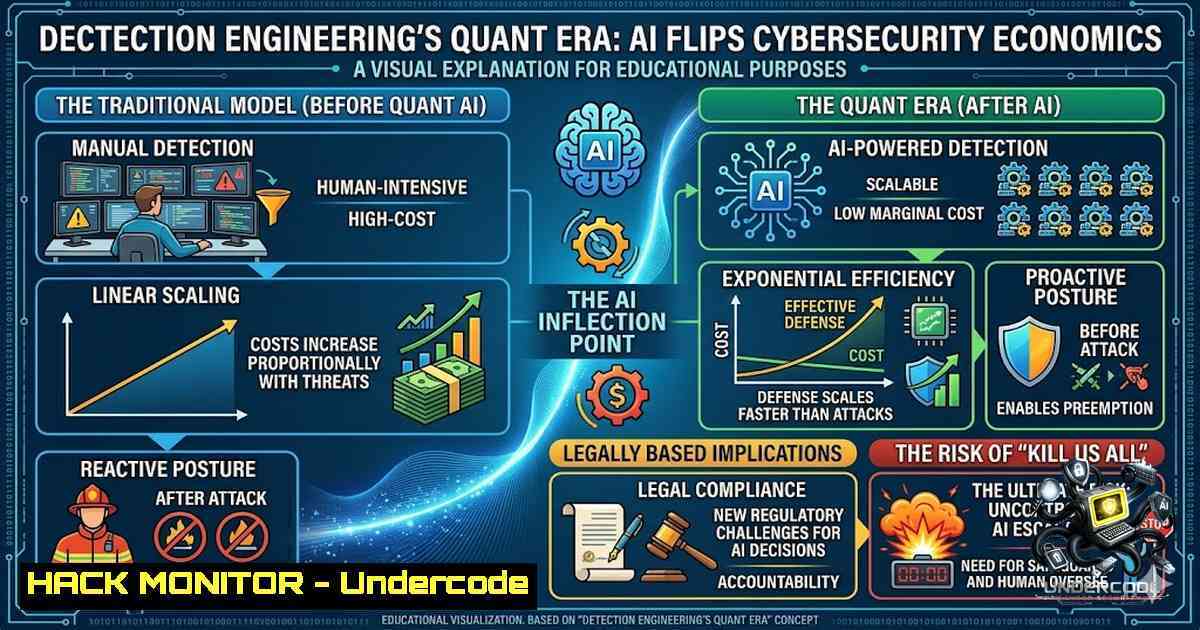
The cybersecurity industry is standing at a pivotal crossroads, one that mirrors the transformation Wall Street underwent when quantitative trading and computational finance reshaped global markets. According to Gabriel Abdelgawad’s groundbreaking analysis, the story isn’t that AI writes detections faster—it’s that the economics of the entire detection engineering craft have just flipped, compressing finance’s fifty-year evolutionary arc into a fraction of the time. A detection engineer who once produced two quality detections per week now generates twenty, not because they type faster, but because their hours have shifted from writing rules to judging them. This isn’t incremental improvement—it’s a structural regime change that will redraw the boundaries of the entire security operations industry.
Learning Objectives
- Understand the finance-to-cybersecurity analogy and how computational cost collapses create structural regime shifts in detection engineering
- Master the three-office framework (Front, Middle, Back Office) and identify where AI dissolves bottlenecks and exposes new ones
- Learn how to fight on the “unavoidable ground”—the adversary chokepoints that cannot be abandoned—using behavioral detection at scale
- Implement practical detection engineering workflows with Linux/Windows commands, SIEM configurations, and API security hardening
- Recognize the systemic risks of detection monoculture and build resilience against correlated failure modes
1. The Spreadsheet Moment: Why AI Changes Everything
The most dangerous misreading of AI in detection engineering is treating it as a productivity tool—something that just writes rules faster. That’s like saying VisiCalc just made accountants faster. In 1979, the spreadsheet didn’t speed up finance; it made a new kind of deal thinkable—the leveraged buyout, which simply couldn’t exist when recalculating a page of math took hours. Similarly, AI hasn’t handed detection engineering a better map of the adversary. ATT&CK is the same map it always was: useful, deeply tautological, a catalog of what has been seen rather than a forecast of what is coming. What AI collapsed is the cost of operating over the rule libraries we already have.
Step-by-Step: Assessing Your Detection Economics
1. Audit your current detection pipeline:
 Linux: Count detection rules by type and creation date
find /etc/suricata/rules/ -1ame ".rules" -exec wc -l {} \; | sort -1
 Windows PowerShell: Enumerate Windows Event Log rules
Get-WinEvent -ListLog  | Where-Object {$_.RecordCount -gt 0} | Format-Table LogName, RecordCount
2. Measure your true bottleneck:
 Measure SOC triage time per alert (SIEM query example - Splunk)
index=security_alerts sourcetype=detection
| stats avg(triage_time) as avg_triage by rule_name
| sort -avg_triage
3. Identify rules written vs. rules validated:
 Python script to calculate validation coverage
import pandas as pd
rules = pd.read_csv('detection_rules.csv')
validated = rules[rules['last_validated'] > '2025-01-01']
print(f"Total rules: {len(rules)}, Validated: {len(validated)}")
print(f"Validation gap: {(1 - len(validated)/len(rules))100:.1f}%")
What this does: The spreadsheet move isn’t about speed—it’s about the unit of analysis climbing from the single rule to the whole portfolio of coverage. If you’re still measuring detections per engineer, you’re fighting the last war. Start measuring portfolio coverage quality and time-to-validation.
- Front Office, Middle Office, Back Office: The Three Detection Bottlenecks
Banks split work into three offices: Front (makes trades), Back (clears/settles), and Middle (prices risk, reconciles books). Detection engineering has all three.
Front Office (Authoring Cost): The cost of writing a detection rule. AI collapses this to near-zero.
Back Office (False-Positive Economics): Every false positive costs analyst time, so rational engineers wrote narrow, brittle, low-volume rules. Narrow rules miss exactly what the adversary varies. When AI absorbs triage at near-zero marginal cost, the optimal shape inverts—from a small corpus of brittle rules to a large corpus of broad, behavioral detections.
Middle Office (Per-Client Operating Overhead): The hidden bottleneck. Does this rule actually fire on the threat actor’s behavior in this environment, given this client’s log sources and field availability? Most shops never did this—they just tag-matched and called it coverage.
Step-by-Step: Building Your Detection Middle Office
1. Validate rule applicability per environment:
 Linux: Check if required log fields exist in your SIEM
curl -X GET "https://your-siem-api.com/search/jobs" \
-H "Authorization: Bearer $TOKEN" \
-d '{"query":"index= | stats count by source_type"}'
2. Detect “green-but-dead” coverage—rules that fire nothing:
-- SQL query to find rules with zero hits in production
SELECT rule_id, rule_name, COUNT(alert_id) as alert_count
FROM detection_rules r
LEFT JOIN alerts a ON r.rule_id = a.rule_id
WHERE a.timestamp > NOW() - INTERVAL '30 days'
GROUP BY r.rule_id, r.rule_name
HAVING COUNT(a.alert_id) = 0;
3. Build a rule-by-source-by-client coverage matrix:
 Python: Generate coverage matrix
clients = ['client_a', 'client_b', 'client_c']
sources = ['Windows', 'Linux', 'AWS', 'Azure']
rules = load_all_rules()

matrix = {}
for client in clients:
matrix[bash] = {}
for source in sources:
matrix[bash][source] = has_coverage(client, source, rules)
print(f"{client} {source}: {'✓' if matrix[bash][source] else '✗'}")
Windows command for log source validation:
 PowerShell: Verify Windows Event Log sources are populating
Get-WinEvent -LogName Security -MaxEvents 1 | Select-Object TimeCreated, Id, ProviderName
 Check specific fields exist
Get-WinEvent -LogName Security -MaxEvents 10 | ForEach-Object { $_.Properties }
What this does: The middle office is where the industry’s quality was quietly sacrificed to make unit economics work. AI makes the good version also the cheap version—per-client coverage that is genuine rather than cosmetic just falls out of running these as a computation per environment.
3. The Ground the Adversary Cannot Leave
Your rules are private. Nobody breaching a network is reading your detection logic. So how does a private detection change an adversary who never sees it? Through shared knowledge. When the security community converges on a specific technique, when it gets documented in ATT&CK, written up by a vendor, shipped as commodity coverage, its cost rises and any competent threat actor abandons it. Cover those, and your coverage goes quietly dead—because covering them is what drives the adversary off them.
The ground that does not go dead is the ground the adversary cannot leave. Every intrusion has to:
– Authenticate
– Execute
– Move across trust boundaries
– Get the data out
Those are the points where a hundred paths converge, and there is nowhere left to migrate.
Step-by-Step: Building Unavoidable-Ground Detections
- Detect renamed powershell.exe (adversary detaches action from signature):
Windows PowerShell: Find renamed PowerShell instances Get-Process | Where-Object { $<em>.ProcessName -match "powershell" -or $</em>.ProcessName -match "cmd" } | ForEach-Object { $path = (Get-Process -Id $<em>.Id -Module | Where-Object {$</em>.ModuleName -eq "powershell.exe"}).FileName if ($path -and $path -1otlike "C:\Windows\System32\WindowsPowerShell\v1.0\powershell.exe") { Write-Warning "Suspicious PowerShell path: $path (PID: $($_.Id))" } } -
Detect scripting engine loaded as library (no powershell.exe process):
Linux: Detect script engine loaded as library lsof -c | grep -E "libpython|libperl|liblua|libmono" | awk '{print $1, $2, $9}' Monitor for CLR loading in non-.NET processes (Windows Sysmon event 7) Sysmon Config: <RuleGroup name="CLR_Load" groupRelation="or"> <ImageLoad onmatch="include"> <Image condition="image"></Image> <LoadedImage condition="end with">clr.dll</LoadedImage> </ImageLoad> -
Detect authentication anomalies (stolen credentials indistinguishable from yours):
-- SIEM query: Impossible travel / abnormal authentication
index=authentication_logs
| stats earliest(_time) as first, latest(_time) as last, count by user, src_ip
| eval distance = haversine_distance(first_location, last_location)
| where distance > 500 AND (last - first) < 3600
| table user, src_ip, first, last, distance
4. Build behavioral baselines for execution lineage:
 Python: Build baseline of normal execution patterns
import pandas as pd
from sklearn.ensemble import IsolationForest

Load process execution logs
df = pd.read_csv('process_events.csv')
features = ['hour_of_day', 'day_of_week', 'parent_process', 'user', 'command_line_length']
X = pd.get_dummies(df[bash])

Train isolation forest on historical data
model = IsolationForest(contamination=0.01)
df['anomaly_score'] = model.fit_predict(X)
anomalies = df[df['anomaly_score'] == -1]
print(f"Detected {len(anomalies)} anomalous executions")
What this does: Detection on the durable ground is not a signature question (“did powershell.exe run?”) but a structural one—what does this execution encode in its lineage, timing, and deviation from baseline? AI lets you finally fight on the chokepoints the adversary cannot abandon, at a volume no human SOC could triage.
4. Detection’s Quant: The Theory Layer
Ordinary trading was a bet on the world. Arbitrage was a bet on other people’s mistakes—modeling the modelers, which you cannot do on instinct. Detection has spent twenty years at the lower level, treating adversaries as a mostly static catalog of techniques to write rules against. AI pushes detection up a level—to where you model an adversary who is modeling what a competent defender would watch for.
The value lands at the theory layer—the person who supplies the causal model of the adversary and the judgment about which gap matters. That person is detection’s quant.
Step-by-Step: Becoming Detection’s Quant
1. Build adversary models, not just rule libraries:
 YAML: Adversary model template
adversary_model:
name: "FIN7_2025"
behaviors:
- Tactic: Initial Access
Techniques: [T1566, T1190]
Observable_indicators:
- "spearphishing_attachment"
- "exploit_public_facing"
- Tactic: Execution
Techniques: [T1059, T1204]
Observable_indicators:
- "powershell_encoded_command"
- "mshta_scriptlet"
Known_evasions:
- "renames_powershell.exe"
- "loads_scripting_as_library"
Unavoidable_chokepoints:
- "authentication"
- "process_execution"
2. Map gaps to adversary models:
 Python: Gap analysis that actually means something
def gap_analysis(client_coverage, adversary_model):
gaps = []
for behavior in adversary_model['behaviors']:
for technique in behavior['Techniques']:
if not client_coverage.has_technique(technique):
gaps.append({
'technique': technique,
'tactic': behavior['Tactic'],
'risk': assess_risk(technique, client_coverage.context)
})
return sorted(gaps, key=lambda x: x['risk'], reverse=True)

gaps = gap_analysis(get_client_coverage('enterprise_corp'), load_adversary_model('APT41'))
print("Top 5 gaps by risk:")
for gap in gaps[:5]:
print(f" - {gap['technique']} ({gap['tactic']}): Risk={gap['risk']:.2f}")
3. Implement continuous coverage testing (mark-to-market):
 Linux: Automate daily breach-and-attack simulation
 Install Caldera or Atomic Red Team
./atomic-red-team/atomic_red_team.py -t T1059.001  PowerShell execution
./atomic-red-team/atomic_red_team.py -t T1078  Valid accounts
./atomic-red-team/atomic_red_team.py -t T1021  Remote services

Check if detections fired
curl -X GET "https://your-siem-api.com/search" \
-d '{"query":"index=alerts source=atomic_red_team"}'
What this does: Coverage stops being a claim and becomes a measured property—marked to market. Instead of asserting coverage, you test it continuously, per client, proving what is detected and what is missed against emulated behavior.
- The Reflexivity Engine: Keeping Detections Indexed to the Present
A static rule is a decision function frozen the day it was written, fighting a world that has moved on. The thing that keeps detections indexed to the present is a reflexivity engine. It runs in two modes:
Mode 1—Reactive (shaped like news): A piece of threat intelligence lands. In the time it took one analyst to read the report, the whole fleet is re-marked—who has telemetry, who has proven coverage, who has a real gap, whose configuration is exposed. Then it drafts the detection, tests it against behavior, deploys where it proves out, and flags where it does not. The old loop was a report, a human, and maybe a rule in a week. The new one is same-day, across everyone, tuned to each.
Mode 2—Proactive (did not exist before at any price): Run adversary models against each client’s actual environment as a near-free background process. Ask what this actor would do here that you cannot currently see, and build behavioral coverage before the technique is ever used.
Step-by-Step: Building Your Reflexivity Engine
1. Automated threat-intel-to-detection pipeline:
 Python: Threat intel ingestion and rule generation
import requests
from detection_generator import generate_sigma_rule

Fetch latest threat intel
threat_feeds = [
'https://otx.alienvault.com/api/v1/pulses/subscribed',
'https://api.misp-project.org/events'
]
for feed in threat_feeds:
intel = requests.get(feed).json()
for indicator in intel['indicators']:
if indicator['type'] == 'file_hash':
sigma_rule = generate_sigma_rule(
title=f"Detection: {indicator['description']}",
detection=f"hash: '{indicator['value']}'",
tags=indicator['tags']
)
 Auto-deploy to clients with relevant telemetry
deploy_rule(sigma_rule, clients_with_telemetry('file_hash'))
2. Proactive gap detection (run adversary models continuously):
 Linux: Scheduled adversary emulation
0 2    /usr/local/bin/run_attack_simulations.sh --client all --mode continuous
 Script contents:
!/bin/bash
for technique in T1059 T1078 T1021 T1040 T1087; do
atomic-red-team/atomic_red_team.py -t $technique --output json > /tmp/sim_${technique}.json
 Send results to SIEM for detection validation
curl -X POST "https://your-siem-api.com/validation" -d @/tmp/sim_${technique}.json
done
3. Mark-to-market coverage dashboard:
-- SQL: Daily coverage verification
WITH daily_tests AS (
SELECT client_id, technique_tested,
CASE WHEN alert_triggered THEN 1 ELSE 0 END as detected
FROM breach_simulation_results
WHERE test_date = CURRENT_DATE
)
SELECT
client_id,
COUNT() as total_tests,
SUM(detected) as detected_count,
ROUND(SUM(detected)  100.0 / COUNT(), 2) as coverage_pct
FROM daily_tests
GROUP BY client_id;
What this does: The reflexivity engine is the practical side of the insight that “a detection is an engine, not a camera”. It continuously re-indexes your decision function to the current state of the world because both move.
6. The Failure Mode: When Genius Fails
The reflex is to worry the AI writes a bad rule. But one bad rule on some clients is contained and survivable—a single trade gone wrong. That is not what kills. What kills is what capsized Long-Term Capital Management in 1998. They didn’t die because their trades were wrong—mostly they were right. They died because they were enormously leveraged and every clever firm was crowded into the same positions, so the unwind took them all down together.
A detection hyperscaler has both halves:
- Leverage: A platform backing the security of most institutions you can name, all resting on one shared method, with no diverse reserve to absorb failure
- Correlation: That shared method’s blind spots are not one client’s but every client’s at once
One sufficiently novel bypass—an EternalBlue-class flaw that worms through everyone at once before anyone has a detection for it—hits the shared method and detonates the whole book together. Cosmetic variety over a monoculture is still a monoculture where it counts.
Step-by-Step: Building Resilience Against Correlated Failure
1. Implement diversity requirements (de-lever):
 Python: Ensure detection method diversity
def check_method_diversity(client_deployments):
methods = ['sigma', 'custom_yara', 'ml_anomaly', 'threat_hunting']
diversity_score = {}
for client in client_deployments:
used_methods = set(client_deployments[bash])
diversity_score[bash] = len(used_methods) / len(methods)
if diversity_score[bash] < 0.5:
print(f"WARNING: {client} has low method diversity ({diversity_score[bash]:.0%})")
return diversity_score

Rotate detection engines per client
clients = ['client_a', 'client_b', 'client_c']
for client in clients:
primary_engine = random.choice(['sigma', 'custom_yara', 'ml_anomaly'])
backup_engine = random.choice([e for e in ['sigma', 'custom_yara', 'ml_anomaly'] if e != primary_engine])
deploy_engines(client, primary=primary_engine, backup=backup_engine)
2. Build circuit breakers for machine-speed attacks:
 YAML: Circuit breaker configuration
circuit_breakers:
- name: "alert_volume_spike"
trigger: "alert_rate > 5x baseline for 5 minutes"
action: "throttle_alerting, escalate_to_human"
- name: "new_bypass_pattern"
trigger: "detection_efficacy_drop > 30% in 1 hour"
action: "isolate_affected_clients, rollback_recent_deployments"
- name: "shared_method_failure"
trigger: "false_positive_rate > 20% across > 50% of clients"
action: "fallback_to_secondary_detection_engine"
3. Isolate and contain correlated attacks:
 Linux: Network isolation script
!/bin/bash
 Detect and isolate compromised segments
COMPROMISED_SUBNETS=$(grep -l "ETERNALBLUE" /var/log/suricata/.log | cut -d'/' -f5 | cut -d'.' -f1-3)
for SUBNET in $COMPROMISED_SUBNETS; do
iptables -I FORWARD -s $SUBNET.0/24 -j DROP
echo "Isolated subnet: $SUBNET.0/24 at $(date)" >> /var/log/isolation.log
done
Windows PowerShell isolation:
 PowerShell: Isolate infected workstations
$compromisedIPs = Get-Content "C:\SOC\compromised_ips.txt"
foreach ($ip in $compromisedIPs) {
New-1etFirewallRule -DisplayName "Isolate_$ip" -Direction Outbound -RemoteAddress $ip -Action Block
Write-Host "Blocked outbound traffic to $ip"
}
What this does: You de-risk the tail, knowing you can only reduce and survive it, not erase it. You deliberately de-lever by keeping genuine diversity in your methods, paying for it in the efficiency you give up.
What Undercode Say
- The spreadsheet analogy is the key insight. AI didn’t just make detection engineers faster—it made new kinds of detection programs thinkable. The unit of analysis climbs from the single rule to the whole portfolio, and the winners will be those who optimize at portfolio level, not rule level.
-
The middle office is where the real value lies. Most shops skipped per-client applicability analysis because it was too expensive. AI makes the good version the cheap version. The organizations that build real middle-office capabilities—validating coverage per environment, per client—will outperform those that just generate more rules.
-
Fight on the unavoidable ground. Chasing the avoidable (named tools, IOCs, specific obfuscation tricks) is a losing game—your coverage dies the moment it works. The durable edge is on the chokepoints the adversary cannot abandon: authentication, execution, trust boundaries, and data exfiltration.
-
The theory layer is the new elite. Just as arbitrage summoned the quants—people who could model the modelers—AI pushes detection up to where you model an adversary who is modeling you. The value lands with the people who supply the causal model of the adversary and the judgment about which gaps matter.
-
The brilliance and the fragility are the same thing. The homogeneity that gives you coverage, quality, and index-fund economics is the homogeneity that makes the fleet fail together. The industry needs to deliberately de-lever—keep genuine diversity in methods, build circuit breakers, and invent security-specific forms of hedging.
Prediction
-1 The detection monoculture risk is real and unaddressed. When the first AI-driven, zero-day bypass hits the shared method underlying most major MDR platforms, we will see a 2008-style correlated failure—not one client breached, but hundreds simultaneously. The industry will scramble for diversity requirements and stress tests, but only after a crash teaches everyone why.
+1 The collapse of detection authoring costs will democratize boutique-grade security. Organizations that previously couldn’t afford personalized detection will get it at index-fund marginal cost. Onboarding will drop from weeks to days, and coverage metrics will become continuous and tested rather than asserted.
-1 The “seventy-eight percent ATT&CK coverage” metric is the Value at Risk of cybersecurity—one legible figure for the board, hiding all the adversary variety it cannot represent. Organizations that continue using this as a proxy for security posture will be dangerously overconfident until a breach exposes the green-but-dead cells.
+1 The adversary’s stale tradecraft will finally be punished. When the unavoidable chokepoints are watched at scale, the cheap reused moves stop working. The adversary’s only moves left are to pay even more to camouflage what they cannot stop doing, or to invent something genuinely new. The frontier of the craft becomes detecting the move the adversary is forced to invent—work that is irreducibly human.
-1 The industry is sleepwalking into the same arc finance ran—computers entering, bottlenecks dissolving, new elites crowned, and catastrophe produced inseparably from brilliance. The difference is that cybersecurity’s crash won’t be measured in dollars lost; it will be measured in data stolen, infrastructure paralyzed, and trust destroyed.
▶️ Related Video (72% Match):
🎯Let’s Practice For Free:
🎓 Live Courses & Certifications:
Join Undercode Academy for Verified Certifications
🚀 Request a Custom Project:
Secure, high-velocity infrastructure and disruptive technological engineering. Contact our engineering team for high-tier development and proprietary systems:
[email protected]
💎 Smart Architecture | 🛡️ Secure by Design | ⭐ Trusted by Thousands
IT/Security Reporter URL:
Reported By: Koifman Daniel – Hackers Feeds
Extra Hub: Undercode MoN
Basic Verification: Pass ✅


