
Listen to this Post
Introduction
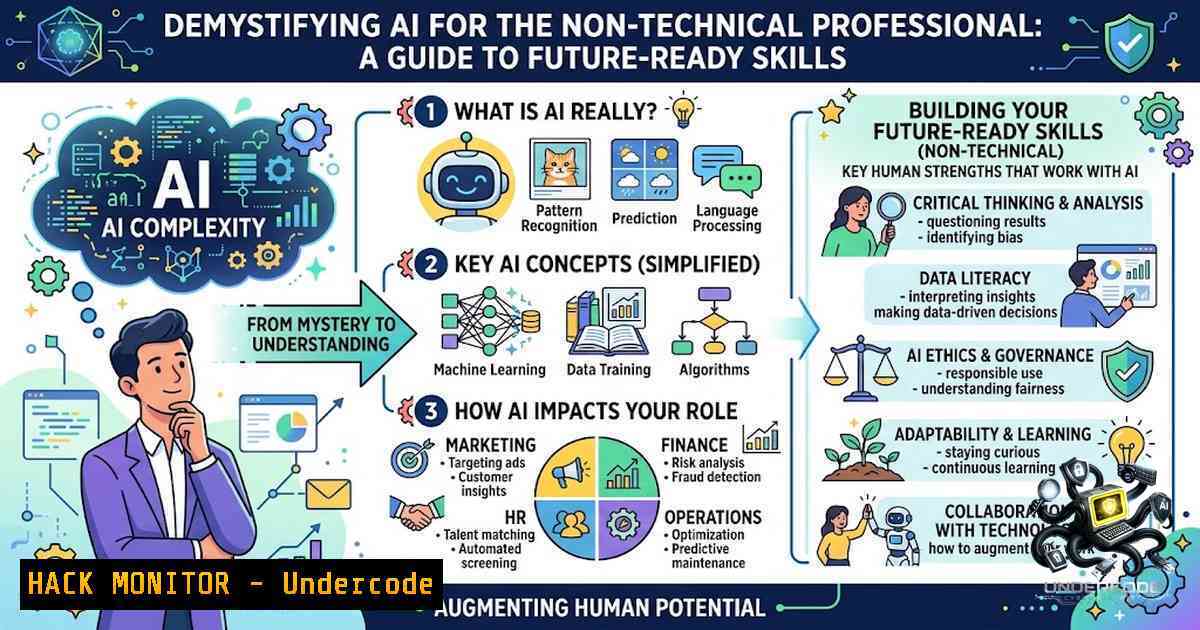
Artificial Intelligence has transitioned from a niche field for data scientists into a transformative tool accessible to everyone, regardless of their technical background. The common fear that AI will replace jobs is giving way to a more nuanced understanding: AI is a powerful ally that can augment human capabilities, automate mundane tasks, and unlock new income streams. This article explores a foundational approach to understanding and leveraging AI for students, educators, small business owners, and parents, breaking down complex concepts into practical, actionable strategies.
Learning Objectives & Secrets
- Objective 1: Understand AI Fundamentals Without Jargon – Grasp core AI concepts like machine learning and natural language processing using simple, real-world analogies rather than technical definitions.
- Objective 2: Apply the VEDIORA Framework – Unlock secret tips on using practical formulas (e.g., TCFT, SACH, PADHO, BALAK) to structure AI interactions for better outputs, whether for business or personal growth.
- Objective 3: Implement Income Hacks – Discover secret techniques to monetize AI skills, from automating content creation for small businesses to building personalized tutoring systems, enabling you to increase your value and earnings.
You Should Know
- Core AI Concepts: What You Need to Know
AI is not a single entity but a collection of technologies. At its heart, it’s about training computers to learn from data to make decisions or predictions. For a non-technical user, understanding that AI excels at pattern recognition is key. This allows it to generate text, translate languages, and even compose music. You do not need to know how to code to harness its power; you only need to know how to ask the right questions.
Step‑by‑step guide explaining what this does and how to use it:
– Step 1: Identify Repetitive Tasks – List tasks in your daily work or home life that are repetitive, such as drafting emails, scheduling meetings, or sorting data.
– Step 2: Select a User-Friendly Tool – Choose an AI tool designed for general users, such as ChatGPT, Google Bard, or Microsoft Copilot. These platforms allow interaction via natural language.
– Step 3: Craft a Clear Prompt – Use the “SACH” principle (Specific, Actionable, Contextual, Honest) to formulate a prompt. For example, “Write a friendly reminder for a team meeting about the quarterly budget.”
– Step 4: Iterate and Refine – Review the output. If it doesn’t meet your needs, refine your prompt. You can say, “Make it more formal” or “Add a bulleted list of talking points.”
2. The VEDIORA Framework and Its Practical Formulas
The VEDIORA framework is a structured methodology designed to help individuals of all backgrounds learn and apply AI concepts effectively. It emphasizes practical application over theory. The formulas within the framework provide mental models for problem-solving and prompt engineering.
Step‑by‑step guide explaining what this does and how to use it:
– Step 1: Understand the TCFT Formula – This stands for Task, Context, Format, Tone. Define what you want AI to do (Task), provide background information (Context), specify the output style (Format), and set the emotional tone (Tone).
– Step 2: Apply the PADHO Formula – This is for learning. It stands for Plan, Act, Do, Have, and Observe. Plan what you want to learn, Act by using the AI tool, Do the practical exercise, Have the AI explain the output, and Observe the process to reinforce learning.
– Step 3: Implement the BALAK Formula – This stands for Business, Audience, Learning, Application, and Knowledge. Use this to create a learning or business development plan, ensuring you understand who you are serving and what you need to learn to serve them better.
– Step 4: Practice with a Real Scenario – For example, if you are a teacher, use the TCFT formula to create a lesson plan. Task: Create a lesson plan. Context: For 10-year-olds on the solar system. Format: 40-minute session with an activity. Tone: Engaging and simple.
- AI for Small Business Owners: Automation and Growth
For small business owners, AI can be a game-changer in marketing, customer service, and operations. From chatbots that handle customer queries 24/7 to AI-driven analytics that predict sales trends, the applications are vast and accessible.
Step‑by‑step guide explaining what this does and how to use it:
– Step 1: Customer Service Automation – Implement a simple AI chatbot on your website or social media. Tools like ManyChat or ChatGPT API can be integrated without coding knowledge.
– Step 2: Content Creation – Use AI to generate social media posts, blog outlines, and email newsletters. For instance, you can ask AI to “Generate 5 Instagram captions for a new skincare product launch.”
– Step 3: Data Analysis – Upload your sales data (CSV file) to an AI tool and ask it to find patterns. You could say, “Analyze this sales data and tell me which products are most popular in November.”
– Step 4: Cost-Effective Strategy – Start small. Use free tiers of AI tools to test their effectiveness on your business workflow. Track the time saved and the quality of output.
4. AI for Students and Educators: Personalized Learning
AI offers unprecedented opportunities for personalized education. Students can use it as a 24/7 tutor, and educators can use it to create customized learning materials and assessments.
Step‑by‑step guide explaining what this does and how to use it:
– Step 1: Personalized Tutoring – A student can paste a confusing passage from a textbook and ask, “Explain this to me like I’m a 10-year-old.”
– Step 2: Quiz Generation – An educator can ask, “Generate a 10-question multiple-choice quiz on the French Revolution, with an answer key.”
– Step 3: Language Translation – Use AI to translate articles or documents to learn in your native language while still accessing global resources.
– Step 4: Project Assistance – Use AI to generate ideas for a science fair project or to outline a research paper.
5. AI Ethics and Career Resilience
The fear of job displacement is valid, but history shows that technological shifts create new opportunities. The key to career resilience is learning to work with AI, not against it. This involves developing skills like prompt engineering, critical thinking, and ethical judgment—skills that AI currently lacks.
Step‑by‑step guide explaining what this does and how to use it:
– Step 1: Stay Updated – Dedicate 15 minutes daily to reading about AI developments on news aggregators or social media.
– Step 2: Develop Critical Thinking – Don’t accept AI outputs blindly. Always fact-check and cross-reference information, especially on sensitive topics.
– Step 3: Understand Bias – Recognize that AI models are trained on human data and can perpetuate biases. When using AI, actively look for and mitigate these biases.
– Step 4: Learn Prompt Engineering – This is a new skill. Practice writing different prompts to see how phrasing affects the output. This skill is highly valuable as it enables you to extract the best results from AI models.
What Undercode Say:
- Key Takeaway 1: AI is not a threat but a tool. The real danger lies in ignoring its potential. Embracing it proactively can secure your future, regardless of your field.
- Key Takeaway 2: The path to leveraging AI is through practical application, not theoretical study. Simple, consistent usage of AI in daily tasks transforms fear into competency.
Analysis: The book “AI Ki Paathshala” represents a crucial shift in how we approach AI education. By using simple Hindi and practical formulas, it breaks the elitist barrier often associated with tech. This approach democratizes AI, enabling a wider demographic to participate in the digital economy. It empowers the individual to see AI not as a black box but as a collaborator. The income hacks and frameworks (like BALAK) are particularly insightful because they connect immediate value with learning, creating a positive feedback loop. This pragmatic, value-centric approach is likely to be more effective than traditional academic models for mass adoption.
Prediction:
- +1 Increased AI literacy among non-technical populations will lead to a surge in small business innovation, enabling local businesses to compete globally with minimal cost.
- +1 Educational systems will begin integrating practical AI use (like prompt engineering) into standard curricula, preparing students for a future where AI is ubiquitous.
- -1 The digital divide could widen as those without access to AI literacy resources are left behind, creating a new socio-economic gap.
- +1 The job market will see a rise in new roles focused on “AI-human collaboration” specialists, who bridge the gap between technical AI capabilities and business needs.
- -1 An overload of AI-generated content (text, images, videos) may reduce the overall quality of digital information, leading to a greater emphasis on verification and trust.
- +1 Personalization in sectors like healthcare and education will become vastly more efficient as professionals learn to use AI for diagnostics and tailored learning plans.
▶️ Related Video (86% Match):
🎯Let’s Practice For Free:
🎓 Live Courses & Certifications:
Join Undercode Academy for Verified Certifications
🚀 Request a Custom Project:
Secure, high-velocity infrastructure and disruptive technological engineering. Contact our engineering team for high-tier development and proprietary systems:
[email protected]
💎 Smart Architecture | 🛡️ Secure by Design | ⭐ Trusted by Thousands
IT/Security Reporter URL:
Reported By: https://lnkd.in/p/eZi8Uqj2 – Hackers Feeds
Extra Hub: Undercode MoN
Basic Verification: Pass ✅


