Listen to this Post
Introduction:
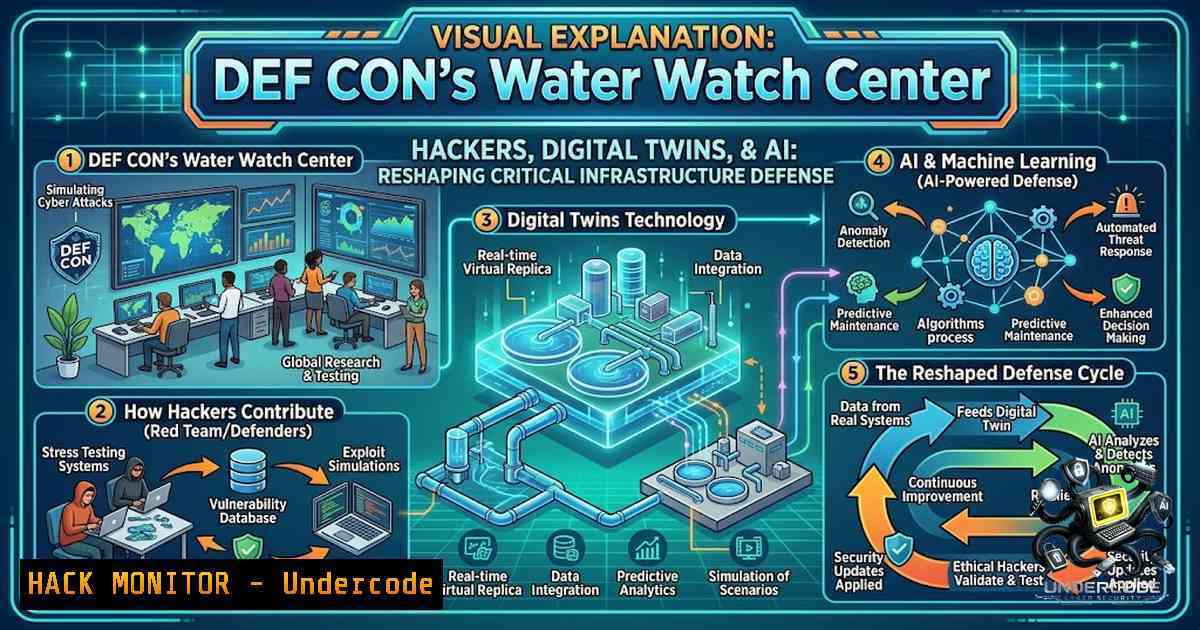
The convergence of nation-state cyberattacks and aging operational technology (OT) has exposed a critical vulnerability: America’s 50,000 community water systems, 91% of which serve fewer than 10,000 people and lack enterprise-grade security. In response, DEF CON Franklin and the National Rural Water Association (NRWA) launched the Water Watch Center (WWC) at DEF CON 2026—a pioneering initiative that deploys managed detection and response (MDR) providers, digital twin simulations, and AI-driven threat intelligence to defend rural utilities against adversaries like the Iranian Red Guard and Chinese military. This program transforms the hacker community’s grassroots ethos into a scalable cyber-defense model for critical infrastructure.
Learning Objectives:
- Understand the Water Watch Center’s architecture, including its five MDR providers and threat-intel sharing mechanism.
- Learn to implement OT-specific hardening commands for Linux/Windows SCADA environments.
- Explore digital twin and AI agent deployment for vulnerability simulation and automated response.
- Master incident response procedures for credential-theft and malware targeting water utility control systems.
You Should Know:
- The Water Watch Center: Architecture and MDR Integration
The WWC centralizes threat intelligence and patch data through a dedicated collaboration hub operated by the NRWA. Five hand-picked MDR providers—Rapid7, Defendify, Legato Security, L1 Secure, and Sentinel Technologies—deliver continuous monitoring, incident response, and vulnerability management to utilities serving fewer than 10,000 people. This shared model satisfies SOC 2 audit readiness by producing continuous evidence-collection and vendor-management controls (CC6.1, CC6.2, CC7.1).
Step‑by‑step guide to integrating MDR services into a water utility OT environment:
1. Asset Discovery: Scan your OT network using Nmap (nmap -sS -sU -p 1-1024 --open <target-IP-range>) to identify all PLCs, HMIs, and RTUs.
2. Log Forwarding: Configure Syslog or Windows Event Forwarding to send logs to your MDR provider’s SIEM. For Linux-based SCADA hosts, edit `/etc/rsyslog.conf` and add: . @<MDR-SIEM-IP>:514.
3. Threat-Intel Feed Integration: Subscribe to the WWC’s centralized threat-intel feed (via STIX/TAXII) and ingest into your security stack using curl -X GET https://wwc-threatfeed.nrwa.org/api/v1/indicators -H "Authorization: Bearer <API-KEY>".
4. Patch Management: Automate patch status reporting using `ansible-playbook -i inventory.ini patch-report.yml –tags “water-ot”` to generate compliance dashboards for NRWA submission.
5. Incident Response Playbook: Establish a 24/7 hotline to the WWC’s MDR providers; test monthly with tabletop exercises simulating credential-theft scenarios.
- Digital Twins: Cloning Water Networks for Proactive Defense
The WWC is collaborating with Vanderbilt University and the U.S. military to create digital replicas of water and wastewater system environments. These digital twins allow security teams to simulate attack vectors—from ransomware on HMIs to manipulation of chemical dosing ratios—without risking operational disruption. AI agents analyze twin telemetry to identify anomalous patterns and auto-generate mitigation rules.
Step‑by‑step guide to deploying a digital twin for SCADA security testing:
1. Data Collection: Export OT network topology and device configurations using `nmap -O snmpwalk -v2c -c public <device-IP> 1.3.6.1.2.1.1.
2. Twin Creation: Use open-source tools like Mininet or commercial platforms (e.g., AVEVA Dynamic Simulation) to model your water distribution network.
3. Attack Simulation: Launch controlled exploits against the twin using Metasploit (use exploit/linux/http/plc_rce; set RHOSTS <twin-IP>; run) to test detection capabilities.
4. AI Agent Training: Feed twin telemetry into Python-based ML models (e.g., scikit-learn IsolationForest) to establish baseline behavior and detect deviations.
5. Rule Deployment: Export validated detection rules as Suricata signatures (alert http any any -> <twin-IP> any (msg:"PLC write attempt"; content:"POST"; http_method; sid:1000001; rev:1;)) and push to production firewalls.
- OT Hardening: Securing Programmable Logic Controllers (PLCs) and HMIs
Retired Gen. Paul Nakasone stressed at DEF CON that “PLCs should not be exposed to the internet”. Yet many rural utilities have internet-facing control systems. The WWC’s first-line defense is basic hygiene: password resets, multi-factor authentication (MFA), and network segmentation.
Linux/Windows commands and configurations for OT hardening:
- Network Segmentation (Linux gateway):
iptables -A FORWARD -i eth0 -o eth1 -p tcp --dport 502 -j DROP  Block Modbus TCP
iptables -A FORWARD -i eth0 -o eth1 -p udp --dport 161 -j DROP  Block SNMP
iptables -A INPUT -p tcp --dport 22 -s <MDR-SIEM-IP> -j ACCEPT  Allow only MDR SSH
- Windows Firewall (PowerShell):
New-1etFirewallRule -DisplayName "Block SMB from OT" -Direction Inbound -Protocol TCP -LocalPort 445 -Action Block
New-1etFirewallRule -DisplayName "Allow MDR Agent" -Direction Outbound -RemoteAddress <MDR-IP> -Protocol TCP -LocalPort 443 -Action Allow
- MFA Enforcement for SCADA Access: Deploy Duo or Microsoft Authenticator; for Linux PAM, edit `/etc/pam.d/sshd` and add:
auth required pam_duo.so. - Credential Rotation: Automate with `chage -M 30
` on Linux and `net accounts /maxpwage:30` on Windows. - Disable Unused Services: On Windows OT workstations, run `sc config
start= disabled` for Telnet, FTP, and RDP if not required.
4. AI Agents: Automated Threat Hunting and Response
The WWC integrates AI agents that continuously analyze MDR telemetry, digital twin simulations, and NRWA threat feeds to autonomously hunt for indicators of compromise (IoCs). These agents prioritize alerts based on criticality—for example, a credential-theft attempt on a chemical-dosing PLC triggers immediate isolation.
Deploying an AI-based threat hunter (Python + Elasticsearch):
from elasticsearch import Elasticsearch
from sklearn.ensemble import IsolationForest
import pandas as pd

es = Elasticsearch(["http://localhost:9200"])
logs = es.search(index="ot-logs", body={"query": {"range": {"@timestamp": {"gte": "now-1h"}}}})
df = pd.DataFrame([hit['_source'] for hit in logs['hits']['hits']])
model = IsolationForest(contamination=0.01).fit(df[['cpu_usage', 'memory_usage', 'packet_rate']])
anomalies = model.predict(df[['cpu_usage', 'memory_usage', 'packet_rate']])
if -1 in anomalies:
print("Anomaly detected! Triggering MDR alert.")
 Send alert to MDR provider via API
requests.post("https://wwc-mdr-api.nrwa.org/alerts", json={"alert": "Anomalous OT behavior"})
5. Incident Response for Credential-Theft and OT Malware
The recent wave of attacks—impacting at least 12 states, including Minnesota, Michigan, and New Jersey—primarily leveraged credential theft and malware on OT systems. The WWC’s MDR providers share vulnerability patches and IoCs through the NRWA hub.
Step‑by‑step IR for a suspected OT breach:
- Isolate Affected Segment: On the OT switch, shut down the compromised VLAN:
configure terminal; interface vlan <id>; shutdown. - Capture Forensic Images: Use `dd if=/dev/sda of=/forensics/ot-plc.img bs=4M status=progress` on Linux SCADA hosts.
- Analyze Logs for IoCs: Search Windows Event Logs for suspicious logins:
Get-WinEvent -FilterHashtable @{LogName='Security'; ID=4624} | Where-Object {$_.TimeCreated -gt (Get-Date).AddHours(-24)}. - Credential Reset: Force password changes for all OT accounts: `net user
/domain` (Windows) or `passwd ` (Linux). - Patch Deployment: Apply vendor-supplied patches via the WWC’s patch feed using
wget https://wwc-patches.nrwa.org/ot-patch-20260810.bin && ./install.sh. - Post-Incident Review: Submit a detailed report to NRWA within 72 hours, including attack vector, affected assets, and remediation steps.
What Undercode Say:
- Key Takeaway 1: The WWC proves that hacker-led, volunteer-driven models can successfully scale critical infrastructure defense—450 volunteers in two years laid the groundwork for a national program.
- Key Takeaway 2: Digital twins and AI are not futuristic luxuries; they are immediate force multipliers for cash-strapped utilities, enabling safe attack simulation and automated threat hunting.
Analysis: The WWC’s approach—centralized threat intelligence, shared MDR services, and cutting-edge simulation—directly addresses the “scalability problem” that has plagued water sector cybersecurity for decades. However, success hinges on adoption: rural utilities must overcome cultural resistance and resource constraints. The inclusion of Cyber Maryland to engage utilities supporting military assets signals a national security imperative. The WWC’s SOC 2-aligned model also offers a blueprint for other critical infrastructure sectors (e.g., electric grids, gas pipelines). Yet the threat landscape is evolving rapidly—Iran and China are sophisticated adversaries, and the WWC must continuously update its AI models and threat feeds to stay ahead.
Prediction:
- +1 The WWC will expand to all 50 states within 18 months, driven by federal funding and bipartisan support for critical infrastructure resilience.
- +1 AI agents will evolve to predict attacks before they occur, using digital twin data to pre-deploy countermeasures autonomously.
- -1 Adversaries will increasingly target the WWC’s centralized threat-intel hub itself, necessitating air-gapped backup systems and zero-trust architecture.
- -1 Without mandatory cybersecurity standards for water utilities, many small systems will remain unprotected, leaving the WWC’s voluntary model insufficient against determined nation-state actors.
▶️ Related Video (76% Match):
🎯Let’s Practice For Free:
🎓 Live Courses & Certifications:
Join Undercode Academy for Verified Certifications
🚀 Request a Custom Project:
Secure, high-velocity infrastructure and disruptive technological engineering. Contact our engineering team for high-tier development and proprietary systems:
[email protected]
💎 Smart Architecture | 🛡️ Secure by Design | ⭐ Trusted by Thousands
IT/Security Reporter URL:
Reported By: Gregorydevans Def – Hackers Feeds
Extra Hub: Undercode MoN
Basic Verification: Pass ✅


