Listen to this Post
Introduction:
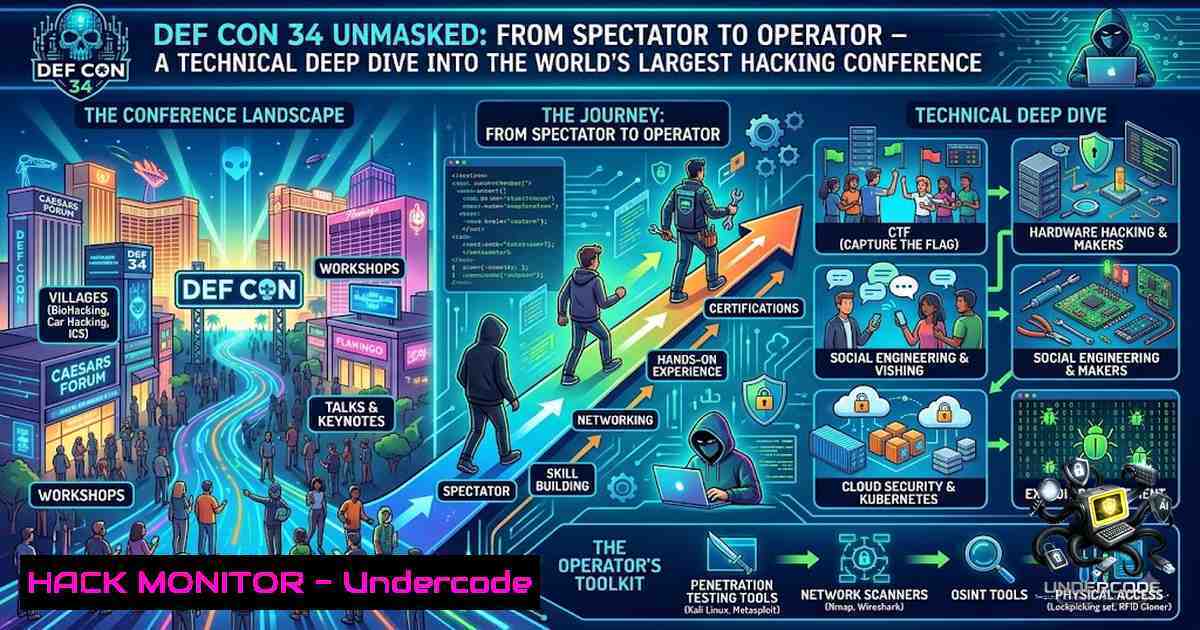
DEF CON is not merely a conference; it is a living, breathing ecosystem where the theoretical boundaries of cybersecurity are stress-tested, broken, and rebuilt in real-time. For a first-time attendee, the sheer scale—with over 38 specialized “Villages” spanning AI, cloud, hardware, and social engineering—can be overwhelming, yet it is precisely this intensity that forges the next generation of security practitioners. The central lesson from DEF CON 34 is clear: passive observation is insufficient; the true value lies in hands-on engagement, from hacking kiosks in the Red Team Village to competing in AI-driven Capture The Flag (CTF) challenges where autonomous agents, not humans, execute the attacks.
Learning Objectives:
- Understand the evolving role of Artificial Intelligence (AI) in both offensive and defensive cybersecurity operations, including the mechanics of Agentic AI in CTF competitions.
- Master the practical application of OSINT, social engineering tactics, and red teaming methodologies through immersive village experiences.
- Acquire actionable technical skills, including cloud attack paths, hardware hacking, and malware reverse engineering, with verified commands and configurations.
You Should Know:
- The Agentic AI Revolution: When Machines Become the Attackers
The most significant paradigm shift at DEF CON 34 was the emergence of AI as an autonomous actor in cyber operations. The AI Village CTF required participants to build AI agents that could independently analyze problems, select attack vectors, and capture flags without human intervention. This is a departure from traditional CTFs where humans manually execute every step. The SK Shieldus EQST team, which secured 5th place globally out of 200 teams, optimized their agents by tailoring AI models to specific problem types and prioritizing targets based on difficulty and point value.
Step-by-Step Guide: Simulating an Agentic AI Pentest
While full-scale agentic AI development requires significant resources, you can simulate the logic using a combination of open-source tools and scripting. The goal is to create a workflow where an AI (via API) can interpret a target, select a tool, and execute a command.
- Environment Setup: Install Python and necessary libraries:
pip install openai requests beautifulsoup4. - Tool Wrapper: Create a Python script that defines functions for common pentest actions (e.g.,
scan_port(ip, port),fetch_url(url)). - Agent Logic: Use a Large Language Model (LLM) API (e.g., OpenAI, local Llama model) to act as the “brain.” Provide the LLM with a system prompt: “You are an automated pentest agent. Your goal is to find the flag. You have access to these tools: [list functions]. Analyze the output of each tool and decide the next action.”
- Loop Execution: The script runs in a loop, passing the LLM the output of the previous command, allowing it to autonomously chain actions to achieve an objective (e.g., `http://target/flag.txt`).
Code Snippet (Conceptual Agent Loop):
import openai
import subprocess

def execute_command(cmd):
return subprocess.getoutput(cmd)

tools = {"nmap": "nmap -p- [bash]", "curl": "curl [bash]"}
prompt = "You are a pentest agent. The target is 192.168.1.100. Find open ports."
response = openai.ChatCompletion.create(..., messages=[{"role": "system", "content": prompt}])
command = response.choices[bash].message.content
output = execute_command(command)
 Feed output back to the LLM for the next step...
This represents the foundational logic behind the “Agentic” shift observed at DEF CON, where AI is no longer just a helper but an operator.
2. The Human Firewall: Social Engineering and the Vishing Competition
Amidst the high-tech hacking, the Social Engineering Village served as a potent reminder that the most critical vulnerability often resides in human psychology. The live Vishing (Voice Phishing) competition showcased how skilled social engineers can manipulate individuals into divulging sensitive information. One memorable moment from the conference involved a confident participant who, after giving away multiple “objectives,” was asked if they would recognize a suspicious call—highlighting the gap between perceived and actual security awareness.
Step-by-Step Guide: Defending Against Vishing Attacks
Organizations can mitigate these risks through a combination of policy, technology, and training.
1. Implement Caller Verification: Establish a strict policy that any unsolicited call requesting sensitive information (passwords, MFA codes, account changes) must be verified through a separate, out-of-band communication channel (e.g., hang up and call the official company number).
2. Deploy AI-Powered Filtering: Use telecommunications and email security solutions that leverage AI to detect and block phishing and vishing attempts based on anomaly detection and known threat intelligence.
3. Conduct Simulated Exercises: Run internal vishing campaigns where a red team calls employees to test their adherence to security protocols. This transforms theoretical knowledge into practical, muscle-memory responses.
4. Battle of the Bots: Interestingly, the village also featured a “Battle of the Bots: Vishing Edition,” where AI agents competed in social engineering, demonstrating that the human layer is now a target for automation as well.3. Red Teaming and Cloud Offense: Beyond the Domain Admin
The Red Team Village at DEF CON 34 emphasized that modern red teaming is less about achieving “domain admin” and more about answering specific defensive questions. A key workshop, “Stop Chasing Domain Admin,” challenged the traditional metrics of success, pushing for exercises designed to test specific security controls and generate actionable insights. This theme extended to the Cloud Village, where practitioners mapped attack paths across AWS, Azure, and GCP, focusing on misconfigurations and identity-based attacks.
Linux/Windows Commands for Cloud and Red Team Operations
Linux (Cloud Enumeration with AWS CLI):
– List all S3 buckets: `aws s3 ls`
– Enumerate IAM users: `aws iam list-users`
– Check for overly permissive policies: `aws iam list-policies –scope Local –only-attached`
Windows (Active Directory Enumeration):
- Enumerate domain users: `net user /domain`
– Find domain admins: `net group “Domain Admins” /domain`
– Use PowerView (PowerShell) to find users with SPN (Service Principal Names) for Kerberoasting: `Get-1etUser -SPN`These commands are the building blocks for understanding an environment’s attack surface. At DEF CON, experts demonstrated how to chain these simple enumeration steps into sophisticated attack paths that bypass traditional defenses.
- Hardware and Physical Security: Hacking the Real World
DEF CON’s villages extend beyond the digital realm. The Hardware Hacking and IoT Villages provided hands-on opportunities to interact with physical devices, from embedded systems to vehicle networks. The Car Hacking Village, for instance, featured CTF competitions where teams exploited vulnerabilities in vehicle Ethernet and electronic control units (ECUs). This reinforces the concept that cybersecurity is increasingly about securing the physical world, as attackers move from compromising servers to manipulating locks, sensors, and even medical devices.
Step-by-Step Guide: Basic IoT Firmware Analysis
- Extract Firmware: Use `binwalk` on Linux to analyze a firmware image:
binwalk -e firmware.bin. This extracts embedded filesystems and compressed data. - Search for Hardcoded Secrets: Use `grep` to search for strings like “password”, “admin”, or “api_key” within the extracted filesystem: `grep -r “password” .`
3. Emulate the Firmware: Use tools like QEMU to emulate the extracted ARM or MIPS binaries to test for vulnerabilities without physical hardware.
This process, demonstrated in workshops, allows security researchers to uncover backdoors and insecure configurations before an attacker does.
What Undercode Say:
- Key Takeaway 1: The core of DEF CON is not the talks, but the collaborative, hands-on experience in the Villages. The real learning happens when you are actively breaking and fixing things alongside a community of passionate experts.
- Key Takeaway 2: AI is rapidly transforming the cybersecurity landscape from a tool-assisted human endeavor to a field where autonomous agents conduct their own reconnaissance and exploitation. This demands a fundamental shift in how we design, deploy, and defend our systems.
Analysis: Hannah Sharp’s experience is a microcosm of the modern cybersecurity professional’s journey. The transition from “watching talks” to “hacking kiosks” represents the critical shift from theoretical knowledge to practical application. The overwhelming nature of the conference is a direct reflection of the cybersecurity domain itself—vast, constantly evolving, and impossible to master alone. Her observation that everyone shared a “passion for cybersecurity and hacking” underscores the community-driven nature of the field. The most effective security professionals are not isolated experts but active participants in a global network of knowledge-sharing and collaboration. The integration of AI into CTFs, as seen with the SK Shieldus team, is a harbinger of future security operations where human analysts will increasingly manage and interpret the actions of AI agents rather than executing every command themselves.
Prediction:
- +1 The rise of Agentic AI in security will lead to the creation of “AI Security Engineers” – professionals who specialize in designing, monitoring, and red-teaming autonomous AI systems, creating a new and highly lucrative career path.
- -1 The democratization of sophisticated attack capabilities through AI will lower the barrier to entry for cybercriminals, leading to a surge in automated, large-scale attacks that outpace traditional, human-led defense mechanisms.
- +1 Conferences like DEF CON will become even more critical as “reality check” forums, where the gap between vendor promises and actual security is exposed, fostering a more resilient and pragmatic industry.
- -1 The increasing complexity and specialization of security domains (AI, cloud, hardware) will create silos, making it harder for organizations to find professionals with a holistic view of their security posture.
- +1 The hands-on, village-based learning model of DEF CON will influence corporate training programs, pushing organizations to adopt more immersive, simulation-based cybersecurity education to better prepare their teams for real-world threats.
▶️ Related Video (70% Match):
🎯Let’s Practice For Free:
🎓 Live Courses & Certifications:
Join Undercode Academy for Verified Certifications
🚀 Request a Custom Project:
Secure, high-velocity infrastructure and disruptive technological engineering. Contact our engineering team for high-tier development and proprietary systems:
[email protected]
💎 Smart Architecture | 🛡️ Secure by Design | ⭐ Trusted by Thousands
IT/Security Reporter URL:
Reported By: https://lnkd.in/p/eaxsEbHp – Hackers Feeds
Extra Hub: Undercode MoN
Basic Verification: Pass ✅


