Listen to this Post
Introduction:
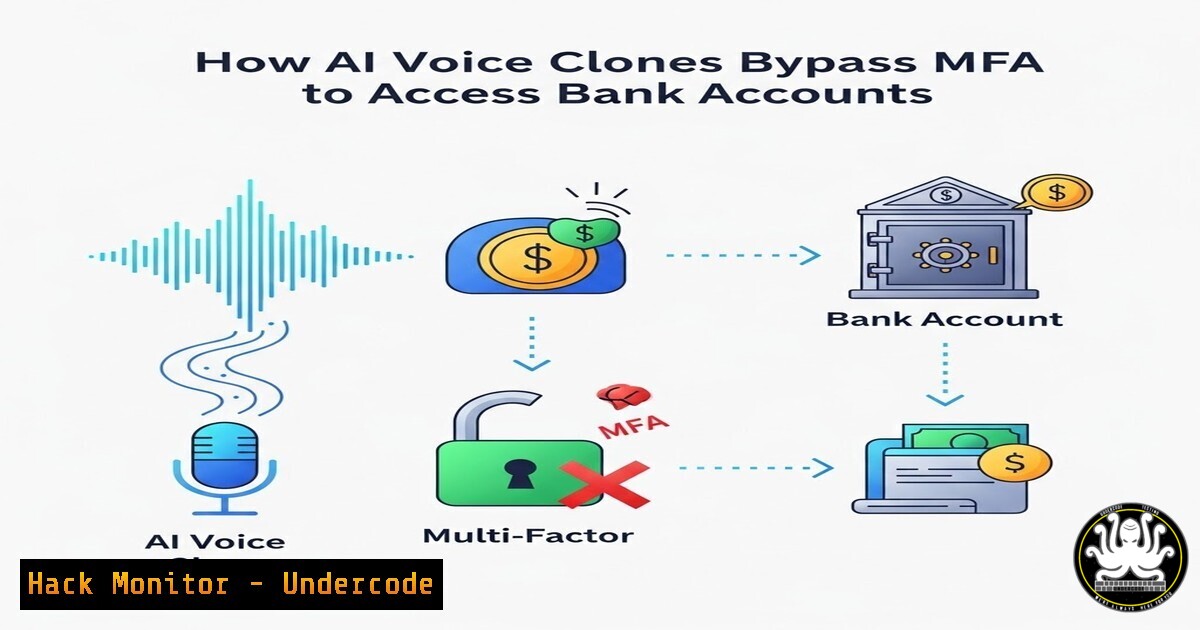
The convergence of Generative AI and social engineering has given rise to a new class of cyber threats: hyper-realistic audio and video deepfakes. Threat actors are now leveraging sophisticated AI voice cloning tools to bypass traditional multi-factor authentication (MFA) systems, specifically targeting voice-based biometrics and vishing (voice phishing) defenses. This article dissects the technical anatomy of a modern deepfake attack, providing blue teams and security engineers with the command-line tools, configuration hardening steps, and forensic techniques required to detect and mitigate these synthetic identity threats.
Learning Objectives:
- Understand the workflow of AI-powered voice cloning and its application in vishing attacks.
- Learn to identify digital artifacts in audio files using Linux command-line forensics.
- Implement Windows Group Policy and cloud security configurations to resist deepfake-enabled social engineering.
- Master the use of open-source tools for detecting AI-generated media.
- Develop incident response playbooks for deepfake-related financial fraud.
You Should Know:
1. The Anatomy of a Deepfake Vishing Attack
Modern vishing attacks no longer rely on generic robocalls. Attackers scrape 3–10 seconds of a target’s voice from social media (TikTok, YouTube, LinkedIn) or corporate earnings calls. Using tools like ElevenLabs, Resemble AI, or open-source variants like Tortoise-TTS, they generate synthetic speech capable of fooling both human listeners and voice-based authentication systems.
Step‑by‑step guide explaining what this does and how to use it:
To understand the threat, security researchers can simulate an attack using open-source tooling in a controlled environment (Ubuntu 20.04+).
Step 1: Clone a repository for voice cloning.
git clone https://github.com/neonbjb/tortoise-tts.git
cd tortoise-tts
pip install -r requirements.txt
Step 2: Prepare a sample audio file (e.g., target_voice.wav). Ensure it’s a mono 22050Hz WAV file.
 Convert an mp4 video to the required audio format using ffmpeg
ffmpeg -i input_video.mp4 -ac 1 -ar 22050 target_voice.wav
Step 3: Run the TTS inference. This command generates a synthetic audio file saying the phrase in the prompt.
python tortoise/do_tts.py --voice samples/target_voice --text "Please authorize the urgent wire transfer to account 3492." --preset ultra_fast
The output `generated.wav` demonstrates how easily an attacker can create a convincing audio deepfake.
2. Detecting Synthetic Audio Artifacts (Linux Forensics)
AI-generated audio often contains specific frequency artifacts and lacks natural breath patterns. Security analysts can use `spek` (spectrogram viewer) and `sox` to visualize these anomalies.
Step‑by‑step guide:
Step 1: Install analysis tools.
sudo apt-get install sox spek
Step 2: Generate a spectrogram image of a suspicious audio file.
spek -c -t "Suspicious Audio Analysis" suspicious_call.wav
Look for unnatural gaps in high frequencies or repeating grid-like patterns, which often indicate TTS generation.
Step 3: Use `sox` to extract statistical data and check for anomalies.
sox suspicious_call.wav -n stats
Pay attention to “Rough frequency” and “DC offset” values. AI-generated audio often has abnormally low background noise (high signal-to-noise ratio) compared to a live recording.
3. Hardening Windows Against Voice MFA Bypass
Windows Hello and other biometric systems can be tricked. While hardware-based anti-spoofing is improving, administrators should enforce strict policies.
Step‑by‑step guide:
Step 1: Configure Group Policy to enforce anti-spoofing for biometrics.
Open Group Policy Management Editor (`gpedit.msc`).
Navigate to: Computer Configuration > Administrative Templates > Windows Components > Biometrics.
Enable “Use anti-spoofing for facial recognition” and set it to “Enabled” with “High Security” level.
Step 2: Disable voice activation features when not needed.
 Disable Cortana voice activation via PowerShell (run as Admin)
Set-ItemProperty -Path "HKLM:\SOFTWARE\Policies\Microsoft\Windows\Windows Search" -Name "AllowCortana" -Value 0
4. Cloud Security: Hardening AWS Connect Against Vishing
If an attacker uses a deepfake to call a corporate help desk, they might exploit cloud contact center services like AWS Connect.
Step‑by‑step guide:
Step 1: Implement “voice fingerprinting” blocks using Amazon Connect Lex bots. Configure a Lex bot to ask dynamic security questions (e.g., “What was the amount of your last transaction?”) rather than static ones that can be scraped.
Step 2: Use AWS CloudTrail to monitor for unusual contact flow modifications.
 AWS CLI command to search for changes to Connect instances
aws cloudtrail lookup-events --lookup-attributes AttributeKey=EventName,AttributeValue=UpdateContactFlowMetadata --start-time "2024-01-01T00:00:00Z"
Look for events occurring outside business hours, which could indicate compromise.
5. API Security: Protecting TTS Services from Abuse
Many companies provide TTS APIs. Attackers use stolen API keys to generate deepfakes at scale.
Step‑by‑step guide:
Step 1: Implement rate limiting on API gateways (e.g., using Nginx).
 In your nginx configuration for the TTS endpoint
location /api/tts {
limit_req zone=tts_limit burst=5 nodelay;
limit_req_status 429;
proxy_pass http://tts_backend;
}
Step 2: Use Web Application Firewall (WAF) rules to block suspicious payloads. For example, in AWS WAF, create a regex pattern to block JSON payloads attempting to clone voices of known executives.
{
"Name": "ExecVoiceCloneRule",
"Priority": 1,
"Statement": {
"RegexPatternSetReferenceStatement": {
"ARN": "arn:aws:wafv2:.../regexpatternset/ExecNames"
}
},
"Action": { "Block": {} }
}
6. Incident Response: Analyzing a Suspected Deepfake Call
When an incident occurs, a digital forensic analyst must quickly triage the audio evidence.
Step‑by‑step guide:
Step 1: Extract metadata from the audio file using exiftool.
exiftool suspicious_call.wav
Check the “Encoder” or “Software” fields. Some TTS tools inadvertently leave metadata (e.g., “ElevenLabs”).
Step 2: Analyze the audio for Electric Network Frequency (ENF) signals. Live recordings capture the hum of the power grid (50/60Hz). Deepfakes lack this. Use a tool like `enf-magic` (Python library).
 Python snippet to check for ENF
from scipy.io import wavfile
import numpy as np
rate, data = wavfile.read('suspicious_call.wav')
 Perform FFT to check for 50/60 Hz peak
 A missing peak suggests synthetic generation
What Undercode Say:
- Key Takeaway 1: Deepfakes are not a future threat; they are a current, operational vulnerability targeting human trust and voice biometrics. Defenses must shift from “what” is said to “how” it is said (acoustic analysis).
- Key Takeaway 2: Multi-layered defense is critical. No single tool (MFA, WAF, or analyst) is sufficient. Organizations must combine endpoint anti-spoofing policies, cloud API rate limiting, and forensic audio analysis training for help desk staff.
In the current landscape, detection is an asymmetrical battle. While AI generation tools improve monthly, forensic tools are lagging. Security teams must proactively baseline their executives’ vocal patterns and create “voice fingerprints” stored in secure vaults. Furthermore, user education must evolve: employees need to be trained that seeing is not believing, and that urgent financial requests, even if they sound like the CEO, must be verified out-of-band via a secondary channel like a secure messaging app or in-person confirmation.
Prediction:
Within the next 12–18 months, we will see the emergence of “Deepfake-as-a-Service” (DfaS) on dark web marketplaces, offering real-time voice and video cloning for as little as $50 per hour of synthetic content. This commoditization will trigger a wave of attacks against financial institutions and political campaigns. Consequently, the cybersecurity industry will witness a rapid adoption of “liveness detection” chips in endpoint devices and a new standard for “Proof of Liveness” in high-value transaction protocols, likely mandated by regulatory bodies like the SEC or FINRA. The arms race between synthetic media generation and forensic detection will define the next decade of cybersecurity.
▶️ Related Video (80% Match):
🎯Let’s Practice For Free:
IT/Security Reporter URL:
Reported By: Vettrivel2006 The – Hackers Feeds
Extra Hub: Undercode MoN
Basic Verification: Pass ✅


