Listen to this Post
Introduction:
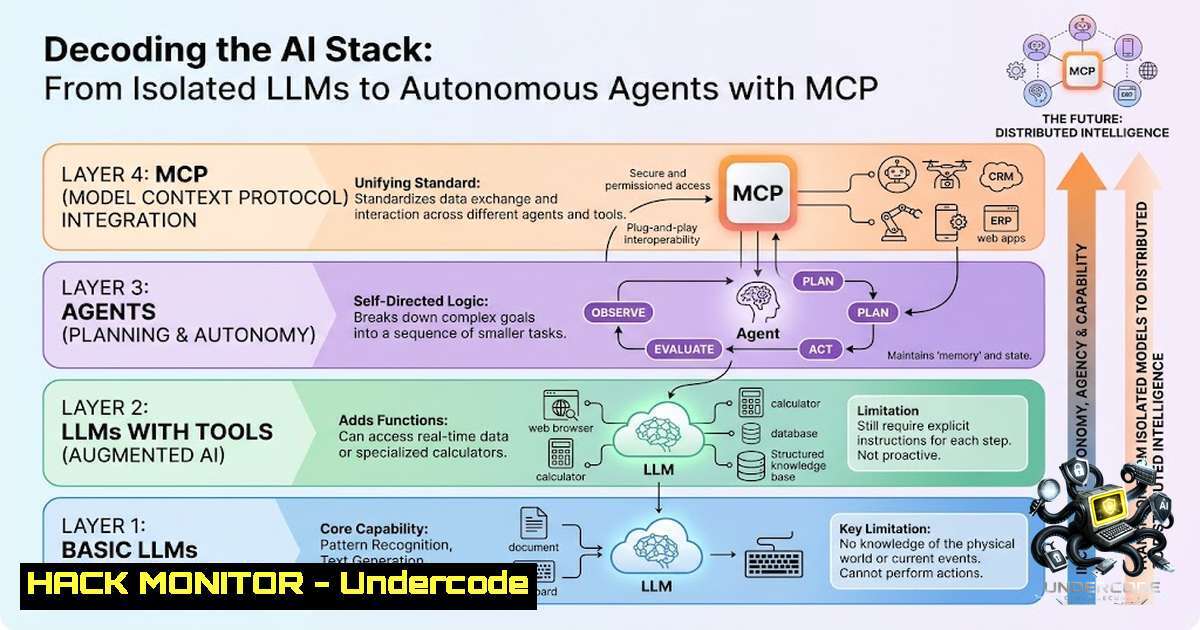
The artificial intelligence landscape is currently saturated with buzzwords that often overlap in meaning, creating a fog of confusion for developers, business leaders, and security professionals alike. Terms like LLM, RAG, Agents, and the newly prominent MCP are frequently used interchangeably, yet they represent distinct and critical layers of modern AI architecture. Understanding these components—not as isolated technologies but as an integrated “human body” system—is essential for building secure, effective, and scalable AI solutions.
Learning Objectives:
- Understand the distinct functional roles of LLMs, RAG, AI Agents, and MCP in the AI stack.
- Learn how to identify the security implications and attack surfaces associated with each layer.
- Develop a practical implementation strategy for integrating these components to build autonomous, data-aware AI systems.
You Should Know:
- LLM: The Brain – Intelligence Without Context or Action
The Large Language Model (LLM) represents the core intelligence layer, akin to the human brain. It processes information, reasons over inputs, and generates coherent responses based on the vast patterns it learned during training. However, as powerful as models like GPT-4 or Claude are, they possess critical limitations: their knowledge is frozen at the point of training, they lack access to private organizational data, and they cannot independently perform actions.
Step‑by‑step guide to interacting with an LLM via API:
import openai

openai.api_key = "YOUR_API_KEY"

response = openai.ChatCompletion.create(
model="gpt-4",
messages=[{"role": "user", "content": "Explain the concept of a neural network."}]
)
print(response.choices[bash].message.content)
While this is straightforward, security must be a primary consideration. Without safeguards, LLMs are vulnerable to prompt injection attacks where malicious inputs can override system instructions. Additionally, they often hallucinate when faced with queries outside their training data, leading to inaccurate outputs. When deploying LLMs, always implement input sanitization and context filtering to prevent data leakage and ensure response accuracy.
- RAG: The Brain + Books – Augmenting Knowledge with Retrieval
Retrieval-Augmented Generation (RAG) enhances the LLM by providing access to external knowledge bases. If the LLM is the brain, RAG provides the books—the encyclopedias, databases, and documents it can consult. RAG works by retrieving relevant information from a vector database (like Pinecone or Milvus) based on the user’s query and injecting this context into the prompt, allowing the model to generate a grounded, accurate response.
Step‑by‑step guide to implement a basic RAG pipeline:
- Chunking: Split your documents (PDFs, HTML) into manageable, semantically relevant chunks (e.g., 500 tokens).
- Embedding: Convert these chunks into vector embeddings using an embedding model (e.g.,
text-embedding-3-small). - Ingestion: Store these vectors in a vector database with metadata.
- Querying: Convert the user query into an embedding and perform a similarity search to retrieve the top K relevant chunks.
- Generation: Pass the retrieved chunks as context alongside the user query to the LLM.
from langchain.vectorstores import Pinecone
from langchain.embeddings import OpenAIEmbeddings

embeddings = OpenAIEmbeddings()
vectorstore = Pinecone.from_documents(documents, embeddings, index_name="my-index")
query = "What is the company's refund policy?"
docs = vectorstore.similarity_search(query)
context = " ".join([doc.page_content for doc in docs])
response = openai.ChatCompletion.create(
model="gpt-4",
messages=[{"role": "system", "content": f"Answer based on: {context}"},
{"role": "user", "content": query}]
)
The security risk here shifts to the data store. Improper access controls can expose sensitive documents. Additionally, the retrieval mechanism can inadvertently pull irrelevant data, leading to the “Lost in the Middle” effect where the LLM ignores crucial information. To mitigate this, implement strict role-based access control (RBAC) on the vector database and experiment with reranking strategies to improve retrieval accuracy.
- AI Agent: The Brain + Hands – From Reasoning to Execution
An AI Agent transcends the role of a passive responder. It is an autonomous entity that can perceive its environment, make decisions, and take actions to achieve specific goals. If the LLM is the brain, the agent provides the hands. Agents interact with the world by using tools—like searching the web, calling external APIs, or executing code. They are capable of planning and executing multi-step workflows, iterating based on feedback.
Step‑by‑step guide to building a tool-calling agent:
- Define the tools available to the agent (e.g.,
get_weather,send_email). - Provide the LLM with a system prompt describing the tools and their schemas.
- The user asks a question requiring action (e.g., “Send an email to my team about tomorrow’s weather”).
- The LLM reasons and responds with a request to call a specific tool with parameters.
- The application executes the tool and returns the result to the LLM.
- The LLM synthesizes the final response for the user.
tools = [{
"type": "function",
"function": {
"name": "send_email",
"description": "Send an email to a recipient",
"parameters": {
"type": "object",
"properties": {
"to": {"type": "string"},
"body": {"type": "string"}
}
}
}
}]
The greatest vulnerability in agents lies in their autonomy. An agent with excessive permissions can inadvertently execute destructive commands, a concept known as “tool poisoning” or “agent jailbreaking.” To secure agentic workflows, adopt the principle of least privilege. Never expose destructive tools without explicit human approval steps. A robust logging system is also critical to audit every action the agent takes.
- MCP: The Nervous System – Standardizing Communication Across the Stack
The Model Context Protocol (MCP) is a standardized communication framework that acts as the nervous system of the AI architecture. It connects the brain (LLM) to the hands (Agents) and the books (RAG) in a universal language. Without MCP, each tool requires custom coding and integrations, leading to fragmentation. MCP standardizes how models interact with external systems, allowing for a plug-and-play ecosystem where new tools can be integrated seamlessly.
Step‑by‑step guide to conceptualizing an MCP implementation:
- Identify Servers and Clients: In an MCP architecture, the AI application acts as the client (or host), and the external tools and data sources act as servers.
- Define Resources: Resources are data or files that the client can read (e.g.,
file:///docs/internal_policy.txt). - Define Prompts: Templates that the client can ask the AI to fill or execute.
- Define Tools: Functions the client can execute (e.g.,
database_query). - Establish Communication: The client sends a request to the MCP server to list available tools, prompts, or resources.
- Execute and Return: The client requests a specific resource or tool execution, and the server returns the data.
// Example of a tool definition in an MCP server
{
"tools": [
{
"name": "get_customer_data",
"description": "Retrieves customer information by ID",
"inputSchema": {
"type": "object",
"properties": {
"customer_id": {"type": "string"}
}
}
}
]
}
From a security perspective, MCP centralizes governance. Instead of managing API keys for dozens of tools, they are managed at the server level. This mandates strong authentication and authorization between the AI client and the MCP server. Implement OAuth 2.0 or mutual TLS (mTLS) to ensure that only authorized AI systems can access sensitive functions.
- Integrating the Stack: A Unified Architecture for Production
To deploy a complete, production-ready system, you must orchestrate all four layers. The user’s query flows through the stack: the Agent determines if it needs external data, the MCP facilitates the connection to the RAG pipeline to retrieve data, the Agent uses MCP to execute a necessary tool, and the LLM synthesizes the final response. This cohesive architecture enables complex, reliable, and context-aware applications.
Step‑by‑step guide to cloud hardening for AI workloads:
- API Gateway: Place an API gateway in front of your LLM to handle authentication, rate limiting, and request logging.
- Network Segmentation: Deploy your vector databases (RAG) and MCP servers in a private subnet, inaccessible to the public internet.
- Secrets Management: Use a vault (e.g., HashiCorp Vault) to store all API keys for tools and databases. Never hardcode them.
- Data Encryption: Ensure data is encrypted in transit (TLS 1.3) and at rest (AES-256) for your vector store and document storage.
- Monitoring: Implement comprehensive monitoring for anomalous behaviors, such as rapid-fire tool calls or excessive data retrieval, which could indicate an attack or a malfunctioning agent.
Linux command to monitor network traffic for suspicious activity on the API port
sudo tcpdump -i any port 443 -A -l | grep -i "authorization|token"
Windows PowerShell command to audit file access logs
Get-WinEvent -FilterHashtable @{LogName='Security'; ID=4663} | Select-Object TimeCreated, @{N='User';E={$<em>.Properties[bash].Value}}, @{N='Object';E={$</em>.Properties[bash].Value}}
What Undercode Say:
- Key Takeaway 1: The AI “stack” is best understood as a biological system. Treating each component (LLM, RAG, Agent, MCP) as a distinct organ clarifies its role and prevents the confusion caused by overlapping terminology.
- Key Takeaway 2: The evolution from simple LLMs to autonomous agents marks a paradigm shift. A successful AI strategy is no longer about choosing one layer but about securely integrating all four to create a resilient, intelligent ecosystem.
Analysis: The current trend of treating LLMs as a panacea is fading. Organizations are recognizing that raw intelligence is useless without context and action. MCP, in particular, is emerging as the critical missing link. By standardizing the communication layer, it allows businesses to rapidly adapt to new tools and data sources without restructuring their entire architecture. The primary challenge remains security; as the system gains more access, the potential for catastrophic failures grows. The future will be defined by who can master this integration while maintaining the highest security standards.
Prediction:
- +1 MCP is poised to become the industry standard for AI-tool interoperability, drastically reducing development time for complex agentic workflows.
- -1 The democratization of AI agents through MCP will lead to a surge in data breaches, as poorly configured agents inadvertently leak sensitive information to unauthorized tools.
- +1 RAG pipelines will evolve from simple retrieval mechanisms to hybrid search systems combining semantic and keyword search, significantly reducing hallucinations in specialized domains.
- -1 The adversarial landscape will shift from attacking LLMs via prompt injection to attacking the MCP layer itself, poisoning the communication channel to intercept and manipulate tool calls.
- +1 Security vendors will release specialized “AI Firewalls” designed to monitor and filter MCP traffic, leading to a new sub-industry in AI security solutions.
▶️ Related Video (84% Match):
🎯Let’s Practice For Free:
🎓 Live Courses & Certifications:
Join Undercode Academy for Verified Certifications
🚀 Request a Custom Project:
Secure, high-velocity infrastructure and disruptive technological engineering. Contact our engineering team for high-tier development and proprietary systems:
[email protected]
💎 Smart Architecture | 🛡️ Secure by Design | ⭐ Trusted by Thousands
IT/Security Reporter URL:
Reported By: Javeriyaahsan Brandingstrategist – Hackers Feeds
Extra Hub: Undercode MoN
Basic Verification: Pass ✅


