
Listen to this Post
Introduction:
The lexicon of Artificial Intelligence has become a chaotic jumble of buzzwords, often used interchangeably, creating a fog of confusion for IT professionals and business leaders alike. In the cybersecurity and IT operations spheres, misusing these terms can lead to flawed architectures and misaligned security strategies, where a “rule-based chatbot” is mistaken for a “self-healing neural network.” This article serves as a technical roadmap to dismantle the AI hierarchy, providing the foundational literacy required to architect, secure, and govern modern intelligent systems.
Learning Objectives:
- Differentiate the technical architectures and use cases of Artificial Intelligence (AI), Machine Learning (ML), and Deep Learning (DL).
- Identify the core infrastructure requirements (Data, Compute, MLOps) for deploying scalable AI solutions.
- Evaluate the hidden security risks, including model bias and the “Black Box” problem, and implement governance guardrails.
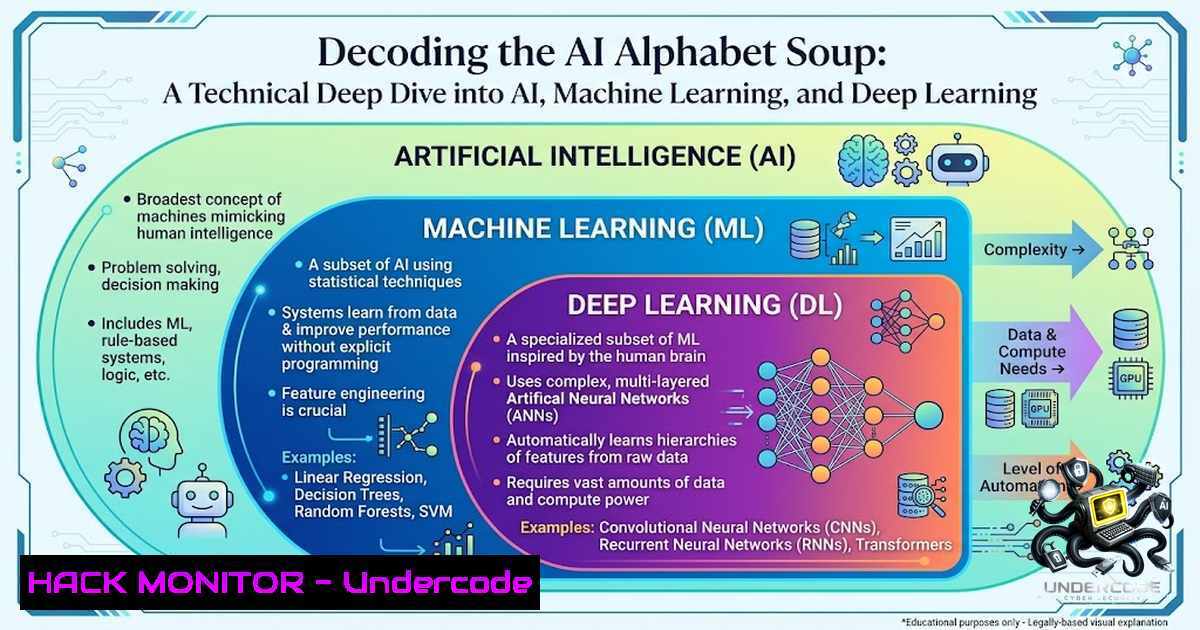
- The Nested Dolls: Defining AI, ML, and DL from a Technical Lens
At the highest level, Artificial Intelligence (AI) is the overarching umbrella. In practice, this often manifests as “Good Old-Fashioned AI” (GOFAI) or rule-based systems—think of a sophisticated firewall with static rule sets or a basic decision-tree antivirus. However, modern cybersecurity demands more dynamic responses.
Beneath AI lies Machine Learning (ML), a subfield where algorithms learn from data rather than hard-coded rules. In a Security Operations Center (SOC), ML might involve anomaly detection using clustering algorithms to identify unusual network traffic patterns that a rule-based system would miss. ML is the engine that powers predictive analytics and automated threat hunting.
Deep Learning (DL) is the most specialized subcategory of ML. It leverages Artificial Neural Networks (ANNs) with many hidden layers—hence “deep.” In cybersecurity, DL excels at processing unstructured data; for example, analyzing raw packets or binary files to detect zero-day malware via Convolutional Neural Networks (CNNs). Unlike traditional ML, DL automatically engineers features, extracting high-level complexity from raw inputs without manual intervention.
- How AI Learns: Understanding Neural Networks & Core Architectures
The learning process of an AI is fundamentally a mathematical optimization loop. The primary architectures used are CNNs for spatial data (images, packets) and Recurrent Neural Networks (RNNs) or Transformers for sequential data (logs, time-series).
Step-by-step: Training a Basic Neural Network for Anomaly Detection (Conceptual)
1. Data Ingestion: Collect network flow data (e.g., NetFlow logs). Convert it into numerical tensors.
2. Forward Propagation: Pass the tensors through the network layers. Each neuron applies a weighted sum followed by a non-linear activation function (e.g., ReLU).
3. Loss Calculation: Compare the output (e.g., “Malicious” probability) against the ground truth using a loss function like Cross-Entropy.
4. Backpropagation: Compute the gradient of the loss with respect to each weight.
5. Optimization: Update weights using an optimizer like Adam to minimize the loss.
To manage these models in Linux environments for cybersecurity simulations:
 Linux Commands for monitoring GPU utilization during training (critical for DL)
nvidia-smi
watch -1 1 nvidia-smi

Installing common ML libraries in a Python virtual environment
python3 -m venv venv
source venv/bin/activate
pip install tensorflow scikit-learn pandas
- The Fuel & The Engine: Data, Compute, & MLOps
The efficacy of a DL model is directly proportional to the quality of its data and the horsepower of its hardware. Data pipelines must be secure and robust. For training a Deep Learning model, you typically require massive parallel processing via GPUs or TPUs.
Implementing a Secure Data Ingestion Pipeline (Linux/MacOS):
- Data Versioning: Use DVC (Data Version Control) to track datasets alongside code.
dvc init
dvc add dataset/
git add dataset.dvc .gitignore
git commit -m "Add dataset"
- Data Validation: Use Great Expectations to ensure data quality and prevent “garbage in, garbage out.”
pip install great_expectations
great_expectations init
- Compute Containerization: Encapsulate the training environment using Docker to ensure reproducibility.
FROM tensorflow/tensorflow:latest-gpu
COPY . /app
RUN pip install -r requirements.txt
CMD ["python", "train.py"]
Windows Command to run the container:
docker build -t ai-training .
docker run --gpus all ai-training
- The Generative AI Ecosystem: LLMs, RAG, GANs, and Diffusion
Generative AI represents the frontier, creating new content. Large Language Models (LLMs) are foundational models trained on vast text corpora. In enterprise security, Retrieval-Augmented Generation (RAG) is crucial—it connects an LLM to a private knowledge base to ground the AI’s responses, preventing hallucinations.
Implementing a Basic RAG Workflow for Security Documentation:
- Embedding: Convert your internal security policy PDFs into vector embeddings using an API like OpenAI or a local model via HuggingFace.
- Storage: Store these embeddings in a Vector Database (e.g., Pinecone or ChromaDB).
- Retrieval: When a user asks a question, convert the query to a vector and find the most similar documents in the DB.
- Generation: Feed the retrieved documents and the user query into the LLM to generate a contextually accurate, cited response.
To run a local LLM (like Llama 2) for testing without cloud API costs (Linux):
 Install Ollama for local LLM management
curl -fsSL https://ollama.ai/install.sh | sh
ollama pull llama2
ollama run llama2 "Explain the principle of least privilege."
- The Hidden Risks: Bias & The Black Box Problem
The “Black Box” problem refers to the opacity of DL models. We know the inputs and outputs, but it is nearly impossible to intuitively explain why a specific decision was made. This is a critical risk in cybersecurity, where a false positive could lock out a legitimate admin, or a false negative could let in an attacker.
Mitigation Strategy – Explainable AI (XAI) using SHAP:
SHAP (SHapley Additive exPlanations) values can help explain model predictions.
import shap
explainer = shap.Explainer(model, X_train)
shap_values = explainer(X_test)
shap.summary_plot(shap_values, X_test)
This tool shows which specific features (e.g., “Port 443,” “Login Time 3 AM”) contributed most to the model’s classification decision, helping security analysts trust (or distrust) the output.
6. Trust & Governance: Building Ethical Guardrails
Organizations must implement a Responsible AI Framework. This involves establishing controls around the “5 Pillars of AI Governance”: Fairness, Reliability, Privacy, Security, and Inclusiveness.
Step-by-step: Embedding Security into the AI Lifecycle:
- Threat Modeling: Conduct a threat model on the AI architecture to identify attack vectors (e.g., Adversarial Attacks, Prompt Injections).
- Data Sanitization: Implement strict data sanitization to remove PII before feeding into public LLM APIs.
import re def sanitize(text): Redact emails and phone numbers text = re.sub(r'\b[A-Za-z0-9._%+-]+@[A-Za-z0-9.-]+.[A-Z|a-z]{2,}\b', '[bash]', text) return text - Continuous Monitoring: Set up alerting for model drift. If the model’s performance metrics suddenly degrade, it may indicate a data poisoning attack or a shift in the threat landscape.
What Undercode Say:
- Key Takeaway 1: AI is an Umbrella, Not a Monolith. Treating AI as a single entity is a strategic failure. Organizations must delineate between deterministic rule-based systems and probabilistic ML/DL systems to correctly assess risk and allocate resources.
- Key Takeaway 2: Explainability is Non-1egotiable for Security. In a defensive role, you cannot trust a decision you cannot explain. Implementing XAI is essential for compliance and for analysts to verify threat validity.
- Analysis: The series outlined (Days 1-6) provides a solid skeleton for AI literacy. However, a crucial missing piece is the “Securing the AI” component—specifically, adversarial machine learning, where attackers manipulate inputs to cause misclassification. Organizations must understand that AI models themselves become attack surfaces. As we integrate AI deeper into SOCs and DevOps, the threat of “Prompt Injection” and “Data Poisoning” will eclipse traditional vulnerabilities. The push for ethical AI must be accompanied by a push for resilient AI, built on robust MLOps and strict data governance.
Prediction:
- +1 : AI will automate 80% of Tier 1 SOC analyst tasks within 3 years, allowing humans to focus on advanced threat hunting.
- -1 : The rise of Generative AI will cause a massive spike in sophisticated, AI-generated social engineering attacks (deepfakes, automated spear-phishing), widening the attack surface.
- -1 : A major CVE related to a “Black Box” ML model failing under adversarial conditions will trigger a regulatory overhaul, mandating explainability and transparency in AI products by 2027.
- +1 : The integration of RAG with private enterprise data will unlock localized intelligence, creating “Corporate Memory” AIs that significantly reduce knowledge attrition.
▶️ Related Video (76% Match):
🎯Let’s Practice For Free:
🎓 Live Courses & Certifications:
Join Undercode Academy for Verified Certifications
🚀 Request a Custom Project:
Secure, high-velocity infrastructure and disruptive technological engineering. Contact our engineering team for high-tier development and proprietary systems:
[email protected]
💎 Smart Architecture | 🛡️ Secure by Design | ⭐ Trusted by Thousands
IT/Security Reporter URL:
Reported By: Kiran Deep – Hackers Feeds
Extra Hub: Undercode MoN
Basic Verification: Pass ✅


