Listen to this Post
Introduction:
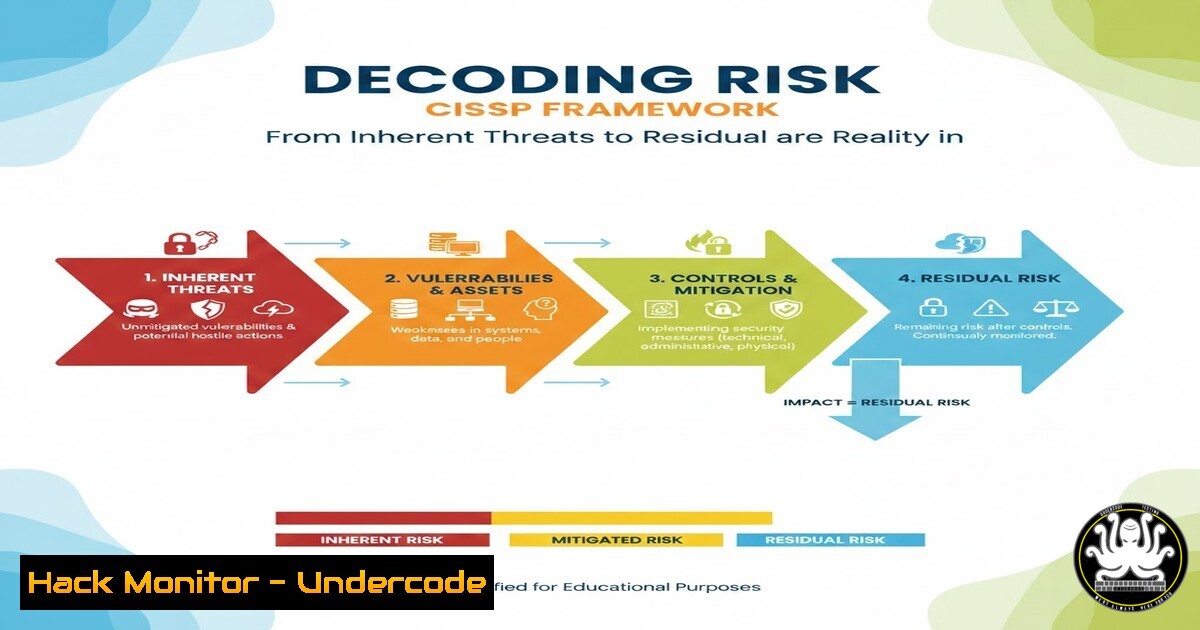
In the landscape of cybersecurity, the term “Risk” is often misunderstood as a current problem, such as an active breach or a malware infection. However, as highlighted in recent professional discourse, Risk is fundamentally the potential for future damage—a probabilistic equation involving threats, vulnerabilities, and impact. Understanding the lifecycle of risk, from its raw, unprotected state to its managed residual form, is the cornerstone of the CISSP mindset and effective security governance. This article decodes the essential terminology and provides a practical, step-by-step guide to navigating the risk management process.
Learning Objectives:
- Differentiate between Inherent Risk and Residual Risk within an organizational context.
- Understand the complete Risk Management lifecycle as defined by CISSP frameworks.
- Apply practical commands and analytical techniques to identify, assess, and treat cybersecurity risks.
You Should Know:
- Defining the Core Equation: Threat, Vulnerability, and Impact
To manage risk, we must first understand its components. Risk exists because a Threat (a malicious actor or natural event) can exploit a Vulnerability (a weakness in a system) to cause an Impact (damage or loss). Without any of these elements, there is no risk.
To identify vulnerabilities in a system, security professionals often perform reconnaissance and scanning. For example, on a Linux system, you might use `nmap` to identify open ports that could be vulnerable:
 Scan a target IP for open ports and service versions
nmap -sV -p 1-65535 192.168.1.100
On a Windows environment, you might use PowerShell to check for missing patches, a common vulnerability:
 Get a list of installed updates to identify potential missing security patches
Get-HotFix | Sort-Object InstalledOn | Select-Object -Last 10
2. Understanding Inherent Risk: The Raw State
Inherent Risk is the level of risk before any security controls or mitigations are applied. It represents the “wild west” state of a system. For example, a web server connected directly to the internet with default passwords and no firewall has a massive inherent risk. Calculating inherent risk helps organizations understand their exposure if they took no defensive action.
To visualize this, you can model the attack surface using Linux IP table rules to see what is exposed before applying a restrictive policy:
 List current firewall rules to see the inherent exposure
sudo iptables -L -n -v
If this returns empty or permissive rules, the inherent risk is high.
3. Risk Identification and Analysis
This is the process of finding risks (identification) and understanding their nature (analysis). This involves cataloging assets, identifying threats, and evaluating existing controls.
A practical method for analysis is qualitative risk assessment, often using a matrix. However, technically, you can analyze logs to identify potential risks. Using Linux, you might grep authentication logs for brute-force attempts, which represent a high-probability threat:
 Analyze auth log for failed SSH login attempts (risk identification)
sudo cat /var/log/auth.log | grep "Failed password" | awk '{print $9}' | sort | uniq -c | sort -nr
This command lists IP addresses with the most failed attempts, highlighting a clear and present risk to the authentication system.
4. Risk Assessment and Evaluation
Assessment involves comparing the analyzed risk against pre-defined risk criteria to determine its significance. This is where you decide if a risk is acceptable or requires treatment. It often involves calculating the Annual Loss Expectancy (ALE).
From an operational perspective, evaluating the impact might involve simulating a Denial of Service (DoS) to test thresholds in a lab environment using tools like `hping3` on Linux:
 Simulate a TCP SYN flood against a test server to evaluate impact (AUTHORIZED TESTING ONLY)
sudo hping3 -S --flood -V -p 80 TARGET_IP
This helps evaluate how the system behaves under stress, quantifying the impact part of the risk equation.
5. Risk Treatment: From Inherent to Target
Once assessed, you must treat the risk. Options include:
– Mitigate: Implement controls (e.g., a firewall).
– Transfer: Buy insurance.
– Avoid: Stop the activity.
– Accept: Acknowledge it and move on.
To mitigate the SSH brute-force risk identified earlier, you can implement a control using Linux fail2ban. This tool reads logs and updates firewall rules to block malicious IPs:
 Install and configure fail2ban to mitigate authentication risks
sudo apt-get install fail2ban
sudo systemctl enable fail2ban
sudo systemctl start fail2ban

Check the status to see blocked IPs
sudo fail2ban-client status sshd
This action treats the risk by actively reducing the vulnerability exposure.
6. Residual Risk and Monitoring
After implementing controls, you are left with Residual Risk—the risk that remains after treatment. The goal is not to eliminate risk entirely (impossible) but to reduce it to a level the organization finds acceptable (Risk Appetite).
Monitoring residual risk requires continuous verification. On Windows, you can use Event Viewer to monitor for persistence mechanisms or new services that might indicate a control failure, ensuring the residual risk hasn’t increased.
 Monitor for new services which could indicate unauthorized software (residual risk monitoring)
Get-WmiObject -Class Win32_Service | Where-Object {$_.State -eq 'Running'} | Select-Object Name, DisplayName, PathName
What Undercode Say:
The distinction between Inherent and Residual Risk is not just academic; it is the fundamental metric of a security team’s effectiveness. Most organizations operate on residual risk but only budget for inherent fear. The true skill lies not in listing every possible threat, but in the “Risk Treatment” phase—applying precise, technical controls to shift the organization from a state of theoretical exposure to a measured, acceptable level of safety. Without continuous monitoring, residual risk eventually creeps back toward the inherent level due to configuration drift and new vulnerabilities.
Prediction:
As AI-driven threat actors accelerate the pace of vulnerability exploitation, the “Risk Analysis” phase will become automated and machine-led. Static annual risk assessments will become obsolete, replaced by real-time, continuous risk scores generated by AI models that ingest threat intelligence and live telemetry. The human role will shift from calculating risk to interpreting these dynamic scores and making rapid “Risk Response” decisions, compressing what used to be a yearly cycle into a daily operational rhythm.
▶️ Related Video (84% Match):
🎯Let’s Practice For Free:
IT/Security Reporter URL:
Reported By: Biren Bastien – Hackers Feeds
Extra Hub: Undercode MoN
Basic Verification: Pass ✅


